The One And Only
pp. 81-83 · Read in the full issue
Port Moresby
By Donald Woolford
Port Moresby, the capital hardly anyone wants, in April became Papua New Guinea’s first city. It is fastgrowing and diverse. It has a population of 68,000 of which 15,000 are white and 1,000 Chinese and mixed race. It has been called two cities—black and white with few close points of contact between them.
The whites live in the suburbs of Boroko, Korobosea and Gordon.
They retire after work to their clubs.
The wives push their trollies in air conditioned supermarkets that vary little except in price from those in any Australian suburb.
Plenty of whites admit they have never had a black in their house, apart from the domestic servant and many count the months to their next visit South.
But in a way Port Moresby is many cities, for the indigenous popu lation is roughly broken into three separate groups. First group is the original Motu inhabitants whose fore bears saw Captain John Moresby sail into their graceful harbour in 1873.
Their biggest concentration is at Hanuabada, a big stilt village that juts into the upper reaches of the harbour.
There are the squatters. Usually unskilled immigrants attracted by the delusive promise of city life, they fly m from the Highlands or sail in from the Papuan Gulf. They find unused land and throw up rough houses of whatever material they can lay then hands on. Often fiercely clannish, they tend to live in tribal groups.
Finally, there are the inhabitants of Hohola, the suburb of the in
digenous public servant. It is a jungle of little concrete block houses. Its people are in settled jobs and they expect to spend the rest of their work ing lives there. But most hope to go home to Papuans and New Guineans, home is almost invariably the village of their birth—when they retire.
Last year, when opening the Port Moresby show, Mr. Johnson tried to assail the town’s collective conscience.
Many people here, he said, were living in misery, and “few of the rest gave a damn”.
He says that the situation is a little better now. The new council and the administration were trying to im prove squatter conditions and there was a greater community awareness of the plight of the poor. But the population was rising as rapidly as measures to improve living standards could be taken.
While the people of Port Moresby are ambivalent towards their city, the rest of the country is almost unani mously hostile. To them it is a distant and remote centre from which a largely anonymous government issues directives and which appears to swallow huge hunks of scarce de velopment funds. It is also, as many members of parliament argued when
advocating that the capital be moved to the Eastern Highlands, far from the main centres of population and wealth.
There is not even a road link with the New Guinea side. Nevertheless, moves to have the capital shifted are unlikely to succeed, partly because of cost, partly because of easily aroused Papuan fears of New Guinea domination. So Port Moresby will continue to grow to 200,000 people by 1990 according to recent survey.
With the population will grow all the problems that afflict big cities.
Deteriorating race relations car stoning, for example is becoming more widespread—will aggravate the problems.
Yet Port Moresby can be a most pleasant place. If one shuts one’s eyes to the shanties, and as they are usually discreetly out of obvious sight this is not hard, there is the sparkling Coral Sea, the brooding backdrop of the Owen Stanleys, and at this time of year as the wet nears its end, the green blanketed hills.
But the hills after a few months of the dry will turn to a dusty khaki.
The wet and the dry are the two seasons here, and they provide a con trast as sharp as the city they twice yearly transform.
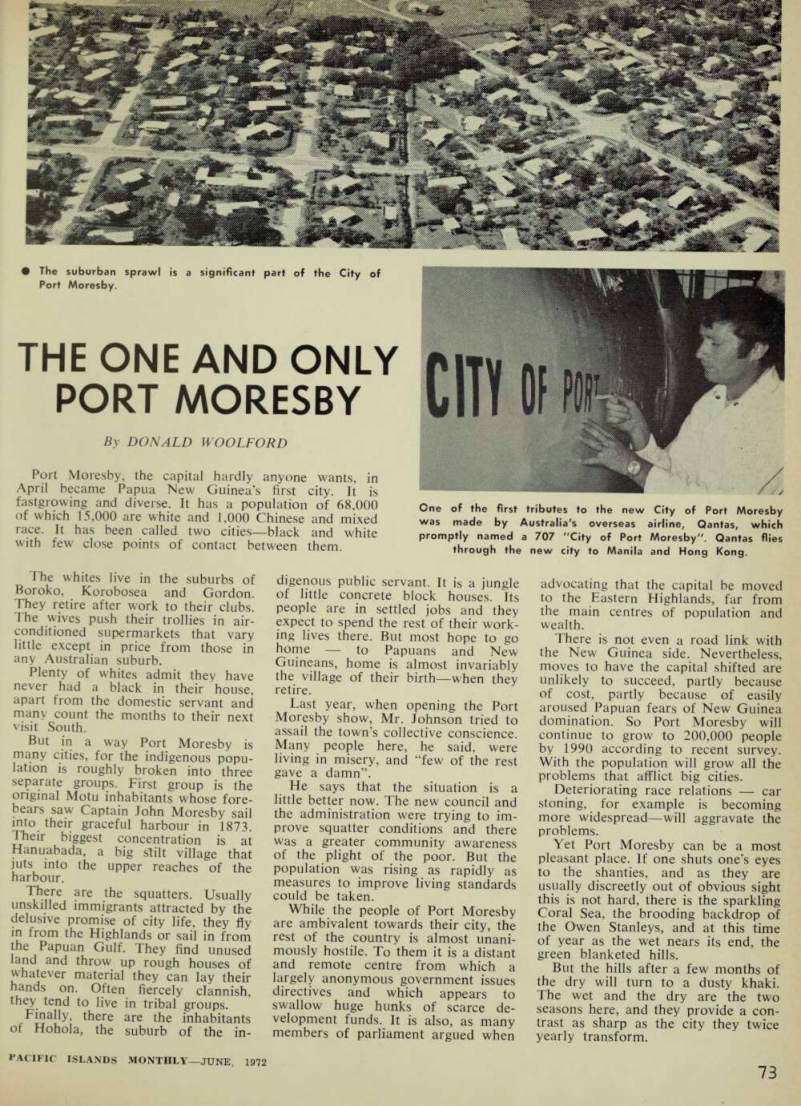
The suburban sprawl is a significant part of the City of Port Moresby.
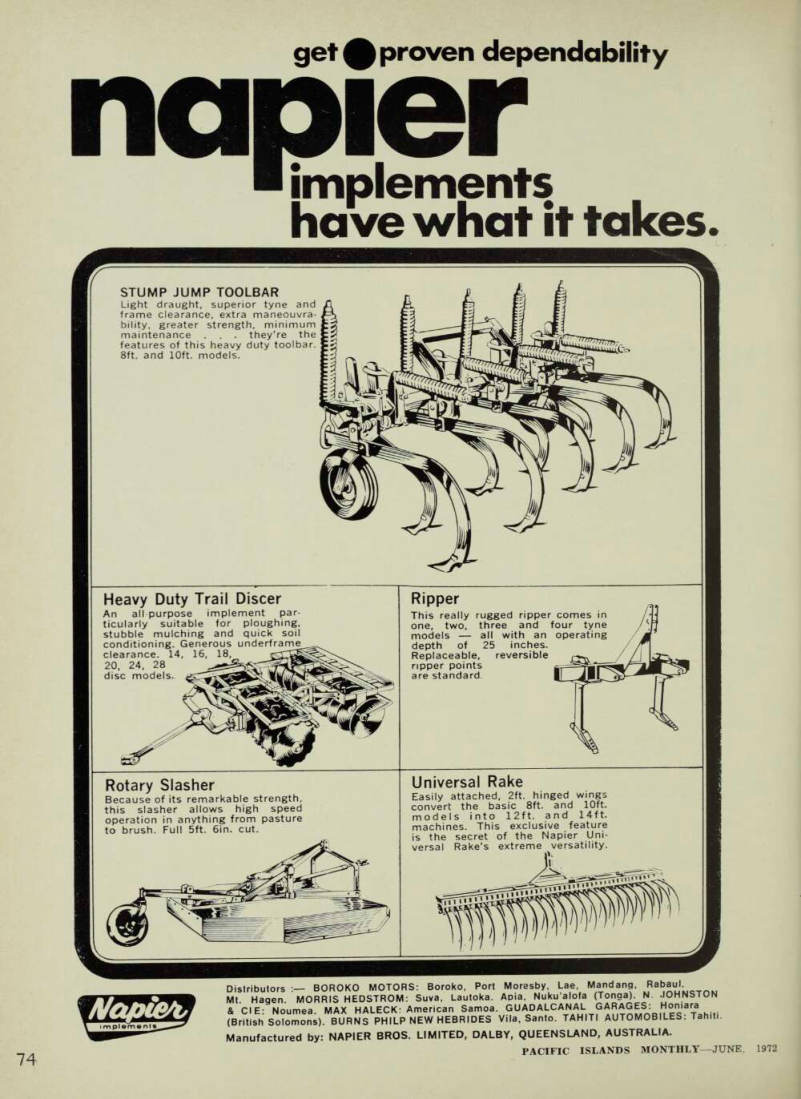
One of the first tributes to the new City of Port Moresby was made by Australia's overseas airline, Qantas, which promptly named a 707 "City of Port Moresby". Qantas flies through the new city to Manila and Hong Kong.
When the Winds of Change began to blow in the Pacific they generated more than a little flatulence in some of the Island territories around two decades ago and one of the places which suffered from a political bellyache was New Caledonia.
And it was an ache—over common roll —which lasted for some time until it was finally assuaged after General De Gaulle took over in France and New Caledonia had elections on a Loi Cadre system, a kind of modified common roll.
But before the settlement there were some wild times. PIM, in its June issue of 20 years ago, reported a "bitter fight over votes for natives".
The indefatigable Mr. Maurice Lenormand, who had been elected to the French Parliament as Deputy for New Caledonia and New Hebrides, was demanding common roll and secured the defeat of a bill which would have given the territory a new constitution and a General/Council in which Europeans would have a majority of seven. With the defeat of the bill, the New Caledonian Council resigned in May. "The political atmosphere is strained; the future character of the administration is uncertain," said PIM. "Common roll will lead to the economic ruin of New Caledonia," said Mr. Henri Bonneaud, council chairman, and his fellow Europeans.