Yesterday
p. 83 · Read in the full issue
There was another political bellyache at the same time, with some below the-belt work, in Papua New Guinea and Canberra. It was all over the retirement of Colonel J. K. Murray as Administrator of the territory. Colonel Murray was reported as saying that he hadn't retired willingly and there were accusations that he had been forced to drop out by the Liberals because he was a Socialist and "was resisting with all the means at his disposal the attempt by the government to create opportunities for private enterprise to exploit the native races in those territories." All this was denied, of course, and the Colonel went.
He's still going strong as a picture in this month's issue demonstrates.
Twenty years ago Fiji was girding its loins for a battle against a suspected invader following what PIM called an "alarming statement" by Director of Agriculture Mr. C. Harvey, who warned that the coconut palm destroyer, the rhinoceros beetle, "may already have reached Fiji from Tonga and be quietly
breeding near one of the ports."
He was right. The pest had arrived and battle has been waged ever since— and a losing battle at that. The beetle is almost everywhere now and it seems to be a neck and neck race to see who can ruin the copra planter, the beetle or the price fixers!
One crop which was enjoying a better time was cocoa—to the satisfaction of the Western Samoans who had just shipped several hundred tons of cocoa beans to the United Kingdom at an f.o.b. Apia price of £290 to £315 a ton.
What with the drop in money values today and the fact that today's price of cocoa to the growers is nowhere near that 20-year-old price, cocoa, once a money-spinner, looks like a has-bean.
Talking about fruit, PIM reported that New Zealand was crying out for more bananas from the Islands but the Islanders were eating so many there weren't enough to fill the Kiwi stomach.
Now look at it, the banana, not the stomach. The Islands are losing the NZ market to the South Americans.
Take a look in any NZ fruit shop and you'll see the lovely-looking Ecuadorian banana which, in a beauty parade, leaves the Island banana for dead—but the beauty is only skin deep. For taste it can't hold a candle to the Island banana.
Tonga grew copra and a nice banana and made much of its living out of them, a fact which constrained Mr.
R. J. Harrison, retiring headmaster of Tonga High School 20 years ago, to say in PIM that prosperity was spoiling the Tongans. According to Mr. Harrison, in Tonga, "servants were now difficult to obtain, unreliable, light-fingered and even heavy-fingered; many Tongans were richer than the Europeans." Today,
only 20 years later, such a statement would have brought the pedagogue an awful blast, which shows how we've changed—and for the better.
It was a busy time 20 years ago last month for the Tahiti morticians—they called them undertakers then—PlM reporting the deaths of no fewer than four Tahiti residents. They were "Tete", who was originally Miss Pauline Brander, Mr. Georges Gournac, Captain Emile Brisson, well-known Papeete harbour pilot, and Mr. Dick Bambridge, who used to be in charge of the Societe Hippique de Tahiti's race meetings.
There were weddings as well, of course, and one of the really newsworthy ones was in Rarotonga. Mr. Willie P. Browne, prominent Rarotonga businessman and leader of one of the Ariki families, married Miss Elizabeth Marsters, member of the well-known Palmerston Island family. Said PIM of the colourful Mr. Browne, "No visitor to Rarotonga has failed to enjoy the sight of Mr. Browne and his drum band hurtling through the villages aboard an ancient jalopy-truck on movie days, the band beating a rousing tattoo while 'Willie', sitting regally on the open seat next to the driver, scattered handbills announcing the evening attraction."
There was a lot more news—PlM had a rewarding month—and a few samples are, the Cine Tropical Theatre at Santo burning down, a new Resident GEIC Commissioner, Mr. M. L. Bernacchi, making his way to Tarawa, New Guinea District Commissioner George Greathead retiring to become a Highlands farmer.
Burns Philp complaining about the "staggering" rise in shipping costs, a reprieve for Rabaul, to be rebuilt instead of being replaced.
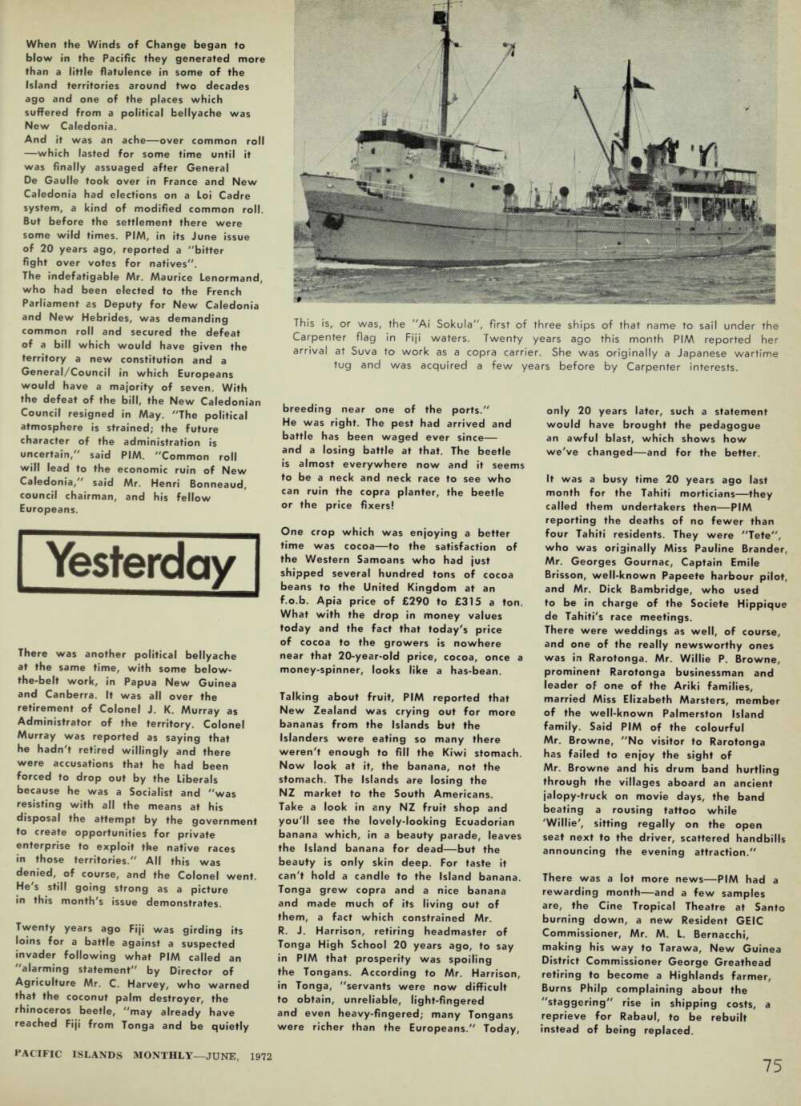
This is, or was, the "Ai Sokula", first of three ships of that name to sail under the Carpenter flag in Fiji waters. Twenty years ago this month PIM reported her arrival at Suva to work as a copra carrier. She was originally a Japanese wartime tug and was acquired a few years before by Carpenter interests.