Magazine Section
pp. 77-79 · Read in the full issue
Noumea's Guardian Island
By Kathleen Hancock
He Nou—a soft sound like a cooing of doves. And the New Caledonian island itself, lying protectively across Noumea’s harbour, is all gently roll ing hills crisscrossed by winding paths that lead to little coves where the ripples of a surfless sea lap the shore.
New Caledonians say, “No He Nou, no Noumea”. For without He Nou, the westerlies that sometimes roar across the Coral Sea could batter Noumea’s sheltered port. From the days of the English seaman, John Paddon, first large-scale trader in these latitudes, to New Caledonia’s present bustling prosperity, He Nou has been protector and guardian to the charming little city of Noumea.
Paddon set up as a trader in New Caledonia about 1845 and in 1851 he bought He Nou and built his trad ing station there. He erected huge “go-downs” on the lee side of the island, facing Noumea, then called Port de France. Dealing in whale oil, sandalwood and tortoiseshell, he established a core of settlers whom he brought over to the yet unclaimed island in his own ships.
This might have been the moment for the British to take possession of New Caledonia, so close to Australia and New Zealand. At He Nou Paddon certainly seemed to be laying the foundations for a new colony.
He controlled what trade there was, and gave the settlers sound advice.
His fleet of schooners carried the mail to Sydney. And he got on splendidly with the local tribes who respected him as a courageous and honourable man.
But the British were dilatory and the French had their own ideas about this long, cigar-shaped island in the South Pacific. The massacre of two French naval officers and 15 ratings at Yenguibane in the north-west in 1850 had enraged public opinion in France. Further, the acquisition of a naval base in the South-West Pacific
appeared to be a desirable move.
And finally, most pressing of all, a prison colony with a climate rather less insalubrious than the pestilential vapours of Guiana was felt in Paris to be an urgent necessity.
And so in 1853 France, in the person of Capitaine de Vaisseau Tardy de Montravel, raised the tricolore at Balade. By then the foundation of a prison colony was uppermost in the minds of the government and only 10 years later the first shipload of 250 galley slaves were buildmg their own prison on He Nou, sold by Paddon to the French government for this purpose.
The 250 were followed by many mor f Until transportation was abolished in 1898 there were, in any year, between 7,000 and 10,000 ablebodied criminals in the colony, workmg for the most part in the mines, on
public works, and for a short while as domestic help in the households of local officials, It wasn’t unusual to see 50 prisoners controlled only by a man in uniform carrying a white umbrella. Julian Thomas, correspondent in New Cale donia for the Sydney Morning Herald during the great “canaque revolt” of 1878, regarded the prisoners’ lot as not too uncomfortable, Twenty years later George Griffiths, an English traveller, was staggered at Noumea’s nonchalant acceptance of the concerts provided in the Place de Cocotiers by the convict band. He called the scene bizarre. “Take five and 20 musically inclined convicts out of an English prison, put them into the Western Gardens at Earl’s Court on a warm July evening and you would have something like it but not quite.” He remarked that
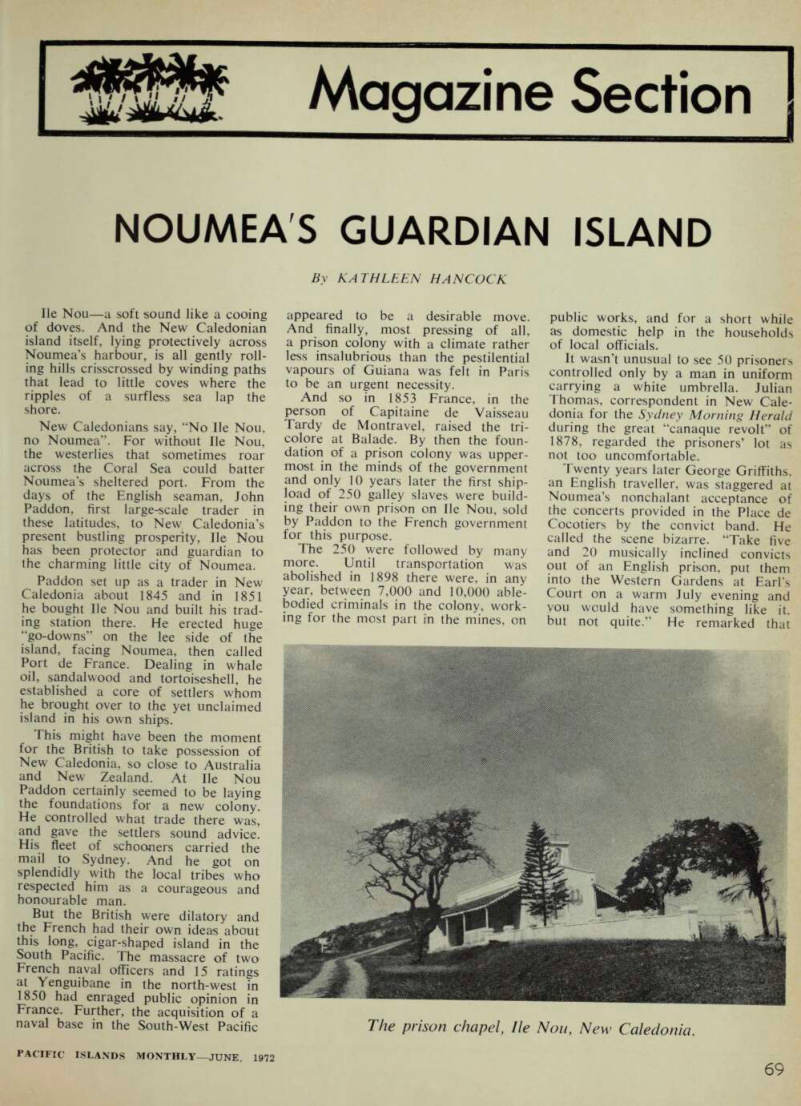
The prison chapel, Ile Nou, New Caledonia.
the “chef d’orchestre” had cut the heart out of a man he considered his rival in his wife’s affections, got her to cook it and dined off it with her.
But the involvement of the criminal deportees—as opposed to political prisoners—in the domestic bfe of the
colony turned out to be something of a mistake. This well-meant effort at rehabilitation resulted in a wave of crime ranging from petty theft to murder. Even the convict band played up, in a non-musical sense.
An 1 a disillus.oned administration
passed yet another regulation for bidding the employment of prisoners as domestics.
The Communards, who were sent out in thousands after the collapse of the Paris Commune, were, of course, birds of a very different
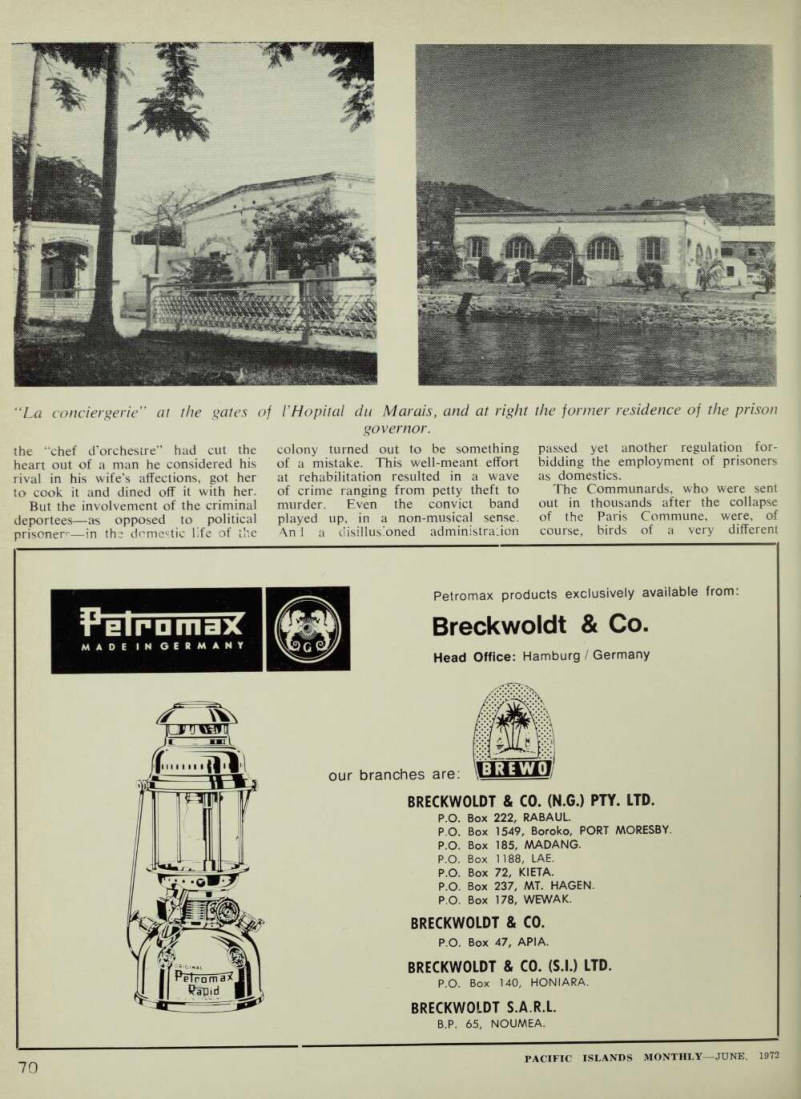
“La conciergerie” at the gates of I’Hopital du Marais, and at right the former residence of the prison governor.
An island of terror, but now it's asleep
feather, honest workers and intellectuals for the most part. But few of these were imprisoned at He Nou.
Some were exiled on the Ducos peninsula just outside Noumea, but most finished up on the He des Pins where as political prisoners they enjoyed comparative freedom on one of the loveliest islands in the Pacific.
The great majority of Communards returned to France after the amnesty of 1879.
Today He Nou sleeps in the sun.
No longer do these soft words send a frisson of fear down the spine of criminals and political dissenters alike in “la metropole”. None of Paddon’s original buildings remain, but a 20minute launch trip will take you across Noumea’s harbour to a scene very much like that in which those unhappy men sweated out their grim sentences.
Exile was the thought uppermost in the minds of the prisoners who built the charming little house of the governor that greets the visitor ns he chuffs in the Patonga into He Nou’s tiny harbour. A winding path leads past the big barnlike building thnt was once the bakety “a® end houses a tiny store where the floo? is fashioned from local stone purple and yellow and worn into ho lows bv a centurv of feet Y - , ’ hurtfier along, the mam workshop of the prison is an elegant building in
classical style, used today as a school for indigenous teachers. In one of its courtyards Madame la Guillotine used to lop off the heads of in corrigible prisoners. Above on the hillside, the charming terraced houses °f the non-commissioned officers and warders had a grandstand view of this not infrequent spectacle. Their quarters still accommodate a number of families domiciled on the island.
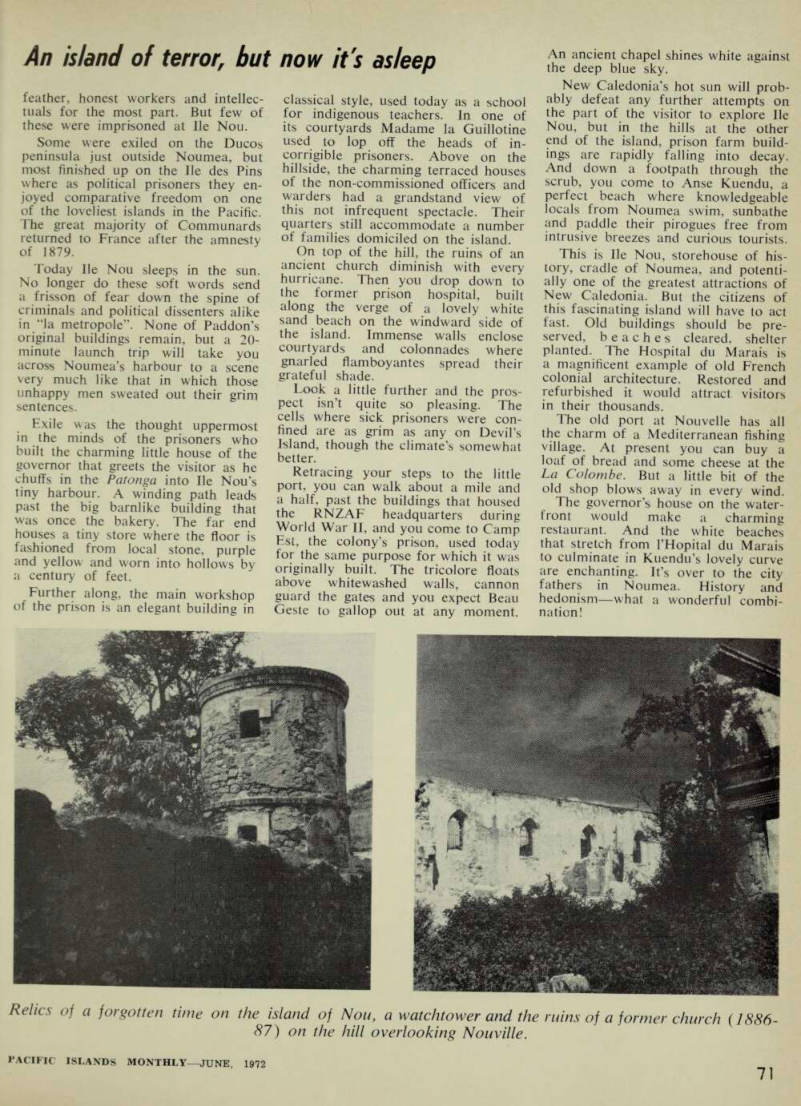
On top of the hill, the ruins of an ancient church diminish with every hurncane. Then you drop down to , former prison hospital, built along the verge of a lovely white sand beach on the windward side of tbe ls^ Immense walls enclose courtyards and colonnades where gnar J. e< f uamboyantes spread their grateful shade.
Cook a little further and the pros- P ect ,snt quite so pleasing. The £ ells , Where P risoners were con aS i?™. 01 any on Devd s defter’ 8 climate’s somewhat De U el / Retracing your steps to the little
a^alf^nas^ThrhidlH^T
a ■ naif, past the buildings that housed £L 1h R * ZA * h ,f dquarters t duri "g ’ a " d y ° U COme C T P o onys P rlson ’ l ' sed today F the „ san ? e P urp “ e for.whtch it was °P Binally built. The tricolore floats above whitewashed walls, cannon guard the gates and you expect Beau Geste to gallop out at any moment.
An ancient chapel shines white against the deep blue sky.
New Caledonia’s hot sun will prob ably defeat any further attempts on the part of the visitor to explore He Nou, but in the hills at the other end of the island, prison farm build ings are rapidly falling into decay.
And down a footpath through the scrub, you come to Anse Kuendu, a perfect beach where knowledgeable locals from Noumea swim, sunbathe and paddle their pirogues free from intrusive breezes and curious tourists.
This is He Nou, storehouse of his tory, cradle of Noumea, and potenti ally one of the greatest attractions of New Caledonia. But the citizens of this fascinating island will have to act fast. Old buildings should be pre served, beaches cleared, shelter planted. The Hospital du Marais is a magnificent example of old French colonial architecture. Restored and refurbished it would attract visitors in their thousands.
The old port at Nouvelle has all the charm of a Mediterranean fishing village. At present you can buy a loaf of bread and some cheese at the La Colombe. But a little bit of the old shop blows away in every wind.
The governor’s house on the water front would make a charming restaurant. And the white beaches that stretch from I’Hopital du Marais to culminate in Kuendu’s lovely curve are enchanting. It’s over to the city fathers in Noumea. History and hedonism—what a wonderful combi nation!
Relics of a forgotten time on the island of Nou, a watchtower and the ruins of a former church ( 1886- 87) on the hill overlooking Nouville.