own special thing
pp. 32-33 · Read in the full issue
The Islanders did their own special thing
By Sue Wendt
Anyone looking for the real meaning of the term Beautiful People found the answer in Suva between May 6-20. There were thousands of them happy, talented, laughing, handsome Pacific Islanders, all doing their own special thing for their own and everybody else’s enjoyment.
The first South Pacific Festival of Arts had come to town! A massive exposition of traditional craft and culture, unsurpassed in concept or execution by anything yet seen in the Pacific Islands.
Like a runaway train, the excite ment gathered momentum. For months beforehand, executive director Victor Carell and wife Beth Dean had travelled to the various corners of the region, talking of a cultural explosion, a joyous resurgence of traditional art, dance and music such as few could envisage.
And explode it did —with all the vitality, exuberance and spontaneity of the true South Seas spirit.
With typical Islands enthusiasm, the performers arrived in much larger numbers than expected. The organisers were counting on having to feed 2,000 entertainers from Fiji and 1,000 from overseas. The local numbers swelled to 2,500 and an early count for overseas participants was 1,200.
The Tongans, who never do things by halves, totalled around 250, but ate 400 meals at the first sitting.
Another country said it would send 38 performers, but more than 70 turned up to join in the fun. The extras weren’t mere hangers-on either.
They came to entertain and that’s just what they did.
From the very first night, more than 2,000 superbly-costumed per formers wove the cultures of a dozen Island nations into an unforgettable, faultlessly-presented display of song and dance at Albert Park, the festival was undeniably everything that Aus tralian-born Mr. Carell—-impresario extraordinaire that he is had promised.
The odds, in the beginning, were against it. On the opening night the park was a quagmire, the result of days of heavy Suva-style downpours.
Even as the VIPs took their places
on the open-sided dais and the per formers gathered to begin, the weather gods proved contrary. Per haps a sun dance from the Australian aborigines? someone jested. But it wasn’t necessary.
The Islands’ spirit shone through as extrovert Cook Islanders pre sented their famous drum dances; Australian Aborigines enacted the stark drama of the hunt; Fijians per formed their ebullient mekes; Papua New Guineans displayed gloriously colourful masks and head-dresses and Tongans, New Zealand Maoris, Melanesians from New Calendonia, Western Samoans, Solomon and Gilbert and Ellice Islanders and members of Fiji’s Chinese and Indian communities all made their own exciting contributions to the even ing’s entertainment.
Thousands of dollars worth of lighting, including powerful coloured spotlights, turned the elaborate open air performances on both opening and closing nights into pure theatre, with all the elements of drama and exhilarating spectacle.
Behind-the-scenes expertise was provided by some of the most sought-after people in the Australian theatre-world. People like Nick Dowling, head of the huge Rank
Strand organisation in the Asia- Pacific area, who was technical director for the entire festival. And John Antill, who came weeks ahead to rehearse the 150-voice choir which joined with the Dorian Singers of New Zealand to present the Elijah.
He also wrote the processional for the Ecumenical Sunday on May 14.
They included lighting expert Mel Conder, stage director Hayes Gordon, property master Dennis Parry and sound man Alex Vale, who assisted the sound director, local man Trevor Agar.
Incredibly, they were all volunteers,
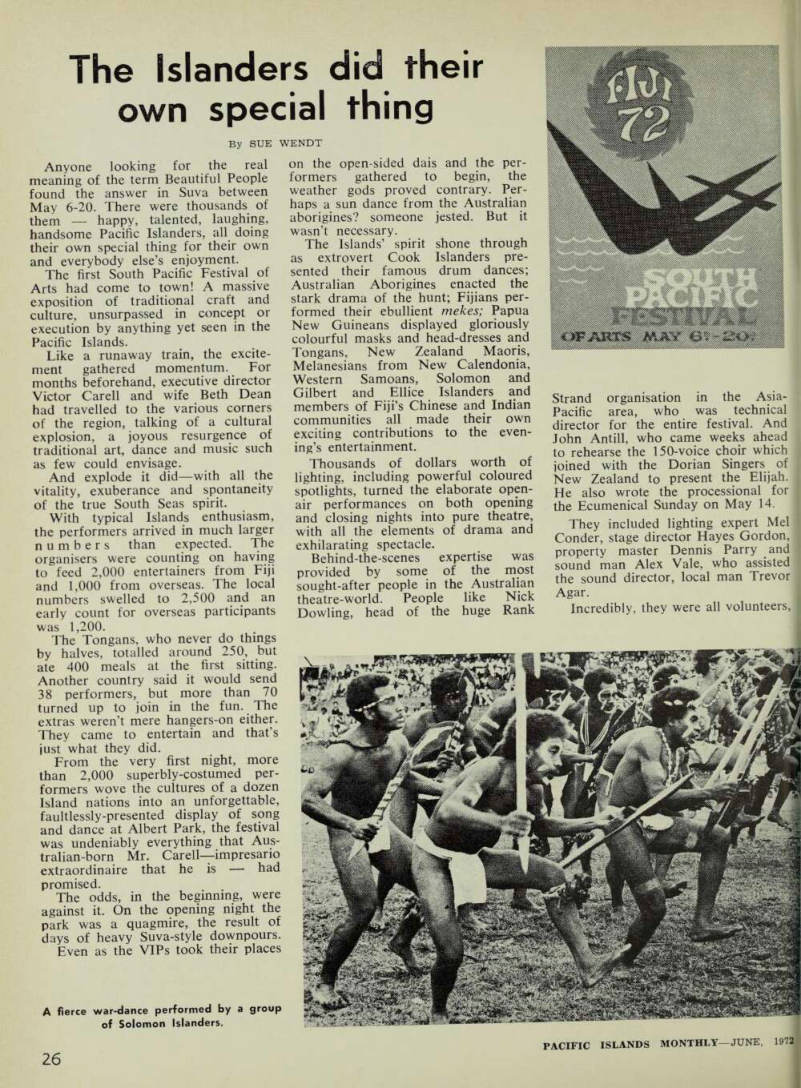
A fierce war-dance performed by a group of Solomon Islanders.
paid nothing for their services. “To buy that kind of expertise, we’d have had to pay around $10,000,” declared Victor Carell. “Some of these people took holidays, a couple have actually taken leave without pay to be here.
They’ve worked together as a team for many, many years. All they want is the satisfaction of having been involved in this first, unique festival.”
For two weeks, there was so much to do in Suva, so much to see, that locals will take a long time getting over the “cultural shock”.
On an average day for instance, one might have the choice of seeing Tongans and Gilbert and Ellice Islanders dancing at the Civic Centre, a screening of films about the South Pacific at the Phoenix, a variety concert at the Grammar School, two plays by a group of Papua New Guinea students at the Playhouse and a lecture-demonstration about Aus tralian Aborigines at the museum.
If you weren’t interested in any of those or couldn’t get a ticket (most shows were completely sold out), you could visit the University of the South Pacific where an instant village of traditional dwellings had sprung up virtually overnight, browse through the excellent exhibition of South Pacific painting and pottery or see a comprehensive display of South Pacific stamps.
At the university, beautifully-made Islands hand-craft especially from the Gilbert and Ellice Islands, the Solomons and Papua New Guinea was snapped up in the first couple of days. It was planned that the handcraft would be sold towards the end of the festival, or at least enough articles kept for display, but supplies looked like being cleaned out quite early in the piece. Exhibitors hadn’t had to pay duty on their handcraft (as a special festival concession) and most were wishing they’d brought ten times the amount.
No single event highlighted the two-week festival. It was made up of a thousand big and small excitements,
some as overwhelmingly professional
as the performances of the Solomon Islands Dance Theatre Group, which had the audience shouting for more at the Suva Civic Centre, others as spontaneously delightful as the free lunch-hour concert of the Cook Islanders, who became so caught up [ n th e spirit of the thing that their leader George Karaponga, leapt into Nubukalou Creek, followed by five of the audience.
Ticket sales for staged performances proved excellent, but some of the greatest successes were the free shows presented for highly-appreciative audiences at open-air venues.
Even those who couldn’t afford 50 cent tickets could thrill to the savage splendour of the Small Nambas from the New Hebrides, shout with delight at the mock battles of the Solomon Islanders, whistle with astonishment at the towering feathered headdresses of the New Guinea Highlanders g rji A 1 ongans me f. Australian Abongmes. Fijians joined with performers from Niue and New Caledonia, Gilbert and Ellice Islanders found new triends from Nauru, American Samoans discovered at first hand the ethnic arts of a score of neighbouring nations. That, after all, was what the festival was all about.’ ~.. , , Organising the performers accommodation, meals and transportation by bus for rehearsals and shows was a mammoth task, involving the efforts of 300 volunteer helpers.
Collecting the props alone was a major exercise.
As the festival opened, the organisers were besieged with requests for such absolutely essential items as 200 lemons (for Tonga’s contribution to the indigenous games), for 2,600 palm leaves (for Niue’s traditional dwelling), for two eucalyptus trees (the Australian Aboriginal Dance Theatre) and a 19th century hatstand and Victorian bric-a-brac (for the play Pritchard ). They were all produced.
On the surface at least, nothing fazed Victor Carell and his team of helpers—even the disastrous news, as the festival got under way, that tech nical director Nick Dowling was down with hepatitis « /;tk tU . ’ 1 , seemed certaln that F, )‘ would £?nn ”° r ,l “T ! h ® fI 00 ’.? 00 , had or S 1 " 3 , 11 ? located f ,he . fest ' aal ' , We /, e certainly m the realm of hospitality,” agreed Mr. Carell. With all the un expected arrivals, the $60,000 for food, etc., will have to be expanded, But the government is insistent on Fiji fulfilling its complete host duties —in keeping with the spirit of the festival.” c „ f - „ .„ , Festival organisers wiU be making to the South Pacific Commission with regard to future venues. Its envisaged that similar festivals will be held every three or four years in various parts of the Pacific.
As a result of this first historic South Pacific Festival of Arts in Fiji however, the art and culture of the region looks like finding another in ternationally-acclaimed stage the Sydney Opera House, “We’ve had top-level inquiries to see whether performances of the calibre of those we’ve seen in Fiji can be included at the Opera House opening in 1973,” Victor Carell told PIM. “It’s probable too that cultural displays from throughout the Islands will be staged around Sydney during the two-week celebrations marking the Opera House opening.”
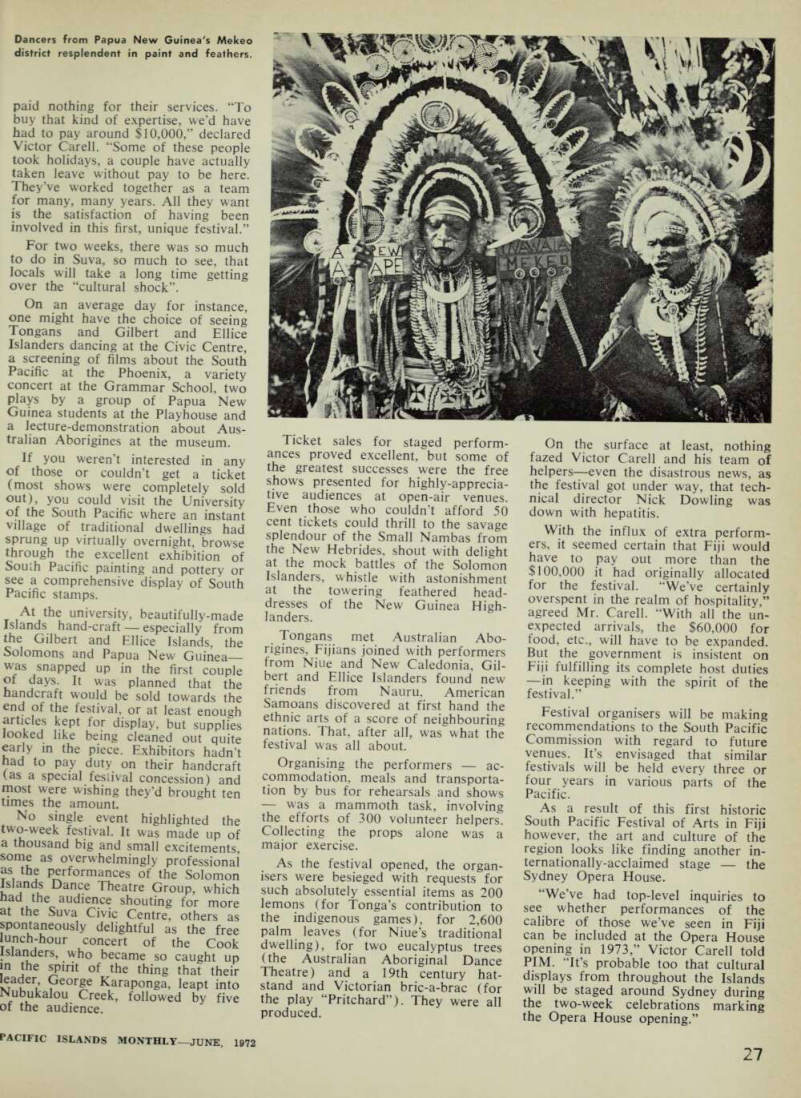
Dancers from Papua New Guinea's Mekeo district resplendent in paint and feathers.