Tropicalities
pp. 28-31 · Read in the full issue

New Hebrides tea party
A Spanish merchant navy officer is serving a three-month sentence in the British prison in Vila following an incident which must be rare, if not unique, in the colourful catalogue of sailors’ misdemeanours.
Fernando Goyanes, second officer on the Swiss refrigerated vessel Castaneda, which had called at Santo at the beginning of April to pick up frozen fish, was so furious with his German captain over a disputed over time claim that, after several hours of serious drinking, he threw over board or destroyed nearly every item of the ship’s navigational equipment.
Radar, compass, Aldis lamp, radio receiver and 550 charts were among the $6,000 worth of gear which went over the side. The radio transmitter and an echo sounder remained on board but were smashed, adding another $l,OOO to the bill.
Goyanes had confided to his drinking partner, the bosun, that he was going to get the captain and the chief officer into trouble, but some where along the line he seemed to have got confused.
Because he committed his “larceny and malicious damage” at night, the Spaniard was not detected until a British police officer had flown from Vila to Santo to investigate. When confronted he chose to be tried in a British Court (in the Condominium aliens can opt for the code of law they prefer, French or British) which is why he found himself facing a British Magistrate in Vila courthouse 10 days later. The result was un favourable for him, but not, perhaps, as unfavourable as it might have been in his native Spain or another country—three months for larceny from a ship (the maximum sentence in British law is 14 years!) and three weeks for malicious damage, to run concurrently.
Even for the New Hebrides the international flavour of the story is
remarkable. The ship was Swiss, her captain German, the chief officer Yugoslavian, Goyanes Spanish and her crew included Ecuadorians and a Ghanaian. The Castaneda was on her way from the USA to take frozen fish from the New Hebrides to Puerto Rico.
Goyanes should be grateful that the New Hebrides’ Joint Court no longer has a Spanish president.
The reluctant
Fuzzy Wuzzy
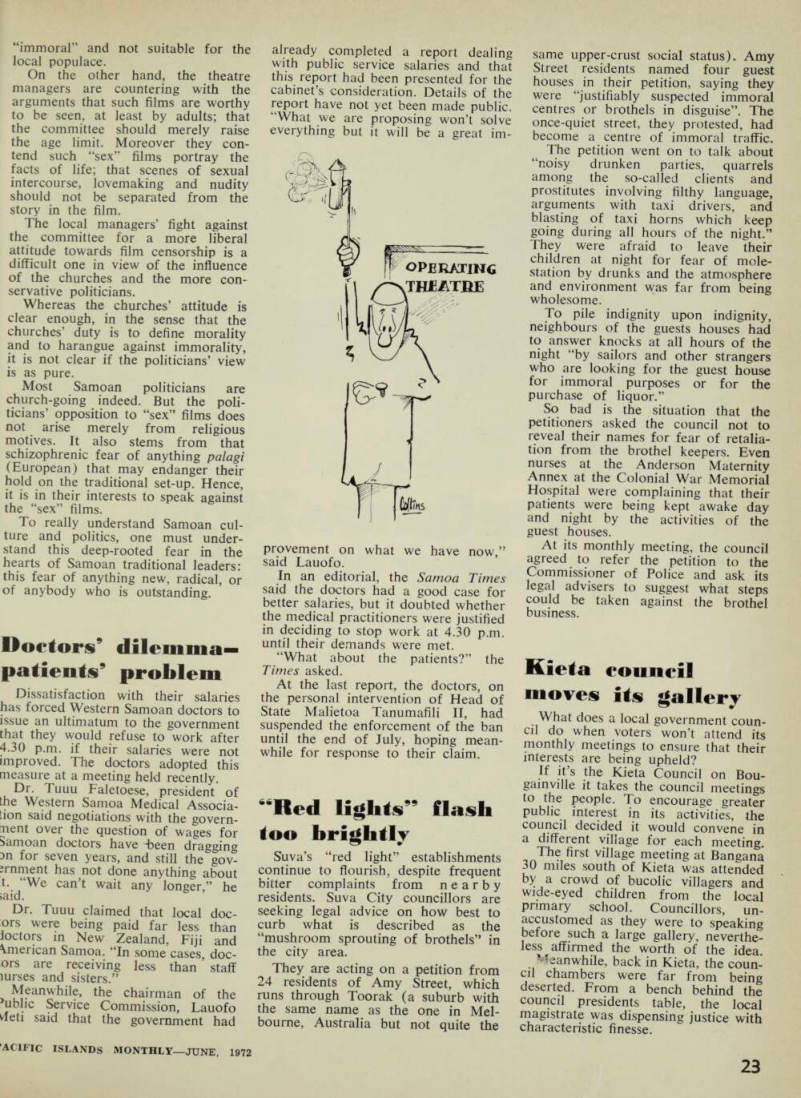
There is no mistaking Joe Abiara as a Papuan Fuzzy Wuzzy, especially if you first sight him in the centre of the New Guinea Highlands, where we found him at Kundiawa’s Anzac Day dawn service this year. It’s cold at Kundiawa at dawn, so we shared an innards-warming coffee laced with rum at the traditional Gunfire Break fast and heard how Joe became an Anzac.
Joe, now 43, has been a PWD plumber at Kundiawa for almost three years. He comes from Kairuku, on the Papuan coast, and when Joe was 14 in 1942 he found himself enlisted as a carrier to move Australian Army
supplies from the coast over the Bull dog track to Wau. One day Japanese started to strafe the track from the air, and what with the work being tough enough anyway, young Joe decided to shoot through and leave U the war to somebody else.
“But they got me,” recalled Joe, ■ with his hands round the mug of ■ coffee. “Angau rounded up deserters I like me, and I got a hiding. So I ended up carrying on the Kokoda |l Track.”
This original Fuzzy didn’t care for 1 the Kokoda Track, either, especially I as he wanted to enlist in the Papuan I Infantry and nobody would have I anything to do with him. Then one day while carrying on the Buna side of the range he came across a Japanese officer in a poor state who attacked him with his bayonet, inflict ing wounds in his hands before Joe could despatch him.
Joe was taken to hospital to have his wounds attended to, where he de cided for the second time that it was i a lousy war for a Fuzzy, and shot through. And they nabbed him again. ’
“After that,” said Joe cheerfully, “I settled down and finished the war. I No more trouble. I never did get into I the infantry!”
But Joe’s proud of his Fuzzy Wuzzyl background, and one family member in particular. Susan Hareho Karike,| who leapt to fame last year as designer of Papua New Guinea’s 1 national flag, is his niece.
Sex scares
Samoa's politicians
If the Tongan film censors delight! in banning films depicting violence ini their territory, then the Western Samoan censors are apparently en-| joying themselves in banning the bolder of the sex films.
The most recent film to fall to the local censors’ axe was The Female Bunch scheduled for showing at the Savalalo Grand. The censors had already banned Zabriskie Point from this theatre.
Tommy Schaafhausen, manager of the Tivoli Theatre, says the censoj have banned two of his sex films:!
Isadora and Woman In Love and he estimates 20 films in all had beem banned by the Censorship Commit-J tee.
Like the manager of the Savalalo Grand, Rudolf Keil, he is disapl pointed by the committee’s bans.
The censors, apparently, are very touchy about any scenes depicting sexual intercourse, “immoral ’ sexual behaviour and nudity. They would 1 say such scenes were downngn|
Joe Abiara.
“immoral” and not suitable for the local populace.
On the other hand, the theatre managers are countering with the arguments that such films are worthy to be seen, at least by adults; that the committee should merely raise the age limit. Moreover they con tend such “sex” films portray the facts of life; that scenes of sexual intercourse, lovemaking and nudity should not be separated from the story in the film.
The local managers’ fight against the committee for a more liberal attitude towards film censorship is a difficult one in view of the influence of the churches and the more con servative politicians.
Whereas the churches’ attitude is clear enough, in the sense that the churches’ duty is to define morality and to harangue against immorality, it is not clear if the politicians’ view is as pure.
Most Samoan politicians are church-going indeed. But the poli ticians’ opposition to “sex” films does not arise merely from religious motives. It also stems from that schizophrenic fear of anything palagi (European) that may endanger their hold on the traditional set-up. Hence, it is in their interests to speak against the “sex” films.
To really understand Samoan cul ture and politics, one must under stand this deep-rooted fear in the hearts of Samoan traditional leaders: this fear of anything new, radical, or of anybody who is outstanding.
Doctors’ dilemma
patients’ problem
Dissatisfaction with their salaries has forced Western Samoan doctors to issue an ultimatum to the government that they would refuse to work after 4.30 p.m. if their salaries were not improved. The doctors adopted this measure at a meeting held recently.
Dr. Tuuu Faletoese, president of the Western Samoa Medical Associa tion said negotiations with the govern ment over the question of wages for Samoan doctors have ■been dragging m for seven years, and still the gov ernment has not done anything about t. “We can’t wait any longer,” he >aid.
Dr. Tuuu claimed that local doc tors were being paid far less than lectors in New Zealand, Fiji and \mencan Samoa. “In some cases, dec ors are receiving less than staff mrses and sisters.”
Meanwhile, the chairman of the üblic Service Commission, Lauofo vleti said that the government had
already completed a report dealing with public service salaries and that this report had been presented for the cabinet’s consideration. Details of the report have not yet been made public.
“What we are proposing won’t solve everything but it will be a great im-
provement on what we have now,” said Lauofo.
In an editorial, the Samoa Times said the doctors had a good case for better salaries, but it doubted whether the medical practitioners were justified in deciding to stop work at 4.30 p.m. until their demands were met.
“What about the patients?” the Times asked.
At the last report, the doctors, on the personal intervention of Head of State Malietoa Tanumafili 11, had suspended the enforcement of the ban until the end of July, hoping mean while for response to their claim.
“Red lights" flash
too brightly
Suva’s “red light” establishments continue to flourish, despite frequent bitter complaints from nearby residents. Suva City councillors are seeking legal advice on how best to curb what is described as the “mushroom sprouting of brothels” in the city area.
They are acting on a petition from 24 residents of Amy Street, which runs through Toorak (a suburb with the same name as the one in Mel bourne, Australia but not quite the
same upper-crust social status). Amy Street residents named four guest houses in their petition, saying they were “justifiably suspected immoral centres or brothels in disguise”. The once-quiet street, they protested, had become a centre of immoral traffic.
The petition went on to talk about “noisy drunken parties, quarrels among the so-called clients and prostitutes involving filthy language, arguments with taxi drivers, and blasting of taxi horns which keep going during all hours of the night.”
They were afraid to leave their children at night for fear of mole station by drunks and the atmosphere and environment was far from being wholesome.
To pile indignity upon indignity, neighbours of the guests houses had to answer knocks at all hours of the night “by sailors and other strangers who are looking for the guest house for immoral purposes or for the purchase of liquor.”
So bad is the situation that the petitioners asked the council not to reveal their names for fear of retalia tion from the brothel keepers. Even nurses at the Anderson Maternity Annex at the Colonial War Memorial Hospital were complaining that their patients were being kept awake day and night by the activities of the guest houses.
At its monthly meeting, the council agreed to refer the petition to the Commissioner of Police and ask its legal advisers to suggest what steps could be taken against the brothel business.
Kieta eouneil
moves its gallery
What does a local government coun cil do when voters won’t attend its monthly meetings to ensure that their interests are being upheld?
If it’s the Kieta Council on Bou gainville it takes the council meetings to the people. To encourage greater public interest in its activities, the council decided it would convene in a different village for each meeting.
Th o first village meeting at Bangana 30 miles south of Kieta was attended by a crowd of bucolic villagers and wide-eyed children from the local primary school. Councillors, un accustomed as they were to speaking before such a large gallery, neverthe less affirmed the worth of the idea.
Meanwhile, back in Kieta, the coun cil chambers were far from being deserted. From a bench behind the council presidents table, the local magistrate was dispensing justice with characteristic finesse.
Bombs, butterflies
on Bougainville
Peter Baylis, a 33-year-old English man, is the only European planter in south Bougainville. He also happens to live in the middle of a huge war dump—the remains of the Japanese army garrison at Buin.
Peter works on the plantation during the week, and at weekends, between occasional forays to the Buin Club, hunts down Japanese graves and equipment. His fame has spread to Japan. Every year since 1968 Japanese visitors have arrived looking for re mains of their comrades killed in action. One woman offered $lOO for information leading to the recovery of her son’s remains, but they were not found.
She stayed three days at Pete’s plan tation. When he visited Japan she showed him the sights. “She still writes and I give her what information I can,” says Peter.
Peter was originally a Sydney clerk.
“It was bloody lousy. So I answered an ad for a job as bookkeeper for a company on Karkar Island, off Madang. Stuck that for two years then went back to Sydney. I bought a car and used up all my money. Two months later I was headed for New Guinea, this time as bookkeeper for ‘Kip’ McKillop’s Arawa Plantation.”
After some time with “Kip”, Peter decided to strike out for himself, and heard about Togurau Plantation be longing to Chinese merchant Joe Tak Long. Peter bought it with a carpen ter friend, Brian Raggett, and moved in in 1966. Brian didn’t like the life; Peter bought him out and cocoa was doing so well that by 1969 he had paid off the plantation debt.
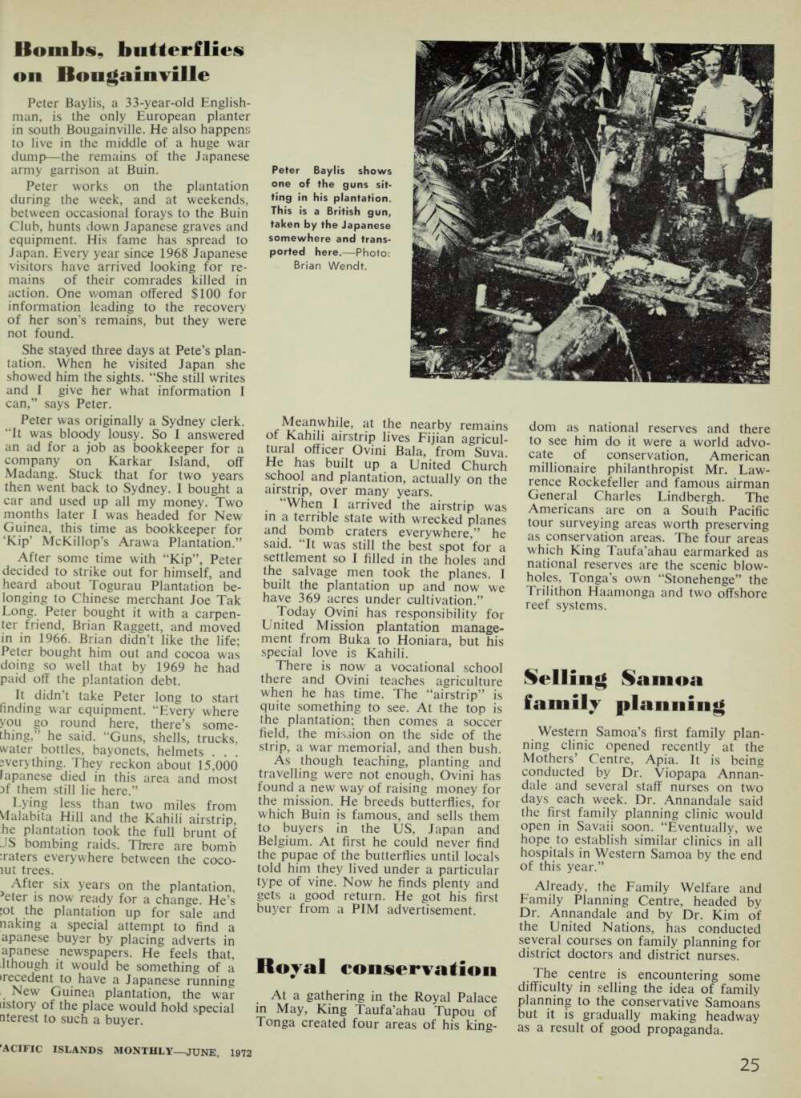
It didn’t take Peter long to start finding war equipment. “Every where you go round here, there’s some thing,” he said. “Guns, shells, trucks, water bottles, bayonets, helmets . . . everything. They reckon about 15,000 lapanese died in this area and most Df them still lie here.”
Lying less than two miles from Vlalabita Hill and the Kahili airstrip, he plantation took the full brunt of JS bombing raids. There are bomb :raters everywhere between the coco mt trees.
After six years on the plantation, J eter is now ready for a change. He’s ;ot the plantation up for sale and nakmg a special attempt to find a apanese buyer by placing adverts in apanese newspapers. He feels that, Ithough it would be something of a •recedent to have a Japanese running New Guinea plantation, the war iistory of the place would hold special nterest to such a buyer.
Meanwhile, at the nearby remains of Kahili airstrip lives Fijian agricul tural officer Ovini Bala, from Suva.
Fie has built up a United Church school and plantation, actually on the airstrip, over many years.
“When I arrived the airstrip was m a terrible state with wrecked planes and bomb craters everywhere,” he said. “It was still the best spot for a settlement so I filled in the holes and the salvage men took the planes. I built the plantation up and now we have 369 acres under cultivation.”
Today Ovini has responsibility for United Mission plantation manage ment from Buka to Honiara, but his special love is Kahili.
There is now a vocational school there and Ovini teaches agriculture when he has time. The “airstrip” is quite something to see. At the top is the plantation; then comes a soccer field, the mission on the side of the strip, a war memorial, and then bush.
As though teaching, planting and travelling were not enough, Ovini has found a new way of raising money for the mission. He breeds butterflies, for which Buin is famous, and sells them to buyers in the US, Japan and Belgium. At first he could never find the pupae of the butterflies until locals told him they lived under a particular type of vine. Now he finds plenty and gets a good return. He got his first buyer from a PIM advertisement.
Royal conservation
At a gathering in the Royal Palace in May, King Taufa’ahau Tupou of Tonga created four areas of his king
dom as national reserves and there to see him do it were a world advo cate of conservation, American millionaire philanthropist Mr. Law rence Rockefeller and famous airman General Charles Lindbergh. The Americans are on a South Pacific tour surveying areas worth preserving as conservation areas. The four areas which King Taufa’ahau earmarked as national reserves are the scenic blow holes, Tonga’s own “Stonehenge” the Trilithon Haamonga and two offshore reef systems.
Selling Samoa
family planning
Western Samoa’s first family plan ning clinic opened recently at the Mothers’ Centre, Apia. It is being conducted by Dr. Viopapa Annan dale and several staff nurses on two days each week. Dr. Annandale said the first family planning clinic would open in Savaii soon. “Eventually, we hope to establish similar clinics in all hospitals in Western Samoa by the end of this year.”
Already, the Family Welfare and Family Planning Centre, headed by Dr. Annandale and by Dr. Kim of the United Nations, has conducted several courses on family planning for district doctors and district nurses.
The centre is encountering some difficulty in selling the idea of family planning to the conservative Samoans but it is gradually making headway as a result of good propaganda.
Peter Baylis shows one of the guns sit ting in his plantation.
This is a British gun, taken by the Japanese somewhere and trans ported here. Photo: Brian Wendt.