The Simple Structure’
pp. 35-37 · Read in the full issue

Islanders Urged To 'Go For
From PERCY CHATTERTON, in Port Moresby.
My first glance at the programme of the sixth Waigani Seminar filled me with foreboding. Had Ron Crocombe’s brain-child become respectable, I asked myself.
An opening address by the Hon.
Andrew Peacock, MP, Minister for External Territories of the Commonwealth of Australia; a session chaired by the Chairman of the Public Service Board; two directors and one assistant director of administration departments in the list of speakers; what did this portend?
I needn’t have worried.
The subject of the Seminar which filled UPNG’s superb lecture theatre to capacity four times a day for a week was “Priorities in Melanesian Development”, and it was explored under the headings of Political Development. Priorities in Health and Social Services, Priorities in Industrialisation and Rural-Urban Issues, and finally Self-respect and National Identity.
There were 65 speakers, three of whom were described as “principal guest speakers”. They came from all over the Western Pacific, as well as from Indonesia, Africa, Europe, the West Indies and Central America.
If the fare offered was at times a little starchy, the dietary balance was corrected by the “principal guest speakers”, who supplied the needed protein component by a ruthless butchery of sacred cows.
The three were: Professor Rene Dumont of France, an agronomist; Mr. Lloyd Best, of the West Indies, an economist; and Dr. Ivan Illich, originally from Central Europe and now head of a centre for thought and work on the social and cultural needs of Latin America, located in Mexico.
From these entirely different back grounds they all came up with vir tually the same advice to Papua New Guinea, namely that we should settle for a simply structured society with a limited technology, pitched some
where between the simple technology of pre-contact Melanesia and the highly complex technology of the west.
Rene Dumont thinks poorly of our agriculture, which he regards as too cash-crop orientated and too neglect ful of improved subsistence food cropping, and our education, which he considers too academic. He would like to see our pupils spending part of each day out of doors growing their own food.
It is worth noting in passing that this is exactly what did happen in many mission boarding schools until about twenty years ago. Since then, the pressures of the educational rat race have forced them to abandon this system and to concentrate ex clusively on academic studies, To Ivan Illich, who has written a book called “De-schooling Society”, schools are anathema. They are the tools of the “manipulative society”. which he wants to replace by the
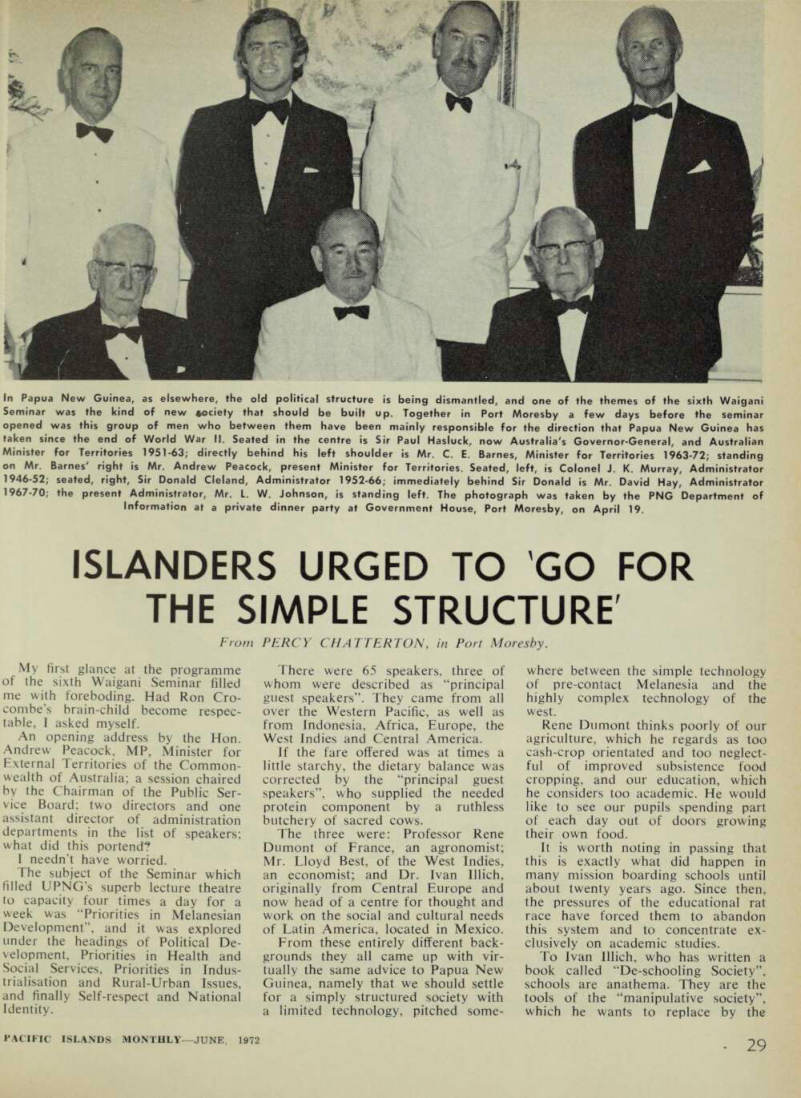
In Papua New Guinea, as elsewhere, the old political structure is being dismantled, and one of the themes of the sixth Waigani Seminar was the kind of new society that should be built up. Together in Port Moresby a few days before the seminar opened was this group of men who between them have been mainly responsible for the direction that Papua New Guinea has taken since the end of World War II. Seated in the centre is Sir Paul Hasluck, now Australia's Governor-General, and Australian Minister for Territories 1951-63; directly behind his left shoulder is Mr. C. E. Barnes, Minister for Territories 1963-72, standing on Mr. Barnes' right is Mr. Andrew Peacock, present Minister for Territories. Seated, left, is Colonel J. K. Murray, Administrator 1946-52; seated, right, Sir Donald Cleland, Administrator 1952-66, immediately behind Sir Donald is Mr. David Hay, Administrator 1967-70; the present Administrator, Mr. L. W. Johnson, is standing left. The photograph was taken by the PNG Department of Information at a private dinner party at Government House, Port Moresby, on April 19.
“convivial society”. He seemed to think that Papua New Guinea is one of the very few places left in the world where it is not too late to establish such a society, a society in which the permissible limits of tech nology are defined by law. Is he right, I wonder? Or have Paguineans already been hooked (as Illich would say) by the manipulative society?
Lloyd Best hadn’t much to say about education as such, but judging by the quotation from West Indian poet Timmy Vaughan with which he ends his paper he would probably agree with Rene Dumont, and pos sibly with Ivan Illich too.
“Turn sideways now and let them see What loveliness escapes the schools Then turn again and smile And be the perfect answer to those fools Who always prate of Greece and Rome.”
A liking for small communities no doubt comes naturally to a West Indian, and Lloyd Best’s political recipe may be paraphrased as “Take care of local government and central government will take care of itself”.
The 64 dollar question underlying much of the discussion at Waigani this year has been “What kind of society for Melanesia?” How about this as a subject for the Seventh Waigani Seminar? For so much hangs on it. For instance, Ken McKinnon, PNG’s Director of Education, plain tively and reasonably complains that the educational planners can’t get on with the job of devising an educa tional system, much less a curriculum, until the politicians make up their minds about the kind of society they want in Papua New Guinea.
In the meantime, let us be grateful for the Sixth Waigani Seminar. If the organisers can continue to secure guest speakers of the calibre of Dumont, Illich and Best, and if in addition they can give us more Melanesian dominated “symposia” on the lines of the quite hilarious one which concluded (except for Profes sor O. H. K. Spate’s closing address) this year’s seminar, the continued success of this annual intellectual feast is assured.
In the meantime, whatever else may result from the -mercurial Ivan lllich’s visit to Papua New Guinea, he has given us what is likely to prove a very popular synonym for the verb “to brainwash”, namely “to school up”. This delightful expres sion cropped up during the sym posium just referred to, and I have heard it several times since. I shall be very surprised if it doesn’t find a permanent place in the vocabulary of Melanesian English. It might even find its way into Pidgin as skulapim.