from it
pp. 22-23 · Read in the full issue
You can't get away from it
New Caledonia Diary
with
Helen Rousseau
A long holiday weekend is always welcome, even in the South Pacific, where Caledonians gasp to “get away from it all” and escape from their 50,000 neighbours in Noumea. A long weekend means no peak-hour traffic banked up for half a kilo metre, no nickel smelter dust and no racing to fetch and deliver schoolchildren four times a day (including home for lunch and siesta).
Preparations for a holiday weekend do mean long queues at the supermarket, however, where you can watch a French couple rapidly tally up a SA9O grocery bill—with cartons of Dutch beer, French wine, lemonade and mineral water, all fit for a hearty weekend not forgetting the English teabags.
But if you’re making for the East Coast, you wonder: why all the fuss? Along this lush stretch, on the opposite side of the island from Noumea and its dry West Coast, the local crops give abundantly. Before stopping off at your property, you call on your friend the local chief who promptly offers you cartons of oranges; his fruit is rotting on the ground, while just recently in Noumea you have bought imported oranges at 90 francs per kilo (37 cents a lb).
This is one of the problems faced by Caledonian agriculture, and you have more time to think about it as you sit over a salad lunch, including heart of coconut palm in oil and vinegar dressing.
You don’t need to come laden
with tinned food from Noumea when you can paddle up the river and collect your own mangrove oysters. Nor do you want to eat deep frozen cauliflower when someone is willing to offer you a tender white heart—split from in side the shell of a germinating young coconut. Some of your favourite liquor, with ice, makes this coconut germ all the more tempting.
You wonder absently what has happened to the noise and hustle in Noumea, till the thud of a falling coconut rouses you from your drowsiness and then you detect a familiar sound the droning of bulldozers. They’re at work even up here, on the other side of the mountain, and out in the bay you spot the Japanese ship, anchored offshore, while the barges slowly ferry across the 15,000 ton load of nickel ore. As a fishing boat motors from the river to the sea, you notice how it churns up the red mud—this is the polluting mineral soil washed down from the open-cut mountain mine.
Then as you gather up dozens of coconuts to burn, to stop them all sprouting around the mangoes and citrus, you are reminded that nickel is so much more valuable than coconuts. Only you’re happy you can enjoy the freshness and shade of the trees as you watch the mountains being laid bare by the hungry bulldozers scooping out the rich ore.
Visitors to New Caledonia do not often manage to see the more inviting East Coast of the island.
The problem is that it takes at least five hours by car to reach the scenic upper East Coast region.
Back in the capital, Noumea, tourist traffic is beginning to im prove again this year, however.
After the decline registered since 1969, figures have begun to rise, with 4,012 visitors counted in the first four months of this year (excluding cruise passengers) and more hotel rooms are now avail able.
Overseas visitors to New Cale donia must not expect to “get away from it all” completely. The ter ritory has just received equipment from France permitting the intro duction of the “Alcotest”, or breathalyzer test, for drivers.
Caledonians have thus been warned that by drinking three quarter of a glass of pure whisky, or i litre of wine or 1 litre of beer they run the risk of driving off to gaol.
This danger did not seem parti cularly to concern the Noumea dockers, however, as they un corked champagne, early May, in their new canteen and recreation hall. Aided by the SHRM, a leading French catering firm which is providing budget meals at the new canteen, the dockers and Port Authority entertained the Gov ernor, Noumea’s Mayor and local politicians, during the inaugura tion of the hall.
Waterside Workers Federation secretary Guy Menneson took the opportunity to refer to that
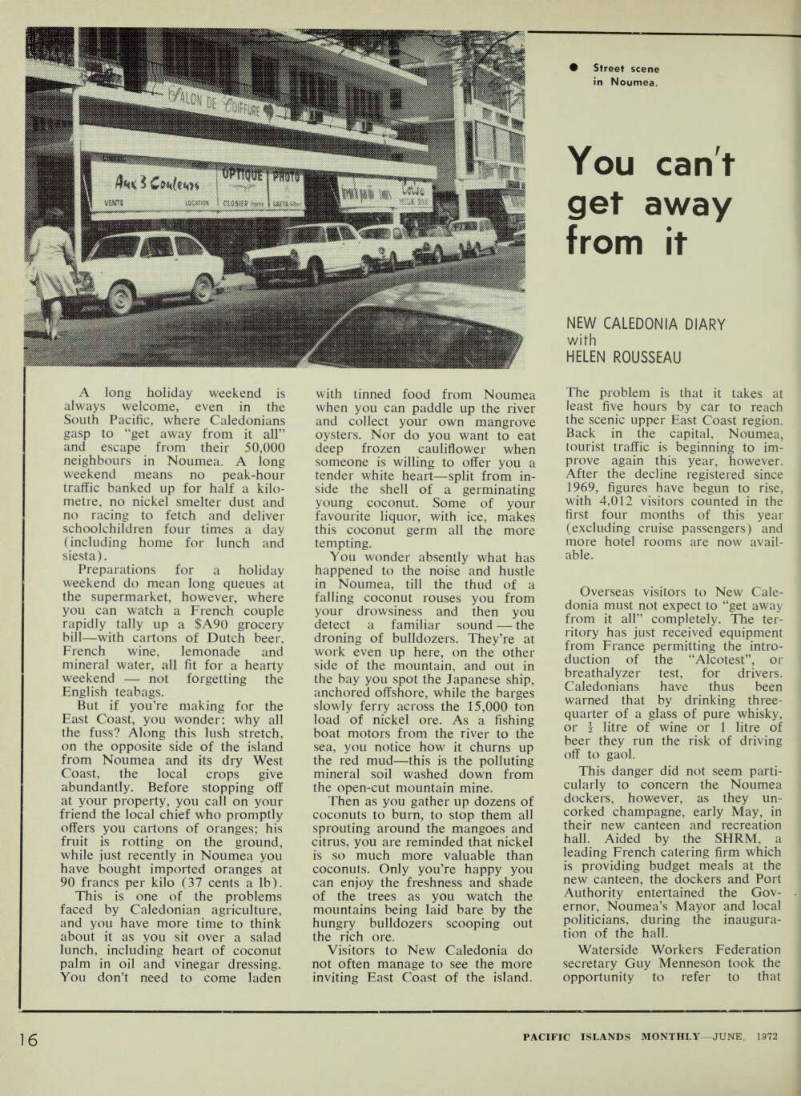
Street scene in Noumea.
morning’s dock strike —over the use of foreign seamen to unload a French ship. The incident in volved the use of Fijian sailors in discharging the Cvpitaine Wallis. With the visit of French Overseas Territories Minister, Mr.
Pierre Messmer, only two weeks away, talks with the French administration brought a speedy tightening up of port regulations on this labour issue.
The Paris minister was also to visit the New Hebrides and Wallis islands during his Pacific tour.
His Caledonian schedule, May 19- 27, included various contacts with local political leaders, besides meetings with members of returned servicemen’s groups which the French see as patriotic links with France. On the business side, Mr.
Messmer’s programme included a visit to the Noumea nickel smelters of the SLN mining com pany and talks with the New Caledonian Nickel Ore Producers’ and Exporters Association. Future Paris policy on political and mining developments in the ter ritory was expected to be most affected by the Paris minister’s visit. Frances Sanford, Deputy for French Polynesia, arrived in Noumea the same day as Mr.
Mesmer and was welcomed by members of the Caledonian Front for Autonomy who were expected to boycott all official contacts with the minister.
Noumea in May was a town of pop music, women’s cricket and car stuntmen. The territory’s first pop festival was held over two weekends, with Caledonian and overseas musicians participating before an enthusiastic young audience.
Before this, the 90-member Caledonian delegation to the South Pacific Festival of Arts flew off to Suva almost unnoticed, after the over-harassed chief French organiser had been obliged to fly off for holidays in New Zealand to recuperate. The Noumea post office, however, honoured the occasion with a special-issue 24 franc stamp, featuring a traditional Melanesian dwelling.
The group of Melanesian work men scheduled to assemble the territory’s dwelling in Suva had requested a fee of almost $A2,000 for its labour. The cost of liv ing is obviously being felt here now and the Noumea organisers
finally agreed to pay the $2,000 to the Mayor of Canala, for dis tribution among the tribes con cerned.
Further inflated costs for art work were seen in the first Cale donian Salon de Mai exhibition, where a couple of Noumea artists asked over $A 1,000 for single paintings. The exhibition of some 90 works from over 30 local artists aroused great enthusiasm, however. Being the first such joint show held here the Salon promises more stimulating efforts ahead.
The paintings were exhibited in the gallery wing of the Noumea museum, where two other looms now offer a most decorative per manent display of Pacific objects and artefacts. Exhibits range from giant carved totem poles to ancient pieces of Lapita pottery. The pottery reflects the work excavated here by such researchers as Dr.
Richard Shutler, Jr., whose Pacific friends will be interested to hear that he has left Canada for the Department of Anthropology in the University of lowa, USA.
Turning from art to sport, the Caledonians in May welcomed a team of 14 young New Zealand swimmers who came to compete against the locals. The Cale donians have to build up a new team for the next South Pacific Games, in Guam, and were pleased to see 14-year-old French newcomer Beatrice Godard create a new Caledonian record of 3 min. 7.2 secs, in the 200 metre women’s breaststroke.
In an evening of international boxing in Noumea, Australian welterweight Paul Moore returned to the island to face Jacques Van Mellaerts, who flew out from France especially for the combat.
With no defeats in 17 pro matches, Van Mellaerts suffered his first setback in the Noumea fight when the Australian won on points.
Seme Caledonian spectators ap parently confused the fight with another round of the polit-ball contest. The metropolitan French man collected a few words to take back to Paris from the auto nomists while on the other hand, his opponent said how impressed he was by the warm backing he received from the crowd.
During the same evening, other Australian and New Zealand
boxers fought amateur bouts against the Caledonians who ex pect to send the following team to Tahiti for the first Oceanic championships in June: Jean Jacques Thomas (flyweight), Noel Hmae Kaoutche (welter), Ray mond Nebayes (middleweight), Olivier Berlioz (light-heavy) and Vincent Fafoa (heavyweight).
Introducing a different kind of spectator sport to Noumea, the New Caledonian Auto Club in May helped sponsor a show by the Cascadeurs, a group of stunt men from France who performed amazing feats in cars. Perhaps this is to be taken up as training by drivers preparing for the next annual Safari Caledonien car trial around the island in December. It is hoped no driver will attempt these acrobats in the middle of the busy main street, Rue de I’Alma.
Back to more sober sport, the Caledonian Cricket League opened the women’s championship season in May. Matches are played every Saturday afternoon and Sunday morning near Anse Vata beach.
The women wear the colourful “Mother Hubbard” dress originally introduced by missionaries. The cricket played by the Melanesian women in New Caledonia has some interesting compromises with original English rules, e.g. the batswoman can conserve her strength by using another, prefer ably younger player to do her running. The whole game is played in festive spirit, with lots of boisterous fun and colourful swirling of the “Mother Hubbard”.
The umpires are always men.
Another women’s festival on the May calendar was Jeanne d’Arc day. The French heroine is honoured every year in Noumea, on the same Sunday as the military parade commemorating Victory in Europe in World War 11.
After the parade on the Anse Vata beach promenade and Mass in Noumea’s Roman Catholic Cathedral, a ceremony was held at Joan of Arc’s statue in the Cathedral grounds. With the French military band in the back ground, Governor Louis Verger, accompanied by Archbishop Eugene Klein, laid a wreath at the feet of Jeanne d’Arc who, high on her pedestal, proudly watches over the town and port of Noumea.