'David' slings a stone
p. 21 · Read in the full issue
across the Strait
It is perhaps a bit of bad luck for PNG’s newly formed coalition govern ment that right at the start it should have tossed into its lap a problem which is likely to test its acumen to the full.
The fact that the Queensland-Papua New Guinea border runs in one place to within 200 yards of the Papuan coast and that traditional Papuan fishing grounds are within Austra lian waters has long been a source of irritation to the Kiwai people of the Western District. Their member, Ebia Olewale, who is now also Minister for Education in the coali tion government, after thoroughly researching the rather complex his tory behind this odd situation, raised the issue repeatedly in the second House and is now raising it again in the third, with possibly more hope of a sympathetic hearing, and perhaps to the embarrassment of his leader, Michael Somare.
The present boundary was estab lished unilaterally by Queensland in 1879, five years before what is now Papua became a British Protectorate.
During the 1890 s two proposals were made for shifting the boundary further south, one by Queensland Premier Sir Samuel Griffiths, and the
other by the Administrator of British
New Guinea (as Papua was then named), Sir William MacGregor.
The British Government accepted a modified version of the Griffiths proposal, and an Order-in-Council to establish this boundary was pro mulgated. However, the Queensland Government never accepted the change, and in 1925, at Queensland’s request, the Commonwealth Govern ment re-affirmed the original boundary of 1879.
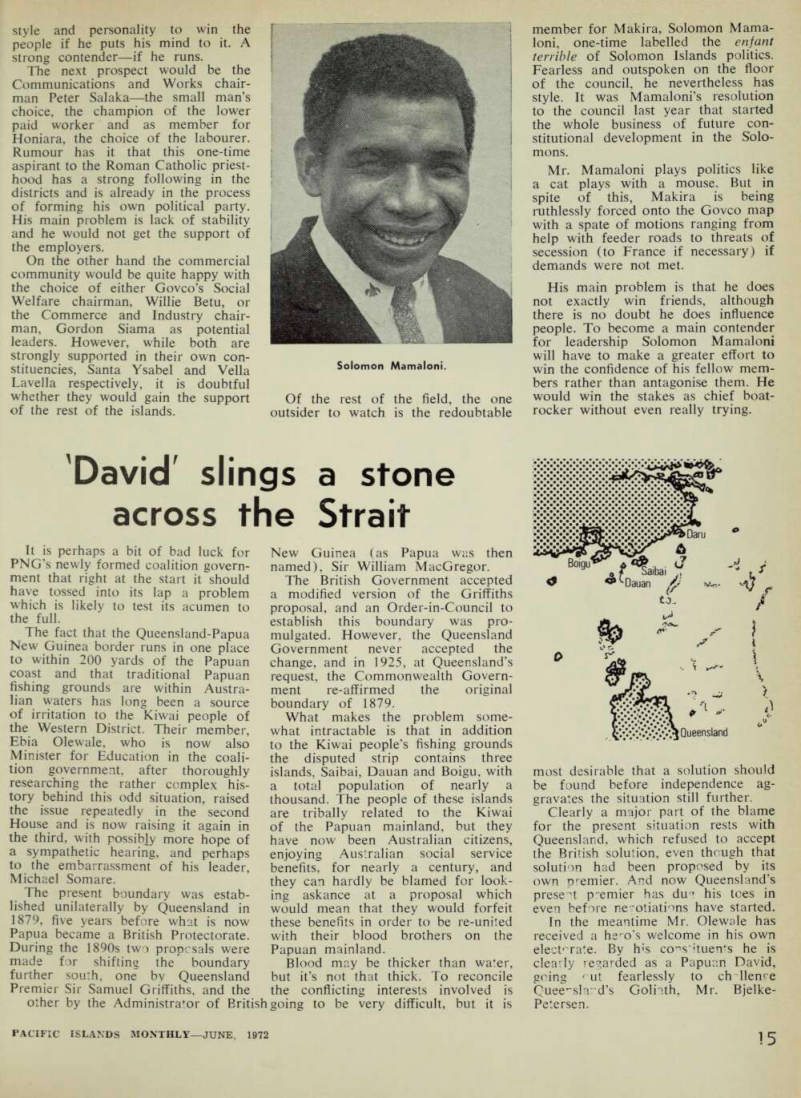
What makes the problem some what intractable is that in addition to the Kiwai people’s fishing grounds the disputed strip contains three islands, Saibai, Dauan and Boigu, with a total population of nearly a thousand. The people of these islands are tribally related to the Kiwai of the Papuan mainland, but they have now been Australian citizens, enjoying Australian social service benefits, for nearly a century, and they can hardly be blamed for look ing askance at a proposal which would mean that they would forfeit these benefits in order to be re-united with their blood brothers on the Papuan mainland.
Blood may be thicker than water, but it’s not that thick. To reconcile the conflicting interests involved is going to be very difficult, but it is
most desirable that a solution should be found before independence ag gravates the situation still further.
Clearly a major part of the blame for the present situation rests with Queensland, which refused to accept the British solution, even though that solution had been proposed by its own p r emier. And now Queensland’s present premier has his toes in even before negotiations have started.
In the meantime Mr. Olewale has received a he r o’s welcome in his own electorate. By h’s constituents he is clearly regarded as a Papuan David, going r ut fearlessly to ch llenre Queensland's Goliath, Mr. Bjelke- Petersen.