Solomons'
pp. 20-21 · Read in the full issue
Stand Up
Big Men!
From a Honiara correspondent
Wanted in the British Solomon Islands: One National Leader capable of winning the support of more than 100 ethnic groups inhabiting a 900-mile string of islands in the Western Pacific.
Has to be recruited locally. Job carries promise of promotion to post of Prime Minister (or equivalent) within three to five years. Salary—should be around the $6,000 mark. Primary aim— to amalgamate some 160,000 indigenes and give them one national identity; also to provide direction, initiate pride and give incentive.
This advertisement has not gone out yet, but has been compiled in the writer’s mind. As the Governing Council session wound up its business on March 24, one point became clear.
The country was short of aspiring leaders. This was admitted not only privately by members, but also on the floor of the house.
It has already been recorded that the existing constitution is being closely scrutinised. And the select committee doing this is none other than the Governing Council itself.
Already representations from in dividuals and organisations are being heard in Honiara.
The next step is to take the con stitution to the villages and outstations for further airing, and a schedule for this has been drawn up begin ning in May when sub-committees consisting of Govco members them selves begin sounding out opinions in the language of the people.
But when the dust settles, and by
the time the rainy season begins at the end of the year, the basic question will still remain, Have we a leader.
In the meantime will all potential Big Men please stand up and be counted.
Also in the meantime the people are being given a choice. Do you like the current Govco set up in which the country is governed by a system of committees? Should some changes be made? Or should we throw out the whole system and begin again perhaps a two-party system styled on Westminster.
This latter system has already been suggested in a few representations, and in one case with the added refinement of a House of Lords (Solomon Island style) consisting of chiefs, line leaders, retired civil servants and headmen.
However, and with the current trend of thought, somebody other than the High Commissioner is going to have to lead the show in the next few years.
The field is currently limited to the existing members of Govco whose performance can be studied each session on the government-run Solomon Islands Broadcasting Service and in the fortnighly News Sheet, also individually by the voters them selves on their home ground. For a start, leading contenders could be the five chairmen of Govco who should be studied individually for form.
Firstly, and a strong favourite, we have the politically steady David Kausimae who sits at the helm of the Natural Resources Committee.
His basic job is to put into action plans and policies for the future economic independence of the Solomons.
He could be described as the strong
man of Solomon Islands politics, but the unfortunate tendency to throw him straight into the firing line in such cases as disputes over land for mining and fishing rights may have caused a drop in his status, and shaken his self-confidence to boot.
His self-effacing manner and lack of rhetoric does not lend itself in gain ing popular support. On the other hand, when aroused, he is capable of crossing verbal swords with anyone on the council floor.
The Internal Affairs Committee chairman, Mariano Kelesi, has been the longest in politics and is un doubtedly the most experienced. He is, like Kausimae, a Malaitaman, but unlike Kausimae he has a number of other outside interests and it’s an even bet that he fades out of politics long before the end of this decade. On the other hand he has the necessary
Willie Betu.
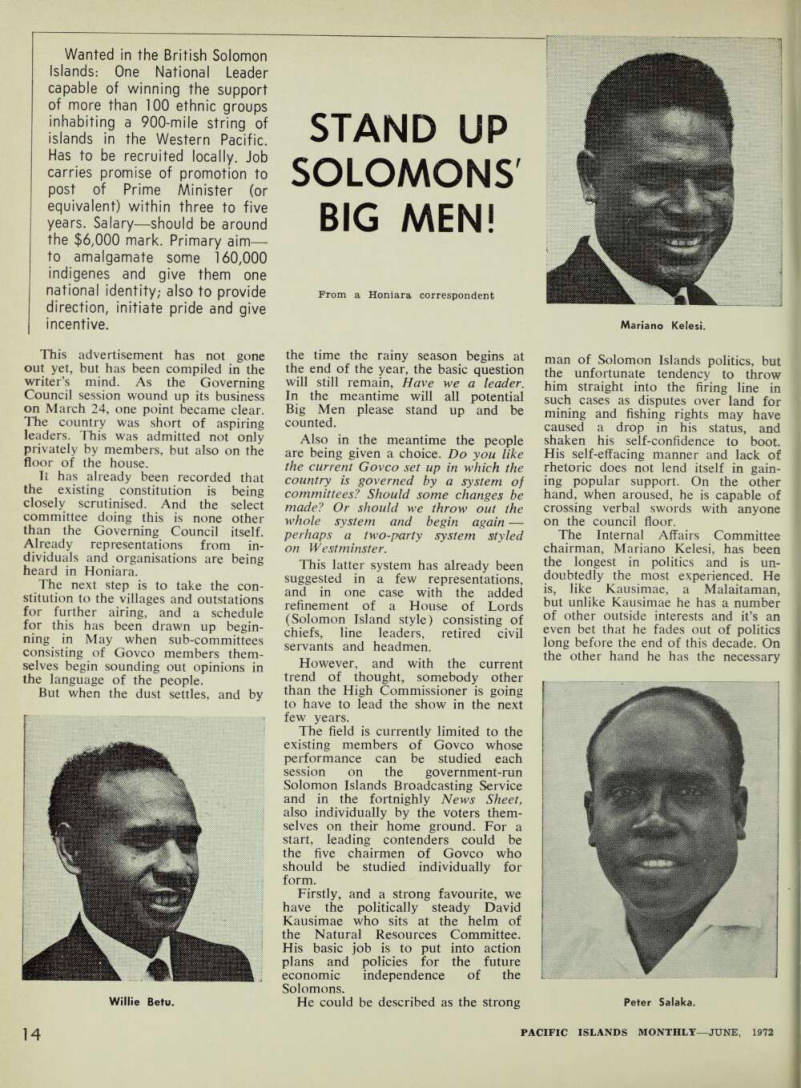
Mariano Kelesi.
Peter Salaka.
style and personality to win the people if he puts his mind to it. A strong contender —if he runs.
The next prospect would be the Communications and Works chair man Peter Salaka—the small man’s choice, the champion of the lower paid worker and as member for Honiara, the choice of the labourer.
Rumour has it that this one-time aspirant to the Roman Catholic priest hood has a strong following in the districts and is already in the process of forming his own political party.
His main problem is lack of stability and he would not get the support of the employers.
On the other hand the commercial community would be quite happy with the choice of either Govco’s Social Welfare chairman, Willie Betu, or the Commerce and Industry chair man, Gordon Siama as potential leaders. However, while both are strongly supported in their own con stituencies, Santa Ysabel and Vella Lavella respectively, it is doubtful whether they would gain the support of the rest of the islands.
Of the rest of the field, the one outsider to watch is the redoubtable
member for Makira, Solomon Mama loni, one-time labelled the enfant terrible of Solomon Islands politics.
Fearless and outspoken on the floor of the council, he nevertheless has style. It was Mamaloni’s resolution to the council last year that started the whole business of future con stitutional development in the Solo mons.
Mr. Mamaloni plays politics like a cat plays with a mouse. But in spite of this, Makira is being ruthlessly forced onto the Govco map with a spate of motions ranging from help with feeder roads to threats of secession (to France if necessary) if demands were not met.
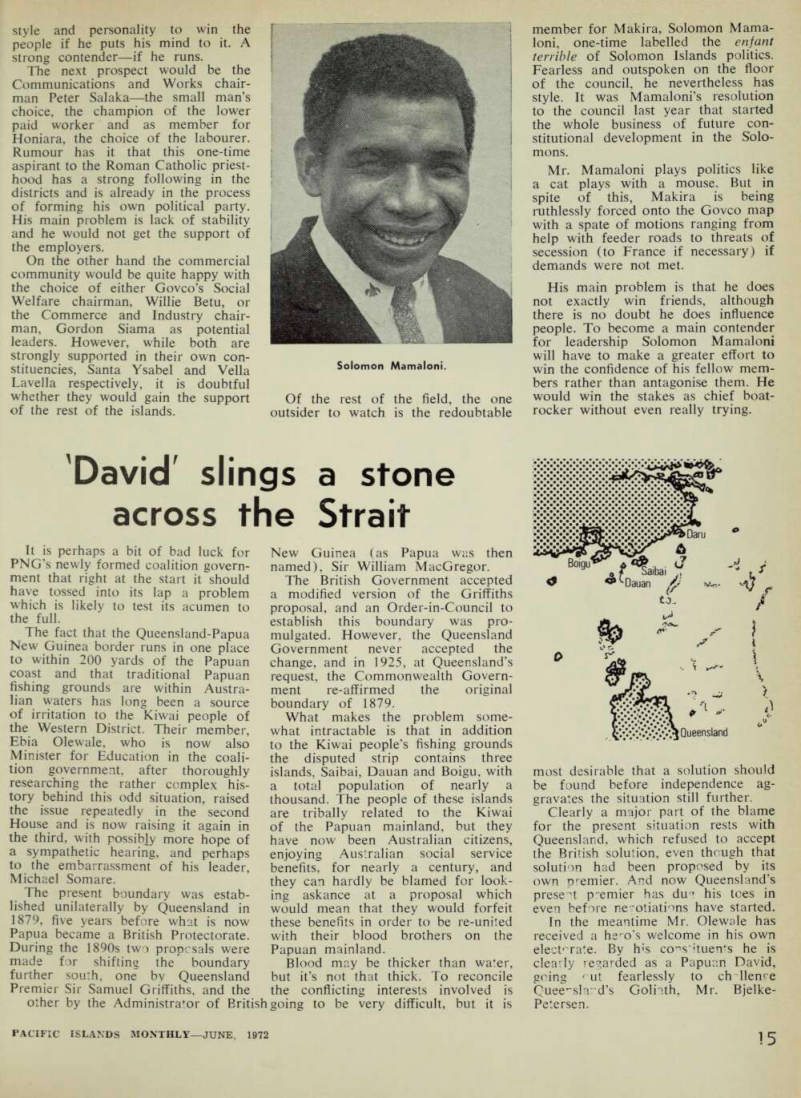
His main problem is that he does not exactly win friends, although there is no doubt he does influence people. To become a main contender for leadership Solomon Mamaloni will have to make a greater effort to win the confidence of his fellow mem bers rather than antagonise them. He would win the stakes as chief boat rocker without even really trying.
Solomon Mamaloni.