fiji talanoa
pp. 24-25 · Read in the full issue
Everything happened in the merry month of May
With Sue Wendt, In Suva
11/|AY, in Fiji, was a devastatingly
“happening" month.
We had it all. Election results, the opening of Parliament and a walk out by the Opposition; a disruptive strike by airport workers; a spectacu lar court case involving a newly elected Member of Parliament: a series of mindless bomb hoaxes; “ban the bomb" demonstrations—and of course, the first exciting, memor able South Pacific Festival of Arts (see festival story, page 26). rpHE ceremonial opening of the new Fiji Parliament took place on May 12 with the Alliance, returned to power for the next five years, occupying 33 seats and the National Federation Party 19 —at least for the first 10 minutes.
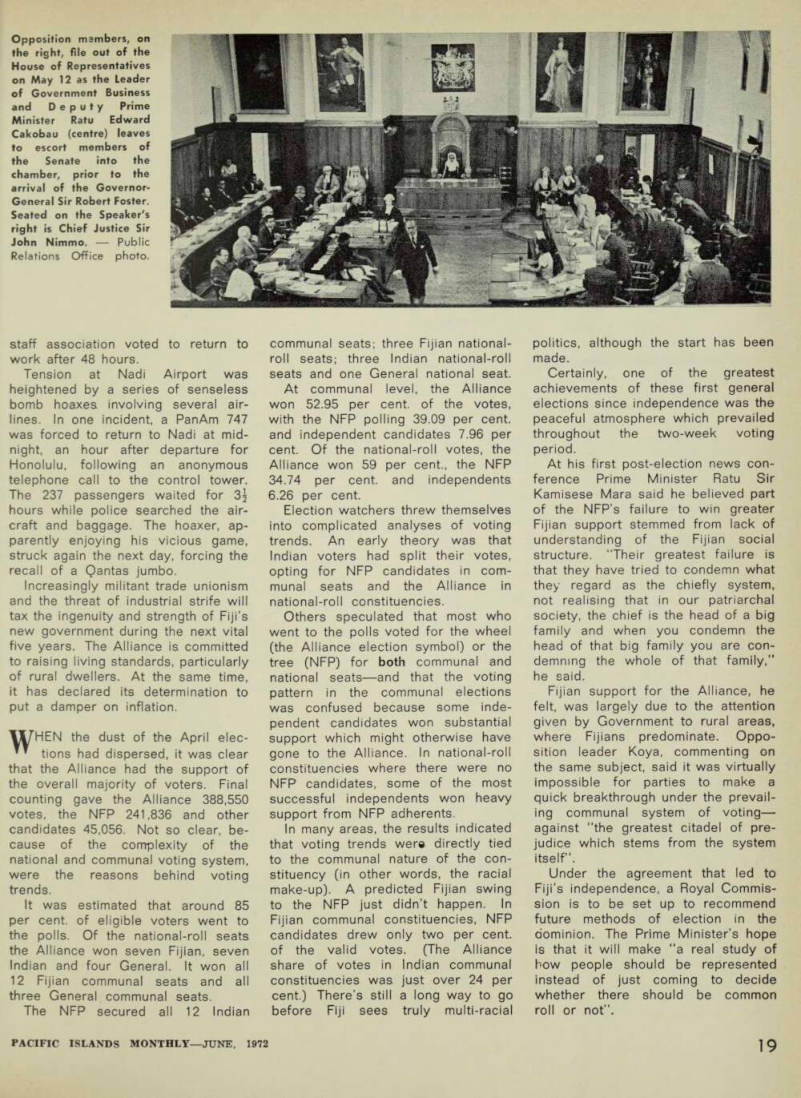
“My first duty is to welcome mem bers of the new enlarged Parliament . . .” began the Governor-General Sir Robert Foster, glancing perhaps despite himself towards the Oppo sition seats. They were empty. The Opposition—in what re-elected leader Mr. S. M. Koya termed a “serious anxious and permanent protest con cerning the appointment of the pre sent Chief Justice”—had walked out immediately prior to the Governor- General’s arrival The demonstration, described by some observers as infantile and bor dering on madness, was an extension of the NFP's vigorous objections last December to new legislation raising the retiring age of judges in Fiji. The legislation made it possible for an Australian, Sir John Nimmo, to be appointed Chief Justice.
Although Mr. Koya declared later that the walk-out wasn’t intended as an insult to the Speaker (one of the NFP’s most active members, Mr. R. D.
Patel, has been appointed), to Parlia ment or to the Governor-General, it was generally felt that the Oppo sition’s action was, at least, irre sponsible and contemptuous of the spirit of Parliament in Fiji.
Unlike its months-long boycott of Parliament in 1967, when it was demonstrating its objection to the re tention of the communal voting system, the NFP was this time in tending to stay out for only a day— getting into its stride, as it were, in its promised role of a “hard-line and vigorous" opposition.
A BSENT from the Parliamentary polemics was Opposition member Mr. Vijay Parmanandam, one of the most vociferous protagonists in the controversy surrounding Mr. Justice Nimmo’s appointment. Mr. Parmanan dam was at the Suva District Office, working off, extra-murally, a six months' gaol sentence for contempt of the Supreme Court and the Chief Justice in a political speech and pamphlet.
The Supreme Court judgment
against him was handed down just 10 days after the results of the general elections, which won him a seat in the House of Representatives as Indian communal candidate for Suva City West-Navua.
Under his extra-mural sentence, Mr. Parmanandam was required to work a 36-hour week of at least six hours a day without pay. It enabled him to be sworn into the House prior to the official opening of Parliament —but several days later the extra mural sentence was rescinded by the court and Mr. Parmanandam was back in gaol. This followed an attempt by lawyer Parmanandam to appear for a client in court on May 12.
Absence from three parliamentary sessions could lose Parmanandam his seat and force a by-election on the electorate, unless special leave of absence can be obtained from the Speaker.
A MOTHER Opposition member with pressing business elsewhere after the parliamentary walk-out was union leader Mr. Apisai Tora. He was involved in an inquiry into a Qantas pay dispute which had re sulted in a strike at Nadi Airport by 115 members of the Airline Workers’
Union.
The strike began on May 4, follow ing the airline’s rejection of union de mands for a minimum weekly wage of $4O for ground staff at the airport.
A commission of inquiry, under the Chief Justice of Nauru, Mr. Justice lan Thompson, began on May 9 —but the position became critical the fol lowing day when 160 members of the Qantas local salaried staff also walked off the job.
Prior to this, salaried staff and management personnel of all airlines, working round the clock, had
managed to keep international flights
operating through Nadi on schedule, with minimum inconvenience to pas sengers.
At midnight on May 9, however, the salaried staff association called a 48-hour strike, alleging that a Qantas engineer had kicked a traffic officer.
It was also learned that the asso ciation had served a new log of claims on Qantas and intended start ing negotiations after settlement of the dispute with the Airline Workers’
Union.
For two days almost all inter national flights through Nadi were cancelled. A strict security guard was mounted at the almost-deserted airport and 4,000 tourists faced being stranded in Fiji for an indefinite period.
Fortunately for Fiji and for the success of the South Pacific Arts Festival, members of the salaried
staff association voted to return to work after 48 hours.
Tension at Nadi Airport was heightened by a series of senseless bomb hoaxes involving several air lines. In one incident, a PanAm 747 was forced to return to Nadi at mid night, an hour after departure for Honolulu, following an anonymous telephone call to the control tower.
The 237 passengers waited for 3j hours while police searched the air craft and baggage. The hoaxer, ap parently enjoying his vicious game, struck again the next day, forcing the recall of a Qantas jumbo.
Increasingly militant trade unionism and the threat of industrial strife will tax the ingenuity and strength of Fiji’s new government during the next vital five years. The Alliance is committed to raising living standards, particularly of rural dwellers. At the same time, it has declared its determination to put a damper on inflation.
VIfHEN the dust of the April elec " tions had dispersed, it was clear that the Alliance had the support of the overall majority of voters. Final counting gave the Alliance 388,550 votes, the NFP 241,836 and other candidates 45,056. Not so clear, be cause of the complexity of the national and communal voting system, were the reasons behind voting trends.
It was estimated that around 85 per cent, of eligible voters went to the polls. Of the national-roll seats the Alliance won seven Fijian, seven Indian and four General. It won all 12 Fijian communal seats and all three General communal seats.
The NFP secured all 12 Indian
communal seats; three Fijian national roll seats; three Indian national-roll seats and one General national seat.
At communal level, the Alliance won 52.95 per cent, of the votes, with the NFP polling 39.09 per cent, and independent candidates 7.96 per cent. Of the national-roll votes, the Alliance won 59 per cent., the NFP 34.74 per cent, and independents 6.26 per cent.
Election watchers threw themselves into complicated analyses of voting trends. An early theory was that Indian voters had split their votes, opting for NFP candidates in com munal seats and the Alliance in national-roll constituencies.
Others speculated that most who went to the polls voted for the wheel (the Alliance election symbol) or the tree (NFP) for both communal and national seats —and that the voting pattern in the communal elections was confused because some inde pendent candidates won substantial support which might otherwise have gone to the Alliance. In national-roll constituencies where there were no NFP candidates, some of the most successful independents won heavy support from NFP adherents.
In many areas, the results indicated that voting trends were directly tied to the communal nature of the con stituency (in other words, the racial make-up). A predicted Fijian swing to the NFP just didn’t happen. In Fijian communal constituencies, NFP candidates drew only two per cent, of the valid votes. (The Alliance share of votes in Indian communal constituencies was just over 24 per cent.) There’s still a long way to go before Fiji sees truly multi-racial
politics, although the start has been made.
Certainly, one of the greatest achievements of these first general elections since independence was the peaceful atmosphere which prevailed throughout the two-week voting period.
At his first post-election news con ference Prime Minister Ratu Sir Kamisese Mara said he believed part of the NFP’s failure to win greater Fijian support stemmed from lack of understanding of the Fijian social structure. “Their greatest failure is that they have tried to condemn what they regard as the chiefly system, not realising that in our patriarchal society, the chief is the head of a big family and when you condemn the head of that big family you are con demning the whole of that family,” he said.
Fijian support for the Alliance, he felt, was largely due to the attention given by Government to rural areas, where Fijians predominate. Oppo sition leader Koya, commenting on the same subject, said it was virtually impossible for parties to make a quick breakthrough under the prevail ing communal system of voting— against "the greatest citadel of pre judice which stems from the system itself”.
Under the agreement that led to Fiji’s independence, a Royal Commis sion is to be set up to recommend future methods of election in the dominion. The Prime Minister’s hope is that it will make “a real study of how people should be represented instead of just coming to decide whether there should be common roll or not”.
Opposition members, on the right, file out of the House of Representatives on May 12 as the Leader of Government Business and Deputy Prime Minister Ratu Edward Cakobau (centre) leaves to escort members of the Senate into the chamber, prior to the arrival of the Governor- General Sir Robert Foster.
Seated on the Speaker's right is Chief Justice Sir John Nimmo. - Public Relations Office photo.