Magazine Section
pp. 75-77 · Read in the full issue
Computerised Clues Unlock A
Door To Polynesia's Past
The time has come for another look at the Polynesians and the question of where they came from.
Let me say at once that they are not American Indians, and they did not come from Peru on a raft.
It is time because of what the new breed of anthropologist has been doing. This is not to look down upon the old, but the years have been pass ing, giving everyone more experience and training. If the archaeologists, instead of measuring stone platforms, find more information in unnoticed trash heaps, that is what they have learned to do; and they have the benefit of radiocarbon, to give dates in actual years.
Linguists and physical anthro pologists have learned a thing or two, and they have computers. Radio carbon was first used in 1951; com puters could not be used easily until 10 years later.
TLe older breed did what they could, and did it well, studying culture and language—above all the oral history and tradition of the Polynesians. Religious conceptions were so impressive, and genealogies so explicit, that European scholars easily magnified accounts into long voyages of migration.
Who can blame them for succumb ing to a few romantic notions?
Writers found connections as far away as the Aryans of India and the Buddhism of China. The vigour and integrity of Polynesian culture chal lenged scholars to think it must have been brought intact from somewhere.
But where?
The physical anthropologists could not help. They were baffled by the outward appearance of the Poly nesians, which they interpreted as a blend of Caucasoid, Mongoloid and Negroid features, an interpretation which immediately involved them in complicated hypotheses.
The Polynesians, they concluded, had probably arrived in more than one migration, and the cultural
By W. W. Howells,
Professor of Anthropology at Harvard University, who prepared this article on the Polynesian question especially for PIAA. anthropologists agreed with them, offering various homelands and migra tion routes. For example, they might allow one or more voyages through Melanesia into Polynesia, plus per haps a third through Micronesia direct to Hawaii, all to explain slight internal differences in Polynesia.
These views have been given up in the face of new facts, the kind of evidence which will let us trace the Polynesian story backward by detec tive work. Let us begin with the physical anthropologists. They have
been re-educated. They no longer believe that a stately bearing and a moustache signify Caucasoid ancestry emerging, or that broad noses have to be Negroid, or other features Mongoloid, all to be sorted out.
The Polynesians are simply a natural population and by statistical tests, a rather uniform one, which has expanded into a “race” by spread ing through the islands and multiply ing greatly. Computer studies (partly my own) of their skulls show them to be quite distinct from Melanesians, with characteristic features of shape.
They are least unlike (the best way of putting it) various Mongoloid populations of Asia and, at a next remove, Europeans or American Indians.
Blood type testing also shows them
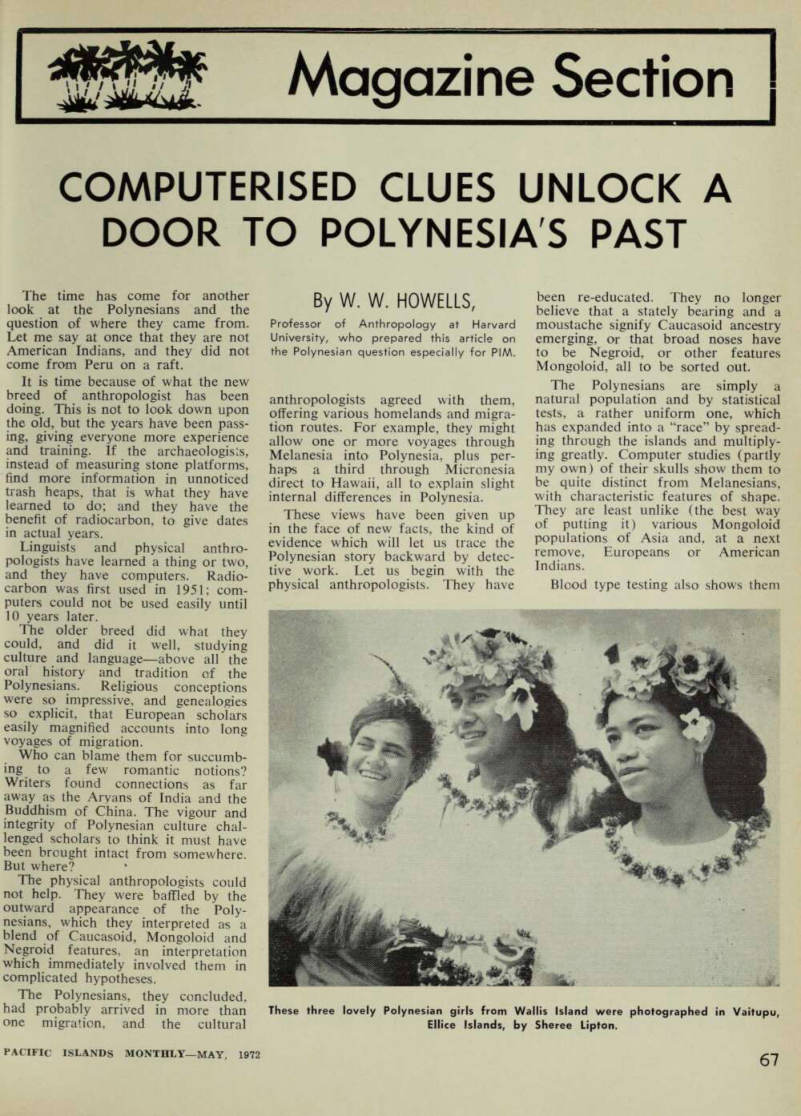
These three lovely Polynesian girls from Wallis Island were photographed in Vaitupu, Ellice Islands, by Sheree Lipton.
to be generally uniform, but here they are quite unlike Asiatics. Most notably, eastern Polynesia (New Zealand also) is lacking in blood group B, which is high in Asia but absent in American Indians. This and some other blood features would indeed allow Heyerdahl’s theory of American connections; however, it would also allow Polynesians to be allied with Australian aboriginals.
Today it seems that such blood percentages are not good evidence of ancient connections, as had been hoped. Rather, it is realised that when populations are small and isolated they are apt to lose some genes by accident, particularly that for B blood. This is important, sup porting the view that Polynesian colonisation started from an original small and isolated colony, and later established others, also originally small and generally isolated.
Polynesian languages say the same.
They are hardly more than dialects.
In fact, Captain Cook had barely met his end when a Spanish scholar noted the existence of the great Malayo- Polynesian stock (now called Austro nesians). Today linguists can trans late likenesses between languages, especially in vocabulary, into a family tree, and so they can reckon, roughly, the date at which two languages once the same became separate.
For Polynesia they find that Maori and Tahitian had one common parent not very long ago, and Marquesan and Hawaiian another.
These all have an earlier common parent which they share with the language of Easter Island, which split off earliest, perhaps 500 AD by esti mation.
This ancestral language, proto eastern Polynesian, existing some time not long after the beginning of the Christian era, came from an earlier ancestor still, proto-nuclear Polynesian, which had dissolved to give off proto- Samoic, parent of Samoan, and the languages of the Tokelau and Ellice groups, together with the bulk of the outliers in the west. Finally, earlier still, this proto-nuclear was joined with proto-Tongic in the parent of them all, proto-Polynesian.
This may sound like the Old Testament begats, but it is a clear picture of Polynesian development when you run the film the other way.
About 2,500 years ago a community, still small, spoke an actual proto- Polynesian language. This divided into ancient languages spoken in Tonga and Samoa; from Samoa there was a long colonising voyage to a new centre in eastern Polynesia (the Marquesas? Tahiti?) and from here came the settlements of all the mar-
ginal groups from New Zealand around to Hawaii.
The linguists can virtually speak proto-Polynesian, reconstructing it by allowing for regular and obvious changes the modern languages have made (for example, in Hawaiian “k” is substituted for “t” in “tapu” and all similar positions), and by building up the lists of words which must have been present in it. So, because proto-Polynesians talked about moun tains and waterfalls, Andrew Pawley and Kaye Green (at the University of Auckland) have decided that they were not atoll-dwellers, concluding that the most likely first home of these early Polynesians was Tonga.
Professor Pawley also finds that the language has an essential relation to Fijian, but that Fijian (which is actually made up of many varied dialects) differs from Polynesian partly because it was affected by certain other different but closely related languages, especially from the New Hebrides.
The conclusion is this: about 1,500 to 2,000 BC there existed such a group of closely related tongues, known as eastern Oceanic, in eastern Melanesia. Several of them at dif ferent times reached Fiji. One of them, unaffected by the others, reached Tonga, and this proto-Polynesian,
with the benefit of a long period of isolation, took on its specifically Polynesian nature before it broke up through colonisation of the rest of Polynesia, expanding throughout the eastern Pacific.
Therefore the original Polynesian started as only one of a group of languages in eastern Melanesia. This writes finis to notions about multiple migration: Polynesian language and culture were shaped in Fiji and Tonga, not India or China. Sister languages, from an eastern Oceanic parent, still exist in Fiji, the New Hebrides, and the southern Solomons, with two more probable members well to the west—Nakanai of north west New Britain, and Motu of Papua.
But the linguists leave us with this question; how did the parent of all these languages get into eastern Melanesia before its dispersal?
Eastern Oceanic (of which Polynesian is actually only a small piece) looks like one branch of many among the Austronesian languages, a number of which were already present in Mela nesia.
Let us ask the archaeologists, who are working from various active centres, especially the Department of Prehistory at Australian National University. They agree very well with the linguists about the peopling of eastern Polynesia. Easter Island was settled early, 500 AD being con sidered the earliest allowable. Hawaii and New Zealand, reached later, may have had arrivals from both the Marquesas and Tahiti. All this ex ploration seems at the moment to have radiated first from a centre in the Marquesas, where the oldest re mains are believed to date from about 350 AD.
These oldest finds include a little pottery. Pottery was supposed not to have been made by Polynesians, but the art arrived in the Marquesas, only to die almost at once. Other objects, especially adze forms, point like the pottery to an origin in Samoa for the eastward migrants. For the earliest levels yet found in Samoa are dated by radiocarbon to the third century BC, and pottery making was certainly established here, though it stopped after a few centuries. Origins for Samoa in turn point clearly to Tonga and Fiji.
In these places pottery was made in profusion, in the Lapita style, and its early forms are identical in the two groups. The oldest radiocarbon date now known for Tonga is 1140 BC, and that for Fiji 150 years be fore, at 1290 BC (there are margins of error in such readings). It was also present in southern New Cale donia as early as in Fiji, and with
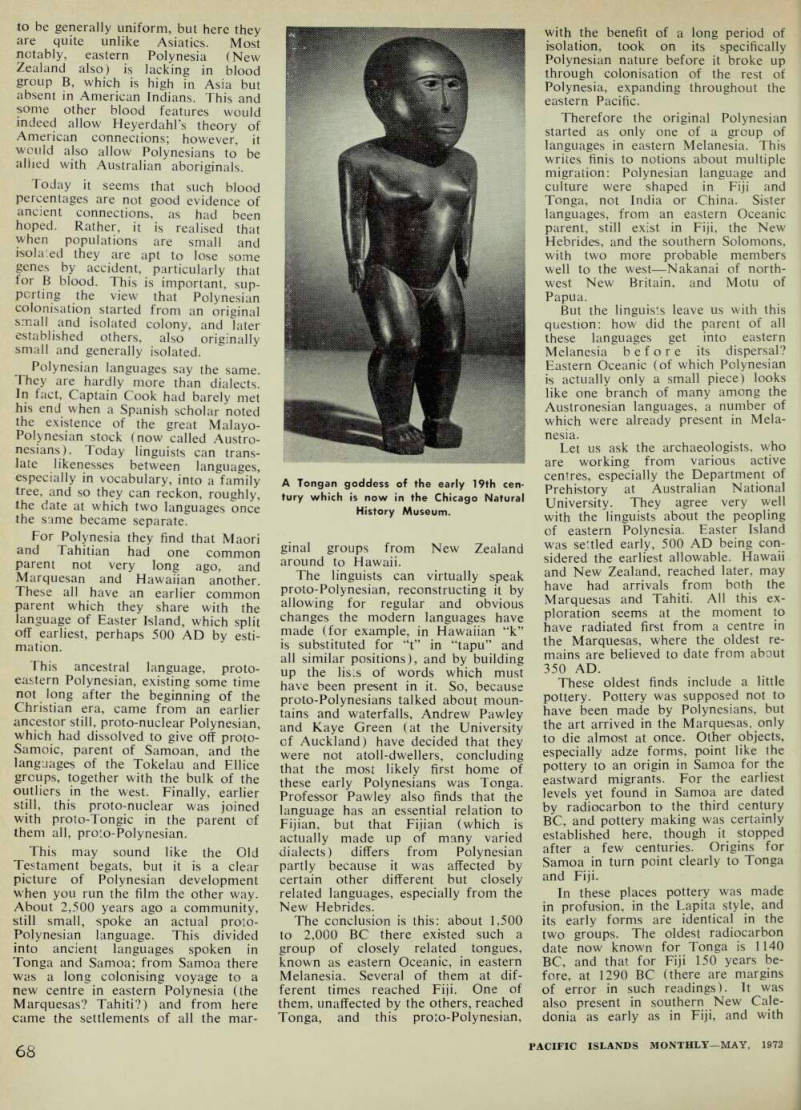
A Tongan goddess of the early 19th cen tury which is now in the Chicago Natural
History Museum.
Digging in Tonga reveals ancient history
nearly as early a date in the Isle des Pins. It was made in the New Hebrides, but the date is not clear.
This looks like the work of the people who were speaking the oldest eastern Oceanic languages. Where did they come from? Origins of Lapita ware remain unknown. It is being found in various small islands in Melanesia (see PIM, December, 1970, p. 39), including Watom off New Britain, and Yule Island in the Gulf of Papua, near the speakers of Nakanai and Motu respectively.
The long-sought route of the Poly nesians? Apparently not —the dates, as known, are all later than the oldest in Fiji, New Caledonia or Tonga, 550 BC at Watom being the earliest.
So these sites look like settlements from the dispersal of eastern Oceanic speaking peoples after they got to eastern Melanesia, not before.
Let us get back to Fiji and Tonga.
Here, obviously, archaeology has located the ancestral Polynesians, well before 1,000 BC, when typical Poly nesian culture was beginning its incu bation. In the September, 1971, Journal of the Polynesian Society, L.
M. Groube, whose own recent digging and surveys in Tonga established the 1140 BC date there, has proposed some important ideas.
Historically the Polynesians, like the Melanesians, subsisted on familiar foods, especially taro, yams, bananas and breadfruit, and on domestic pigs, dogs and chickens. But, Groube points out, no pig bones are found in the oldest living sites in Fiji or Tonga (apparently this is true for New Caledonia also).
And these sites are all shell middens along the shores, leaving un touched the fertile inlands, so hospit able to the crops named. Only with the settlement of Samoa, nearly a thousand years later, do remains of inland villages appear, with bones of domestic animals.
So, says Groube, the ancestral pre- Polynesians were devoid of pigs.
They may have grown taro. His principal site shows signs of large pits, suitable for storage of taro or breadfruit. But he believes that they were reef-fishers "and shellfish col lectors, not primary gardeners as the Polynesians are assumed always to have been. If for centuries they found no other uses for Fiji, this must be so. We can only conclude that eventually they got animals and the completed list of plants from the Melanesians.
Here we push off into the unknown.
Ward Goodenough suggested some time ago that reef-users and atoll
dwellers must have evolved such a special existence from a high (volcanic) island background, and only after the high island had been settled. (Some archaeological evidence, for example in Palau, would support this.) His idea, coupled with those of Groube, seems to open the way for arrival of the early, eastern Oceanic-speaking Polynesian ances tors, about 1500 BC, out of eastern Micronesia.
Now a Micronesian migration route has been unpopular with anthro pologists, partly because of difficulties raised by the food plants and the absence in Micronesia, from end to end, of pigs, dogs and chickens in pre- European times. A Melanesian route lacks evidence, and is unlikely, since the Polynesians would have hybri dised to a visible extent with resident Melanesians along the way. The larger islands of Micronesia (Yap, Palau, Truk, Ponape, Kusaie, Nauru) had most or all of the plants, but not the animals.
Language would allow us to sup pose an early eastward settlement (perhaps via Palau). In eastern Micronesia the diversity of language would match that of the eastern Oceanic group at least, and a relation ship is more than likely between the two.
If the Micronesians then began adjusting themselves to atoll life,
managing to keep taro and perhaps breadfruit (as do atoll-dwellers to day), but stripped of other plants except the übiquitous coconut, they could expand through the atoll world of the Marshalls, the Gilberts and the JEihce Islands, until they came down into Fiji and the New Hebrides.
After generations of life as pigless reef-fishers, they were ignorant of the fertility of Fiji and Tonga. They used these rich lands as if they were atolls.
If we believe this (and there are plenty of loose ends), the Polynesians came, beginning about 2,500 BC, from some place in the Formosa- Philippines-Celebes region, a solution which is the most reasonable one for their physical features. Later changes in those places will have made it impossible to show direct connections now.
And, to cite the Old Testament again, we must not compare the Poly nesians to the Israelites, preserving an identity through thick and thin.
Instead, they were doubtless only one community among their somewhat varied Micronesian or early Indo nesian cousins. They happened, it is true, to have a special history, eventually finding an open realm of rich and healthy islands. So, after some 3,000 years of slow movement, losing and regaining important food plants, and forming their own culture tradition in a Tongan sojourn, they grew at last to a people hundreds of thousands strong.
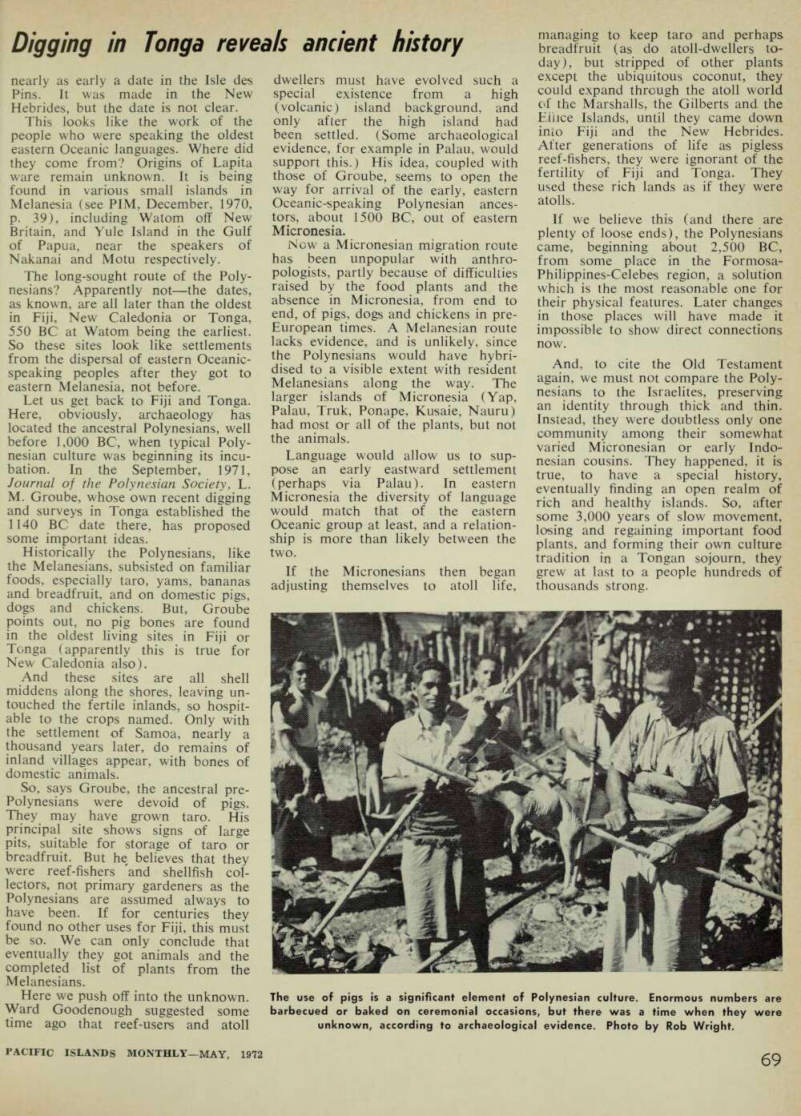
The use of pigs is a significant element of Polynesian culture. Enormous numbers are barbecued or baked on ceremonial occasions, but there was a time when they were unknown, according to archaeological evidence. Photo by Rob Wright.