Fiji Revisited-A Quick Audit
pp. 62-66 · Read in the full issue

Of The New Management
Sophistication! That’s it. 1 had been in Suva for only a few hours and I’d been searching for a first impression. You’ve got to have one of those when you come back to a place. Friendliness? Yes, there was that, although some of the “belongers”
I talked to about impressions had only gloom to impart. “The place has gone down, not half. There’s no friendliness here anymore. Look at the shops.”
I’d already looked. “They don’t smile when they serve you now, and down at Government Buildings it’s worse. When you get them to open their eyes, they don’t seem to want to talk to you.” That ruled out friendliness as a first impression, but maybe that “belonger” had a hang over.
I know I had—from Sydney with its surly shop assistants and post office workers, not to mention the bank chaps. In comparison, the Suva folk, Fijians, Indians, part-Euro peans, Europeans, the whole polyglot, were positively, overwhelmingly friendly. No, the image the tourist has enthused about was still there.
But that wasn’t the first impression.
It dawned on me after 24 hours, a sort of reaction to the bunglings of the hotel waiter who brought me coffee instead of tea, pineapple juice instead of grapefruit juice. They’ve always been bungling, but as the travel writers always say, “They send you up the wall with their bungling but smilingly, so you don’t mind”.
I didn’t either.
I did catch that first impression.
Sophistication. Not a lot, but definitely some. Suva, at least, looks a little more sophisticated and its people have a newly-acquired air of being somebody, going somewhere. No doubt independence did that—the first stirrings of nationhood.
Maybe it’s tourism, which is ex ploding; 38 per cent, increase in visitors last year and more big leaps forward expected. “Wait till the Japanese start to pour in, any time now,” I was told. So many tourists from so many sophisticated places.
It’s bound to rub off.
What else did I find? A week isn’t a long time in which to find anything but there were some things to be seen very clearly, easily. It might have been the lingering impression of an
Formerly on The Fiji Times editorial staff for nearly nine years, PlM’s assistant editor John Carter returned for a short visit in March after more than two years absence. In that two years, Fiji has become indepen dent. What changes has that brought? Here he records his impressions.
untidy Sydney—the Sydneyite is an untidy, polluting creature who thinks a wastepaper basket is a waste and should be used for something else.
Compared with Sydney, Suva has become a clean city; there are newer and bigger waste baskets about with their exhortation to “Keep Suva beautiful’’. The locals say the place is filthy, a disgrace and that’s why they passed a law only a few weeks ago to fine litter-bugs. I don’t care. I still think it’s a darned sight cleaner than any other city.
It looks a bit tatty in parts, of course. The Indian shopping area always has looked tatty and it hasn’t altered, though some of the ever present Lutu Sobu (sale) banners looked a bit cleaner. There’s been
little new building in the city over the last two years, and apart from Williams and Gosling’s new five storey block, a new hotel going up on Gordon Street, two new club houses, the Union and the United, there’s nothing new.
Which doesn’t mean the place is slipping. There’s no room to build.
The big estate boys would put up dozens of multi-storeyed mushrooms, given the land, which has zoomed in price to the highest ceiling in the South Pacific outside Australia. The condition of the city streets is lousy, there’s no other impolite word for it.
There are potholes all over the place and little of the top sealing remains on many streets.
Why? Some shrug. They don’t know why. Maybe it’s because the council hasn’t enough money. Maybe there’s no interest. Maybe with a one to 15 ratio—one doing the job and 15 looking on—repairs cost too much.
But the streets are bad, and some tourists are going to notice them.
There was a report in The Fiji Times the other day about protests over noise coming from a guesthouse in Amy Street, Toorak. Guesthouse!
When I first arrived in Fiji nearly 12 years ago guesthouses were guest-
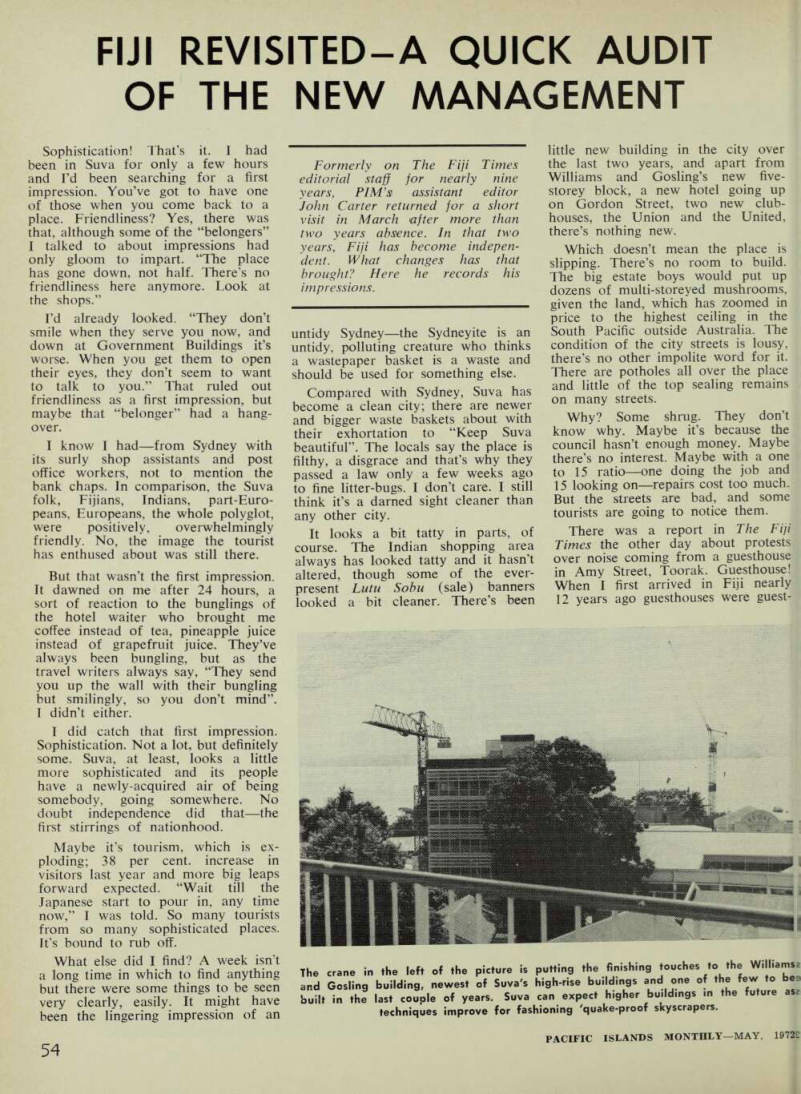
The crane in the left of the picture is putting the finishing touches to the Williams and Gosling building, newest of Suva's high-rise buildings and one of the future be built in the last couple of years. Suva can expect higher buildings in the future as techniques improve for fashioning 'quake-proof skyscrapers.
houses, unliquored places where the tariff was well below the hotel prices, and standards more so.
Today, “guesthouse” can be a euphemism for a plain, dishonest-to goodness brothel and my, how they’ve proliferated in the last two years. I daresay two years ago there were two, maybe three in Suva. I didn’t make the rounds. You can’t do much in a week, but I’m told there are now dozens and some even have a red light outside.
And, it’s becoming a serious busi ness. Once it was an operation limited to a few good-time girls, more enthusiastically amateurish than prac titioners of professional prostitution.
Today, according to some responsible Suva citizens who know the score on most things, there’s a real danger of a Mafia-type of operation developing.
And pot! Yes, there’s pot, but the clampdown on this has been pretty severe, with several successful pro secutions and nowhere is it out of hand, though there are those who’ll tell you they know who can get you some grass any time you want it.
Some of the old Indian farmers have grown it for years, in the days when people thought Indian hemp was the stuff convicts sewed mailbags with.
But, there seems to be little evidence of the presence or use of hard drugs in the country.
Prices? Yes, they’ve all risen. One dish in a restaurant which used to 'ost me 70c is now $1.50, but there ire still many articles on sale which, lespite having to be shipped into the fface, are cheaper than in, say Sydney, and certainly cheaper than n some of the other Island ter itories. On the other hand of course, vages have also risen but not at as ast a rate, and there seems to be [Uite a gap between wage rises and he upward spiral of the cost of living ndex.
But you can’t lay all the blame at ndependence’s door. Fiji is parti ularly vulnerable to economic tresses. As an archipelago, the rise f world freight rates (and there’ve een a lot lately), wage rises over 2as, in fact anything which sends ving costs up in other countries, reduces echoes in Fiji pockets.
The other week' The Fiji Times arned a story of a “sharp increase i house rents”, an increase of 10 Dints on the index in the last six tenths. That has been a continuing ory for the last two years and some f that can be blamed on indepen- J nce, although the trend had begun st before I left at ’69’s end. With dependence came the diplomatic issions with almost bottomless irses. They wanted houses, the
executive type, and they didn’t care what they paid.
My house a few miles outside Suva cost me a mere $6O a month—there was a bit of grace and favour about the thing. Today, four times that amount wouldn’t cover it. In the early part of 1970, a good executive type of house was rented at between $6OO and $BOO a year. The price today is at least $3,200 a year. The same goes for flats.
With that kind of money around, little wonder that the impact carries into other spheres, the retail trade, entertainment, transport and the rest.
It even reflects itself in the much greater number of squatters around the city. Squatters were a problem before independence. They’re a bigger headache today. It works this way.
As the diplomats and big business executives flocked into the erstwhile
colony and took over the best houses, the sitting tenants had to move out.
They were outbid. So, they moved into the house on the next level, and adhering to the creed “Do as you’ve been done”, offered a higher rent.
That meant another move by an outbid tenant and, like big fleas and lesser fleas, on almost ad infinitum, down to the lowliest who found him self left with nothing but the chance to squat on open land, often times illegally. In spite of a government housing scheme which hasn’t its equal in the other Islands, Viti Levu today has more squatters than ever before.
In one area, ironically on the edge of the Raiwaqa low-cost housing estate, there are 400 families living in very much sub-standard dwellings, which is a polite way of saying they are in hovels, and they have no
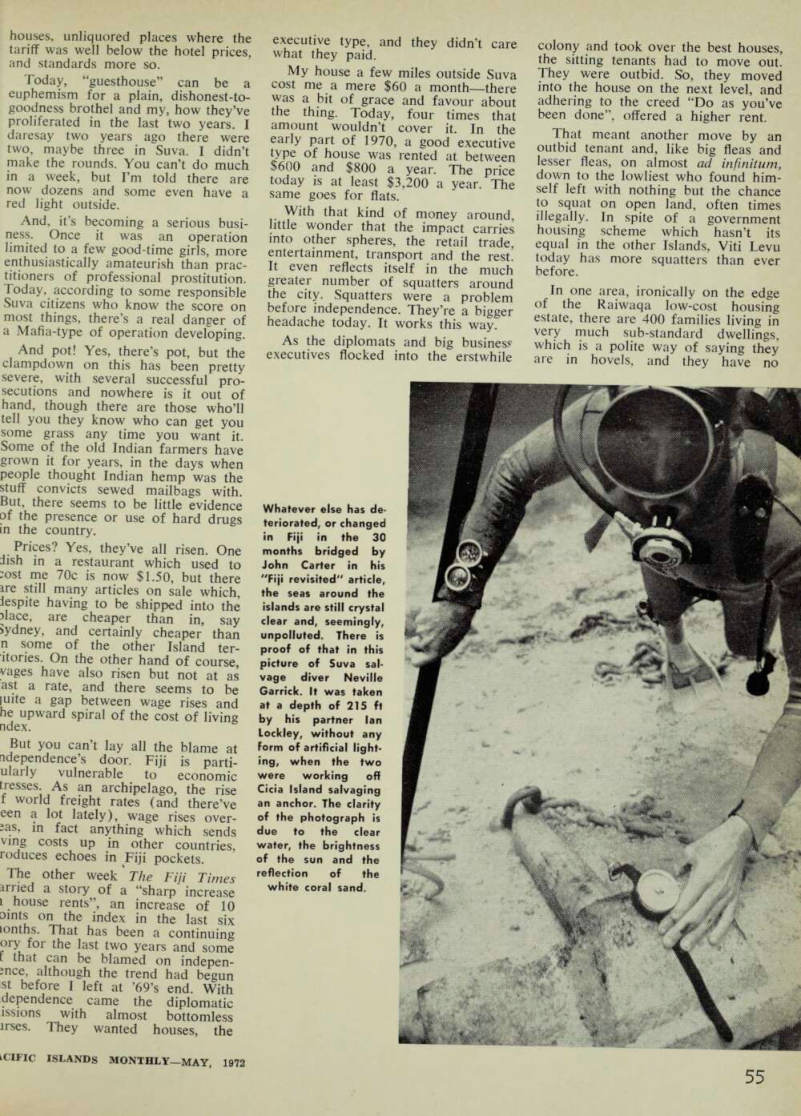
Whatever else has de teriorated, or changed in Fiji in the 30 months bridged by John Carter in his "Fiji revisited" article, the seas around the islands are still crystal clear and, seemingly, unpolluted. There is proof of that in this picture of Suva sal vage diver Neville Garrick. It was taken at a depth of 215 ft by his partner lan Lockley, without any form of artificial light ing, when the two were working off Cicia Island salvaging an anchor. The clarity of the photograph is due to the clear water, the brightness of the sun and the reflection of the white coral sand.
sanitary services of any kind. Now Fiji, and Suva City Council in parti cular, have always striven to get rid of the shack-dweller. In the past there was always a determined “no” to any suggestion of lowering housing standards. Today, it seems, it’s a losing battle. 6 There’s no doubt living standards have risen in the last two years. The only barefooted pedestrians I saw, in the main that is, were tourists from countries where barefeet don’t reflect the economic position of the shoeless one. In few Island places are the people better dressed than in Fiji, and in Suva the untidy individual slouching along Cumming Street is as likely as not to be a tourist and not a local.
There are more wheels in Suva han ever before. This year the lumber of new cars imported will be above the two thousand figure, "ars reflect economic standards, and oday few of the gentry working in government buildings travel by bus )r “shanks’ pony”. Most have cars >ought with loans which a generous lovernment is handing out. In 1969 he people of Fiji paid $1,820,876 o bring 1,405 cars into the country, n 1970 those figures had risen to 2,531,651 and 1,907.
The rise in living standards, specially of the civil servant, has fen quite spectacular, but there’s a loomy side to it. The sudden cquisition of wealth, with in some Promotion bringing another 2,000 a year, has resulted, so I’m )Jd, m some reckless spending. “But hat the hell,” some say, “it makes ie money circulate.”
Talking about governmental merosity, some people in the busi « c ommuni.y fear the government ight be heading for a little financial rcss through handing out so much subsidies to the rural communities.
The idea, say these businessmen, to prove to the people that Fiji a much better place under a neficent government of their own ople and choosing than it ever was ider colonial rule. It could be, of urse, that the government, which s lacked the support of a large :tion of the farming community, using its moneybags to conjure up little support in that sector.
There must be many changes, some od, some bad, some subtle, some tnng, when a country takes up the ns of its own government. I saw tew, I missed plenty I’ve no doubt, t I tried to pump some of the als for impressions. There was a narkable consensus about the effect the change on the civil service and the people in the service industries, a as the ones I talked to were of
all races they couldn’t be accused of fk- r t , This is what I learned. The H° f f th ?i I CIVI I s £ l 7 lce . has dete no rated at all levels. There is a n r° a H n on't°nT government buildrnnnWt iV I de ™ 0 ? 1( ?r S ’ coupled with a lack of a spirit of disciplme. Time-keeping is bad but, say i^L yOU K g , et the /;i il servant in the lower echelons and the worker m commerce to go by the bOSSCS arC S ° Care ‘ less over time-keeping.
I confess Ididnt twigg any of it.
Government buildings, especially in
the new wing, were quiet. It could have been the quiet of deep sleep or the quiet of an industrious battery of workers though one man told me that if I had looked into some of the offices I would have found rows
of clerks, doing nothing industriously
a J? d u Pat l ent l y 7 aitl ? g for 4,30 pm> Maybe he had a hangover as well, but thats what he said. One thing I can vouch for. I asked the Goveminent Statisticians Department for some facts and figures and got them m about three minutes flat. Try to do tha. ,n Syndey!
One businessman, long resident in Fiji came down heavily on the side of those critical of the way things ar “Th^ hat T r V a- • r There is a lack of discipline, of public discipline and a considerable Sit e v m ?H° thC sense , of responsibihty an d a sense of obligation among the people as a whole. This
is evident in government and com mercial circles. Courtesy, helpfulness and efficiency have all dwindled courtesy almost to the point of dis appearance. Instead of a spirit of co-operation and unity one would expect to find in a People newly independent, there is disunity, a malaise which has spread almost entirel y throu Z h the community, and it’s not the work of any party pro pagandists ” P y P He pointed the fin § er the Medical Department and the long queues in the outpatients’ departments and. sadly, at the Police Force “its image is deplorable,” he said, Well. 1 looked around the city and watched the law at work, or going about its work. I saw a batch of traffic violations including ignoring “red” stop lights, but no one booked them. They might have booked themselves. They were police con stables.
One funny thing I did see—a squad of police motor cyclists roaring along Victoria Parade. Behind them was a police Landrover packed with uniformed policemen. They were doing about 45 mph wh J e were they going? Somebody said they weren’t going anywhere. The noisy column, red warning lights showing at the front ’ was in traini ng, working to a pattern provided by a gentleman from the Hawaii police, in Fiji to train the motor patrol section. No sirens shrieked. They’ll probably come later. I’ve no doubt that in
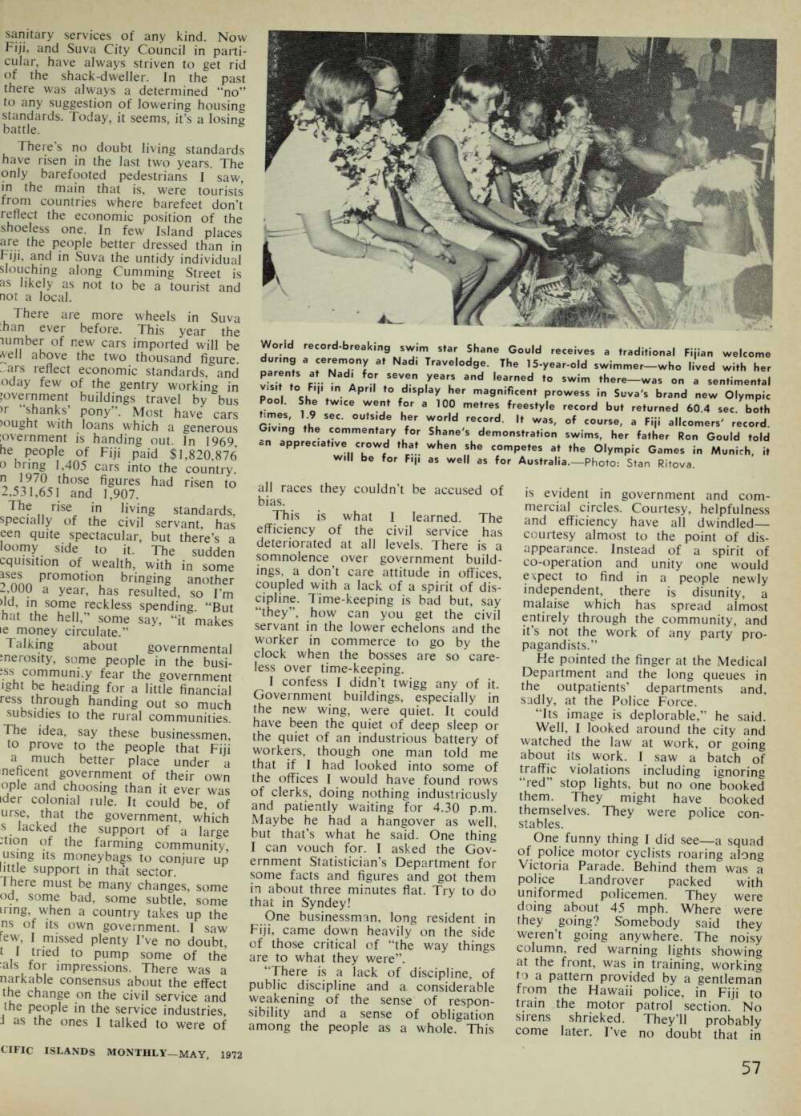
World record-breaking swim star Shane Goold receives a traditional Fijian welcome during a ceremony at Nadi Travelodge. The 15-year-old swimmer-who lived with her parents at Nadi for seven years and learned to swim there-was on a sentimental visit to Fiji in April to display her magnificent prowess in Suva's brand new Olympic Pool. She twice went for a 100 metres freestyle record but returned 60.4 sec both time s, 1.9 sec. outside her word rec l ord. It was , of a Fiji allcomers' record.
Giving the commentary for Shane's demonstration swims, her father Ron Gould told an appreciative crowd that when she competes at the Olympic Games in Munich, it Will be for Fill as well as for Australia.—Photo: Stan Ritova.
Closer to people
time Fiji will become famous for its police motorcade.
There’s a lot on the debit side, but I think much of it is just human nature; that it’ll straighten out in time and that, when the going gets tough, as it will, Fiji’s people will prove equal to it. There’s a lot of hard work being done, mostly by the Indians, and any drop in efficiency standards in the civil service can be blamed on the rapidity of localisa tion—much too rapid, say some local civil servants. It will find its own level again.
One shining spot was uncovered for me. I found that there is much a closer relationship between the government and the people. In the old days, “they” said, there was an artificial barrier between the ex patriate civil service and the people, because the former would insist on going through the old colonial pro cedure of passing the buck.
Files would pass from one officer to another and there would ac cumulate from a variety of sources opinions galore, so that, when a decision was made there was no one man to blame if things went wrong.
Today, all that has gone. Perhaps
they don’t care who’s to blame, but at any rate urgent matters—except perhaps clangers dropped by Immigration—are very quickly dealt with.
Red tape is cut, and very often if things seem too desperate, the minister concerned will step in and tackle the job himself.
There is a willingness to tell the people the score, and now the government is giving the people an ombudsman—a silly Scandinavian word—(why not People’s Champion?) with the job of taking the bureaucrat off the people’s back if need be.
No, there’s not a lot sadly wrong
with Fiji. Governments are often wrong, the world over and people are people everywhere. There are the arrogant from the North Pole to the South and professional toe-steppers abound. Fiji has its share of the good and the bad, but it s still one of the good places of the world, The sun still shines, and along Victoria Parade m Suva the mim skirts still pass, along with some of the best shaped limbs m the South Pacific. Thank heavens I didn t see one maxi-skirt—there is something to be said for the high humidity after all.
Former Australian middleweight cham pion Dick Blair shoots wide with a right as
Fiji light-heavyweight
champion Sunia Cama covers well in their recent 10-round con test in Suva. Cama won easily on points.