Fight For Independent
pp. 57-59 · Read in the full issue
Broadcasting In Png
• A controversy is developing in PNG about the control of broadcasting in the future. Here Percy Chatterton, who has been very close to the situation for a long time, argues for a compromise, and what s more important, for a decision soon.
From PERCY CHATTERTON, in Port Moresby
The first attempt to provide a broadcasting service for Papua New Guinea was made by AWA (Amalga mated Wireless Australasia Ltd.) in the 19305, when a small broadcasting station, 4PM, was established in Port Moresby. Technically, I suppose, it was a commercial station, though I cannot recall that it ever carried any advertising. At that time radio re ceivers were cumbrous and expensive, and it may safely be assumed that 4PM’s listening audience was almost exclusively expatriate. The station suspended operations at the outbreak of the Pacific war.
During the period 1942-46, ANGAU, the military administration which replaced civil government in Papua New Guinea for the duration of the war, inaugurated an embryo broadcasting service, mainly con cerned with disseminating informa tion, advice and instructions to the populace at large. Involved in this service were Dick Humphries and Maynard Lock, both subsequently victims of the Mount Lamington disaster, and Geoff Baskett, happily ‘till among us and still involved in broadcasting.
In 1946 the provisional Civil Ad ninistration took over this service n a caretaker capacity, pending the dready-expected arrival on the scene )f the Australian Broadcasting Com nission.
Early ABC programming was timed mainly at the expatriate sector, )ut a period of U hours was allotted ach afternoon and early evening to was called “the Native People’s icssion . This session was prepared nd presented by officers of the department of Education, and was Resigned to be informative and educa te as well as entertaining.
Under the direction of Peter Living ton, also still among us, it achieved icse aims with a good deal of suc ess; indeed, on the mission station f which I was then in charge, the rogrammes were eagerly listened to. erhaps this was in part due to the ict that an “old boy” of our mission mool was one of the announcers and
occasionally gave us a short burst in our local language, Roro.
Other vernaculars, in addition to the lingua franca, English, Motu, and Pidgin, were also used in these programmes. Which vernaculars were used depended on the availability of announcers who could speak them, rather than on their importance or range.
Unfortunately in those pre transistor days the only radio re ceivers available to most indigenous listeners were those provided by the Department of Education, the missions and similar organisations, and the servicing and battery upkeep of these receivers presented consider able problems.
In the late 1950 s and early 1960 s administration participation in the preparation and presentation of broad casts was progressively phased out.
The ABC assumed full responsibility for the programmes broadcast from its stations, and initiated a policy of
integration, as a result of which the Native People’s Session disappeared as a separate entity.
The commission’s aim has been to present a range of programmes de signed to appeal as far as possible to all sections of the listening public, irrespective of race. In the meantime the introduction of transistor radios, which became progressively cheaper as time went on, substantially ex panded the listening public. More and more Papuans and New Guineans were able to have their own radios.
Early in the 1960 s the administra tion, perhaps resenting its exclusion from direct participation in ABC pro grammes, decided to establish its own broadcasting network. Its first station was established at Rabaul in 1961, and subsequently stations were opened in other districts. There are now 10 of these administration radio stations, and the aim is to have one in each of Papua New Guinea’s 18 districts.
These stations are run in a very simple and informal way, amusingly reminiscent of the AWA set-up of the 19305, from the studio of which I occasionally broadcast.
As the administration network has
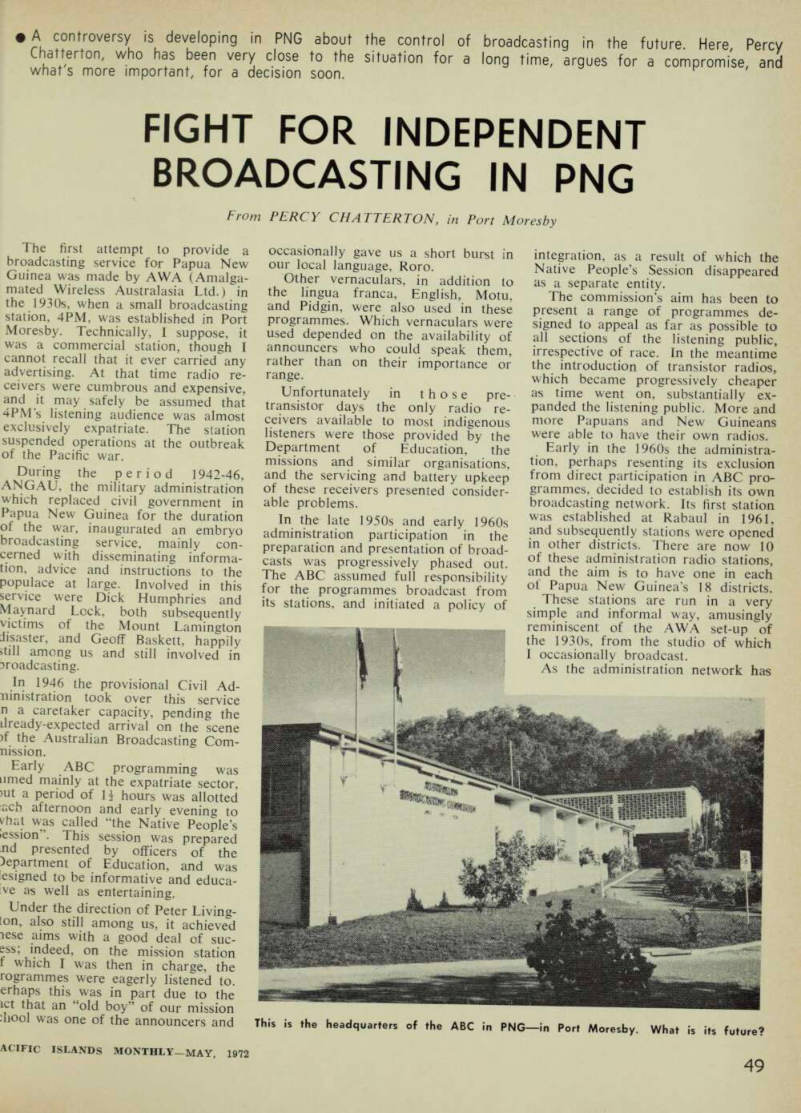
This is the headquarters of the ABC in PNG—in Port Moresby. What is its future?
developed, a trend, if not a specific policy, has emerged in the operation of the two networks. The ABC has concentrated on programmes of nationwide appeal, aimed mainly at the more sophisticated sector of the community, brown and white, and has confined its broadcasts to the three official languages English, Motu and Pidgin.
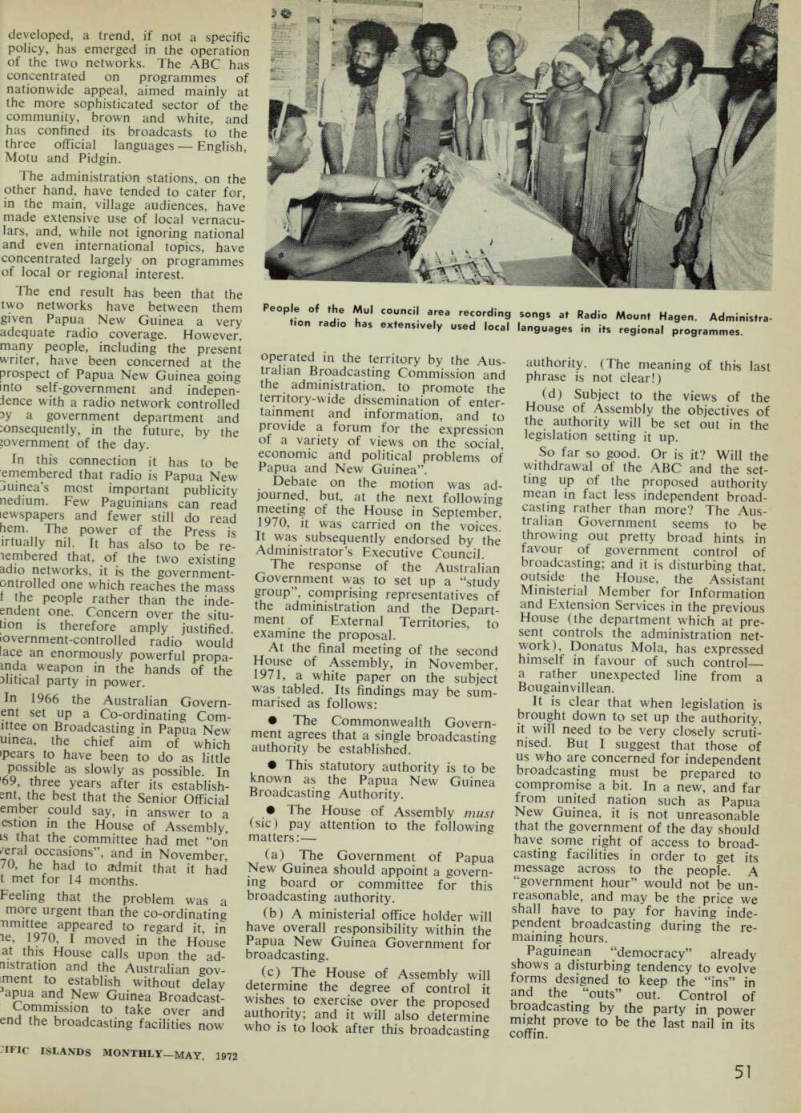
The administration stations, on the other hand, have tended to cater for, in the main, village audiences, have made extensive use of local vernacu lars, and, while not ignoring national and even international topics, have concentrated largely on programmes of local or regional interest.
The end result has been that the two networks have between them given Papua New Guinea a very adequate radio coverage. However, many people, including the present writer, have been concerned at the prospect of Papua New Guinea going into self-government and indepen dence with a radio network controlled 3y a government department and consequently, in the future, by the government of the day.
In this connection it has to be Remembered that radio is Papua New Guinea’s most important publicity nedium. Few Paguinians can read lewspapers and fewer still do read hem. The power of the Press is irtually nil. It has also to be re lembered that, of the two existing adio networks, it is the government ontrolled one which reaches the mass f the people rather than the inde endent one. Concern over the situ fi°n is therefore amply justified, rovernment-controlled radio would lace an enormously powerful propa mda weapon in the hands of the ahtical party in power.
In 1966 the Australian Govern ent set up a Co-ordinating Com ittee on Broadcasting in Papua New uinea, the chief aim of which •pears to have been to do as little possible as slowly as possible. In '69, three years after its establish ed, the best that the Senior Official ember could say, in answer to a estion in the House of Assembly, is that the committee had met “on /eral occasions”, and in November, 70, he had to admit that it had t met for 14 months.
Feeling that the problem was a more urgent than the co-ordinating nmittee appeared to regard it, in ie, 1970, I moved in the House at this House calls upon the ad ustration and the Australian gov ment to establish without delay apua and New Guinea Broadcast- Commission to take over and end the broadcasting facilities now
operated in the territory by the Aus tralian Broadcasting Commission and the administration, to promote the temtory-wide dissemination of enter tainment and information, and to provide a forum for the expression of a variety of views on the social, economic and political problems of Papua and New Guinea”.
Debate on the motion was ad journed, but, at the next following meeting of the House in September, 1970, it was carried on the voices It was subsequently endorsed by the Administrator’s Executive Council.
The response of the Australian Government was to set up a “study group”, comprising representatives of the administration and the Depart ment of External Territories, to examine the proposal.
At the final meeting of the second House of Assembly, in November, 1971, a white paper on the subject was tabled. Its findings may be sum marised as follows: • The Commonwealth Govern ment agrees that a single broadcasting authority be established, • This statutory authority is to be known as the Papua New Guinea
Broadcasting Authority.
• The House of Assembly must (sic) pay attention to the following matters:— (a) The Government of Papua New Guinea should appoint a govern ing board or committee for this
broadcasting authority.
(b) A ministerial office holder will have overall responsibility within the Papua New Guinea Government for
broadcasting.
(c) The House of Assembly will determine the degree of control it wishes to exercise over the proposed authority; and it will also determine who is to look after this broadcasting
authority. (The meaning of this last phrase is not clear!) (d) Subject to the views of the House of Assembly the objectives of the authority will be set out in the legislation setting it up.
So far so good. Or is it? Will the withdrawal of the ABC and the set ting up of the proposed authority mean in fact less independent broad casting rather than more? The Aus tralian Government seems to be throwing out pretty broad hints in favour of government control of broadcasting; and it is disturbing that, outside the House, the Assistant Ministerial Member for Information and Extension Services in the previous House (the department which at pre sent controls the administration net work), Donatus Mola, has expressed himself in favour of such control a rather unexpected line from a Bougainvillean.
It is clear that when legislation is brought down to set up the authority, it will need to be very closely scruti nised. But I suggest that those of us who are concerned for independent broadcasting must be prepared to compromise a bit. In a new, and far from united nation such as Papua New Guinea, it is not unreasonable that the government of the day should have some right of access to broad casting facilities in order to get its message across to the people. A “government hour” would not be un reasonable, and may be the price we shall have to pay for having inde pendent broadcasting during the re maining hours.
Paguinean “democracy” already shows a disturbing tendency to evolve forms designed to keep the “ins” in and the “outs” out. Control of broadcasting by the party in power might prove to be the last nail in its coffin.
People of the Mul council area recording songs at Radio Mount Hagen. Administra tion radio has extensively used local languages in its regional programmes.