keep in step?
pp. 54-55 · Read in the full issue
Can Islands' sportsmen keep in step?
By Mike Hohensee
The sporting seasons should be standardised throughout the South Pacific, says Maurice Garbutt in a recent letter to PIM. Mr. Garbutt, president of the Gilbert and Ellice Islands Amateur Sports Association, believes the sporting calendars of the islands should coincide, so that everyone is playing the same sport at the same time of the year.
He writes: “From exchanges with officials (at the South Pacific Games) of other territories we have obtained information about their sporting calendars and for the most part there is no cohesive organisation of seasons.
Each body goes its own way and it is only the stimulus of the Games that brings them together. In a number of cases it is only in the Games year that any semblance of effort or
orgamsation appears.’’
That is very true. I said much the same thing in this column a few months ago with regard to the attitude of Games competitors. But what is the object of Mr. Garbutts recommendation? He explains: The: GEIC proposed at the Games Council that a greater effort be made bv territories to Standardise on seasons in order that to standardise on seasons in oroer mai competitive exchanges can be planned While all of them were active in a oarticular snort ”
P . P , r . .. f .
In other words, Mr Garbutt feels that common seasons would encourage inter-island competition at a time convenient to all concerned. In addition, such pre-planning would not dismpt the workings of individual associations and the training and
playing programmes of their mem bers.
The timing of the South Pacific Games is important. Some Island sports associations, especially those governing athletics, are obliged to re arrange their training schedules, and j n som e cases their championships, so that peak performances can be timed to coincide with the Games.
In theory, Mr. Garbutt’s proposal is an excellent one but I feel it would be a i most impossible to put it into practice. It is true to say each territory “ goes j ts own wa y”, but they do so oat G f necessity. They do not make a conscious effort to ignore their neigh hours nor do they wish to undermine attempts to stage international com petition. . . . . ■. ,
enough to even’d with'intemally be
fore th can consider aligning them seives w j t h other associations which m bave a completely different con cep{ S p G rts administration and organisation based on local conditions. s>ome extern iuc ummg of the sporting seasons may have been influenced by the expatriate, nurtured . if r t Himes who feels that bv m ditterent climes, wno reeis mai oy very definition cricket wouldn’t be cricket unless it were played at the opposite end of the year to football. ... r , But it is the availability of grounds and the climate which ultimately de cide who shall play where, and when.
If cricket must share the same venue as rugby because of the lack of pitches, their seasons must be sepa
rated—and there’s not much anyone can do about that!
The Islands do rally round the flag in Games years and they make the necessary sacrifices and adjustments to be represented. After all, they have years in which to prepare themselves, But it doesn’t follow they can con veniently stick to these arrangements year by year without causing havoc within their own s P ortin g set ’ u P- There is much to be gained by the territories getting together to discuss the subject, or alternatively, exchang ing information regarding their seasons. They may be pleasantly sur prised at the outcome, for I feel sure few could, with any certainty, name those territories which have begun their rugby and soccer seasons in re cent weeks.
And if anyone anticipates holding South Pacific Championships or inter island competitions, he should have this sort of information at his finger
tips.
Ideally, there should be a South P acific association for each sport, and . T rannot envisage until that happens 1 cannot envisag the free exchange of ideas or the machinery to implement them. The ««~»rtnnitv in most instances only opportunity, m most instances, for Island delegates to get their heads together is at the council and techm cal meetings held during Games time, , hr the F 1 1 ?. ce ... T „ teams or block. To send individuals acmss the S Pacific costs money, tions have the resources to do
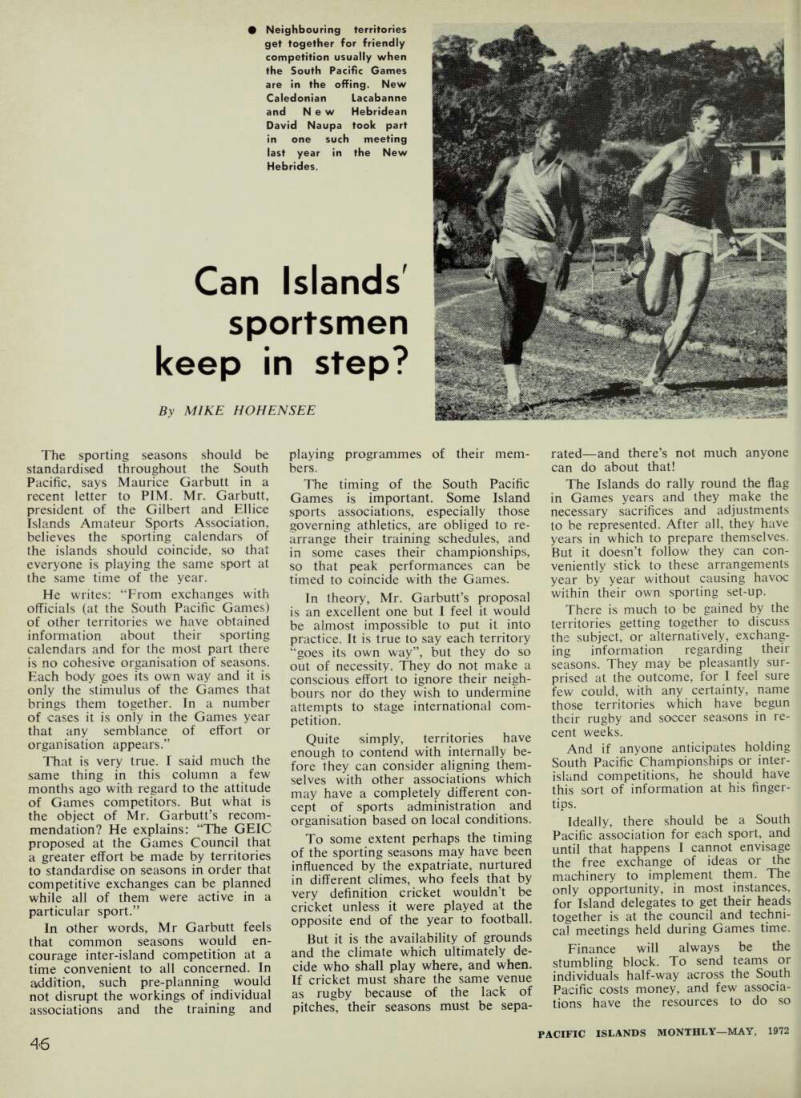
Neighbouring territories get together for friendly competition usually when the South Pacific Games are in the offing. New Caledonian Lacabanne and New Hebridean David Naupa took part in one such meeting last year in the New Hebrides.
without appealing to the public or government for help. Over the years there has been a growing resentment at the vast amounts needed to send teams to the Games. Some Island associations are still paying off their bills.
There is a case for immediate neighbours with common interests coming closer together. Their over heads would be much lower. Mr.
Garbutt’s association has already seen the possibilities.
Says Mr. Garbutt: “At the council meeting we also proposed that South Pacific Championships be introduced and that there be an exchange of in vitations for territories to send teams in international matches. Out of this have come the Fiji Amateur Athletics Association agreeing to hold an In vitational Marathon in July and the Rarotonga AAA organising an athletics meeting for August.
“In addition, the Nauruan AAA held an Invitational Marathon championship in December. This was arranged as some form of com pensation for not being able to attend the Tahiti Games.
“The event was an organisational triumph and a credit to the NAAA.
Mile times were available for the seven competitors and each runner was supported by a radio-controlled Landrover. The marathon was won by Robbie Morgan-Morris of Nauru.
“This was the third time the GEIC and Nauru have met in sporting events since October, 1970, and plans are in land for 1972 exchanges.”
From all accounts the Gilberts have in active sports association. Since last Jctober, says Mr. Garbutt, they have leld a successful cricket league on larawa and a ladies’ volleyball team lew to Abemama in November for m inter-island meeting.
“We are into the football season other islands take note) and for hose who feel so inclined a road unnmg season as a build-up for the dji and Cook Islands’ invitations.
“We have invited all the colony’s dands to send a representative to arawa for the Queen’s Birthday thletics meeting—in particular the larathon. From this meeting we will ffect the team to travel to Fiji and opefully, the Cook Islands,” says lr. Garbutt.
“Each of the islands in the colony as some form of sporting activity nd we are gradually extending the ancept of organised sport. In the ast most effort has been extended to arawa. We see the project being >read over 5-10 years before the alony association is truly a colony jsociation. However, events like the ueens Birthday marathon will aid > in this direction.”