Footnotes
pp. 51-53 · Read in the full issue

VI/'HEN is a cargo cult not a cargo cult? This is a question which Papua New Guinea’s third House of Assembly may be called on to answer.
On the one hand, Matias Yaliwan, leader of the Mount Turu cargo cult, and more recently of the Peli Association which has grown out of it, has been elected as member of the House of Assembly for one of the Sepik District electo rates, and apparently envisages himself as about to be acclaimed Papua New Guinea’s national leader.
On the other, Pangu Party members from the Sepik District have announced their intention of promoting legislation to outlaw cargo cults.
If they succeed, a legal definition of “cargo cult” will have to be devised, and this should give the lawyers a few headaches.
How do we get the things we want? By know-how, by ritual, or by a bit of both?
Undoubtedly Papua New Guinea’s traditional answer was, “A bit of both”.
In the part of Papua which I know best, the cultivation of yams was surrounded by ritual (magical or religious, according to how you define these words).
But no Papuan woman was so foolish as to suppose that she could get a good crop merely by observ ing the appropriate rituals. She knew that she had to contribute
her own know-how, learned from her mother, aunt or grandmother, to achieve success. The bumper crop, when it came along, was in her estimation due in part to her own know-how, and in part to rituals faithfully observed and accurately performed. Both were, in her think ing, essential to success.
If she had known of them, she would have thoroughly approved of such sayings as “Trust in God and keep your powder dry” and “God helps those who help themselves”.
We of the west have largely abandoned, [hpugh only recently and still not completely, our aith in the effectiveness of ritual, and tend to
Headaches
Ahead For
The Lawyers?
regard our success as the product of our know how alone.
The cargo cultists are at the opposite end of the scale. They seek to secure success and affluence by ritual alone generally the white man’s affluence, though not always. At the height of the Mount Turu cult, its leaders were variously promising their followers the white man’s “cargo” on the one hand, and greater success in garden ing and hunting on the other. And although in this case the prescribed ritual the removal of concrete survey markers from a mountain top
and their manhandling down the mountain side—did involve a con siderable amount of hard work, it was from the ritual, not from the hard work, that results were expected.
To devise a definition of cargo cult which has no ragged edges will be very difficult indeed.
On the one hand, cargo cults shade off into confidence tricks.
In a recent episode in the High lands, villagers were induced to
part with varying sums of money, in some cases as much as $5O, in exchange for boxes of stones, which were to be buried in the ground and which, when dug up on a date to be fixed, would be found to be full of money. When the ordained day arrived, they were dug up and found to be, as before, full of stones. In the meantime the organisers of this jape had taken off for destina tions unknown. Apparently they had no confi dence in their own “cult”.
Although this incident was described by the news media as a cargo cult, it was clearly nothing of the kind. It was just a confidence trick, and, when the law caught up with some of its perpetra
With Percy Chatterton
in Port Moresby
tors, they were very properly gaoled for obtain ing money by false pretences.
But in other cases the organisers appear really to believe in the bizarre creeds they teach, and often only benefit from them in terms of imponderables like prestige and power. To have obtained the respect and even the veneration of one’s fellow men and women can hardly be made a legal offence. On the disciples’ side, the neglect of food gardens under the erroneous belief that gifts of food and other “cargo” from the ancestors are about to arrive in planes, ships or trucks, while it may be condemned as foolish, can hardly be as criminal.
If on one flank cargo cultism shades off into confidence trickery, on its other flank it shades off into religion.
I have suggested that what distinguishes the cults from both traditional Paguinean religion and introduced Christianity is that, while both the latter accept St. James’ dictum that “faith without works is dead”, the cultists believe in the efficacy of ritual alone, any “works” involved being incidental to the performance of the ritual rather than vital to the success of the exercise.
But a definition of this kind might easily catch in its net some marginal Christian sects whose watchword is “by faith alone”. And then the fat would be in the fire. Banner headlines would break out in American magazines: “Papua New Guinea Suppresses Freedom of Religion”.
If legislation is to be prepared to outlaw -argo cults, I d just hate to be the legal draftsman vho has to prepare it.
There is, however, a closely related field in vhich some sort of legal control might be not )nly possible but desirable. I refer to the control )f fund raising. At present there is nothing to )revent a single person or a group of people ;omg around collecting money from the enthu mstic or the gullible. There is nothing to prevent i group of people forming themselves into some nnd of association or society with ill-defined aims
Tid objects, quite inadequate organisation, and
hen enrolling members and collecting subscrip
ions. Sometimes these associations grow out to a argo cult and have vaguely economic aims, as i the case of the Peli Association.
Sometimes they have a more political slant, s in the case of the Mataungan Association.
Jany Paguineans seem to like joining and sub siding to organisations of this kind, even though icy sometimes have little idea of their aims or f what their money is going to be spent on. In ome cases those who are responsible for raising nd disbursing these funds are completely honest; i others perhaps less so. But even in cases where
there is no actual dishonesty, it is often very difficult, due to inexpert and happy-go-lucky accountancy, to find out at a later date just how much money has been collected and what has happened to it. In my missionary days I frequently ran into problems of this kind with village church funds.
Legislation providing that any organisation collecting contributions or subscriptions must be registered, must have clearly defined aims and objects, and must keep such minimal records as will make it possible to find out at a latter date how much money has been received and what has happened to it, would not be unreason able, I think, and would serve to restrain racket eering.
Exceptions might have to be made, perhaps, in cases such as that of members of a kinship group “dobbing in” to buy a communal truck—though even in such cases a bit of elementary book-keeping might help to prevent the strife which all too frequently stems from such opera tions.
At least an approach such as this might be better than the very tricky business of trying to “outlaw cargo cults”.
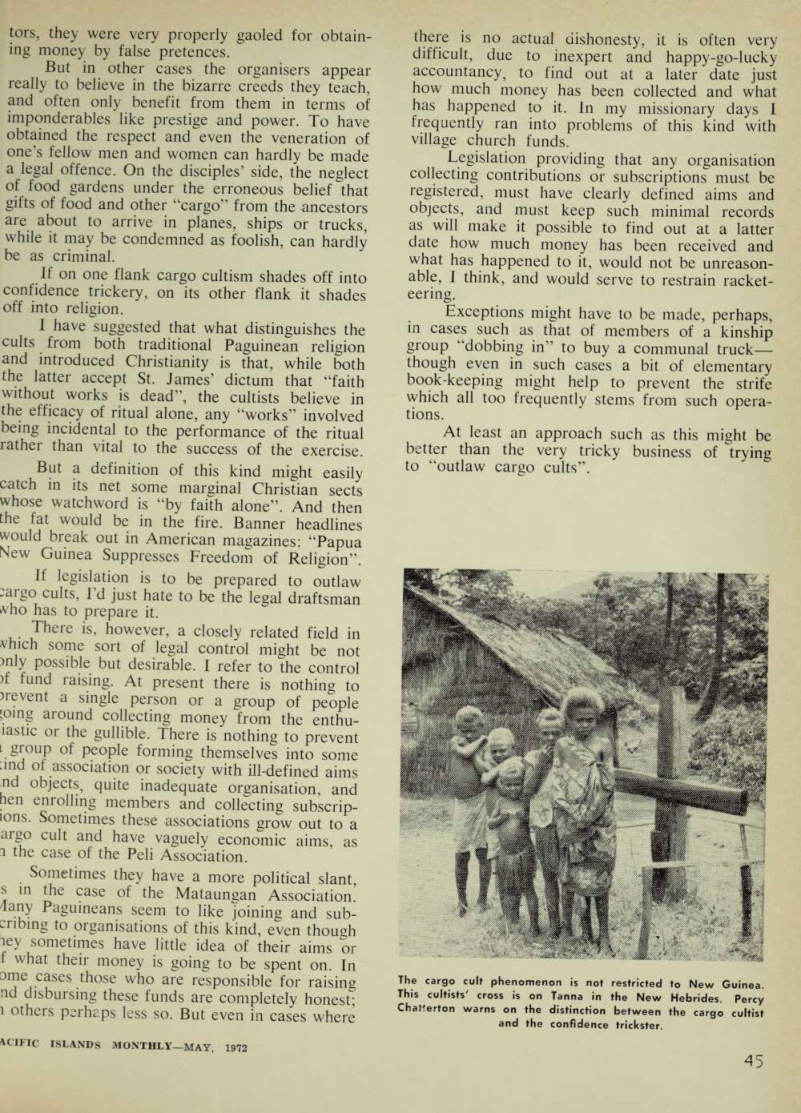
The cargo cult phenomenon is not restricted to New Guinea.
This cultists' cross is on Tanna in the New Hebrides. Percy Chatterton warns on the distinction between the cargo cultist and the confidence trickster.