"Tauloto" Bears A Burden
pp. 79-80 · Read in the full issue
• "Who rules the waves, rules Tonga", King Taufa'ahau Tupou IV told his people in March during a reception ceremony for the "Tauloto", ex-"Tsingtao", ex-"lsland Chief", newest addition to Tonga's newly-named national shipping line, the Pacific Navigation Company. His Majesty delved into history, the mechanics of weight-lifting and the principles of marine warfare in a graphic illustration of shipping's role in the welfare of the kingdom. He even brought the Republic of Minerva into his argument. King Taufa'ahau has a happy knack of wrapping his royal pronouncements in a wealth of interesting facts, and this, his latest, is no exception and well worth a place in PlM's Magazine Section.
We, here in Tonga, are aware of the meaning of the word tauloto. It is the carrying yoke or pole to which load is attached at the front and rear and balanced over a man’s shoulder.
This method of carrying a heavy load was adopted long ago before we came into contact with the outside world and had a chance to consider the mechanics of it. It is still used in some parts of Tonga and those of you who are acquainted with the laws of physics will realise the Tongan method of tauloto is a strenuous way of carrying a load because the centre of gravity is high and the carrier, if not careful, is liable to stumble and fall.
In spite of this, we are venturing today to undertake an economic burden not only for Tonga alone but also for Fiji and the Samoas, who are both looking to us to accomplish this challenge with responsibility.
It is interesting to note that countries like China, Korea and even Africa are still using other variations of the tauloto method of carrying a heavy load.
The Chinese for instance use a longer rope to suspend the load from either end of the bamboo carrying pole, with the result that the lift is only some six inches from the ground.
This is much different from the Tongan method where the initial lift is something like five or six feet from the ground and conversely when the Tongan wanted to take a spell he had to lower the load by that great distance—whereas the Chinese calcu lated that the six-inch lift and lower ing process was much easier and suited his smaller and less powerful physique.
The Koreans, on the other hand, have a different method altogether.
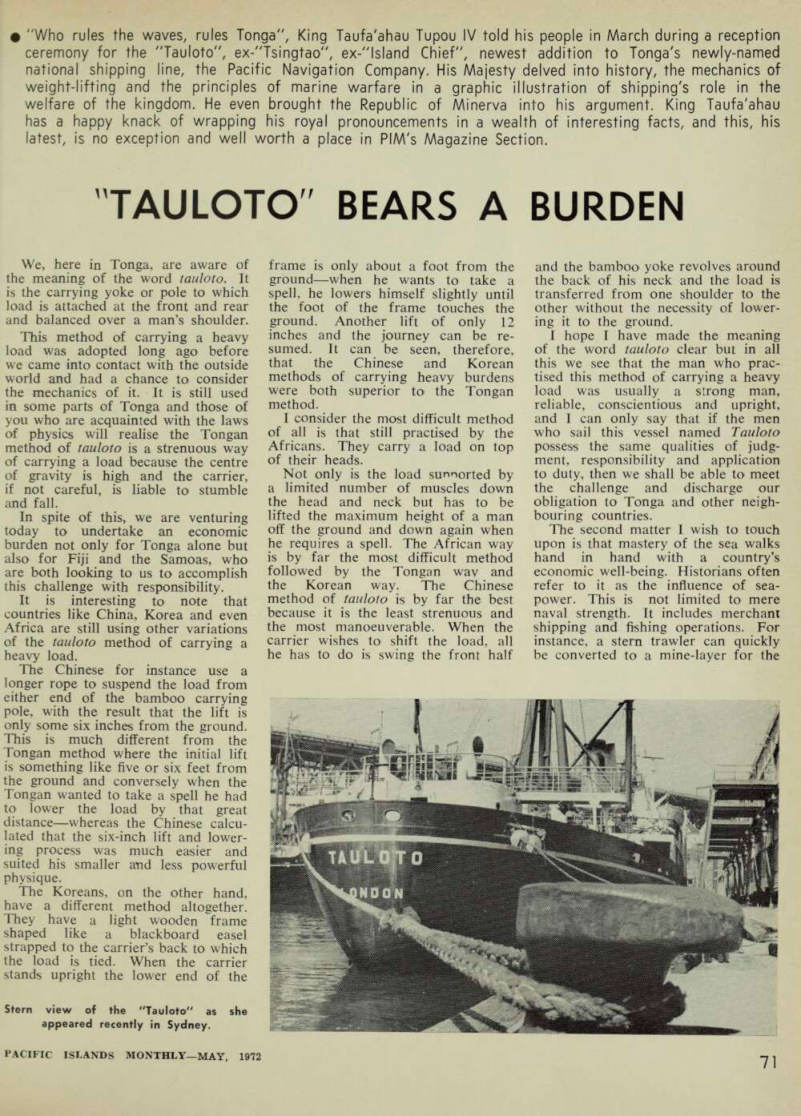
They have a light wooden frame shaped like a blackboard easel strapped to the carrier’s back to which the load is tied. When the carrier stands upright the lower end of the Stern view of the "Tauloto" as she appeared recently in Sydney.
frame is only about a foot from the ground—when he wants to take a spell, he lowers himself slightly until the foot of the frame touches the ground. Another lift of only 12 inches and the journey can be re sumed. It can be seen, therefore, that the Chinese and Korean methods of carrying heavy burdens were both superior to the Tongan method.
I consider the most difficult method of all is that still practised by the Africans. They carry a load on top of their heads.
Not only is the load sunnorted by a limited number of muscles down the head and neck but has to be lifted the maximum height of a man off the ground and down again when he requires a spell. The African way is by far the most difficult method followed by the Tongan wav and the Korean way. The Chinese method of tauloto is by far the best because it is the least strenuous and the most manoeuverable. When the carrier wishes to shift the load, all he has to do is swing the front half
and the bamboo yoke revolves around the back of his neck and the load is transferred from one shoulder to the other without the necessity of lower ing it to the ground. 1 hope I have made the meaning of the word tauloto clear but in all this we see that the man who prac tised this method of carrying a heavy load was usually a strong man, reliable, conscientious and upright, and I can only say that if the men who sail this vessel named Tauloto possess the same qualities of judg ment, responsibility and application to duty, then we shall be able to meet the challenge and discharge our obligation to Tonga and other neigh bouring countries.
The second matter I wish to touch upon is that mastery of the sea walks hand in hand with a country’s economic well-being. Historians often refer to it as the influence of sea power. This is not limited to mere naval strength. It includes merchant shipping and fishing operations. For instance, a stern trawler can quickly be converted to a mine-layer for the
Ruling the waves
protection of harbour facilities in time of war.
In our case the Tauloto was for merly a British vessel, though built in France. And the British Admiralty sees to it that all British merchantmen are constructed with a short powerful aft lifting-crane, capable in time of war of handling heavy military equip ment such as tanks, heavy trucks and even locomotives. By the same Admiralty direction and subsidy, the forward portion of each merchant man is often reinforced to mount a heavy machine-gun for self-protection against surface or air attack. The Tauloto is in this class and you can see the growth of our own merchant fleet is contributing to the theory of strength on the sea.
Many books have been written on the conduct of total warfare. German generals and theorists have concen trated on land warfare and developed an efficient military machine. But one of the most prolific and ablest writers on overall tactics was the naval philosopher, Admiral Alfred Maine, who lived from 1840-1914.
Theories propounded by Alfred Maine were found to be true in his day and are still applicable today and have been widely adopted by Great Britain and other European countries as well as the USA.
His best-known works are: “The Influence of Sea Power upon History from the years 1600-1783”, published 1890; “The Influence of Sea Power upon the French Revolution and Empire, during the years 1793-1812”, published in two volumes in 1892; “The Influence of Sea Power upon the War of 1812”, published also in two volumes in 1905.
He also wrote two volumes on the Life of Admiral Lord Nelson.
Out of his comprehensive investiga tions and research Admiral Alfred Maine came up with one unassailable conclusion: “It is the country or people who control the sea who will ultimately control the land as well.”
The history of world conquests and settlement proves this. When the Greeks and Persians were at war some 300 years before Christ, it was the Greek superiority at sea that led to ultimate victory and the glorious feats of Alexander the Great.
In the struggle between Rome and Carthage, weakness at sea forced Hannibal to travel overland through Spain to approach Rome from the north. Whereas the Romans with the balance of sea-power sailed direct for Carthage for a frontal attack.
History also tells us that the Vikings from Norway, Denmark and Sweden with their tremendous sea power were able to overrun and settle half of Britain and France, a part of Russia and sailed as far as America.
Today, the inhabitants of South America are predominantly Spanish and Portuguese for that simple reason and at one time these two countries between them possessed the most powerful naval forces in Europe.
The time was when the Dutch owned what is known today as Indo nesia because Holland, one of the smallest countries in Europe, was a powerful seagoing nation.
There are many English-speaking nations in the world today like Canada, the United States of America, India, parts of Africa, Aus tralia and New Zealand; these were parts of the far-flung British Empire built up last century by British sea power and domination of the sea.
The result of two world wars further demonstrates the truth of Admiral Alfred Maine’s theory.
Even in the case of Tonga this prin ciple was manifest. We know that a part of Fiji was settled by Tongans because they were more daring on the high seas. During King Aho’eitu’s reign, Tongan chiefs settled and held sway in Samoa because they operated
more and better ships. More recently in our history, the reason why Finau ’Ulukalala became king of Vava’u was his ability to control the sea— he also owned a large area of the swamp grass called kuta which grows on the island of Ngofe to this day, from which sails of the double canoes were made. In those days it was the chief who held mastery of the sea who emerged as controller of the land area.
In the case of unification of Tonga during the reign of King George Tupou the First, the deed was not done by the people of Tongatapu but by the star navigators and seafaring chiefs of Ha’apai and Vava’u. As king of Ha’apai and Vava’u at that time, George Tupou I was in sole control of shipping which gave him both the power and the opportunity to establish the kingdom with its constitution and laws as we know it today and to reign over it as the first king over the whole of Tonga.
We are told that when the warrior chiefs from the two northern islands were being farewelled prior to launching attacks on Tongatapu their friends ashore would call out tearfully “Take good care, lest you be over come and killed”. To which the de parting chiefs replied, “All is well.
If we should die, we die for Tonga”.
It was the late Prince Ngu who turned this heroic saying into a motto for Tonga College Mate Ma’a Tonga —“Give your life for Tonga”.
It can be seen that, although Tongatapu was much larger than either of the two northern groups, she was conquered by them because they had mastery of the sea. This principle has held true throughout history.
On the eve of undertaking this new shipping venture we can almost hear our neighbours say, “We are handing you the key to the Pacific”. Rightly or wrongly, we are conscious of the fact that we are living in a vulnerable situation—a house with no protective doors. In the event of war, it would be normal and our responsibility to protect our harbour entrances with such weapons as mines, torpedoes, rockets and missiles. But because we are without these weapons our house remains vulnerable. The news of the establishment of a Republic of Minerva so close to our shores strengthens the view that we should
set about creating protective
measures for Tonga. This may prove to be a serious matter that cannot be taken lightly.
In your presence, we welcome this vessel today and accept our responsi bility in the traditional Tonga style to carry our burdens and the burdens of others —’Ofa atu.
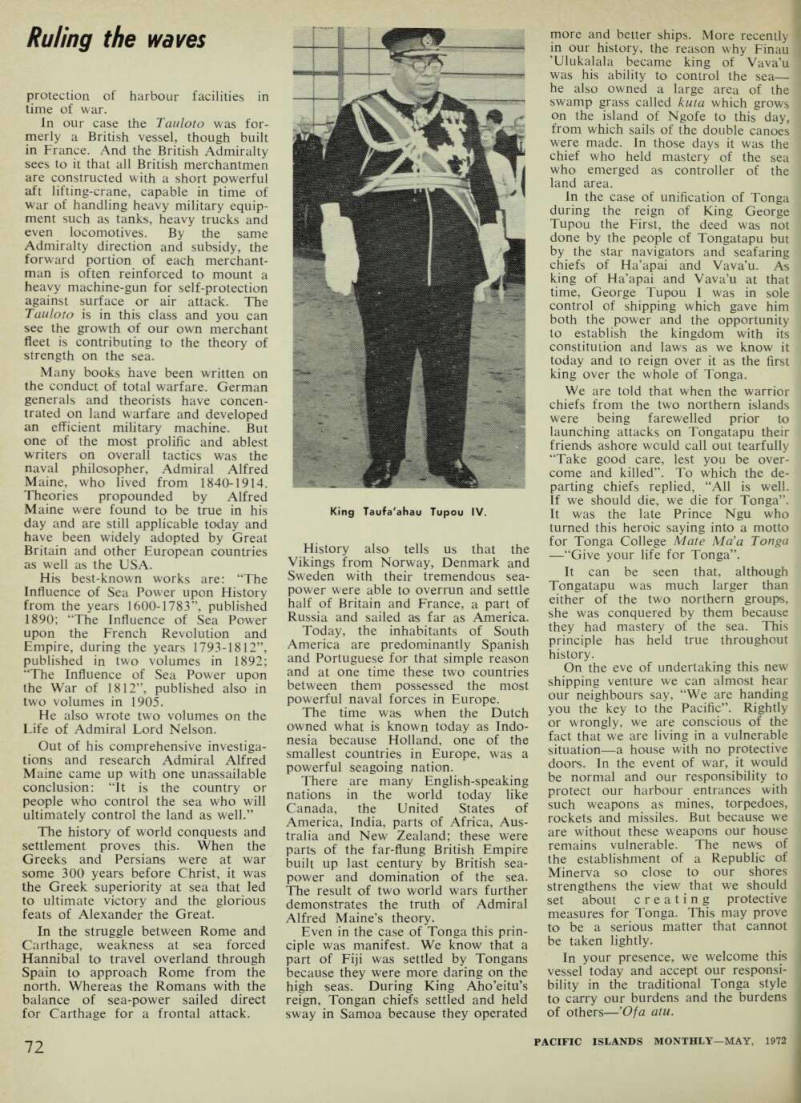
King Taufa'ahau Tupou IV.