p. 77 · Read in the full issue
200 years and a fortune to get Cook sketches into print
Books, prints and artefacts of Australiana, or Pacificana, if you like, have become extremely popu lar of late, demand has exceeded supply and prices have shot up.
PlM’s London correspondent, Ken McGregor, reports on a series of prints, featuring the Society Islands, which have taken 200 years to be published. And they will be completely sold out for a hefty total of $43,000 when they leave the presses late this year or early next year.
Enthusiasts in the UK, Hawaii, US, Sweden and Australia have already paid $325 each for a book of 30 prints, or just over $l,OOO for a binding-designed book of 42 prints. Just 110 sales have been made, to institutions, libraries, museums, universities and collec tors.
The books are titled Captain Cook’s Florilegium, and contain selections from original copper plates engraved in 1780 to illus trate the botanical results of Cook’s voyage in the Endeavour between 1768 and 1771.
Twelve inches by 18 inches, those from the Society Islands comprise beautiful colour prints from the islands of Tahiti, and the circular Leeward Island, Tahaa, 120 miles to the northwest of Tahiti.
Cook is credited with discover ing Tahaa in 1769.
A print also comes from another, unidentified, Society Island.
Sir Joseph Banks, leader of the distinguished botanical team on Endeavour, commissioned four artists to engrave plates from sketches on his return to London in 1771.
The sketches were made at stops in Indonesia (Java), Australia, New Zealand, the Societies and Brazil.
The artists were John Clevely, John Frederick Miller, James Miller and Frederick Polydore Nodder.
Their plates were completed in 1780 and added to Banks’ private herbarium, in Soho, then the scientific centre of London.
Banks bequeathed the prints, along with most of his other very important material, to Robert Brown, an eminent Scottish botanist, who visited Australia with the explorer Flinders in the early 1800’s.
Banks died in 1820.
Brown found after several years he couldn’t maintain the huge herbarium himself, and negotiated with trustees of the British Museum to relinquish his “life interest” in the collection.
The collection was so big, the museum formed a new botanical section, and appointed as its curator, Brown. TTiree years later, the botanical collection of the museum became so big a new branch was formed at South Kensington, to exhibit animals, flowers and minerals.
The plates were moved to South Kensington by 1833, and are there today.
Under the British Museum Act, of 1963, separate trustees were named for South Kensington ex hibitions, and the branch called the British Museum, Natural History.
The current publication of the prints is due to the combined efforts of the Natural History Museum and the Royal College of Art.
Mr. Wilfred Blunt, curator of the London Watts Gallery, has written an introduction to the prints, on Cook’s voyages, and Dr.
W. T. Steam, senior scientific officer of the museum’s Depart ment of Botany, has described the botanical species depicted in the prints.
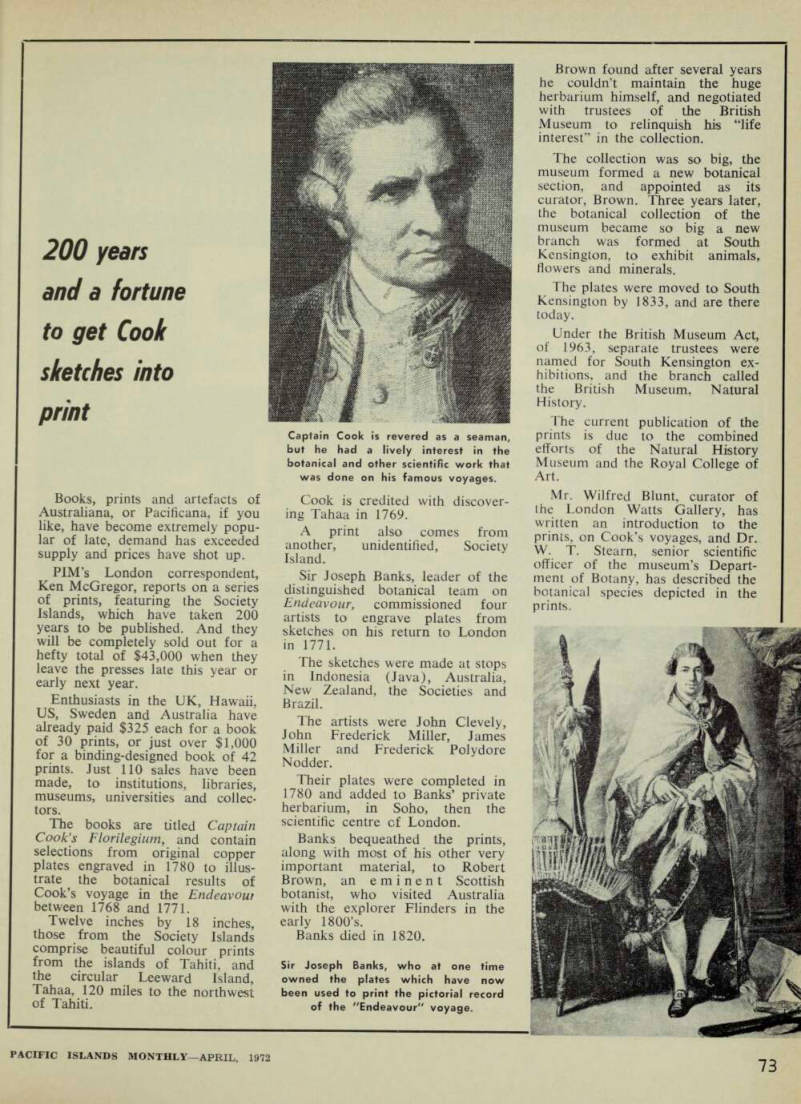
Captain Cook is revered as a seaman, but he had a lively interest in the botanical and other scientific work that was done on his famous voyages.
Sir Joseph Banks, who at one time owned the plates which have now been used to print the pictorial record of the "Endeavour" voyage.