Pacific Islands Monthly
News Magazine Of The South Pacific
April, 1972
Australia, Nz, Geic, Bsip 50C
PNG, FIJI, COOKS, TONGA, W. SAMOA, N. HEBRIDES 45c
Nauru, Norfolk, Niue 45C
AMERICAN SAMOA 70c HAWAII 80c MICRONESIA 90c NEW CALEDONIA 65 CFP FPFNiru doivmccia on rco
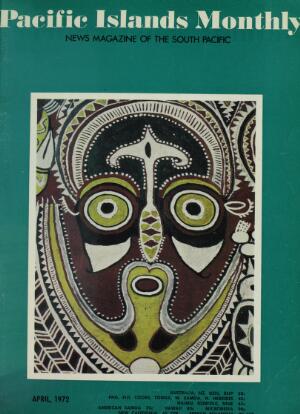
Our Cover
Roving English photographer Alan Vidler took the cover in Port Moresby. It is one of the “panels” in the stylised haus tambaran, the traditional New Guinea spirit house, which forms a striking entrance to St. Mary's War Memorial Cathedral, seen in the picture at right. It is a faith ful “copy” of the haus tambarans found in the Sepik and is the combined work of two Austra lian artists, John Trainor and Harold Thornton, and six New Guinean artists. The spirit house took six months to complete. It is 64 ft high and at the side there is a traditional door, only 4 ft 6 in. in height, through which entrance is gained to the cathedral. As Archbishop Copas told PIM, the spirit house and the cathedral standing together as one building represent the “marriage” of New Guinea’s pre christian past and its Christian present and future.
Advertisements & other items, pp. 2-3 (1 item)
TAAs 12,000 mile
Papua New Guinea
Network*
50 centres throughout Papua New Guinea on a 12,000 mile network.
DJAJA PURA
WEST IRIAN
l\A
CORAL SEA
CAIRNS
RINGS
100 centres in Australia.
TAA serves the lot.
Across Papua New Guinea we give you more flights to choose from.
Including daily Friendship services between Moresby and all major centres. Plus daily ‘Bird of Paradise’ T-Jet flights connecting Port Moresby with Brisbane, Sydney, Melbourne, Adelaide and Perth.
More flights. More seats.
More cargo space.
If you plan to take off soon, keep TAA’s 12,000mile Papua New Guinea network in mind.
TAA
AIRLINES OF NEW GUINEA
No. 1- the friendly one
Call your Travel Agent. Or TAA . Port Moresby 2101 • Boroko 5 3541 • Lae 4 3191 • Madang 2478 . Kieta 95 6372 • Rabaul 92 2567 • Goroka 72 1211(8) • Mt. Hagen 52 1301(301) • Wewak 49 319 3533/72
!fcl -
c REAM
SWEE
(arnation
Now you can enjoy Peacock Full Cream Sweetened Condensed Milk... a top quality condensed milk made by the producers of Carnation Evaporated Milk. It’s on sale at your local store at a value-for-money price.
R
Pacific Islands
Monthly
FOUNDED BY R. W. ROBSON IN 1930
Owned And Published By
Pacific Publications (Aust.) Pty. Ltd.,
29 Alberta St., Sydney, N.S.W., 2000.
Postal Address: G.P.O. BOX 3408, SYDNEY,
N.S.W., 2001.
Telegraphic Address.- PACPUB, Sydney.
Telephones: 61-9197, 61-7101, 61-4369.
Consulting Directors: R. W. Robson, Judy Tudor.
Chief Executives: General Manager: Selwyn Hughes.
Publisher: Stuart Inder.
Director of Advertising; W. A. Gasnier.
Pacific Islands Monthly
Editor: Stuart Inder.
Assistant Editor: John Carter.
Advertising Manager; W. A, Gasnier.
Circulation Manager: Barry Badger.
Representatives
Fiji: Pacific Publications (Fiji) Ltd., Fiji Times Building, 20 Gordon Street, Suva. Tel.; 25601 Fiji Times Office, Cnr. Vitogo Pde, and Namoli Ave, LAUTOKA. Telex: 1144. Tel.: 60-422.
Papua New Guinea: LAE, P.O. Box 227; RABAUL, Mr. Steve Simpson, P.O. Box 433 (c/- Rabaul Photographic. Tel.: 2677).
French Polynesia: Distribution—Hachette Paci fique, 10 Ave Bruat, Papeete.
New Zealand; Pacific Publications, C.P.O. Box 2229, Auckland. 379-494. Representative: John Spedding, Civic House, 291 Queen St., Auckland, Tel.: 379-494.
United Kingdom: S. R. Warman, Park House, 22 Park Street, Croydon, CR9 3NP. Tel.: 01-6884177.
Overseas Newspapers (Agencies) Ltd., Cromwell House, Fulwood Place, London, W.C.I. Tel.: 01-242-0661. Cables; WESNEWS, London, DS4.
Japan: Advertising—Universal Media Corpora tion, C.P.O. Box 46, Tokyo. Tel.; 666-3036.
Victoria: Advertising—Wilke & Co. Ltd., 37 Brown's Road, Clayton, Vic., 3168. Tel.; 544-8222.
Queensland: Advertising—Beale Media Services, 232 St. Paul's Terrace, Fortitude Valley, Qld., 4006. Tel.: 51-5827.
Subscription Rates:
"Pacific Islands Monthly" is air-freighted to all subscribers and agents in the Pacific Islands; copies to other areas go by surface mail.
Australia (including Lord Howe and Thursday Is.), 8.5.1. P., Gilbert and Ellice Is.: $5.50 Aust.; Papua New Guinea, Norfolk Island, Nauru, Tonga and New Hebrides: $5.00 Aust.; New Zealand: $5.50 NZ; Fiji, Cook Islands, Niue and Western Samoa: $5.00 (local currency); American Samoa; $B.OO US; U.S. Mainland, Micronesia (including Guam): $lO.OO US; Hawaii: $9.00 US; New Caledonia: 750 French Pacific francs; Tahiti and French Polynesia; 850 French Pacific francs; United Kingdom and elsewhere: £3.25.
Copyright ©, 1972,
Pacific Publications (Aust.) Pty. Ltd.
April, 1972.
Vol. 43, No. 4.
Advertisements & other items, pp. 3-16 (9 items)
1
ACIFIC ISLANDS MONTHLY—APRIL, 1973
and a Massey-Ferguson 135
MFI POST HOLE DIGGER
mm
MF4O LOADER
MFI2 TRANSPORTER
m
MF2I TRAILER
MF2I MULTI-PURPOSE BLADE
One man
and a Massey-Ferguson 135
can do almost anything
ASK YOUR MASSEY-FERGUSON DISTRIBUTOR FOR COMPLETE DETAILS ... THE MAN TO SEE IS HERE
Everybody loves
U BISCUITS
* Ml f > <gj ift* :" you’ll love the freshness
buy some now!
% TW' K : m B - 0%
Expert advice
for your sick ,
swimming pool
Green slime in your swimming pool?
Trouble keeping accurate chlorine levels?
For sound advice on the best way to deal with all your swimming pool problems, contact ICI in Lae.
ICI have been dealing with swimming pool treatment and care for many years. We’ll tell you how to tackle your pool troubles whether they’re backyard or Olympic size.
W ICI (N.G.) Ply. Ltd., Box 1105 Post Office, Lae.
Telephone: Lae 3301.
Cables: ‘lmpkemix’.
mats
The answer to the TV set
Rich years of creativity and togetherness, something the TV has driven from many homes. The Yamaha Electone brings it back and provides much more besides.
The satisfaction of really playing from the very first day, even for children who have never studied music before.
Versatility to meet every talent; the Yamaha Electone organ is designed to stimulate musical growth.
Durability for decades, thanks to solid state 1C circuitry.
If you've never heard the living beauty of the Electone
in home entertainment
Natural Sound speakers, or the vibrant realism of the exclusive sound-in-motion tremolo, you don't know what your family's missing.
See the whole generous selection of Yamaha Electone organs, and let us show you how to fill your home and life with music.
• @ YAMAHA
NIPPON (.AKKI CO ITU
P.O. Box I, Han.amalsu, Japan Telephone: Hamamatsu til l 111 m &
MH
MORRIS
HEDSTROM
LIMITED
HEAD OFFICE: SUVA-FIJI
LONDON OFFICE:
MORRIS HEDSTROM LTD.,
Park House,
22 Park Street,
CROYDON, CR9 BNP.
• GENERAL MERCHANTS
• PRODUCE BUYERS
• IMPORTERS & EXPORTERS
• PLANTATION OWNERS
• COMMISSION & INSURANCE
AGENTS
AUSTRALIAN REPRESENTATIVE:
W. R. CARPENTER & CO. LTD.,
(MERCHANDISE DIVISION),
The A. & N.Z. Building,
68 Pitt Street,
SYDNEY, 2000.
Registered Cable Addresses:
MORRISHED —SUVA, APIA, NUKUALOFA. • SUVAMARK LONDON. • MORSTROM SYDNEY.
AGENTS AND DISTRIBUTORS FOR:
SHIPPING
China Navigation Company Lloyd's Lloyd Triestino Mitsui OSK Lines Pacific Australia Direct Line Pacific Far East Line, Inc.
MOTOR
Alfa-Laval A.R.A. Airconditioners Assoc. Battery Makers of Aust. Ltd.
Champion Spark Plug Co.
Chrysler U.K. Ltd.
D. H. Davies & Co. Ltd.
Ferodo Ltd.
Ford Motor Co.
Fram Filters Ltd.
Good-year Tyre & Rubber Co.
Hayter Exports Ltd.
Howard Rotavators Pty. Ltd.
Napier Bros. Ltd.
Norton-Villiers Outboard Marine International W. H. Wylie
GENERAL
Addis Limited Benford Ltd.
Crittall-Hope Export Electrolux Ltd.
Imperial Chemical Industries Ltd.
James A. Jobling Ltd.
John Steventon & Sons (Export) Ltd.
H. & R. Johnson Ltd. .
KelvinatOr International Inc. (Leonard Refrigerators) Longines SA Marley Floor Tile Co.
Nippon Kogaku (Nikon Cameras) Noritake Co. Ltd.
Olympus Optical Parker/Eversharp Pen Co.
Pilkington Bros. ltd.
Procter & Gamble Ronson Ltd.
Rowntree & Co. Ltd.
Sanyo Electrical Singer Australia Ltd.
Wiltshire File Co. Pty. Ltd.
Winstone Ltd.
Yorkshire Imperial Metals
LIQUOR
Bacardi International Drambuie Liqueur Co. Ltd.
Guinness Exports Jas. Hennessy & Co.
John Dewar & Sons Ltd.
McWilliams Wines Pty. Ltd.
Tanqueray Gordon & Co. Ltd.
PHARMACEUTICALS & COSMETICS
Burroughs Wellcome & Co. N.Z. Ltd.
Ciba Laboratories Cynamid DHA Pty. Ltd.
Elizabeth Arden Glaxo Laboratories Ltd.
Lentheric Perfumes Max Factor Rimmel Ltd.
Smith & Nephew Ltd.
West Silten Pharmaceuticals t ■
for friendly service
and complete
satisfaction its ...
MORRIS HEDSTROM
LIMITED
Fiji—Western Samoa—Tonga
The Dependabtes -
Australian power and hand tools
For dependability, you can't go past power and hand tools from Australia. They do two kinds of jobs. A selling job for the importer. A professional job for the end-user.
They've proved their popularity in many different markets - and in all kinds of conditions. The range is wide: power tool attachments for drilling, cutting, sanding; pneumatic tools, rivetting tools; pliers, planes, files, rasps, clamps, spanners and wrenches. Delivery is speedy, prices competitive, design and workmanship second to none. For better performance and bigger sales-look to The Dependables-Australian power and hand tools.
what's in
Australia
for you?
Find out today. All you have to do is contact the Australian Government Trade Commissioner who will put you in touch with suppliers of Australian products: cnr. Pratt and Joske Streets, SUVA (P.O. Box 1252). Tel; 25624.
Australian Department of Trade and Industry
The Qantas747B
a better way to fly.
Qantas gives you the big, smooth, quiet and beautiful 7478. This is the plane with the biggest First Class Lounge in the skies. The one with movies and stereo*, with wide, wide aisles and wide custombuilt seats. The Qantas 7478 has 15 washrooms. Separate Shaver Bars.
And it’s a quieter plane from nose to tail.
Even the main galley is below, so you’re really away from any noise. You can now fly the Qantas 7478 between Fiji, Honolulu and San Francisco, and between The service is as big as the plane.
Fiji and Australia and on to Europe. *IATA regulations require us to make a charge of $2.25 for headsets.
QMMi, with AIK HsiuiA, AIK NtW iitALAND, BOAC and MSA.
B
A
great bunch
of flours.
Robert Hutchinson makes the greatest bunch of flours in the Pacific. Bakers’ flour.
Superlite cake and sponge flours.
Biscuit flour and cracker flour.
Wheaten sharps and wheaten meal.
We’re particularly proud of our bunch of flours. So we have a technical advisory service to help you use them properly.
So next time you see a Robert Hutchinson flour (or even one of our Hutmill stock feeds), remember it’s just one of the bunch M
ROBERT
HUTCHINSON
LIMITED
the flour people
Hartington Street, Glenroy, Victoria, Australia. 3046. Telephone Melbourne 3067261
TABATA SKIN & SCUBA DIVING EQUIPMENT
m ff( wmi ■■ w NEW ZEALAND Agents Allan G. Mitchell (N.Z.) Ltd. > mm
NORFOLK ISLAND Agents:
Norfolk Island Sporting Centre Ltd.
The TABATA line offers the importer a complete range of RUBBER
SKIN & SCUBA DIVING
EQUIPMENT and ACC-
ESSORIES for both the professional and amateur. Years of specialized manufacturing experience has establidied our line's
REPUTATION FOR QU-
ALITY, ATTRACTIVE
and PRACTICAL DESI-
GNS and VERY COMP -
ETITIVE PRICES. We a-
Iso offer a varied line of rubber sundries for golfing, skiing and other popular sports.
For full particulars on our lines, write to:
Manufacturers TABATA CO., LTD.
Yajima 81dg..2-2Yoshi-cho. Nihonbashi .Chuo-kujokyo CabIe:"EASTABA"Tokyo TELEX:2S2 -2806 EASTABATA TOK Tel: (663)8651 -5
0k i Looking for an
all-purpose ply
EXTRA TOUGH
EXTRA LIGHT?
KLINKII
Made by Commonwealth New Guinea Timbers Ltd, ®“J®*®» ?*ri® umea PA Available from plywood suppliers m the Territory Pactfac area
Bank of Hawaii is the bank of the Pacific.
Ifou can bank on it...in Guam Roi Namur JJtWhke JL Kwajalein JltPonape Tahiti* 3* American Samoa.
PaJ!f|p nffl?inn'fniPk 6r P- 5 brancl ? es throughout Hawaii and the racific offering full banking services. May we help you?
Bank of Hawaii the bank of the Pacific * affiliate of Banque de Tahiti
X 8 m - * ■
ifill
g ip 1 seal m ' OT & m ■M& i n & m m M & u m m m fern i
How to win friends...
Serve Arnott’s Fancy Biscuits
Whenever friends arrive, here’s the way to please them best serve a selection of Arnott’s famous fancy biscuits.
Lots to choose from, including Monte Carlo, Delta Creams, Lemon Crisp and Spicy Fruit Roll. So fresh and crisp, so chock-full of delicious melt-in-the-mouth flavour. Always have some handy for your friends...enjoy them any time!
The triple-wrapped packs keep the biscuits fresh.
fpQmott*s/ ajnous Biscuits
■J 1 There is no Substitute for Quality
5
ACIFIC ISLANDS MONTHLY—APRIL, 1972
7
*CIFIC ISLANDS MONTHLY—APRIL, 1972
9
"IFIC ISLANDS MONTHLY— APRIL, 1972
Icific Islands Monthly— April, 1972
From the
Islands Press
From the New Hebrides 7 Group News 7 an item demonstrating how, when you 7 re down in the dumps, it helps morale to know that others are suffering too: Radio Vila would like to thank all the people who have kept us informed through letters or radio about cyclone damage in their villages or islands. We were pleased to be able to tell others about this news.
An advertisement in the 7 Fiji Times 7 : Animal House Attendant (JB/72). The person appointed will be responsible for the day to day maintenance of rats and mice and will carry out breeding programmes and maintain records. Experience in rearing animals is preferred.
From a PNG Government Press release: Councillors of the Morehead Local Government Council have reversed a decision made last year that old people should not have to help with road maintenance. At a recent meeting. Councillor Daram pointed out that many of the old people managed to become exceedingly sprightly after drinking tuba and appeared to have sufficient energy to cope with a fair share of road maintenance. He accused the other councillors of being afraid to put the old people to work in case the old people worked "magic" on them Atter much discussion, the councillors voted seven against and eight in favour of their old people helping with road maintenance.
Fr°m a letter by Rura Wagumolo, of Kira Kira m the BSIP 7 News Sheet 7 : J VfJ* the Solomons today must accept this fact that We u/ lke u ° r not we are undergoing a elohinTn We revol ! ln 8 gainst colonialism, we are jolting against discrimination; we are revolting against Zt ™’ We are r i eV ° lting against l ™ standards 8 of Z nr* rn%f reVO tln - g agcilrist Ignorance and illiteracy; ve are revolting against an organised form of conomic and political organisation; we are revolting igainst established value systems. ... To be out “ w . e n . eed to have an agreement signed and atified by dignitaries of the Solomons and Britain o achieve the rest, we must have a new political or 7h 0 e Ph Zo a n'} d ideology develope from this country, 7 this country 0 '* and ** P^ple rom the New Hebrides 7 Group News 7 : >ele village on Tongoa is being infested by flying axes again after the cyclone. A similar incident
occurred last year when flying foxes destroyed most fruit trees in the village. The people report that recently one flying fox went as far as to get its head stuck inside a pawpaw and both fell to the ground. It was later caught and eaten.
PNG Government Press release: Over 1 000 coffee trees planted and nurtured in secret have been discovered by a Rural Development Assistant in the Gulf District, a report from Radio Kerema says. The people responsible are the Kamea group from Kamtiba village who thought that coffee was a fortudden crop and they would be in trouble if the Department of Agriculture discovered the trees, v • Rural Development Assistant is now helping the villagers to improve their coffee gardens which originated from seeds brought from the Morobe District.
Report In the 7 Samoa Times 7 : Scientific equipment at Mulinuu has recorded 15 instances of explosions caused by dynamite in the waters surrounding the Mulinuu peninsula during December and many more have been recorded since. Apparently the dynamite is being used by unidentified fishermen ... The police are reportedly aware of the problem and are planning to find ways of enforcing the law against dynamite more effectively. Their main trouble to date has been lack of ocean-going vessels to be used to chase and catch the suspects.
VILLAGE PEOPLE EARN THEIR FIRST RUBBER MONEY was the headline to a PNG press release last month announcing the first tappings of rubber trees in a Highland village which would result in a cash return to the village people.
Extract from the PNG Information Departments 7 0ur News 7 : The Housing Commission has a new idea, in which people can help themselves. The idea is to rent land to Papua New Guineans for $5 a year. The people must first dig a latrine, or toilet pit, then build any kind of house to live in for a few months. This first house can be a bush house built with whatever thmgs people can buy. The people then live in this bush house but in two years they have to build a good house which will last a long time. This is called a permanent house. When a person has built a good permanent house, he is given the right to rent the land for 25 years.
From a long letter published in 'The Norfolk Islander': It has long been obvious to those interested that the Territories Department has a policy for Norfolk It has disliked having us “different”. The civil servant with his bureaucratic outlook must seek to tidy the system and make it come into line with his mainland colossus. Whether or not it is pleasing to the taxpayer, or economic, doesn’t matter to him.
Achmmstrators are tolls of this bureaucratic disease with its disastrous effect upon small communities. 18 ast os^n S ks entire identity and will finish up as the outpost for the very wealthy— the cost of living being that of Sydney added to which will be the cost of freight
13
ACIFIC ISLANDS MONTHLY—APRIL, 1972
Kid Stuff
s>.
To most of us, Plunket Cream is a high quality emollient for preventing damage to baby's tender skin, caused by wet and chafing napkins. We use it confidently, without a doubt about its effectiveness. A happy baby and the absence of skin disorder is proof enough that it is doing its job. The job it was designed to do !
With Kempthornes it's different. To them, Plunket Cream is day after day of careful formulae calculation. Week after week of research - testing - proving.
Not the tiniest stone left unturned. Not the slightest chance taken, thus ensuring the success of yet another K.P. baby-care
KID STUFF
(Plunket Cream and all that jazz) ■ ; product. In every stage of manufacture, from the individual testing of ingredients to the proving of the finished product, Kempthornes place quality first. It's this quality control that is the secret of their success—your guarantee of a safe and reliable baby-care product. What's kid stuff to Kempthornes is the finest there is! mm i Enquiries to: The Marketing Manager Kempthorne Prosser & Co. Limited P.O. Box 319, Dunedin.
The Editor's Mailbag
Biology Of Lake Wisdom
For the past several years I have been studying the process of re colonisation, by plants and animals, of a small volcanic island created in an eruption in 1968. This island lies in Lake Wisdom which fills the central crater of Long Island (Arop), Papua New Guinea.
I have had a great deal of trouble getting any reliable information on the fauna of the lake and on the history of the islands in the lake and I thought your readers might be a potential source of information. I would greatly appreciate any informa tion on either of these matters or on the history of Long Island as a whole.
Eldon Ball
Research School of Biological Sciences,
Anu,
Canberra.
Phoohey Fiji
Having made almost 20 visits to Fiji during the past 10 years, I feel that I can venture some criticisms without being labelled an “instant expert”.
My criticisms are not aimed at the local shopkeepers, taxi drivers or the people in the Fiji Visitors Bureau.
Also, I continue to be amazed at the way the local people suffer the tourists and still manage to smile as though they mean it. Unfortunately, the boom in tourist hotel building has improved nothing but the availability of accommodation. The standard of food and entertainment is appalling and totally lacking in imagination.
One suspects that the chefs are drop outs from “greasy spoons” in Aus tralia and NZ, and that the entertain ment would grind to a halt if the power were disconnected.
Apart from several Indian restau rants it is virtually impossible to get a decent curry any more. Kokoda appears to be the only “indigenous” dish worthy of inclusion on a menu Do tourists travel thousands of miles to Fiji so they can enjoy the exotic pleasures of baby lamb chops, Vienna Schnitzel and Chicken Maryland? 1 think not. Fiji waters abound with marine life, but grilled walu appears to be the only fish to make the lourney to the hotel kitchens.
Mangoes, coconuts and bananas are everywhere, seemingly reserved for
chutney and inclusion as sambals for the alleged curries that are served.
Have none of the hotels discovered that people actually like eating un pickled mangoes, or that the meat of the green coconut can be transformed into delicious desserts? Perhaps they could write to the Australian Banana Marketing Board and obtain a free banana recipe book!
Still in the imagination department; why can t one of the local importers organise a competition among the local barmen to find some Fijian cocktails based on coconut milk pineapple, mango, etc? White rum added to coconut milk is both delicious and refreshing, and I am sure that the prices charged would more than compensate for the loss m copra revenue.
T° move on to entertainment.
Although I have attended more than enough Touristised Mekes’, the one I last attended in a Nadi hotel was by far the worst. White shorts and petti coats underneath the performers’ grass skirts were bad enough, but the group leader’s use of a trailing microphone hooked up to a stereo system added the fina touch. In a Fitzpatrick IraveLalk accent he managed to talk his way through Isa Lei, then an nounced that the group would end their performance with another Fijian song. Would you believe—the Maori Farewell?
I could go on ad infinitum with criticisms and, I hope, constructive suggestions, but feel that the fore going will suffice for the moment, i still enjoy Fiji more than any other area of the Pacific, thanks to friends among the indigenous population who help me escape the boredom of the hotels and their cuisine.
L. Marshall
Paddington, Sydney.
The Great 'Flu Epidemic
I have been commissioned by my publishers, Macmillan of London and Athenaeum Press of New York, to prepare an authentic narrative account of the great Spanish influenza epidemic of 1918/19, which took a world toll of 20 million lives m little more than 17 weeks. The fatalities were especially great in Australia, New Zealand, New Guinea, Fiji (where 7,070 deaths were reported), the islands adjoining
Pago (8,500 deaths) and Samoa (7,542, a quarter of the population).
I am seeking the hospitality of your columns to ask all Pacific Islands survivors of the epidemic— whether doctors, nurses, patients or descendents of those involved—to get in touch with me, with a view to reconstructing the epidemic’s devasta tion as accurately as can be. Diaries, letters, photographs and word-of mouth reminiscences will all be most gratefully received and acknowledged.
Richard Collier.
None-Go-By, Burgh Heath, Surrey, England.
Micronesian Independence
I would like to thank PIM for the excellent rebuttal of John Dorrance’s rather strained attempt at a defence of the US position in Micronesia (PIM, Dec., 1971). It is clear that one of the fundamental obstructions to any resolution of the Trust Terri tory’s political status is the question of ultimate sovereignty. The American Government and, by ex tension, its negotiators, still operate under an assumption of Manifest Destiny—the belief that it has a sacrosanct right to any territory it can get its hands on.
In 1953 Senator Hugh Butler, chairman of the US Senate Com mittee on Insular and Interior Affairs, told Congress “that our primary title to the islands rests on force of arms, and that the United Nations Trustee ship Agreement represents little more than a fait accompli ... I believe that it should be made perfectly clear to all concerned that the US Govern ment must for security reasons retain absolute control of the entire area forever, or for as far as we can see in distant future”. The position taken by US negotiators at Hana echoes those same sentiments.
Until we Americans realise that Micronesia belongs to the Micro nesians, just as South-East Asia be longs to the South-East Asians, and make a concerted effort to acquaint our Administration with this funda mental truth, the people of Micro nesia will have little chance of re ceiving genuine independence. And until this basic change in our position is made, I, for one, cannot look for ward to future political status talks with the same optimism you voice.
But my pessimism does not still my hopes for an ultimately Free Micro nesia.
Glen Petersen
New York, NY.
More letters on p. 107
Advertisements & other items, pp. 17-22 (1 item)
Papua
NEW GUINEA
PRINTING CO.
PTY. LTD.
• Commercial Offset and Letterpress printers to the territory.
Factories in Port Moresby and Lae.
And we also can supply your regular and specialised stationery needs.
OFFICE EQUIPMENT
RUBBER STAMPS
We welcome your mail orders.
P.O. Box 633, Port Moresby P.O. Box 759, Lae P.O. Box 30, Mount Hagen Cables & Telegrams: PRINTER Port Moresby and Lae
Start summer precautions
against disease carrying
insects with . . .
The Insect Spray
that is
Completely Safe,
Completely
Effective
■— Am harmless to the human system, even in infants. Pea-Beu aerosol insecticide is also guaranteed safe near any warm-blooded domestic animal and near food. Even in the pure state, the odour of pyrethrins is neither overpowering nor unpleasant.
Rigid testing selects only
pure, safe ingredients.
In formulating insect sprays, the aim is maximum effectiveness against many species of pests with maximum safety for humans and pets. A.N.I.
Research Chemists are at work worldwide to ensure that concentrated Pea- Beu aerosol insecticide satisfies in all respects. Its active insecticidal ingredient is pyrethrins . . . proven the most potent insect-killing substance available. All raw materials must conform to rigid specifications of chemical purity. A programme of progress checking then operates at every stage of processing from mixing the insect-killing concentrate and highgrade ‘carrier’ to injecting the propellant which produces Pea-Beu’s highspeed spray. Rigid quality control of every stage of manufacture ensures that Pea-Beu is brought to you in the purest, safest and most effective form.
Because of this Pea-Beu is also really effective against every type of insect pest including flies and mosquitoes.
Pyrethrins; Nature’s
pest control
From the small, innocent-looking white Pyrethrum daisy, modern chemistry extracts pure pyrethrins.
This syrupy fluid is so deadly to all insects, even the microscopic quantities carried in droplets of Pea-Beu spray kill instantly on contact. Yet pyrethrins are absolutely Harmless to spray
freely anywhere
As a powerful space spray, Pea-Beu effectively rids any room of dangerous flies, mosquitoes and other biting insects and plays a major role in family health-protection. In addition it is perfectly safe to spray in kitchen cupboards or on pantry shelves, with no risk of food contamination. The unique strength of the Pea-Beu formula kills the toughest cockroach and colonies of ants rapidly too, yet cannot affect humans or pets in any way.
Pea-Beu aerosol insecticide is so strong it is effective in
killing flies, mosquitoes and
every type of insect pest.
Powerful Pea-Beu kills all insects —yet ifs so pure its safe to spray anywhere.
Brying)
Pea-Beu-the safe, powerful insecticide
All thi
dness
is in the tobacco
Every year, Rothmans buys the finest Virginia tobacco no matter what the price. .. ; H
ROTHMANS-FAMOUS FOR QUALITY SINCE 1890
JW3.2144
Jl, . , I »NOiNms, fMM
ZQZI
nr f >' m & <m W%
tm a $
.< - fv -w : v MM imll IP - i «ik i|S I 1 i
«tfiH
WEI
;iQSi
UN K ?!H
saraw anpii modxi
QDNJiaadxiasow
* w< “ - ™ 1 * mu g|||p*-- '?*%,%*** I* f A * idSli; <tS .j*.*. „; *> r% v ;jbJ ;#cw*r%t iiSfili r> * 1 ■* *. •** h * av‘>/ >,'*.*•■'■- - •. * t ' . v *$ *<* ■>•> ' ~:~- v/v £ p#t
MWi' s&
|Hcome
ON DOWN!
v See your Travel Agent or AIR NEW ZEALAND for further information.
AIR NEW ML AND
KNOWS THE SOUTH PACIFIC BEST
Freshen up down South in a clean, green country where even the prices keep you cool.
There's more of everything you ever wanted to do and it's all only a few comfortable hours away by
AIR NEW ZEALAND DC-8.
Come on down to New Zealand, the clean, green country with the clearest skies in the South Pacific. ■ - MM
Milo makes the difference
■ fiM m .* * >
IFM
% ? V-:4 MU 0
Up Front
with the Editor
They're thrashing out New Guinea's future
Predicting political developments is a risky business anyway but the political horse-trading that is going on in Papua New Guinea as I write this at the end of March makes the exact position there especially un certain. The state of the parties after the general elections is not yet clear.
But in the long term the signs are clear enough. The form of gov ernment that Papua New Guinea is to have is in the melting pot, irrespec tive of whether in the next few weeks a coalition gives the territory some semblance of political cohesion.
It always seems to me it is not sufficiently understood that it is dangerous to judge the PNG political scene on the kind of parliamentary procedures that Australians and New Zealanders are accustomed to.
The fact that the present PNG system leans towards Westminster is certainly no guarantee that it will go that way. It is more likely to go towards a presidential system, or a combination of Westminster and presidential, or something unique or at any rate different, such as the “committee” system now being tried out in the Solomons.
The South Seas is a great place for political experimentation—just look at the variety of approaches adopted by the Republic of Nauru, the Inde pendent State of Western Samoa, the Kingdom of Tonga, the Cook Islands.
And now the Dominion of Fiji is not sure it likes what it’s got, and Ratu Sir Kamisese Mara has some interest ing thoughts on what might be a more suitable constitution (reported in this issue).
One of Ratu Mara’s observations on practical Island politics applies just as much to Papua New Guinea at this time: He says the problem of communication in a multi-racial society is exacerbated because “as there are different races there have to be different interpretations of certain policies, and interpretation can create suspicion, whereas, in Euro pean countries, where there is only one race and one language, the policy can be put across without confusion or fear of wrong interpretation.”
Ratu Mara believes that a coalition
of parties might be the answer in Fiji; certainly in New Guinea we have been given no reason to believe that any one party is capable of having support enough to govern.
Having not merely parliamentary support, mind you, but popular support by an electorate that is prepared to accept party government once it understands it. But why should the electorate even bother to understand it? There is no tradition of parliamentary government in Papua New Guinea. The present system there is not parliamentary government as Australia knows it anyway.
The new House of Assembly has 100 elected members, plus four officials and possibly three nominated
members. Most of its membership will be black. The elected members were elected on a common roll of 1,600,000 names of people aged 18 and over. Voting was not compulsory, and I don’t yet know what the voting percentage was (in the 1968 elections it was 63 per cent.), The major parties fighting the elections were the conservative United Party, which is in no hurry for self-government for the territory; the middle-of-the-road People s Pro gress Party; and the so-called radical (I don’t believe it is) Pangu Party, which wants self-government now.
The radical Mataungan Association, which doesn’t call itself a party, went after four seats in the Gazelle
and triumphantly won three of them.
The Mataungan and the other three parties—but particularly United and Pangu, which have the lion’s share of the votes—are the groups that now have to thrash out a workable system.
In New Guinea the leader of the majority party—or the man who is finally selected to lead the Assembly, whoever he may be, has no right to select his ministers. These are selected by a ministerial nominations com mittee set up by the House, and thus the membership of that committee is pretty important. Horse-trading is therefore far more the order of the day than in Australia, where the leader of the majority party auto matically forms a government and appoints his own ministers.
But Papua New Guinea in the next few weeks not only has to select ministers, and a Speaker of the House, but also a leader of the House, who will be an embryo Prime Minister.
A number of people have their eye on the big new house that’s abuilding on the hill for that top man, but no one person can at the moment claim he’s entitled to it. The man who gets it will probably have to win it by out manoeuvering the other fellows.
And it’s because of this lack of clear guidelines, and because of the whole melting pot that is New Guinea politics at the moment, that the trends which start to emerge in the next few weeks will be of ex citing interest.
PERCY CHATTERTON once com plained that I cheated in my column on one occasion by quoting somebody at length instead of writing original material. I am now about to cheat again, by quoting in full the address that Percy Chatterton made to the University of Papua and New Guinea in March in accepting an honorary Doctorate of Laws that that institution bestowed on him for a lifetime of toil in Papua. I commend it for its brevity and for the clarity of thought and the humanity that are so typical of the man himself: “There are three reasons why the honour which you have conferred on me tonight gives me very special satisfaction.
“The first is that it is of this country, and, although I cannot claim to be either black or beautiful, I like to think of myself as of this country, and I hope to end my days here.
“The second is that it is of this university, and I believe in this uni versity. I believe it has a value for this country not to be measured in terms of dollars spent on it or even of degrees granted by it. It is my earnest hope that from this university will emerge leaders who are not only knowledgeable and highly skilled, but
also wise, tolerant and humane.
“The third is that it is of the Faculty of Law. I am sceptical about the value to this country of some of the alleged blessings of civilisation which we of the west have brought to it. But I have no doubt at all that we have done Papua New Guinea a very great service by establishing in it a system of justice designed to ensure not only that the guilty are punished but also that the innocent are set free. I have no sympathy with those of my fellow parliamen tarians who, if I understand them cor rectly, want to sweep this system away and replace it by some kind of instant justice-on-the-spot jurisdic tion presided over by policemen.
“I must confess that as a parlia mentarian I have sometimes been critical of the jargonisation of the English language by lawyers. They are not the only offenders, of course, but they are among the worst, and I would like to see established within the Faculty of Law of this university a lectureship in English Usage, dedi cated to restoring, in this field which so intimately affects the lives of ordinary people, the simplicity, brevity and clarity which were once the glory of the English tongue.
“For these three reasons, there fore, the honour which you have conferred upon me gives me great satisfaction. Whether, in spite of the very kind things said about me by the Vice-Chancellor, I deserve it, is another matter.
“I would find it difficult now to recapture the mood and motives which brought my wife and myself to this country in 1924. But I can tell you, and I would like to tell you, why we have stayed here for almost half a century.
“We cannot, I am afraid, lay claim to a share of the splendid altruism of those who from time to time remind you that they are here at great per sonal inconvenience simply and solely in order to guide and assist the people of this country in their onward march towards nationhood, prosperity and the Australian Way of Life.
“The reason we have stayed here for so long is a very simple and I am afraid a rather selfish one. We have stayed here because we like it here. We like the place, we like the people, and for some reason which I have never been able to understand, many of them seem to like us. The happiness which we have found among the people of this land has been, in itself, ample reward for any thing which we may have been able to do for them.
“You have very generously added to that happiness and that reward, and I thank you most sincerely.”
Advertisements & other items, p. 24 (1 item)
Guinea
In the current issue
"THE EMERGENT NIUGINI
STATE"
Keep well informed
on
New Guinea affairs
by reading
NEW
GUINEA
AND AUSTRALIA,
THE PACIFIC AND
SOUTH EAST ASIA.
75c a copy ($2.80 Aust. a year) at your bookstore, or direct from: The Sydney and Melbourne Publishing Co. Pty. ltd.
29 ALBERTA STREET, SYDNEY,
N.S.W. 2000.
(Postal Address: Box 1813, G.P.0., Sydney, N.S.W. 2001.)
In This Issue
General
Regional airline competition 27 Union Steam Ship control 29 Valuable Cook sketches 73 "Iberia's" final voyage 87 Copra prices fall 94 Finance shortage affecting Islands ... 97 Islands on TV 121
American Samoa
Trial skipjack fishing 87 Joint ventures with Western Samoa .. 121
Cook Islands
New woman chief 43
Fiji
Elections preview 24 Rabi Island court hearing 29 Two sides of Ratu Mara's personality 34 C'wealth Development regional office 37 Reward for lost badge 37 Proposed ban on metho 42 : iji's first Ombudsman 43 Depressing slums 45 Sue Wendt's "Fiji Talanoa" 47 Survivors from fishing vessel 85
Mo home-building loans 95
Pacific Harbour deal 95 Mational tourism plan 96 fcl million land sale 96 .etter from Mr. Sharma JP 107
: Rench Polynesia
ahiti letter 32
Gilbert And Ellice Islands
Ship exported from Fiji 87
Nauru
Investment field to broaden 127
New Caledonia
Helen Rousseau's diary 30 Champion of fair play ... 59
New Hebrides
Anglo-French talks ... 43 Hurricane aftermath 99 "The soft sell" 108
Norfolk Island
Tax free plans 95
Papua New Guinea
Election results 21, 26 Bougainville survey 37 Fiji teaching experience 37 New Guinea tea popular in London .. 37 Percy Chatterton's column 38 Elaborate residence for "Prime Minister" 39 Cargo cult disappointment 41 Peacock on display 41 Dangerous raw lima beans 45 Successful oil palm project 51 Tourist round-up with Judy Tudor 56
Emma's land 69 Funny-serious novel on New Guinea 77 Picture books 77 Geology text reprint 79 Explosion kills seamen 85
Solomon Islands
Governing Council meets 26 Need for greater national identity ... 42 Santa Cruz visited 54 New ordinance on tourism 96
Tonga
Tourism in Vavau 113 Legacy as a memorial 119 Film ban 125
U.S. Trust Territory
Bill to repeal Trust Territory code ... 41 Oil spillage increases 85 Bank of Micronesia 95
Western Samoa
Democratic or totalitarian government 45 The meeting of cultures 78
Potlatch shipping holdup 93
Price control 94 Joint ventures with American Samoa 121 Polynesian's new aircraft 123 Independence anniversary celebrations 125
DEPARTMENTS: From the Islands Press, 13; The Editor's Mailbag, 15, 107; Up Front with the Editor, 21; People, 37; Tropicalities, 41; Magazine Section, 69; Yesterday, 75; Book Reviews, 77; Pacific Shipping, 81; Cruising Yachts, 88; BOAC Jet News, 89; Business and Development, 93; Produce Prices, 99; Shipping, Airways Information, 101; Deaths of Islands People, 108; Postscripts, 121; Advertisers' Index, 108.
Pacific Islands Monthly
Elections Will Put Fiji's Multi
Racial Dream To The Test
From JOHN CARTER, in Fiji
Fiji goes to the polls in April in the first general election for the House of Representatives since inde pendence came in October, 1970.
By mid-March the pattern emerged as the two main parties cleared the decks for action, the action being polling between April 15 and 29, with the crunch coming on or about May 1 when the results are expected.
It’s expected that the Alliance Government will be returned to power with a smaller majority. But how small? That’s the $64 question.
The gloomiest Alliance Jeremiah forecasts almost a win for the National Federation Party led by Mr.
Siddiq Koya, but even Jeremiah won’t go as far as saying the NFP will win. “The Alliance will have a majority of about four” says Jere miah.
Then you have the optimists on both sides, with Prime Minister Ratu Sir Kamisese Mara prominent among the Alliance optimists. He forecasts a majority of 22, but he must have been feeling a super-optimist when he spoke to PIM because the week before the most he hoped for was a majority of “between six and 10”. The opti mists in the NFP think the party could just win by a head.
Before the jockeying for party tickets began the issue was clear.
The Alliance would retain most of its supporters and maybe gain a little support in the Indian com munity, though there was a slight drift by Fijians away from the Alliance and towards the NFP.
That changed when the party tickets were handed out. Both parties had no shortage of candidates for the honour of carrying the party banner in one constituency or an other. But they all couldn’t be chosen. There were winners and
losers and the losers have reacted forcefully.
Most of them, and the majority Alliance men, decided to fashion their own banner and fight as inde pendents. For the Alliance that could be something of a disaster. Even if no independents should win, they will split the vote. In some constituencies neither party can afford to lose votes.
Ratu Mara’s reaction to these de fections was to warn that any defector who managed to win on his own ticket would not be wel comed back into the party. There’s precedent for that, though. Before the last election. Minister of Com munications, Works and Tpurism Mr.
Charles Stinson was denied a ticket.
He fought as an independent, won, was welcomed with open arms by the Alliance and made a minister. In those days, however, party politics were still in the egg and most felt
the Alliance committee which rejected Charles Stinson wanted its head examined.
Nowadays, the party has become more adult, but with so many mem bers taking the huff and writing their own tickets in opposition to the party, it looks as if it needs more discipline within its ranks.
Of course, there’s more to it than the honour of carrying the banner for either party. The successful candidate can expect an MP’s salary of about $4,000. Money talks, and that is one reason for so many independents taking the field in defiance of party discipline.
The NFP has also been subjected to defections, for the same reason and for others, and there are many stories going the rounds of power struggles, petty jealousies and splits.
A grain of salt is needed with some of the stories. In the past many have
turned out to be wishful thinking on the part of political opponents. The party exercises a much stronger dis cipline on its members.
Two leading Gujeratis (the Indian merchant section, or caste, which has strongly supported and financed the party) announced within days of each other in March that they were leav ing the party. But here again, it’s not a conversion to the tenets of the Alliance. The Gujeratis are becoming increasingly disenchanted with the inner workings of the party under Mr.
Koya’s leadership. The Old Guard, lieutenants under the founder, the late A. D. Patel, are firmly in the saddle along with their own interests and they’ve seen to it that the safe seats in the communal sector are theirs.
They are staunch and vociferous advocates of common roll but to the chagrin of some of the members, none of them has opted for a National seat where the electors are of all races, as against a communal seat with its electors confined to the one race. There’s a risk for any candidate running for a National seat as is the case with Ratu Penaia Ganilau, Minister for Land, Home Affairs and Minerals. Many have forecast that he will be voted out of office in the National constituency where he is challenged by a fellow- Fijian, ex-Army Captain Atunaisa Maitoga.
Many point to his example, to his guts in risking his seat and scoff at the Old Guard in the NFP. But there’s another side to that. They argue that with the Old Guard’s ex perience of parliament their services are needed.
But the Gujeratis are chafing at the bit. There are several warring fac tions in the NFP with two main con tenders for power, one group led by party Whip Mr. K. C. Ramrakha and the other led by Mr. R. D. Patel, brother of the late leader. In be tween is the present leader Mr. Koya, who is managing to hold the reins of power and will do so, at least until after the election. He may find his leadership challenged if the party loses ground at the polls.
These struggles are disgusting the Gujeratis who are also regretting the lack of a party platform.
All this, on both sides of the political front adds up to a growing band of people, ex-one party or the other, searching for a political home.
Should an independent emerge as a forceful political figure another political party may be born in Fiji, one which will meet the conditions suggested necessary by Ratu Mara for a genuine political party—one that has been formed for reasons
other than racial. Its beginnings, however, may be its weakness, for among its first members would be some who put self-interest first.
Many are holding their breath until the result is known. Then, they whisper fearfully, things won’t be as peaceful as they have been.
They point to the tense racial situ ation which existed in 1968 when the nine Federation men, who had forced a by-election by walking out of the Legislative Council, were literally swept back into the council by the overwhelming vote of the Indian com munity. They had been optimistic enough to think that many Indians would turn their backs on the NFP leaders and support the Alliance.
How they were mistaken. They said they had been misled by the Indians and for a short time there was a racial tension which had never existed before and has since almost died away.
They fear its revival if the NFP does so well at the polls that it is clear the Indian community thought and voted as a race. If there is in creased support for the Alliance, it will be a triumph for the beliefs and policies of Ratu Mara, ever struggling for a multi-racial, united country.
If not, many will despair and regard his aims as unattainable, in the face of a declared intention of the Indian community to keep their voting power within their own com munity.
There are those who see little threat to peace in all this. The truth of the matter is that there is more talk and more is written overseas about impending trouble in Fiji, than ever there is in Fiji.
One local view that I heard was that the only threat to public peace were the divisions among the Fijians.
The traditional position of the chiefs within the Fijian community is being challenged more and more, which is why a growing number of Fijians are willing to challenge their chiefs in the elections—a thing unheard of 20 years ago—nay, 10 years ago.
If this opposing faction makes its weight felt in the elections there may be trouble between those who support the chiefly tradition and the New Thinkers. That is why many people feel that on polling days the hotel bars should remain closed. Drink could inflame tempers already volatile in such a situation.
Where do the part-Europeans stand in all this? At long last, mainly through the efforts of Dr. Felix Emberson, a part-European whose family has ties with Tonga’s royalty, they are organised into the Part- European Association (PEA), through which they are hoping to find a political identity of their own.
Founder of the PEA Dr. Emberson believes the part-Europeans have an important part to play in the running of the country. Come to think of it,
The car in which Fiji Opposition Leader, Mr, Siddiq Koya, was injured in a collision with a bread van in March. Both drivers suffered broken limbs, but Mr. Koya was back at work on the electoral hustings after a few days in Lautoka hospital with a head injury and multiple cuts and bruises.
if Ratu Mara’s doctrine becomes a solid fact, future generations will con sist mainly of “parts”.
The part-Europeans through the PEA, hold the balance of power, believes Dr. Emberson. “Up to now,” he said, “political leadership has been provided by the European but our present part-European leaders see the need for organising the part- Europeans politically.
“There is an urgency about the whole business of getting our people involved, and for the first time in our history we will have people stand ing for almost every available seat.
Some are with the Alliance, some with the NFP and some independent.
I believe we have done sufficient work to be able to call on these people to present a united front on matters affecting part - Europeans, party allegiance taken into considera tion, of course.
“The part-European, being neither one race nor another, is very often overlooked in the plans for the future of this country. Therefore, we must organise and play our part in the running of Fiji.”
Well, that’s the stage set for the election. Well into March little real political activity had developed.
Pictures appeared in the Press, es pecially of the NFP candidates taking the oath of allegiance to the party.
As a lawyer, A. D. Patel believed in doing the job “according to the law”.
Perhaps that is why party discipline is so strong. At any rate, an oath taking ceremony with a little solemnity about it creates a kind of “mystique” and that’s something which impresses the Indian com munity.
But they’ll need more than mystique in this election. Mr. Koya, who had been injured in a car accident in the middle of March, was unavailable for comment or a fore cast. He did say, however, to The Fiji Times a little before that his party would “surprise” everybody.
Ratu Mara was a little more definite. His forecast to me was: “There are going to be 12 Fijian com munal seats. I will be very surprised if we don’t win them all. At the worst I might lose one or two. Split the difference—l think we’ll get 11.
I may be able to get 10 Fijian National seats. I have a feeling I will also get the 10 Indian National seats. If you are doubtful, give me eight. I think I will get all eight General Elector’s seats. That totals 17 nut of 52.”
He wasn’t so super-optimistic that he hoped for even one of the Indian communal seats. Win only one of those and he’s on the way to seeing his dream come true.
Last term for Ratu Mara?
Ratu Sir Kamisese Mara, Fiji’s Prime Minister, who is certain to lead his Alliance Government back into power for the next five years, hopes to retire at the end of those five years.
In an exclusive interview in Suva in March with John Carter, PIM’s assistant editor, he said: “I will carry on for the next five years, that is, if I am picked to do so. I have often said I would like to retire soon after reaching 55. I will be 57 by the time the next government ends.
If I can’t find someone to take over after five years, I will look for someone after 10 years.
“I would rather work towards giving up the reins in five years’ time, to allow those who will take over to go on in the next five years. I will still be young enough to go back if needs be rather than carry on in office until I am doddering, going on and on until I can’t do anything.”
He added that he was impressed with the calibre of those who could possibly take leadership within the next five years. But he declined to name anyone. 6 For the interview, see p. 34.
Bigger house
Fiji’s House of Representa tives was dissolved on March 13, and the new House is expected to be constituted and members named by May 1.
There are more than 100 candidates for the 52 seats 16 more than in the last House.
The enlarged House will consist of 12 Indian, 12 Fijian and three General representa tives from Communal con stituencies and 10 Indian, 10 Fijian and five General rep resentatives returned from National-roll constituencies.
Melanesians
take over
From a Honiara correspondent The first meeting of the Solomon Islands Governing Council this year took place in March. This is the sixth time the council has met in its present form since the constitution was changed at the beginning of 1970. Already there is a notable absence of expatriate government officials on the floor of the council.
They have been discreetly relegated to the sidelines thus removing them from direct confrontation with elected members on suspected and often imagined failings of their relative departments. Left to explain the actions of the administration are the ex-officio members, the chief secre tary, finance secretary and the at torney general—the latter mainly there to clarify points of law. Much of the donkey work of explaining government policy now rests on the shoulders of the committee chairmen —elected members approved by the High Commissioner with the virtual rank of a cabinet posting.
Other changes are on the way. At the beginning of the year a select committee on constitutional develop ment began sounding out public opinion on whether the existing con stitution was meeting the needs of the Solomons, whether changes should be made, or a brand new constitution was needed. So far the intelligensia have had a bash and they have been joined by some of the more educated Solomon Islanders in the public service and private sector. The prob lem basically remains getting the opinion of the people in the villages, who are not given to expressing opinions on this type of issue—pro bably because most of them have only a hazy idea what the present constitution is all about anyway.
With only fellow members facing each other across the floor it is ex pected the fireworks this time will be limited to parochial issues such as feeder roads, shipping and better social services.
But there was unexpected trouble at the beginning of the meeting when Govco discussed the Land Develop ment Bill, designed to give the gov ernment control of the kind of land speculation and unsatisfactory development seen elsewhere in the Pacific. Members became suspicious when they learned custom-owned land was not excepted from the bill, and rejected it. Amendments may be made.
Cuff-Hanger
New Guinea
Elections
From a Port Moresby correspondent The national elections for the 100 elected seats in the new House of Assembly, which will be in office for the next four years and which is ex pected to bring self-government to Papua New Guinea, has turned out to be a cliff-hanger.
By the end of March, when this is being written, it was still not sure who was to attempt to form a govern ment,as no party had the numbers at the ballot box. There is now fierce lobbying going on.
Prior to the start of voting on February 19, candidates and parties had been campaigning with consider able vigour and in some cases at considerable expense.
We saw some candidates flying around overhead in planes and heli copters while others were foot slogging it from village to village; and we have seen some spending money like water (where did it all come from?) on lavish advertise ments, string bands, paid campaigners, party T-shirts and fancy caps, while others fought their campaigns on a shoe-string budget.
The United Party, the most lavish spender, was confident of a sweeping victory, and predicted that it would win 60 seats out of the 100 being contended for.
Althought the counting of votes
Highlander studies his ballot paper.
began on the evening of March 11, it turned out to be a long procedure.
By late in the month most candi dates were declared elected, although there was still some cliff-hanging.
The elected members at that stage were aligned as follows: United Party (right) 34; People’s Progress Party (centre) eight; Pangu Party (left) 20; Niugini National Party, one; Mataun gan Association, three; Peli Associ ation (an offshoot of the Mt. Turn Cargo Cult) one; the remainder being uncommitted.
These figures will probably repre sent the state of the House when the final count is made, but obviously both United Party and Pangu will have to do better than this if they are to form a government.
Both are actively lobbying the un committed members, and candidates tipped to become members, in order to gain their adherence. Both are also wooing the People’s Progress Party with a view to a coalition.
Some of the uncommitted members will no doubt prefer to remain inde pendent; others will fence-sit till they see how things shape; but most of them will probably have aligned themselves with one or other of the parties by the time the House meets for its official opening on April 20.
They will do this no doubt when the members get together in Port Moresby in early April for “orienta tion” before the House sits. The matters of a Speaker and ministerial nominations may well be thrashed out then. Dr. John Guise has already announced he won’t be a candidate for Speaker this term; perhaps he has his eye on the “Prime Minister’s” job, and as a compromise in a very tricky situation, he might well get it.
One of the surprises of the election has been the poor showing of Euro pean members.
Dennis Buchanan, managing direc tor of Territory Air Lines and generous provider of free air trans port for United Party candidates, has been defeated by Pangu’s Barry
(Continued on p. 106)
Holloway for the Eastern Highlands Regional seat. Wally Lussick has been defeated by an indigenous PPP candidate in the New Ireland Regional electorate. Bill Fielding in Central Regional did badly and is out; while in Markham Open Tom Leahy, scion of a famous territory family and spokesman for the Ad ministrator’s Executive Council in the last House, lost by fewer than 100 votes to a Pangu unknown, Phillip Buseng. On the other hand, Ron Neville in Southern Highlands Regional and John Middleton in Sumkar Open have held their seats, and Tim Ward in Esa’ala Open.
PPP has lost both its European sit ting members—Warren Dutton and Jim McKinnon. Pangu has none to lose; its two European members, Tony Voutas and Cecil Abel, did not stand for re-election.
While several new European candi dates have been successful in securing elections, it looks as if the number of European members in the third House will be substantially smaller than in its predecessors.
Turing to the ministerial members: Roy Ashton did not seek re-election; Tei Abal and Sinake Giregire (Leader and Deputy Leader respectively of the United Party) and Angmai Bilas have retained their seats; Matthias To Liman and Tore Lokoloko will probably retain theirs; but Toua Kapena has lost Moresby Coastal; on the whole a pretty good survival rate. Among the assistant ministerial members the casualty rate has been higher, and it looks as if about half of the eight AMMs will lose their seats.
A number of indigenous back benchers are also set to lose their seats. There will be many new faces in the new House, and on the whole it will be a younger and better educated House than its predecessors.
Of the four women candidates, three have been definitely eliminated.
But the fourth, Miss Josephine Abaijah, soon established a very sub stantial lead over her six male opponents (five Europeans and one Papuan) in the primary count, and has now become Papua New Guinea’s first woman parliamentarian.
The Mataungan Association has had something of a triumph, three of its four candidates —John Kaputin, Oscar Tammur and Damien Kereku —having been elected. These, with Mount Turn’s charismatic cult leader, Matthias Yaliwan, should help to make the third House of Assembly a colourful one.
Micronesian-U.S. Talks Begin
T* ,°f Micronesia’s Joint Committee on Political Status faces its fourth round with the United States, in Palau beginning April 2, with a greater background of support than at any time previously. There is general hope in the Trust Territory that the committee will come away with a satisfactory blueprint for a free association with the US.
Attitudes at the recent 50-day session of the Congress were reasonably tree of heat on the matter—onlv in the last days of the session was political status discussed at all. Although there was an unexpected call by Charles Marshalls, for the six districts to be allowed to negotiate with the US separately, the session ended with leading members stressing the need for umty. Domnick had said that the “nation of Micronesia is an illusion . . . we cannot pretend any longer”. Senator Roman Tmetuchl, of Palau, said a loose federation of Micronesia was “appealing”, but separate negotiation would not achieve anything meanwhile.
Regional Air Competition
To Be Fiercer
With a scream of jet engines, Air Pacific’s new BAC One-Eleven 475 jetliner—a 21st birthday “present” which at S 5 million left Liz Burton’s present from Richard in the shade— roared and rolled over Suva on March 10 announcing its arrival from the makers in Britain, who are makers also, with the French, of the super sonic Concorde.
The jet had covered 14,000 miles on its delivery flight from the British Aircraft Corporation’s factory at Bournemouth and, in the process shown the flag over Port Moresby, Honiara and Vila before settling into its new $500,000 hangar at Nausori Airport, 12 miles from Suva.
The new jet service was scheduled to begin on April 2, initially on the Suva-Nadi-Vila-Honiara-Port Moresby and the Suva-Apia routes.
But where does Air Pacific go from there?
The building up of Air Pacific’s routes which now encircle many islands was not achieved without a lot of hard work, of negotiation, of anxious campaigning to keep out competitors, mainly from the United States.
But the day is coming when Air Pacific will have to face strong com petition from the United States carriers, though competition isn’t feared by Mr. Charles Stinson, Fiji’s Minister of Communications, Works and Tourism.
“I don’t think it’s a good thing to hold the monopoly,” he told PIM, “and come the right time, when we are running a top-level, modernised fleet, we must realise we can’t for ever go on resisting competition and we must let it in.
“It is very hard to convince your
own people that your own fare structure is at the best possible level when you have no competition.”
Air Pacific hopes that it can extend its routes into the US Trust Ter ritory and it’s there that the question will have to be decided as to how much and what competition should be allowed on Air Pacific’s routes.
“Naturally,” said the Minister, “the United States will look for reciprocal rights but, in this particular case, they would be confined to the GEIC.
Reciprocal rights can only be given for that particular leg of the route.
It would be a matter of economics whether either country wished to exercise other rights. It is not always economically feasible, when one is routed over a restricted area, only to launch operations over that route, unless you are prepared to lose heavily.
“With the modern equipment avail able now it is not economically sound to use it over short distances unless rights are obtained to extend the route.”
Air Pacific hopes to include in its operations a route which will take in Tahiti in the east, New Guinea in the west, Majuro in the north and New Caledonia in the south. The last leg would also include a touch-down at Brisbane, Queensland.
Regional routes would involve the French, United States and British territories along with Tonga, Samoa, Australia and the Cook Islands, but, Mr. Stinson pointed out, there are no plans to fly to New Zealand—at present.
Australia is included because there is a need to link the Islands with Australia.
“But,” Mr. Stinson said, “there is little purpose in Air Pacific wishing to fly Fiji-Brisbane or Fiji-Sydney, competing against Jumbo jets and, by next year, Air New Zealand’s DC 10s, and also have to meet lATA’s air fare pattern—far too low for Air Pacific’s operations.
“What we are seeking to do is to provide links for the Island people to the main centres or to operate on routes which are not being fully ex ploited.”
Very little has been said in flying circles in Fiji about Air Nauru and Nauru’s resignation from the board of Air Pacific, but there’s a feeling that Ansett Airlines has something
to do with Nauru’s ambitions for its airline and with Nauru’s recently announced entry into the economic field in the US Trust Territory.
Air Pacific has one worry about it all. Nauru wants to cash its 20,000 $1 Air Pacific shares. Are there any takers?
Meanwhile in Fiji in March, people were optimistic about the likelihood of Fiji being included in the $7OO round-trip excursion fare to London, now being offered to Australians and New Zealanders by IATA-member airlines.
Letters were being circulated among member airlines for a postal ballot on the question of including Fiji.
This follows a no-nonsense protest from Prime Minister Ratu Sir Kamisese Mara, who rightly felt that his people should not have been left out in the cold when the decision making was in progress.
Airline executives said they felt sure that a positive announcement was imminent and that Fiji people would benefit from the excursion fare soon.
Ratu Mara had told a Suva news conference that he had not raised the issue as intended at the South Pacific Forum in Canberra, because he had earlier been assured by Australia’s Civil Aviation Minister that the French had agreed not to object to Fiji’s inclusion.
As Fiji’s Prime Minister remarked, being able to fly to London and back for $7OO is a lot more attractive to Fiji locals than having to fork out around $1,300 for the same trip. The catch is that one must stay away a minimum of 45 days, disembarking and embarking at the same point— and who can afford this kind of time?
An even more attractive proposition is the one being put forward by British Caledonian Airways, which
hopes to win rights to fly out of Fiji.
Other charter airlines are also looking very closely at Fiji, including the big US carrier, Trans International Air lines.
British Caledonian, for instance, says it would be in a position to offer Fiji people a return fare to London for around $560, with no limitation on the duration of the stay.
The airline’s Australasian sales manager, Mr. Larry Conway, told Sue Wendt in Suva in March that initial government response had been “cautious”, but that he’d been advised to apply in writing for the right to fly out of Fiji, explaining the benefits to the dominion and elaborating on his contention that charter flights would not harm the scheduled airlines.
Flights from Fiji to London via Anchorage could start almost im mediately if government approval could be secured, he said. But it would be necessary to create new accommodation at Nadi for the added number of visitors.
Through its wholly-owned tour operating subsidiary, Blue Sky Holidays Ltd. of England, the air line would become involved in hotel operation in Fiji, and give passengers from Australia and New Zealand a two-day stopover here before flying them to London.
“This way, Fiji would benefit from the duty-free shopping aspect,” said Mr. Conway. “We would be prepared to invest in a hotel in the vicinity of 250-300 rooms, if an agreement with the Fiji Government was ratified.
Blue Sky Holidays already operates nine hotels, eight in the Balearic Islands and one in the Canaries.”
British Caledonian currently opera tes out of Singapore to London.
“While there is no possibility of our closing our Singapore operations, we are instituting a large-scale expansion programme. Fiji is one of the most attractive possibilities,” declared Mr.
Conway.
What the Big Boys—the scheduled airlines, who’ve been serving Fiji for decades—have to say about supple mental airline operations out of there, will doubtless influence the government’s decision to hand out the rights.
Other airline people consider that when it comes to the crunch, the scheduled carriers aren’t really in a position to exert too much pressure on the Fiji Government. Their stake in the country is already very high, in terms of investment in the new Nadi International Airport, and in hotels and travel companies.
Said one airline man; “I don’t believe they can afford to overfly Fiji. They’ve too much to lose, especially in terms of the Aus tralian market. Some airlines might pull back their frequencies, but this could happen anyway because of over capacity on the route.”
The BAC 111 on its first arrival in Fiji in March.
In Honiara, on the delivery flight, Cap tain Alan Smith ex plains the controls of Air Pacific's new BAC 111 to Mr. Peter Salaka, chairman of th e Telecommunica tions and Works Com mittee in the BSIP Governing Council.— Photo: Chris Taboua.
New shipping alliances won't
mean the end of Union SS
“The Union Company is in the Pacific Islands shipping business to stay.”
These are the words of “Mr. Trans port of Australia”, Sir Peter Abeles, deputy chairman and managing director of Thomas Nationwide Transport Ltd.
TNT controls the fortunes of the Union Steam Ship Co. of New Zealand through its holding in Bulkships, which has 50 per cent, of the New Zealand company’s stock.
Sir Peter, a Sydney transport man, revealed that TNT is looking at new shipping systems and new ship types for its line services.
At the moment the new ships are in the study stage only. Cellular con tainerships, vehicle-deckers, and hybrid types are being looked at.
LASH (Lighter Aboard SHip) is not an immediate possibility, but Sir Peter does not rule out small LASH ships in the future for suitable trades.
But one thing is clear: the Union Company’s Island services will go over to one of the forms of unit loads, whether it be pallets, flats, or pure containers. It is only the method of carrying the units which is still in the debating stage.
Union has given the New Zealand Government an undertaking that it will continue to service the Islands.
But even if this were not the case, Union would want to stay in the trade.
“We believe that with general population growth and improvements in standards of living, the trade will grow,” Sir Peter told PIM in late March.
“If we let go now we won’t be there when better commercial times come,” he said.
At the moment, Union has five ships running out of New Zealand to Fiji, Tonga, West Samoa and US Samoa, Norfolk, New Caledonia and French Polynesia.
Three of these vessels run regular schedules out of Auckland to Fiji, Tonga, West and US Samoa with occasional calls at other ports when there is cargo to be picked up. A fourth ship runs from New Zealand ports to Norfolk and Noumea while a fifth operates to Papeete with some calls at Western Samoa.
All of these vessels are of the conventional type.
Shipping experts believe the Islands
trade could lend itself to a smaller version of the highly successful PAD trans-Pacific vessel. This type of ship has a ramp which lowers from the stern quarter and does not need a specially constructed berth.
It has a high rate of working cargo by specialised vehicles running over the ramp into internal vehicle decks.
Building cost is somewhat higher with this type of vessel because of the strengthened decks, but it is highly versatile and is holding down costs wherever it is in use.
This stem-loading vehicle-decker can carry pure containers, pallets, flats and vehicles.
Sir Peter was asked whether TNT would buy into tourist hotels and develop ship passenger services.
This is relevant in view of the fact that his company is now the biggest single shareholder in Ansett which has extensive accommodation interests. TNT acquired a 23 T per cent, interest in Ansett in March, buying one big parcel of Ansett shares from W. R. Carpenter Holdings.
“No,” said Sir Peter, “freight is our business and it is wise to stick to doing what you know best.”
He said it was true that Ansett had accommodation interests, but this was either acquired or built when the tourist accommodation
situation was pretty bad in Aus tralia. It was no longer necessary to build, as agreements could be reached with people who had the accommodation.
“If TNT had a controlling interest in Ansett we would not extend the accommodation side,” he said.
The same philosophy applied to Union’s Pacific Islands business, he said.
Sir Peter confirmed that Union had lost P & O’s general agency business in New Zealand.
Since the takeover of Union from P & O, the British transport giant has formed its own company to handle its passenger, accommodation and general agency business.
But Union has retained P & O agencies in the Islands while P & O continues to hold Union agencies in Australian ports.
Overseas trades?
Sir Peter said Union would not enter liner trades requiring heavy and specialised investment. But it was possible that it would seize the op portunity to take the New Zealand flag into trades offering a basic cargo with the possibility of picking up profitable cargoes at non-scheduled ports.
“Union will not become part of some big overseas operating complex, but it is possible, as a small operator, that it could take advantage of suit able opportunities,” he said.
It seems clear at this stage that Union has a firm future under TNT control.
The parent is well on its way to becoming Australia’s first integrated transport service. Union must benefit from this type of operation.
Sir Peter Abeles.
London talks
on Ocean Is.
Interlocutory talks between parties involved with the two law suits to be brought against Britain and the British Phosphate Commissioners by the Banaban Islanders continued in London in March.
Sir Alexander Waddell, one of the three commissioners, told PIM the first private hearing was to be held in London on March 22. Dates for the first public hearings have not been set.
The Banabans are sueing the British Government over the mining of phosphates on Ocean Island, GEIC. They are sueing the commissioners over an alleged breach of agreement concerning the replanting of worked-out land on Ocean Island.
tension-packed sport
French polit-ball is a tension-packed sport Reports HELEN ROUSSEAU, from NOUMEA
The current Caledonian sporting craze for “Polit-ball” has just claimed its first victim. Surpris ingly enough, the mishap occurred not to a licensed player but to a spectator who somehow became mistaken for a player.
Readers will recall that Cale donians playing “Polit-ball” are divided roughly into two sides, one defending the Paris goal post, the others supporting the Noumea end.
This tension - packed French sport is currently drawing large crowds throughout the island, al though how the Noumea incident occurred is as yet somewhat diffi cult to determine. The result, however, has been the recall to Canberra of the victim, who hap pened to be the Australian Consul in Noumea, Mr, Alan Edwards.
The incident came to light when Paris-supporting players charged that Mr. Edwards, officially a spectator, was actually lending a helping hand to the autonomy team.
In an article mentioned in this column last month, the pro- Administration Journal Caledonien weekly had stated in February that Britain’s dream was “the creation of a Commonwealth of the Pacific that she would direct through Aus tralia”. The paper also claimed that Mr. Edwards had suggested to some anti-autonomist Cale donian politicians that “autonomy would not be a bad thing for New Caledonia”. The four - column article, bearing a photo of the Consul, was entitled: “Mr.
Edwards Australian Consul or Propagandist for Autonomy”.
In a subsequent Press con ference, Mr. Edwards stated that his intention had been mis interpreted and that he had only been carrying out his duty of keeping the Australian government informed about Caledonian public opinion. The Consul insisted he
never tried to influence local politicians.
The autonomists having been brought into the limelight, one of their leaders, Melanesian Rock Pidjot, New Caledonia’s deputy to the French National Assembly, also made a Press statement. Mr.
Pidjot claimed that the whole affair was a plot by the anti autonomists to try to make out that the autonomists were “sold out to foreign powers”.
As this scuffle on the field con tinued, spectators in the grand stand remained puzzled over the reasons for the attack on Mr.
Edwards. Was it that the Consul, like his wife, spoke such fluent French and was such a keen fol lower of “Polit-ball”, he was geared to send close progress reports back to Canberra? Was it that the spectator had appeared too keen in his study of the players and aroused suspicion?
And all this, despite the Edwards’ close friendship with the French Governor and Madame Louis Verger?
The whole affair seems to indi cate that Caledonian “Polit-ball” is hardly a game for novices, and even the spectators are required to exercise considerable skill.
In the meantime, Mr. Edwards has been nominated to a post in London, where there may be more games of Pacific “Polit-ball”—as the British and French negotiate over the future of the New Hebrides.
In Noumea, the spectator value of the Caledonian sport may be measured by the fact that there are now no less than 10 news papers commenting on the progress of the game. These 10 papers, mostly, weeklies and monthlies, are supported by the seven parties in the Territorial Assembly and various other groups. Two of the papers, Aw a and Le Caillou have only begun publication this year.
(In addition, Noumea has three large papers owned by the SLN and another pro-administration group.) The game also occupies quite an army of official scorekeepers, without mentioning the amateur goal counters. Official tallies in clude those recorded by the State controlled radio and TV and the one believed to be kept by the gendarmes posted all round the island. The latter score is not made public; however the colonel in charge of the Territory’s gen darmerie recently returned to France, for health reasons. As for the radio and TV, when three Caledonian mayors recently changed their party memberships to join the ranks of the anti autonomists, this score was re ported three times in one day over the local news broadcasts.
The three mayors all come from the predominantly European popu lation on the west coast, where after one recent round of “Polit ball” a group of municipal coun cillors wrote to the Governor re questing the removal of the Sub-Prefect for that area. (The Sub-Prefect is the Governor’s representative in the region, a uniformed kind of “District Officer”.) Later, in the Loyalty Islands, a militant young Melanesian, Nidoishe Naisseline, was arrested for insulting the local Sub-Prefect.
Naisseline, who is the son of a hereditary chief in the Loyalties, has just returned from several years’ university study in France.
He was detained for three days before his court case when it was claimed he made insulting re marks, with particular reference to the uniform worn by the French official.
As the autonomists waged the attack, their opponents received re inforcement from Paris, with the visit of a French parliamentarian.
Mr. Rene Tomasini, Secretary- General of the UDR party in the majority coalition in France, passed through Noumea early in March on his way to Tahiti. He was quoted widely in the local Press as saying he made no con tact with the autonomists as he considered they were anti-French.
Meanwhile, Noumea received other visitors whose interests were financial rather than political: various banking personalities flew in from Paris to attend the official opening of the Territory’s fourth bank. This Banque de Paris et des Pays Bas, Nouvelle-Caledonie (PARIBAS, NC) includes share holdings by French and Cale donian interests, besides the Bank of America. PARIBAS is ad ministering the SUS2O million loan just obtained by the Territory to continue development projects over the current period of economic stagnation.
A Japanese mission to Noumea in March brought home the full message of the world nickel slump when they announced that their nickel purchases from New Cale donia would be only half the quantity purchased in 1970-71.
The six-man mission from the GOKOKAI (Association of Five Japanese Smelters) held prolonged talks over 10 days with the New Caledonian Nickel Ore Producers and Exporters’ Association.
The group finally flew back to Tokyo without reaching agreement over the new contract price, which the Japanese were seeking to lower. Japan is prepared to buy only around two million tons of nickel ore in the new Japanese financial year beginning April 1, and so the problems remained: who would accept a price cut and how much would it be; how many Caledonian nickel operators will be forced out of business and what will be the loss in private and public revenue?
The Japanese now have an Honorary Consul - General in Noumea. He is Mr. Georges Tsutsui, a local businessman, who assumed this post in February.
Meanwhile, on the nickel metal front, the SLN in 1971 produced 46,020 tons (instead of the pro jected 65,000 tons) and this year the production target is set be tween 48,000 and 55,000 tons, al
though an SLN spokesman says the company may only sell around 43,000 tons. The company is seek ing to avoid mass dismissal of workers, but is gradually reducing the output of the three blast furnaces and plans to transfer all men left in that sector over to a third new Demag electric furnace scheduled for completion at the end of 1972.
Out in the harbour, opposite the SLN smelter works, the cause way from the mainland dock area has now been completely linked up to Nou Island, about half a mile away. The harbour is thus cut in two by the new strip of land and it is expected that the roaa will be open to vehicular traffic sometime during April.
The causeway is the basis for the current extensions to Noumea port, providing new deep water berthing facilities for overseas ships.
Further projects in the develop ment of the Territory, together with political matters, were to be discussed in Paris when Governor Louis Verger left Noumea early March for a month of talks with the central government.
March in New Caledonia was also the month of going back to school after three months of summer vacation. Some 30,000 young people are estimated to be attending school up to Teachers’
College level. Tliis represents about one-quarter of the Terri tory’s population of around 120,000.
The summer holidays were over but there were still plenty of dis tractions for young folk and their elders. Two of the most popular French singers flew out from wintery Paris to the Pacific: they were Francois Deguelt and Johnny Halliday. They were followed by a different form of entertainment with a group of international “Catch” players. This spectacular sport is contested in a ring be tween two, three or even four “Catch” men. The heaviest of these fighters brought to Noumea weighed around 30 stone.
Combat of another kind was re called around March 12 when for
several days the Caledonian Press devoted considerable space to memories of the first landing in Noumea of United States forces.
That was 30 years ago now, during the Pacific War and the Cale donians still vividly recall the dynamism and enterprise of thousands of Americans who almost overnight built airstrips, roads, dams and accommodation, some of which (like SPC head quarters) is still in use today.
Across the pages of photos and local memories, one Caledonian newspaper editor concluded: “The Caledonian people cherish grateful memories of the valiant soldiers of the United States who, by their powerful aid and sacrifices, saved New Caledonia from the horrors of war”.
Caledonians concentrated their sporting efforts in March on swim ming, soccer and boxing.
The local swimming champion ships brought no new records but reinforced the victories of various established swimmers like Jean- Yves Mamelin and Patrick Legras, besides showing up some new hopes like Francoise Calla and Beatrice Godard.
In soccer, the Vallee du Tir district club in Noumea returned from Australia after two defeats in Sydney and Canberra. The SLN nickel company soccer club, having now won the “Coup de Caledonie” cup three years in succession, was offered a two weeks’ trip overseas including Sydney, Djakarta, Bali and Singa pore. The team, which was to play in Djakarta and Singapore, in cluded several members of the Caledonian team that won the soccer gold medal at the Tahiti Games.
For boxing fans, an inter national evening in Noumea dur ing March brought two Fijians into the ring: heavyweight Vuniivi Nadumu defeated Australian aborigine Hunter McHugh by KO in the first round, while Australian middleweight Alan Moore defeated Jekope Raibevu who threw in the sponge in the sixth round.
In amateur bouts, Caledonians were matched against Australians and won four out of the six con tests. These encounters were seen as a good preparation for the Oceanic boxing championship scheduled for Tahiti in June.
Tahiti
Letter
From James Boyack
WHAT with my own tendency to be long-winded and the fact that the least incident here is usually the product of an incredibly complex set of circumstances, my recent letters, and particularly the last one about SACEM, have been lengthy expositions of one general subject. More happens in Tahiti than a reading of my letters in the past six months would indicate, however.
I have decided this time around to mention several newsworthy events.
To start where 1 left off in March, “L’Affair SACEM” is still alive despite all evidence that it should be decently buried. Jean-Charles Troalen, enforcer for the French Society of Authors, Composers and Publishers of Music (SACEM), appeared once too often at the Royal Papeete nightclub. Mr. Troalen had been touring Papeete nightspots for several weeks to ascertain whether or not SACEM material was being illegally played. He was accompanied by a court observer on the critical night he was ejected from the Royal.
Charles Poroi, President of the Hotel Association as well as the Chamber of Commerce, presided over Troalen’s unceremonious exit. Mr. Poroi, surrounded by association executives, took the microphone and announced that no further music would be played until the undesired guest decamped. Poroi, son of the former senator and mayor of Papeete Alfred Poroi, intimated that it would be for his own good that Mr. Troalen left the premises. With no desire to fight his way to the door through a drunken mob, Mr. Troalen took the cue post-haste. Mr. Poroi made it clear that the court observer was welcome to remain, because the fight was a private matter, concerning only the expelled.
Governor Pierre Angeli, meanwhile, chose not to sign the Territorial Assembly bill proposing a one for 1,000 SACEM levy. He sent the proposition to Paris for a French constitutional court ruling on the assembly’s prerogative to limit SACEM collections here.
THE political battle over “communalisation” has begun.
Even as I write this, the Territorial Assembly is meeting in a specially convened session to debate four projected laws which will completely transform the administrative structure of French Polynesia. The assembly has until mid-April to make its opinion known.
The special session, begun in mid-March, could last three or four weeks. The minority delegates, those opposed to internal self-government but vigorously in favor of“communalisation”, walked out of the very first session to protest against alleged majority intentions to express only its own opinion on the matter.
“Communalisation” would create about 40 mini administrative centres across the Europe-wide breadth of French Polynesia. Each would have its own budget and its own bureaucracy. The project boils down to a chance for far-flung islands to take care of their own problems without consulting the Papeete-based assembly and French administration. The concept of “regionalisa tion” is being applied to all of Metropolitan France.
“Communalisation” is the local application of this government reform initiated by General de Gaulle just before he left office.
Local pundits seem to agree on two things—“com munalisation” is acceptable and there is not enough money in the territorial treasury to pay for it. The assembly unanimously rejected the law several weeks ago because, in its opinion, the French government was not willing to provide the additional funds necessary to implement such a sweeping administrative re structuring. Even the most fervent assembly supporters of the general concept reluctantly agreed to dump the project if Paris refused to increase its already large subsidies to French Polynesia.
GOVERNOR Pierre Angeli was one of a crush of administration officials to attend the assembly’s initial discussions of “communalisation”. He and his aides made themselves available to answer technical questions that might thwart easy flow of the debate.
His presence was the excuse for Counsellor Henri Bouvier to address himself to a wholly different subject, and this before a word had been spoken about “com munalisation”.
Mr. Bouvier was concerned that, during the previous weeks, a growing “climate of public insecurity” had been created by newspaper reports of one, hypothetical stores of arms, and two, ammunition stolen from the Army. He moved that the assembly vote (which it did unanimously) to query the governor about what was
being done “to put an end to the felonious activities mentioned by the Press and therefore to calm people down on the eve of the forthcoming elections”. Mr.
Bouvier, the most outspoken autonomist of all, was worried that reports of guns and ammunition would tarnish the autonomist majority’s image of political sanity, and therefore hurt its chances in the September elections. He said that such scare tactics had no place in Polynesia, and that everyone must be able to excercise his civil rights in an atmosphere of calm order.
The governor could not have agreed more. “I sub scribe to your opinion word for word,” the governor exclaimed, and then he promised that an investigation of all allegations would get “to the root of the affair”.
There is no question that the warm relations between those of divergent political opinion, established by Over seas Territories Minister Pierre Messmer in September, took something of a nose-dive in early March. The general uptightness coincided with the arrival here of the Secretary General of the Gaullist party in France Rene Tomasini. The chief of the majority party in France, a militant politician, might have hesitated to over the Polynesian branches’ 3rd Congress had he been aware that he was entering a hornet’s nest of incriminations.
He had not even crawled into bed on his first night here when he was stung for the first time. The bite came from National Assembly Deputy Francis Sanford who wrote him an open letter, published the next day in the three newspapers. The letter was a political blast at a politician by a politician, nothing extraordinary except for a phrase referring to arms Sanford had mi| ed f Y St °J e( l at - h,S home and on Ra ngiroa. Sanford made fun of the investigators who apparently believed this. He mentioned “27 other Fidel Castros” who like wise are thought to have arms caches.
Tomasini chose to make no reply to the letter He went about his business of bolstering the local Gaullist . . p , r ® stl ? e \ H( r lambasted the autonomists as separatists aiming for independence and he concluded n th! e p Sl? n intei T iew ’ Tahiti is an outpost of France French n ° f na - ter what ’ h must remain said s °me logical things about the local budget coming out of a Pans pocket and the fact that only hard thinking would solve Tahiti’s real problems He was continually outspoken. He could not have of 31 hIS haF K politickir, g wou ld coincide with a rash of rumours about guns and ammunition Two days later the arms story broke. To make a hipn ar ?d fan tastic tale short, an autonomist, who had been jailed for passing bad cheques, led the police on a wild goose chase. Where he said there would be arms there were none. The tentative conclusion of informed neZZ TS v a V ha i the man in Wtion was trying to hfs bluff w l5 fr n ed . or £ f u r “ secret ” information When of hf, f called ’ u 6 had to 80 through the motions ? f -J? t + r pnsed ! hat hls information was wrong, one week {ater* conclus,on ” because of what happened ‘ nt ° a * Army muniti °ns depot and Snflrmirt h, h '.?., cases of ammunition. This fact was 16 T m,lltar y sources who also indicated that 16 of the cases contained feeble, plastic training bullets and grenades. This theft was reported by all three on*Vo a^,„ 0n r a , Tu^ ay ' 7116 *** assembly session days Tate" “° n began 0n Thursd ay. two worried TIM PRICE, the 71-year-old American yachtsman who Coot KtenH.- 1 life u n route to Honolulu from the Cook Islands in December, resumed his journey from
Tahiti in early March. The hardy seaman, accompanied by Cook Island crewman Taua Tua, 47, slipped virtually unnoticed through the Papeete pass aboard the 47-foot gaff-rigged cutter Escape from Paradise at the start of what he told me will be a 40-day passage to the Hawaiian Islands.
Although no trumpets blew for his departure (I was the only person on hand for a final farewell), the 25year resident of the Cook Islands will never forget the hospitality he received here. By courtesy of the French Navy, Jim left Tahiti with a new rudder wheel com bination. Jim had lost his original rudder just below the equator two weeks out of Rarotonga. He had a spare boom aboard at the time and with this dragging behind the vessel, he was able to navigate all the way to Bora Bora. He had a temporary rudder built in Bora Bora.
This permitted him to get to Papeete where final repairs were made.
Interest in his tribulations was widespread here Yachtsmen permanently based in Papeete took up a collection and provided Jim with additional stores for his journey.
Governor Angeli took a personal interest in Jim’s adventure and invited the old seadog to the executive mansion for drinks with the commander of the French navy base here. The three men had a pleasant chat for more than an hour. The governor told Jim to stop being so thankful for the assistance he received. He said that it is perfectly natural for Tahiti to care for those who have met with distress in Polynesian waters “There is a solidarity of men of the sea,” he said.
The governor acceded with evident pleasure to Jim’s final request. The indomitable American said that he would plant the boom which saved his life in his daughter Mrs. Jean Rule’s Oahu backyard. It would become a flagpole. Each year he would add another nng around the pole to indicate another year of borrowed time”. Jim asked the governor to give him a French flag which would fly permanently from atoo the pole. * A ND IVe done again. Looking back over this letter f 1 I find I have followed the puzzle of life in Tahiti from one inter-connected piece to another, so you will have to wait before I write about a potential Olympic gold medalist boxer, a single-engine plane which dis appeared in a bad storm, a man who swam for 15 hours, Korean fishing boats heavily fined for non respect of territorial waters, ground-breaking for Travelodge Tahiti, and the first public library, parking meters and required helmets for those who ride two wheel motor vehicles.
Governor Pierre Angeli with Jim Price and Navy Commander in governor's living room.
• Ratu Sir Kamisese Kapaiwai Tuimacilai Mara, KBE, MA (Oxon), Dip. Econ. & Social Admin. (Lond.), Prime Minister of Fiji and Tui Nayau, has two ideals and he believes both are attainable. He wants to see Fiji become a nation, a model multi-racial community. His other ideal is to see his own people, especially those nearest to him in the Lau Group, really "uplifted"—his own word—developing their own resources and becoming economically independent. He spoke of his ideals to John Carter, PlM's assistant editor, in his office in Suva.
Fiji's Leader Talks Of His
Hopes And Plans
From JOHN CARTER, in Suva
I saw two sides of Ratu Mara’s makeup during our talk—and it was more a talk than an interview. I asked for half an hour. I got 50 minutes, a big, generous slice out of a day of a Prime Minister with the government of a country and a critical election on his mind.
For half an hour he was the urbane politician, lucidly explaining his views on a coalition government, on the coming election, on racial policies, economics. Then he unbent and I saw the other Ratu Mara, the father of his people.
Sentimental slant? Perhaps, but I suspect his own people of Lakeba occupy a bigger place in his big frame than anything else. At any rate, he is planning to devote the whole of his life, after the next five years, to improving the lot of the Lakebans and, with them, the rest of the Lauan people. They are his people, his sub jects because he is their traditional ruler, Tui Nayau, Paramount Chief of the Lau Group.
Why five years? The Prime Minister intends to retire at the end of the five-year life of the next gov ernment which, he is sure, as most people are, will be the Alliance Gov ernment, the first to be elected after independence.
“I would like to go back to Lakeba,” he told me. “I think I can then work on how I would like the Fijians to develop, using all the re sources they have and attain as rich a standard of life as any that can be found here. I feel if I am spared another 10 years after the next five years I can show these Island people what a good life can be had in the environment in which they live. This may be more lasting than what I have been doing up to now.”
It’s not an idle dream. He’s already doing something.
“I can over the next five years, by remote control while still in govern ment, plant up Lakeba with 5,000 or 6,000 acres of Caribbean Pine. This will change the whole island. Already
1 have 250 acres planted and my target to the end of this year is 400 acres. I’m getting the good support of the Forestry Department to help me organise this.”
The two jobs, being Prime Minister and Tui Nayau at the same time, go hand in hand in this way—“ Finding ways of uplifting my people has been of tremendous value in my work.
Knowing the aspirations of my people I haven’t any exaggerated ideas of what is possible. I have been in touch with the people all along and know exactly how far they can go; how, by experience, rural develop ment can lift them better than any government-sponsored schemes, and implant in their minds the desire to improve their own lot. They can only do this by seeing their own people taking a step forward. Seeing district officers and other government people in, what are to them, palatial build ings can’t inspire them to attain that standard of living. But show them their own kith and kin working to wards a good standard of life, with electricity and piped water supplies and good housing, then they will realise this is all within their reach and will inspire them.”
Ratu Mara wasn’t being the Prime Minister at this point. He left the room and returned with three pieces of timber, sawn, dovetailed and ready to contribute towards a house.
“Look at this,” said Ratu Mara. I looked. It was coconut wood. No body makes anything out of coconut wood except curio manufacturers.
“It looks good,” I said.
“It is good,” Ratu Mara replied.
“There’s any amount of coconut logs in the outer islands. All that’s needed is a saw, a bench, a tool-kit and you don’t need to go all the way to Suva to get housing timber. This is the sort of thing I am impressing on my people. It’s one of the most enjoyable things I do.”
But all that came in the last 20 minutes of our talk. Naturally, we opened on a political note and Ratu
Mara’s search for a political testa ment.
He had just announced publicly that he would like a coalition govern ment; the country run by his Alliance Party and the present Opposition, the National Federation Party. I asked why?
“By bringing in two-party govern ment to a dependent country like ours, the metropolitan colonial power was creating a form of political division which hasn’t got its correct environment here, said the Prime Minister.
“The environment in which the two-party system was born was one in which there was a division between capital and labour. When you bring such a system into Fiji, undivided as between capital and labour, you then find you must have a division, and that of course is racial. That is why I feel the two-party system, which must of necessity find a racial division here, is politically unhealthy for a developing country.
“As an example of where such a system was proved wrong, take Guyana. There is no division as be tween capital and labour. Two-party government was introduced with the result that you have two parties, one Negro, one Indian. It is the same in Trinidad and Mauritius. That is why you don’t see the two-party system developing in Africa.
“Of course, there are many things we have to unify before we have achieved racial unity—language, culture, tradition. We have yet to have one common language. We have English but you can’t use that in the canefields or the outer isles. It is either one or the other, Fijian or Hindi, and you can’t get your ideas across unless you can be understood.”
Ratu Mara had an answer to the argument that coalition meant single party government with no governor, no check on its powers.
“By coalition government I mean government by more than one party,
the parties agreeing to work together.
Those who think coalition would mean no opposition don’t realise there is a greater opposition in parliament under coalition than under the two party system, because every back bencher can criticise and would.
Some would want to create such a fuss that they would be mollified by a ministerial appointment or some such thing.”
What about common roll, I asked?
Ratu Mara explained that, accord ing to the constitution, a Royal Com mission will have the job of studying the question of common roll and its findings will go to the government.
“We are not committed to common roll in parliamentary government,” the Prime Minister said. “We will examine the report. If we find that the adoption of common roll is not in the best interests of Fiji we won’t have it.”
Outside Fiji, if not inside, there is talk of future trouble between the races in Fiji. Apart from timid souls, few inside the dominion see much to worry about— at present.
Ratu Mara believes he has the formula to keep the climate cool.
Inis is it; “My experience in bringing Fiji to he present state, where there doesn’t leem to be any anxiety over disturb inces or racial strife tells me that it s through the use of the principles )t participation and dialogue, getting he people involved in the running of he country.
“A problem crops up. We sit Dgether and explore areas of agree ment; find areas of disagreement and hen see what can be done to reduce hose latter areas.
In a multi-racial society, especi lly one which has been under olomal administration for genera ons, the problem has always been xacerbated because, as there are ifferent races, there have to be dif- Jrent interpretations of certain olicies, and interpretation can create ispicion, whereas, in European Duntnes, where there is only one ice and one language, the policy m be put across without confusion fear of wrong interpretation.
“One solution is to bring the people volved together in discussion. I ive always done this by asking the pposition to come in and discuss oblems which we haven’t been able solve on the floor of the House.
This has been the precursor to our institutional conference. This way dialogue, this getting together, has :en used to solve problems arising om the constitution and its inter etation.
“If you don’t solve a problem by
this method of dialogue, you invest the people round the table with the responsibility of seeing that any com promise that arises must be observed and maintained. It is a question of sharing responsibility and so far it has been most effective in bringing all the races together and maintaining peace.
“For this reason, I believe we will go through this election time peace fully, and if I am returned, I shall see this same policy is carried out for the next five years. I have the Opposition Leader (Mr. S. M. Koya) with me on this. He believes in this same principle of dialogue.”
Commerce, with an active stock exchange working in Fiji, is one door through which Ratu Mara hopes racial harmony will enter. It seems to be a new slant to an old problem but he sees companies as common ground on which the races can meet, “In our progress towards multi racial harmony we have to look at the commercial and industrial field and see in what form of business organisation multi-racial co-operation can flourish in, “Under the existing commercial set up it appears to me that Indian busi nesses go only as far as family rela tions. Similarly with the Chinese.
We have yet to see a big Chinese or Indian company which goes beyond family relations, “This leaves the present European stock companies as the only possible organisations where you could have a multi-racial society coming together
and developing them as national com mercial business organisations.
“Under the present structure of Morris Hedstroms, Burns Philp and Carpenters it is a matter of buying shares and then you are as equally involved as any other shareholder.
It is for these big firms to seize the opportunity to become truly national companies of Fiji and it is for the people of Fiji to seize opportunities from their side. If this could eventuate then we would have what I am looking for—a commercial and industrial organisation that will ac commodate a multi-racial society.”
I reminded the Prime Minister that when the South Pacific Sugar Mills offered shares to Fiji’s public there was a disappointing response.
“That was different,” he said.
“Only so many shares were offered.
In achieving the sort of multi-racial commercial and industrial organisa tion we are looking for, big firms must not think they need only admit enough local people to give them some sort of stamp of responsibility without any real voice in the firm’s affairs. That is why I said there must be moves from both sides.
“Firms will see it is in their own interests to involve local shareholders.
Similarly, local shareholders will see that as well as developing a business as a family circle they will take an interest in joining the big firms.
“We have already in existence and doing very well Naviti Investments which from the first was multi-racial and is developing as such. If exist ing, so-called European companies would open their doors, with their capital, knowledge and experience, I would be more happy about the future prospects of Fiji. This is one of the challenges I have before me and one I would like to tackle in the next five years.”
Ratu Mara was anxious about one thing. He doesn’t want to be re garded as the only advocate of multi racial harmony.
“I don’t want to take all the credit for multi-racial work. I knew there was a feeling of possible racial co operation when I worked as a district officer. Now that I have the oppor tunity as Prime Minister to initiate certain things I took the risk. It could have been a flop. I promoted multi-racial authorities, the multi racial committees which, at first, were coolly received by the Fijians. Now, they are becoming to come in and are beginning to see that, if you want to get things done, the Indian truck is as good for carrying things as is the Public Works truck.
“Things are now beginning to click and are going well.”
Ratu Sir Kamisese Mara.
Advertisements & other items, pp. 37-40 (2 items)
35
ISLANDS MONTHLY—APRIL, 1972
and golden
The rich and golden eggs’n’butter shortbread: Brockhoff Edinburgh Shortbread.
There’s value, variety and quality in
BROCKHOff
BISCUITS
Farm fresh eggs and creamy dairy butter a quarter by weight, make Edinburgh Shortbread melt in your mouth. Traditional Scottish biscuits that serve so deliciously with coffee or tea.
Edinburgh Shortbread is baked oven-crisp with the flavour-fresh goodness that’s unmistakably Brockhoff.
BROCKHOFF
6442/BX6
(PDR®
News magazine of the South Pacific
For more than 40 years Pacific Islands Monthly has been reporting on events in the Pacific Islands. Not the glossy travel brochure version but the significant things. Social and political changes, commercial development, historical background, extracts from the Islands Press, personalities and PlM's correspondence columns are a noted exchange mart of Pacific Islands opinion.
Take out a subscription and dip yourself each month into the real South Pacific.
USE THE FORM OVERLEAF TO BECOME A REGULAR READER
i Australia (including Lord Howe and Thursday Is.), 8.5.1. P., Gilbert and Ellice Is Papua-New Guinea, Norfolk Island, Nauru, Tonga and New Hebrides ..
New Zealand Fiji, Cook Islands, Niue and Western Samoa American Samoa U.S. Mainland, Micronesia (including Guam) Hawaii New Caledonia Tahiti and French Polynesia United Kingdom and Elsewhere Please enrol me as a subscriber to “Pacific Islands Monthly”.
Attached find payment of for years
subscription.
□ NEW
□ RENEWAL
(CAPITAL LETTERS)
NAME ...
ADDRESS
COUNTRY
PACIFIC ISLANDS MONTHLY
Box 3408, G.P.0., Sydney, N.S.W. 2001, Australia. 29 Alberta Street, Sydney, N.S.W. 2000.
Street, Sydney, N.S.W. 2000. £
APRIL, 1972—PACIFIC ISLANDS MONTHLY
People
• After 18 years of service in the Cook Islands, Mr. David Murray has returned to New Zealand with his wife and family to settle in Auckland.
For the past nine years he has been Registrar of Co-operative Societies, a post to which he rose through various appointments, first in the Fruit Control office and then in the co-operatives. He spent several periods overseas gaining knowledge of that field, including a year at Oxford University. • Mr. John Dumit and Mr. Jack Wartovo are teachers from Papua New Guinea who have been seconded to the Fiji Education Department for a year to gain experience in a wide variety of teaching positions. They will work in schools in both urban and rural areas, and are expected to take further responsibility on their return, under PNG’s localisation programme. Mr. Dumit is from Buka Island, Bougainville and Mr. Wartovo is from Kabakada, near Rabaul. • Mr. Tuingariki Short returned to Rarotonga on January 19 with a BA degree he had gained in New Zealand, to become acting first as sistant at Tereora College in 1972.
He is a New Zealand trained primary school teacher and has been in inter mediate departments in NZ where he was involved in Form one to four curricula in science, mathematics and social studies. He is the brother of Mr. laveta Short, a solicitor and the local representative of the Auckland firm of Kidd, Short and Short. • Jean-Michel Costeau, a son of Jaques-Yves Costeau, and president of the Living Sea Corporation, based in California visited New Guinea’s Wuvulu Island in February. He came away enchanted by the unspoiled nature of the marine habitat. He and marine biologist Dick Murphy told PIM of fish there they had never seen before, and that their organisa tion would take delight in proposing measures to prevent despoilation of the reef which could occur in a development programme. “We’re usually asked to suggest a cure after the damage has been done,” he said.
• Back in he South Pacific after seven years, and looking fit, is Cap tain Alastair Couper. These days he’s Professor Couper, head of the Department of Maritime Studies at the University of Wales Institute of Science and Technology, Cardiff, and for the next few weeks he is making a special study of Bougainville ship ping and transport patterns. He’s accompanied by Captain Charles Cotter, senior lecturer in Alastair’s department, and also a master mariner.
The Bougainville survey is being done for the PNG Department of Transport, the PNG University and the Australian National University (where Alastair earned his PhD for his study of Islands shipping), • Mr. Lincoln Gordon, a manage ment consultant with the Common wealth Development Corporation, has set up a regional office of the CDC in Fiji. Mr. Gordon, who recently examined economic prospects of the GEIC, arrived in Fiji, from London, in early March. • Mr. Arthur Helm, who has been general manager of the Cook Islands Tourist Authority, resigned late last year and returned to New Zealand in February. An inveterate world travel ler, beginning from his service with NZ forces in World War 11, his interests have taken him to 70 countries, including a spell in Antarc tica, and he proposes to continue his career in the tourist trade. • Mr. Gustav Petersen has taken up a two-years appointment as Financial Secretary to the Cook Islands Government. He is seconded from the New Zealand Government and has 32 years service with the NZ Public Service, 20 of which were spent with the Department of Maori and Islands Affairs—previously the Department of Islands Affairs. Mrs.
Petersen is expected to join her husband in Rarotonga in June. • lan Ball, New York correspon dent for the London Daily Telegraph, is back in his office writing a book about his experiences during a recent two-month stay on Pitcairn Island. lan visited Pitcairn with his wife and children. • Stan Proud, director of W. R.
Carpenter and Company, spent a week on business in London in mid- February. Among Mr. Proud’s respon sibilities at Carpenters is the com pany’s extensive tea interests in the New Guinea Highlands. WRC’s tea is selling well on the London markets, at high prices.
• Captain Nason Saeve, a Solomon Islander who has commanded the Ozama Twomey, a Lepers’ Trust Board’s transport vessel in the Solo mons, has retired at Munda, He was in charge of the vessel, one of three the Trust has built for medical mis sions work, for the past 10 years.
This is Mrs. Eileen Sheppard, of Sydney, president of the North Sydney Soropti mists' Club and the pendant round her neck is the club president's badge of office. And thereby hangs a tale. Mrs.
Sheppard was in Fiji last year at a charter dinner of the Suva Soroptimists' Club. On her way back to Nadi by bus she lost her suitcase which had in it, among other things, the badge of office. Despite many inquiries she never got it back. Now she's in a dilemma. Shortly, the presidency will change hands and Mrs. Sheppard has no official badge to hand to her successor— unless some honest person in Fiji recog nises it—it must be there somewhere— and returns it. PIM would be glad to receive it to pass on. It's an oval-shaped badge pendant of sterling silver, hand made, incorporating opal chips. The badge bears the French fleur-de-lys, the words "Soroptimists Club" at the top and "North Sydney, 1958" on the bottom. Attached to the royal blue ribbon are seven sterling silver clasps engraved with the names of past-presidents. Recovery would bring a reward.
*Footnotes
How Lonely Is
The View
From The Top?
the earliest days of white settlement in Papua New Guinea, there has been a tendency among the white men, a tendency shared alike by government officers and missionaries, to build their houses on hills, preferably at the top.
Traders, of course, were exceptions to this rule, since their livelihood depended on their living cheek by jowl with their potential cus tomers.
There were cases, too, in which no hills were available Dam, in the Western District of Papua, is one of them. But, where a suitable hill was available, the “Residency” was pretty sure to be sited at its top; and missionaries all too often followed the same practice. Sometimes the missionaries got there first and grabbed the most elevated site—a shocking situation most detri mental to sound government.
Anyway the Residency and the mission’s “Big House” were pretty sure to be sited in
elevated positions, from which, as a former missionary colleague of mine once rather snakily com mented, their occupants could look down on their feudal re tainers.
Currently, in Port Moresby a new snob suburb is being de veloped on Touaguba Hill, a lofty and previously unexploited hill top in the middle of the old town.
Its residents will be able to look out across the Coral Sea and down
on the harbour, the town, and the busy swarm of lesser mortals. On this eminence the Papuan Chairman of the Public Service Board and the District Commissioner, Central District, are already prestigiously established. And here is currently being erected the most prestigious dwelling of them all—a $72,000 Prime Minister’s Lodge, for a country which as yet hasn’t a Prime Minister, and in a town which the second House of Assembly rightly or wrongly considered should not remain permanently the nation’s capital. More “prestige homes” for Papua New Guinea’s public and private elite are likely to go up there in the near future.
By way of comparison it may be noted that
the Housing Commission’s low covenant houses cost from $4,000 down to about $l,OOO, and that a substantial proportion of Port Moresby’s in digenous work force cannot even afford the modest rent charged for the smallest and cheapest of these dwellings and consequently live in shanty settlements.
Conscious of the problem, the commission’s drawing boards are running hot in an effort to
produce designs which can be built for even less than $l,OOO, and the designers are setting their sights on about $5OO as a possible base level.
But back to the $72,000 job.
How will the denizens of the shanty settlements and the low covenant suburbs view this newest and shiniest “house on the hill”?
I do not think that they will necessarily resent the fact that it is bigger than theirs. The idea of
a “big” man living in a big house is not new to them.
When I was posted to Koke, Port Moresby’s native market area, in 1957 to establish a new mission station, my wife and I lived for a while in a small low-cost house (destined later to become a Papuan pastor’s house) while the “big house” further up the hill was a-building. This time it was not at the top of the hill as our mis sion land didn’t extend that far, but it was as near the top as it could get, with a fine view over the market and out to sea.
I had by that time become uneasy about the traditional house-on-the-hill, and one day I voiced my unease to the Papuan foreman who
With Percy Chatterton
in Port Moresby
was superintending its erection on the site.
Rather to my surprise, he disagreed with me.
“No,” he said, “you’re wrong. You are a leader of our church, and as such you will have many important people coming to see you. We want you to five in a good house so that you will have no cause for shame, because your shame would be our shame too.”
It is probably this sort of feeling which prompts village congregations to build large, impressive-looking homes for their village pastors.
Incidentally, that house at Koke is now occupied by a Papuan minister who is doing the job I used to do, and I do not think that anyone resents his
being there.
What all this adds up to, I think, is that the idea that men of stature, whether in church, state or private enterprise, should live in large, and even prestigious, houses is one which is not un acceptable to Paguinean sentiment. Paguineans will not resent it if their national leaders live in big and even by their standards luxurious houses; indeed, they will want them to live in such circum stances that they can entertain important visitors from other countries, as well as from within their own, without embarrassment.
The gap between $5OO and $72,000 may, of course, be regarded as excessive. But the real problem raised by the house on Touaguba Hill is not that of size and cost, but of segregation.
It is, as I have said, not uncommon in a Paguinean village for one man to have a larger and better house than his neighbours; he may be a pastor, a kinship group leader, a sorcerer—or even a business tycoon, for there were go-getters in Papua New Guinea long before the white man came, and there are more of them now. But his house is in the village, cheek by jowl with those of his less eminent fellow tribesmen. Even the government officer’s “residency” and the mis sionary’s “big house”, though not right in the village, were not as a rule geographically remote from it, and their occupants were not isolated from the rest of the community.
The encouragement given to Paguinean leaders to isolate themselves geographically from the hoi polloi is a phenomenon which has blos somed since 1964. The under-secretaries of the first House of Assembly and the ministerial and assistant ministerial members of the second were given the opportunity of occupying high covenant homes in suburbs which were still predominantly white enclaves. As far as I know, only two, John Guise and Lepani Watson, resisted the temptation.
Even when, in the second House, John Guise became Speaker of the House, taking precedence over all but the Administrator and the Chief Justice, he clung resolutely to his small cottage
in the low covenant suburb of Hohola, where he lives among his fellow Paguineans. His instinct was probably right, for there is no more astute politician in Papua New Guinea today than Dr.
John Guise.
For nearly a century in Papua New Guinea the terms “affluent” and “non-affluent” have been synonymous with “white” and “brown”. This phase is now passing away, and we are entering one in which both affluence and non-affluence will be found housed in brown bodies. This is inevitable, and will only be harmful if the gap between the two groups becomes too great.
It is said that the gap between affluent and non-affluent nations is widening, with the possi bility of dire consequences. That between affluent and non-affluent Paguineans is certainly doing so.
If the gap becomes physical and geographical as well as financial, the seeds of revolution could be sown.
No one minds our national leaders becoming more affluent than their fellow citizens. At least, I hope not, because we won’t get able men as our leaders unless they are allowed to become so. But it will be a sad day for this country when its leaders become segregated from the common people in affluent enclaves, members of a Paguinean version of the cocktail circuit.
One of the greatest of the many perils threatening this embryo nation may be that of the leaders getting so far ahead of the led that they disappear from sight.
PM's residence under way
News Item:
The tender to build the special residence de signed to be the home of the future Prime Minister of Papua New Guinea was won by a Port Moresby building company, Allan R. Hanna Pty. Ltd., who tendered $71,879 for the job.
The 65 square house, including verandahs and carport, is being built on Touaguba Hill, with panoramic views of Port Moresby and the sur rounding area. The actual living area in the residence will be approximately 45 squares.
The timber frame, concrete block residence was designed by the Commonwealth Department of Works using local timbers throughout. Kwila, rosewood and cedar were selected for their ap pearance and durability.
The residence was designed with a covered driveway to the reception area and private car port, and outdoor terraces on four levels. The ground floor is split into two levels with a recep tion room, a reception lounge, formal living and dining areas and a family living room. Upstairs there are three bedrooms and two bathrooms.
The design also incorporates servants’ quarters.
Construction is expected to take approximately 30 weeks finishing in August.
Advertisements & other items, p. 44 (1 item)
What happened
between 19421W5 in
Papua New Guinea
is history
There is still a lot for you to see.
Pictures by courtesy of "Battle Ground South Pacific” by B. J. Adams.
I During World War II Papua New Guinea was a much sought after island. Strategically it was vital. Men from both sides lived and died there.
That is history. Today many relics remain. Old guns, rusty and covered in vines, helmets, rifles, wrecked aircraft and mazes of tunnels. The past is nearly forgotten, but memories don’t die. Now is the time to relive those exciting but tragic days.
You can see how Papua New Guinea has grown and matured as a nation.
You will see the Papua New Guinea you have not seen before. The natural beauty, the traditions of the people, their ancient customs contrasting with today’s tempo of life. n Papua New Guinea is a land of contrasts. You’ve never seen such a contrast: Whether you were there during the 40’s or not Papua New Guinea is an island that will fascinate you, for many reasons.
Some tragic, some happy. All fascinating. Ansett Airlines of Papua New Guinea fly throughout Papua New Guinea. We will fly you to where the memories are.
ETT
AIRLINES OF PAPUA NEW GUINEA
n conjunction with Ansett Airlines of Australia.
AP035.C.3.
Tropicaities
Peacock On
Display
The new Minister for External Territories in the Australian Govern ment, Mr. Andrew Peacock, has already paid three flying visits to Papua New Guinea. On the first, of two days’ duration, he was accom panied by the vivacious Mrs. Peacock, who was credited with stealing the show. On the second, only a week later, he came alone and spent five days on a quick round of visits to as many districts, and soon after that he was back yet again—and again.
Both the Minister and his wife showed themselves to be good mixers among what the Prayer Book refers to as “all sorts and conditions of men”, and their informality and ready laughter enlivened what could easily have been pompous occasions.
Mr. Peacock also believes in having a good “Press” and makes himself available to reporters.
Mr. Peacock showed himself a good listener, without that slight air of condescension that’s been notice able with previous ministers. He can hardly be blamed if, at this stage, having listened carefully he answered cautiously.
He certainly had some curly ones tossed at him the positioning of the Queensland/Papua New Guinea border, the problems of law and order and the possible secondment of Australian military personnel to the Papua New Guinea police force and the animosity of the Highlanders to early self-government were among them. It was fair enough that he was not prepared to give off-the-cuff answers on issues like this.
So far, so good. But it will be when he starts coming up with the answers that New Guineans will decide what they think of him. The decision of the Australian Govern ment partially to reverse its ban on off-shore oil drilling in the Gulf of Papua has earned him his first good conduct mark. Will others follow?
Possibly the only jarring note the new Minister struck was on his first arrival, when he came out very forthrightly in favour of “West minster” style government fo Papua New Guinea.
What really matters is not what Mr. Peacock thinks of “Westminster”, but rather what those New Guineans who have some clues as to what it is all about think of it. The Austra lian Government seems to find it very hard not to be paternal on this issue.
Fun on the floor
Yap, in Micronesia, is noted for its stone money and for its local congressman, John Mangefel. Both are unique, but Mangefel can be more fun. His frequent tongue-in cheek approach to matters in the Congress of Micronesia is indicative of a clear, if sometimes mischievous, mind.
At the Congress meeting which has just concluded in Palau, Repre sentative Mangefel got the House into an unexpected knot by intro ducing a bill to repeal the US Trust Territory Code in its entirety and substitute the Ten Commandments as the law.
The bill was assigned to six dif ferent committees, in the hope that it would get lost, but within a few days it had appeared on the floor of the House with the endorsement of the committees.
So the members were faced with the decision of having to vote against the Ten Commandments or for an obviously impractical bill. The House chickened out.
Senator Baily Olter, of Ponape, had his fun in the Senate when he moved a joint resolution directing each married member of the Congress of Micronesia to bring his or her spouse to Congress sessions, because “it was noted” that members have a tendency to become irritable and frustrated during sessions and the presence of one’s spouse would “tend to temper one’s tendency to excess and bring about more temperate and moderate behaviour”.
Senator Olter is a bachelor. The chamber, after some amusing debate,
referred the measure to the Senate’s Committee on Ways and Means.
Senator Olter is its chairman.
Investment
elnb
It was double or quits in the New Guinea Western Highlands in March when hundreds of villagers gathered to watch the ceremonial opening of the first of a number of red boxes supposed to make the owners rich.
Cargo cult leaders in the area had collected perhaps thousands of dollars by convincing local villagers that if they gave them money to put in the “special” red boxes, the money would multiply. Most people put in at least $lO, some put in as much as $lOO.
Came the appointed day when five of the boxes were opened. Govern ment officials looked on, but the cult officials were, surprisingly, absent.
To the horror of the investors, the red boxes contained stones.
Later one of the cultists, Maga Nugints, appeared before the Mt.
Hagen District Court on a charge of having spread false reports—that is, telling people that if they gave him money to put in red boxes they would get a lot more.
Nugints, who pleaded guilty, ex plained to the court he was not really alive because he was dead—he had become a spirit.
Magistrate R. Allen, taking a chance on the possibility that gaol mightn’t be able to hold such an ethereal character, gave him six months.
Opening of the notorious red boxes produced more red faces than fortunes.
Fiji wants no
dead drunks
Fiji Government officials, police and youth workers are considering banning methylated spirits in order to prevent people drinking it.
Methylated spirits, which can cause death, blindness or severe internal injury, is used in Fiji to make “home brew”, especially in rural areas.
At a meeting in March, officials decided to investigate the possibility of a complete ban on the import of “meths” and to seek information from New Guinea, where there are restric tions on its sale.
It seems that methylated spirits is not essential for any purpose in Fiji.
Surgical spirit is used by the Medical Department and other substitutes such as turpentine are used for com mercial purposes. Banning “meths” would not prevent the making of home brew—but it could prevent deaths and serious illness.
A suggested alternative to pro hibition was to put a distinctive colouring in methylated spirits and to add an emetic to prevent people drinking it.
Downgraded
Papua New Guinea Administrator Les Johnson has just taken delivery of a new automatic Daimler for his official car. It has six electrically operated windows, a soundproof rear compartment, and it cost $11,253.
He’s actually slumming it. His former official car, an Austin Princess, now seven years old, cost $lB,OOO.
Solomons need
national ethos
A “greater sense of national identity” in the Solomons, and the use and subdivision of land in both the Solomons and the New Hebrides were two major problems of these territories. Miss E. J. Emery, Depart ment of Pacific Dependent Territories, British Foreign and Commonwealth Office, told this to PIM in London in March.
She had returned after her second major tour of the Pacific, accompany ing Mr. A. Kershaw, Under-Secretary of the FO. The two spent several days each in Vila and Honiara.
“On political and economic fronts, one thing needed in the Solomons is a greater sense of national identity,” she said. “Solomon Islanders are either Choiseul men or Malaita men.
Guadalcanal men or people from Munda. They don’t consider them selves Solomon Islanders yet.”
Miss Emery said diversification of the Solomons economy was continuing well. Timber, fishing and bauxite mining were the big hopes. However, many more small businesses were needed, with local people in mana gerial positions.
In the Hebrides she found overseas financial interest lively because of the condominium’s tax conditions. A big increase in European migration had occurred in the last two years but of the big numbers of Hawaian residents who were landowners on Santo, only two or three had migrated to Santo. She believed interest was now quickening on the condominium’s constitutional future.
FOOTNOTE; Mr. Kershaw was recently asked in the British Parlia ment what action had been taken for closer co-operation with France in the Hebrides. His reply: Friendly co-operation continued on develop ment and usual exchanges through diplomatic channels were supple mented in October by a meeting of officials in Paris.
“I am hoping soon to have an op portunity of discussing New Hebrides affairs with Mr. Messner, the French Minister of Overseas Departments and Territories.”
Alin’s new ehief
is young woman
Miss Ada Teaupurepure Tetupu Mataio Kea was invested with the title Rogomatane Ariki in Atiu, Cook Islands, on February 23 in the traditional manner. Ada is the second woman and the eighth person to hold the title since the arrival of the Gospel in Atiu in 1822, The ceremony started on the marae of Te-a-Piripiri, and from there Ada and her entourage walked along a road, flanked by guards, to the church.
The guards, wearing sennit war helmets and cloaks of ti leaves, raised their hardwood spears in homage as Ada approached. The guards were all men of Ariki (chiefs), and Mataiapo (sub-chiefs) rank.
A short service and anointing ceremony took place at the church, and this was followed by two other ceremonies, one at the marae of Te Ari and the other at the marae of Te-a-Piripiri. Feasts followed and a well attended dance was held in the evening. Public servants on Atiu were given a half-day holiday by the government so they could witness and take part in the ceremony.
Taking scissors
to red tape
Mr. Justice Moti Tikaram has been seconded from the judiciary for a four-year appointment as Fiji’s first ombudsman. While retaining his post as a puisne judge sitting in Fiji’s Supreme Court, Mr. Justice Tikaram is scheduled to set up office as ombudsman in Suva by June. Prior to that he will visit countries where the ombudsman system operates.
Suva-born Mr. Justice Tikaram, 46, graduated in law from Victoria University in Wellington in 1954.
Some time after setting up private practice in Suva, he defended a Tongan parliamentarian charged with treason and secured his acquittal after an eight-day hearing.
Mr. Justice Tikaram was the first Fiji local to be appointed a stipen diary magistrate and the first local to be promoted to the post of senior magistrate (in 1966).
In December, 1967, he was pro moted to act as a puisne judge to be confirmed in April, 1969, thereby becoming the first local person to hold the post of a Supreme Court judge in Fiji. He acted as Chief Justice from October, 1971, until February this year, when the new
Chief Justice, Sir John Nimmo, arrived from Australia.
The ombudsman’s main role will be to act as “watchdog” over the Public Service, investigating com plaints which otherwise might (and have in the past) become bogged down in a miasma of red tape and official denials.
How to bypass a
parliament’s veto
Last year, the government of Western Samoa introduced in parlia ment a measure authorising a loan to the Samoan community in New Zea land for the Samoa House project.
This project includes purchase of land at Karangahape Road, Auck land, and building of a multi-storey building for use as a community centre for Samoans and as an office complex.
Though cabinet endorsed the measure, it failed to pass in parlia ment—mainly because most of the politicians could not see what benefit the project would be to Western Samoa.
So for a time, the matter was dropped, but cabinet in a shrewd manoeuvre five months later decided to go ahead with the purchase of the property. This time, the money would not be given in the form of a loan, but as an investment by and for the people of Western Samoa. The authority to do this is given under the Public Moneys Act, 1944.
Cabinet directed that the sum of $153,000 be used for the purchase
There's discrimination . . . and dis crimination. This time the tourists are getting it in the neck. This sign is the latest decorative addition to Nukumarau Island, opposite the Tradewinds Hotel, Suva. People who qualify to pay the 20c fee are those visiting the island in reef cruise boats.
Mr. Justice Moti Tikaram, Fiji's first ombudsman. Photo: Vimal Sharma.
of the land effective by February 15 —and that the rent be collected by a certain Mr. Duncan of McElroy, Duncan and Freddie. The govern ment is also believed to have entered into some sort of agreement with the Samoan community in New Zealand whereby the land will eventually be sold to them.
Government officials have defended the cabinet’s action by saying it was taken to fulfil a promise made by the cabinet before the matter was brought to parliament. But though the govern ment may have used the right method, some people are asking whether it acted wisely, in view of the fact that parliament had specifi cally opposed the purchase of the property in its refusal to back up the loan.
Clearly the relationship between parliament and the cabinet needs to be redefined. The issue could well be that between democracy and a totalitarian form of government.
Report slates
Suva slums
Despite much-touted beautification programmes and Keep Suva Clean campaigns, Fiji’s capital city becomes dirtier and more tattered year by year.
The city is littered with rubbish, some of it in great piles outside offices and shops; strange smells assail passers-by in such busy thoroughfares as Gumming Street and Victoria Parade; rats emerge from holes in the footpath and from the foundations of buildings; Nubukalou Creek, which could be a major attrac tion, resembles an open sewer—and one is still likely to step in a gob of spit although rumour has it that spit ting is illegal.
For residents and visitors alike, Suva is visually depressing. But far more serious than the aesthetic aspect is the existence of real slums, some as bad as any in the world.
A survey by the city council’s health department has revealed that at least 10 per cent, of the popu lation of Suva lives in illegal shacks.
To be precise, 7,672 people are living m 1,039 illegal dwellings within the city limits.
According to the report, the build ings are mostly substandard lean-to types with corrugated iron walls and roofs and floors made out of packing cases. Most are over-crowded and badly ventilated. Water supplies for
these desperately inadequate dwel
lings are from standpipes or from roof-fed drums or shallow wells.
Household rubbish is dumped nearby in the bush.
The report says 865 of the homes are occupied by the owners, 95 by owners and tenants and 79 by tenants only. It lists 197 illegal homes on land owned by the Jittu Estate, 136 on Morris Hedstrom Ltd. land, 131 on Fiji Muslim League land and 104 on land owned by Mr. Sethi Narain.
Death beans
The death of a brother and sister, aged two and four, of Menyamya, in New Guinea’s Morobe District, brought a warning in March about the danger of eating uncooked lima beans. The children died in hospital
shortly after eating the beans.
Mr. Don Murty, the PNG Depart ment of Agriculture’s chief chemist, warned that lima beans may contain chemical compounds classified as cyano-genetic glycosides, which can be broken down to release poisonous hydrocyanic acid (prussic acid).
Cooking stopped the reaction, which was found in both red and white beans.
Said Mr. Murty: “Many instances of cyanide poisoning have occurred in Papua New Guinea and no doubt will continue until the people as a whole are educated to appreciate the danger of eating raw lima beans.”
Advertisements & other items, pp. 46-50 (1 item)
Marson
Driclad
Manufacturers of —
AUSTRALIA'S LEADING RANGE OF ABOVE GROUND POOLS AND ACCESSORIES. Pool sizes in a variety of shapes and sizes, from 5 ft. dia. x 12 in. deep to 38 ft x 15 ft x 48 in. deep.
Illustrated: 30 ft x 15 ft x 48 in. FAMILY POOL.
Sizes. Circular: 15 ft x 48 in. deep 18 ft x 48 in. deep 21 ft x 48 in. deep Ovals: 24 ft x 48 in. 30 ft x 48 in.
W-. 38 ft x ; 48 in.
; Olympic:
33 ft tong x 18 ft x 12 ft x 48 in. 12 ft x 15 ft x 15 ft x Please send me complete details of the Driclad range.
EXPORT SALES DIVISION, DRICLAD
PTY. LTD., 20-22 Sussex Street,
Cabramatta, 2166, N.S.W., Aost.
NAME
ADDRESS
"AH over Australia"
MARSON
HP-4 HAND RIVETTING FLIER;
TEST SPECIFICATIONS
80 TONS .. ultimate tensile 2,000 lbs approx, net effective at pulling jaws JAW HARDNESS ss eo rc.
CAPACITY. .. 3/32", 1/8", 5/32", 3/1-6"
KLIKFAST RIVETS
Weight, 1.25 lbs.; length overall, 9.75"
Craftsmanship—material —performance
COMPLETELY GUARANTEED BY
MARSON PRODUCTS (AUSTRALIA) PTY. LTD.
102 May Street, St Peters, N.S.W. 51-2285
ar/ % %
E. TATHAM
& Co. Pty. Ltd.
Melbourne, Australia,
G.P.O. Box 8, Cables “SET",
Telephone 60-1125
SOME OF THE FIRMS
WE REPRESENT ARE:
Frappier (French Brandy) Huvet (French Brandy) Indika (Belgium Dairy Produce) Durobor S.A. (Belgium Glassware) AAiroiterie Gen. de Belgique S.A. (Louvre glass and mirrors) City Engineers (U.K, Bicycles) F.H.I. Japan (Subaru Cars) Sunshine Biscuits Sunrise (Confectionery) Flamenco (Instant Coffee & Tea) Quaker Products (Oats, Jets) Merchants (Canned Soft Drinks, Cordials) Hancocks (Spaghetti, Cereals) Melbourne Canning (Jams) Water Wheel (Flour, Sharps, Wheat) A. P. & D. (Twisties, Twirlies) Edward Zorn (Margarine, Cooking Fats) Allens (Confectionery) Red Tulip (Fine Chocolates) Robert Timms (New Guinea Gold Instant Coffees and Teas) Highness (Canned Vegetables, Fruit Juices) S.P.C. (Abalone) Lunchtime (Honey) Wing Lee (See You Sauce) Hardings (Sauces) Magnet (Mattresses) Essteel (Cookware) Warner-Drayton (Fans) Mitchell's (Abrasives) Regent (Swiss watches) Austramax (Pressure Lanterns) Preservene (Soap Products) Lawn Chair; Tubco (Garden Furniture) Sunrise Lustertone (S.S. Sinks, Plumbers Supplies) Electronic Industries (Electrical Household Appliances) Jex (Steelwool) Arnbro (Folding Beds) Elmaco (Plastics —Electrical Fittings) B.X. (Plastics) Franklite (Light Fittings) J.J. Cash (Embroidered Labels) Disston (Saws) Supa-Swift (Motor Mowers, Tractors) % 1 % 1
DIRECT ENQUIRIES WELCOMED
ASSOCIATE COMPANY
S. E. TATHAM (FIJI)
LAUTOKA, P. 0., BOX 366.
SUVA, G.P.0., BOX 671.
~m~r>
SINCE 1924
1
LTD.,
PETER FISHER TRADING
PTY. LTD.
321 PITT STREET, SYDNEY, 2000, AUSTRALIA
TELEPHONE; 26-1109 CABLES: "FISHERION", SYDNEY
EXPORTERS TO THE PACIFIC
ISLANDS
Some of the firms and products we represent: BRYANT & MAY matches MAURI BROS, yeast
PMU FOOD PRODUCTS
TOOHEYS beer FRENCH KNIT car seat covers REPCO automotive parts CRAVEN confectionery BROWNBUILT office furniture
ADVANCE CONTAINERS
HARDIE'S building products SEBEL furniture BEARD beds and mattresses HUNTER DOUGLAS furniture JJJ. corned beef STERLING bakery machinery WHITE ABBEY Scotch whisky PETROMAX pressure lamps CHILTONIAN biscuits ATLAS plastic ware POLARIS stainless steel ware
ADVANCE PLASTICS
WALKER frozen meat BOND'S underwear ANDY spotlights COUNTRY CLUB shirts WILLOW metal ware FILLETTA tinned fish
PAULCALL TOOL INDUSTRIES
ASTRA razor blades PLUMROSE luncheon meat (etc.)
AND MANY MORE
Supplying butchers’ knives, cooks’ knives, sheath knives and pocket knives from Switzerland, Sweden, Norway, Finland and other countries.
Machettes and bush knives from Portugal, Spain and other countries.
Barclays Bank
International
breaks new ground
in the Pacific.
Vila, New Hebrides (pop. 3,000; 1,200 miles N.E. of Brisbane; chief town and port of the New Hebrides) is fast acquiring a special significance in the world of international business —as an off-shore investment base for the growing economies of Australasia and the Far East.
And since Barclays International —part of Europe’s biggest banking group —aims to be on the spot wherever new business and financial opportunities are developing, we have just opened our newest branch there.
It extends still further our unique banking network (we have more overseas offices- —over 1,700 with our associates and subsidiaries —than any other bank in the world). And it is just one more example of the way we are expanding our international operations to provide an ever better banking service for our customers.
BARCLAYS
International
Private Bag 239, Vila, New Hebrides.
fiji talanoa
Immigration raises the temperature in Fiji
With Sue Wendt, In Suva
Fiji was still ruminating over the » » Prime Minister's most recent attack on Australian immigration laws (and speculating on the vote-power of his stratagem, just prior to the general elec tions), a new row blew up on the home front over the dominion's own immigra tion rulings.
Fiji's immigration attitudes can seem pretty tough to outsiders. Often there are very good reasons indeed for the department's decision not to allow certain people to stay. But officials do little to improve Fiji's immigration and investment image when they decline to give explana tions or delay the granting of permits for so long that people are forced into being here illegally.
Sometimes such situations are the re sult of normal (one comes to accept it as normal) inefficiency or administrative foul ups of one kind or another.
Frequently though, prospective immi grants ruin their own chances by going about things the wrong way—the "Let's get things through FAST, I'm putting a lot of money into this country and I've got some pretty important friends" kind of thing. It's one attitude that doesn't go down at all well in independent Fiji.
Agressive Europeans, Fiji doesn't want.
The immigration blow-up in March re sulted from two well-publicised incidents.
A NATURALISED Australian businessman, Mr. Joseph Maas, declared that he was fed up with Fiji, alleging that he'd had to contend with dishonesty and ob struction since bringing his wife and family here from Melbourne in Auaust 1970. ' He said he'd been given a seven-year permit to reside in Fiji and registered a company to hire out and sell building equipment. Nine months ago he had been fold to stop operating the company until fie obtained another kind of permit. Since fhen, he claimed, he'd been unable to get my explanation or action from immigra ion authorities. He also claimed that he'd lad to put up a much larger bond—about £l,BO0 —than most other Australians.
In addition to his complaints about im migration difficulties, Mr. Maas had a long list of grievances about things that had happened to him in Fiji. He finally left for Australia in mid-March.
Later, Minister for Labour Ratu Sir Edward Cakobau, issued a statement say ing that although Mr. Maas had been given the permit to reside, doubt arose as to whether it covered him in the busi ness he later started. He was advised to apply for a work permit. He subsequently did so but the form was twice returned to him because it was incomplete. It still hadn't been received, properly completed, when Mr. Maas surrendered the original permit on February 16 this year.
As to the matter of the bond, Ratu Sir Edward said, the law required that the
bond should be sufficient for a return to the place of a person's birth, or the place from which a person arrived in Fiji— whichever is the greater. Mr. Maas and his family were born in Holland.
The Minister added: "Although I am satisfied that the immigration section of my Ministry acted correctly, I am not satis fied that it was as helpful to Mr. Maas as it should have been and this, I re gret."
QUICK to join battle on the immigration issue was Opposition Leader Mr.
Siddiq Koya, who also happens to be legal representative in Fiji for Mr. Frank Zenti, who was the subject of another immigration row in March.
Mr. Zenti, a director of two local com panies, Union Woods (Fiji) Ltd. and Union Industries (Fiji) Ltd., was barred from en tering Fiji on March 14, when he was returning after a four-day business trip to New Zealand.
He had left again for New Zealand, a very angry man, before the situation could be sorted out at the Fiji end. It transpired that Zenti's visitor permit had expired in June last year and an applica tion lodged in October for a permit to reside and work had at first been refused.
In a statement, the Minister for Labour explained that the reside and work permit had been refused "for various reasons, including the fact that he had then been unlawfully in Fiji for three months since his visitor's permit expired and had been working here without a permit".
A removal order was issued and Mr.
Zenti's name placed on the list of pro hibited immigrants. After representations by his legal advisers however, it was agreed that the removal order should be revoked and the necessary permit issued.
This had not been issued, however, be cause no satisfactory bond had yet been lodged.
Ratu Sir Edward said that due to an "oversight" in Suva, Mr. Zenti's name had not been deleted from the list of pro hibited immigrants kept by immigration officers —and was still there when he arrived at Nadi, Ratu Edward apologised on behalf of the immigration authorities for the over
Mr. Frank Zenti passes through immi gration at Nadi Airport on his second attempt.
sight and resultant inconvenience to Mr.
Zenti, who returned to Fiji a couple of days later.
MEANWHILE Opposition Leader Koya had made it clear that Immigration Department policies would become a major political issue. He accused the de partment of issuing removal orders "willy nilly" and complained about "tinpot" officials who "thought they were running the country". He described treatment of Mr. Zenti as scandalous and called for a complete overhaul of the department. He also said that immigration authorities should afford special consideration to Commonwealth citizens.
The Opposition Leader pointed out that Fiji's immigration attitudes were tied up with its policy on investment and tourism and relationship with other countries.
The latter is certainly true. But just how unfair is Fiji's immigration policy?
Is it any tougher than in any other country? Are officials any more officious than anywhere else?
To the unjaundiced eye, probably not.
The dominion's requirements are no worse than most countries (though that might be considered faint praise since immigration departments everywhere are notoriously heartless and inhumane) and far less severe than some, but one does hear allegations of disarray in departmental sanctums.
And it does seem to take an inordi nately long time to get things through.
OITING his nails in March was Mr. Don Biddle, who has opened Fiji's first steak house, an excellent establishment long overdue and much appreciated by Suva people. His permit to reside and work hadn't come through at the time his visitor's permit expired, although application had been made. For a while he was wondering whether he'd have to depart, since he was here illegally, leav ing his already-completed restaurant be hind. And until the permit was approved, he wasn't allowed to do anything that might be construed as work.
However, the permit did come through in mid-March and all's well for Suva steak eaters.
Hoping for the same outcome after a much longer wait was Canadian business man Ken Nelson, whose wife Mary is Fiji-born. The couple, who established Fiji's first art gallery, have been trying to get a residency permit for Mr. Nelson for the past two years. They've become pretty bitter about their lack of successs.
In the meantime, Mr. Nelson has had to travel in and out of the country, re newing his visitors' permit. Foreign hus bands of Fiji-born women have no rights of entry, although the reverse works for Fiji males.
In March, Mr. Nelson was in Fiji on an
interim permit, awaiting the Minister's decision on his appeal against the Department's refusal to grant the full reside and work permit.
THE "Pacific Review", which supports National Federation Party policies, burst into print recently on the subject of the Son-In-Law Debacle. The newspaper claimed that few Indian sons-in-law had received permits to stay in Fiji, but it wasn't just an Indian problem. It affected the foreign-born sons-in-law of all Fiji people. The newspaper claimed that "when the NFP comes into power, sons-in-law won't have to shuttle back and forth, separated from their suffering w ' ves / * Another immigration complexity, concerning relatively few people but still important, is the question of what's to happen to "belongers" after October 10, this year. Some of these long-term residents, usually the elderly ones, don't wish to take Fiji citizenship only because it means severing sentimental ties with their homelands. It's tough on them perhaps, but dual citizenship is just not allowed.
To all arguments, the authorities have their reply ready, pointing to the immigration laws and using these as their defence.
They point out that Fiji has only one door the front door—and nobody is going to sneak in the back way. The law is the law and red tape is the same colour everywbere - That doesn't lessen the frustration of those whose applications are rejected without what they consider to be fair
explanation, or those who feel forced to leave because they can't stand the way things are done here. It explains perhaps official attitudes in a young country that is still very sensibly on the lookout for the con man, the seeker of the fast buck, the exploiter of the unsophisticated—but doesn't cut much ice with those who insist that tbe ,aw can,f be bent ' n F 'i'» 't' s certainly been stretched more than once!
Senate has flexed its muscles and -T rejected a bill, previously approved by the House of Representatives, provid ing for a referendum on the death penalty issue. If held, the referendum would cost the country something like $75,000.
As reported in PIM in March, the bill had been approved by the House, despite opposition which included arguments from the Deputy Speaker Mr. R. D. Patel, that taking a referendum was a derogation of the sovereignty of Parliament, The Senate rejected the bill, after speakers, led by the campaigning Senator Dr. Felix Emberson, condemned what they considered the unwarranted expense of such an exercise. It was rejected by 15 votes to six. Before the vote was taken, the Attorney-General Mr. J. N. Falvey, said that if the bill was not passed by the Senate, it would probably lapse, The death penalty in Fiji has been suspended until December 31, 1972. If nothing happened between now and then, it would automatically come into being again. It's probable though that the new Parliament will revive the debate.
Tough-looking aren’t they? Despite their appearance however, Fiji’s policemen are —like the unarmed London bobby—friendly and courteous, unless they’re after speedsters on these specially-manufactured police motor cycles, capable of travelling at 110 mph. The Honda 450 cc machines form the core of a special squad for escort and traffic duties in Suva.
Advertisements & other items, pp. 52-54 (1 item)
before it all changes
Now,
m S m y §
Take a picture on Kodak film
Today happens only once. Tomorrow won’t be the same. And your fondest memories may start to fade. So take a picture now. It’s so easy with a Kodak Instamatic Camera and Kodak Color Film for either color prints or color slides. Just drop in the film cartridge, aim, shoot— and you’ve captured a memory. Color outfits available from your photo dealer.
Kodak film
does make a difference.
Kodak 1 KODAK (Australasia) PTY. LTD. /4Q67
I HI m mm ■ m QS-100 Hi If gl
QSP-10
SoTLSTIi
QS-500 ith Sansui’s QSP-10 Compact 4-Channel Dnsolidator QS-100 4-Channel Rear Amplifier, * QS-500 4-Channel Rear Amplifier, you can ijoy the incomparable richness and “presence”
' 4-channel stereo at minimum cost. The secret 3S in a 4-channel synthesizer decoder that agically transforms 2-channel sources, such as cords, tapes, and FM broadcasts, into eathtaking “live sound field” concert-hall alism. QSP-10 combines this with a 20-watt ereo power amplifier and a set of high- ‘rformance 15-watt speaker systems. Hook it 3 with your present hi-fi system and—presto— m’ve got a complete, compact 4-channel stereo r stem that will quadruple your listening easure. QS-100 combines the 4-channel synthesizer decoder with a 50-watt power amplifier, while the QS-500 combines it with a 120-watt power amplifier. In either case all you need in addition to your present system is a second set of speaker systems.
If you’re building a new system from scratch, Sansui recommends its 210 A solid-state SW/MW tuner with stereo amplifier. It provides sensitive reception in both MW and SW bands, 36 watts of music power, and a wide 30 to 25,000 Hz power bandwidth, while limiting distortion to less than 1%. 210 A isui products are available through: VEE RADIO LTD. Teerad House 13, Midstone Street, Grey Lynn Auckland 2, New Zealand. Tel: 763064 / PRABHU BROTHERS LTD. P.O. Box 183, Nadi, Fiji islands 70183 / SERVONNAT Rue des Polius, Tahitiens Pateete, Tahiti. Tel: 03-29 / OCEANIA INDENT AGENCY P.O. Box 5518, Boroko, Port Moresby, Papua & New nea. Tel: 56406 / PAUL MOW & CO. 9th St., P.O. Box 449, Lae. Tel: 2954 / CHIN H. MEEN & SONS P/L Tabari Place, P.O. Box 1106, Boroko. Tel; 56546/Kamarere et, P.O. Box 224, Rabaul. Tel: 2462 / MICHAEL CHOW & Co. P/L Okari Street, P.O. Box 1106, Boroko. Tel: 56338 / SEETO KONG & SONS P/L Taurama Road, Box 1218, Boroko. Tel; 56445 / PINGS MT HAGEN) P/L P.O. Box 165, Mt Hagen. Tel; 385 / BOUGAINVILLE COPPER Canteen, Panguna / PHOTOSONIC P.O. 519, Madang. Tel; 2503 / MICHEL MERCIER Angle Des Rues Alma-Sebastopol B.P. 1123 Noumea, Nouveue-Caledonia. Tel: 59-11 et 40-78 / SANSUI ELECTRIC , LTD. 14-1, 2-chome, Izumi, Suginami-ku, Tokyo, Japan
Oil Palms Offer Industrial Shelter
For Developing New Britain
By JUDY TUDOR, in a special PIM report
If Bougainville Copper can be called New Guinea success story No. 1, then the palm-oil project in the Stettin Bay area of West New Britain certainly qualifies for spot No. 2.
Some people might even regard it as a better bet, as it builds up a natural asset rather than tears it down.
The West New Britain oil-palm project, in early 1972, seems like the dreams of every economic theorist all come true. The nucleus company, New Britain Oil Palm Development Ltd., is owned 50/50 by the PNG Government and Harrisons and Cross field, a British company with oil palm know-how and established plantations in Malaya.
The smallholders, who have come from every district and range from aggressive Highlanders to politically minded Tolais from the Gazelle Peninsula have, with minor aberra tions, refrained from engaging in all out tribal war and, with very few exceptions, have worked hard on their blocks, planting, building and tending their palms.
The company employs, un obtrusively, less than a dozen Euro peans in key positions and about 900 indigenous workers in plantations and factory. It supplies the small holders with planting material from germinated nuts imported from Malaya and it buys the oil-palm fruit they produce at about $22 per ton and processes it.
The oil-palms themselves have flourished and have yielded quicker and more abundantly than estimated.
Overall, such success has not attended many New Guinea projects.
First exports from the mill were in November, 1971, and in early February palm-oil was still main taining a reasonable price on the world market although copra and coconut oil had fallen to disaster levels. The price of coconut oil must inevitably influence all other edible oil prices, so this question mark must hang over the West New Britain project. Nonetheless, palm-oil is a bonus product. Not only does the palm yield from two to three times more oil per acre than coconuts, it produces two grades of oil itself. One comes from the pulp of the fruit which must be processed within 24 hours of harvesting, is reddish-yellow and usually used in the manufacture of soap, candles and as a source of
palmitic acid, a fatty acid used in many manufacturing processes. The second oil, from the kernel, is of higher grade, is indistinguishable from coconut oil and is used mainly in the manufacture of margarine.
In theory the sale of the kernels, which are exported as such, should pay for the whole cost of producing and processing the rest of the fruit.
In February, investigations were being made as to whether the WNB kernels could be processed at Coconuts Products Ltd. copra mill in Rabaul. Normally they are bagged and exported to European crushing Palms start to produce “flowers” about 18 |months after they are planted out, each frond usually supporting a female or a male flower.
In the early years of their life, the palms produce few male flowers making it necessary to collect all the pollen from those that do. This is stored by the company in a deepfreeze and used for hand-pollinating in the first seven years of a palm’s life. After that time, a palm will generally develop the correct proportion of male flowers to pollinate its female flowers through the agent of the wind.
Smallholders gather pollen from their own palms, usually at three day intervals when they are harvesting mature fruit, but the company pro-
cesses it, stores it in a deep freeze and issues it as required, The palms are in full-bearing after three to four years but in appearance they still look like 10 ft palm fronds sticking out of the ground. In time the trunk can grow to 20 ft, by which time the fruit has to be harvested with long, hooked knives. The pro ductive life of a palm is about 20 years, after which replanting corn mences.
A pollinated female flower turns into what seems to be a bunch of shiny black olives. These gradually enlarge to about the size of a plum and turn orange-red at the tip. When a dozen of these fruit have ripened and fallen to the ground, the whole bunch is ready for harvest, At the mill the bunches of fruit are weighed, sterilised, and the oil expressed from the pulpy skin cover ing of the kernel is refined, strained and run into tankers that carry it to the wharf. The fibrous residue and the bracts on which the fruit grow are dried and fed into the furnaces; the kernels are dried and checked before bagging for export, Between 1967 and 1972, about 4,300 acres of oil palms were planted on the coastal plain between the volcanic hills by the development company and about another 8,000 acres by indigenous smallholders, Eventually the company expects to
A lot more palm oil is yet to flow
extend its planting from the original Mosa estate, which is now fully planted, to Kumbango and have in all 10,000 acres of palms. Small holders will by then have increased their acreage to 12,000 and village plantings will add a further 2,000 acres.
The $7 million oil mill that was completed at Mosa in June, 1971 will be enlarged progressively to take care of the production from these 24,000 acres and will be capable of processing up to 1,000 tons of fruit per 24 hours.
At present there is not enough fruit coming forward to keep the mill going 24 hours a day. As a con sequence the furnaces are laboriously started up each day while the sub sequent crushing takes about 12 hours.
When in full production the furnaces will be kept going on the waste from the crushing process. At present they have to be started on local firewood.
It is suspected that there will be flush and lean periods in the harvest, one of the flush seasons coinciding with the current wet season which has been even wetter than usual.
January yielded 44 inches at Hoskins airport and the first 10 days of February were averaging their inch and a half. As a result of the constant deluge, roads in places were little better than a series of huge pot holes, bridges and culverts were awash, and everything not covered by a sheet of concrete was a bog.
Originally most of the main roads were put in as logging roads when Thompson & Wright worked this area in the early 1960’5. Most of the area where the palm-oil settlements now are well established was originally timber lease, but logging in the New Guinea rain forest is a different proposition to logging in temperate areas. Only a tree here and there is taken and, when the marketable timber cuts out, there is still a lot of timber and scrub left.
For oil-palm this is simply cut or pushed down and left to rot; a cover crop is sown that soon spreads over everything and the 6-months old oil palms are planted at 18-ft intervals in among it.
The native population of this Nakanai area is not great, and there was no reluctance a decade or more ago when the Administration bought surplus land from them and let it out in timber leases.
They probably were not much concerned to find that the logged-out areas were designed as resettlement
areas. However, in more recent years, as the new settlers actually arrived, and as their 15-acre blocks began to be planted up and look like a com mercial asset, the Nakanais naturally begin to wonder whether they have been led up the garden path.
Although the settlers in the Stettin Bay area will eventually have 14,000 acres in oil-palms, the local villagers who now also want to get into the act, will be allowed only 2,000 between them. There is a limit to the area of palms that the mill can service and obviously if there is to be more large-scale planting of oil palm there must be another large “mother” company and another mill.
Plans for these, with predominantly Japanese capital, are already in hand further up the coast in the Bialla- Ewassi area.
Meantime the Nakanai of Stettin Bay look with some unease at the influx of foreigners from the Gazelle, the Sepik, the Highlands, the Mark ham and elsewhere. According to the company’s latest statistics issued at the beginning of 1972, over 1,100 blocks have been occupied, with another 360 blocks ready for alloca tion this year. Politically, at any rate, the local people could find themselves with a member in the House of As sembly who represented the oil-palm settlers rather than the Nakanai vil lagers.
But even with the considerable help given by the company and by extension officers of the Dept, of Agriculture life initially is hardly a breeze for the settlers. It says much for those who select them that there have been few failures up to date.
Successful applicants are given a 15-acre block, on lease, and a loan of S 1,870 from the PNG Develop ment Bank. When the family arrives it finds that five acres on the block have been roughly cleared and that a stack of timber and a bundle of corrugated iron have been deposited at the roadside.
They are expected to, first, erect their house from the timber and the iron, helped and advised by a team of carpenters who travel around on motor cycles. The finished product probably is no worse to live in than the traditional, thatched native house but certainly is a great deal more hideous to look at. However, in the aesthetic stakes they are no worse off than the local villagers, most of whom also build their houses from timber offcuts from the local mill.
The settlers must also plant a
garden, clear a further three acres and plant these eight acres all in oil palm—about 38 per cent, in each of the first two years and the remainder in the third.
Cost of house, subsistence and living allowances, clearing, rent, legal fees, planting material must all come out of the loan, but repayment does not start until the fourth year, by which time some income can be ex pected from the palms. The loan should be fully paid off by the 10th year, after which the settler can ex pect an income of anything up to $2,000, according to present estimates.
Unfortunately, oil-palm, like all agricultural crops, depends on world demand and income from investment must continue to remain something of a gamble. In the years since the war there has been no lack of New Guineans to enter enthusiastically into cocoa, tea, coconut and coffee schemes, only to find that, by the time their plantations reach peak production, there is a world slump in that particular commodity. Euro peans usually understand the com mercial risks they take with tree crops but many indigenous farmers find it hard to understand why some thing worth 50 cents this year is worth only half that several years later.
The returns from oil-palm come faster than from most tropical tree crops but the work is also more constant. It was thought that the busi ness of hand pollinating and of getting the mature fruit to the factory without delay, would be obstacles to people raised in the more leisurely business of producing copra, and it was expected that production from the company plantation would be greater than from the smallholdings.
But the settlers have so far risen to the occasion and the reverse is the case.
As well as a brand new industry, this part of New Britain has a brand new town on Stettin Bay, about eight miles from the oil mill and mid-way between the airports of Hoskins and Talasea. The town is Kimbe, built on the site of old San Remo planta tion which was purchased from the owners for the purpose of creating a West New Britain district H.Q.
Whoever designed it apparently imagined that they had another Panguna-Arawa on their hands and the plantation coconuts have been cleared from an equivalent area. But while down at Arawa the open spaces have rapidly been filled up with houses, Kimbe in the same number of years has scarcely got off the ground.
Continued on p. 98
Seedling oil palms from the nursery at Hoskins . . .
...are planted out by smallholders on their individual five acre blocks.
Palm nuts are harvested in bunches (left) and weighed (above) before being conveyed to the mill at Mosa (below left) for processing. Palm oil is taken to Kimbe wharf (below) where it is piped into Bank Line tankers for export.
To make it seem even less developed than it is, building has started from the perimeter evidently with the idea of building inwards.
The small housing area is shoved up in one corner with its back up against the hills while the tavern, in course of construction for Mr. Max Wright of Hoskins, will occupy a prime site on the beach.
The hotel sites on the road, midway between the housing and the District Office. The District Office stands in the shadow of one of the largest cordial factories ever built in New Guinea and looks capable of flooding all of West New Britain with lolly water. Nearby is a row of four new shops, only one occupied—by a branch of the Bank of NSW.
Half a mile to seaward is the new Kimbe overseas wharf, capable of berthing Bank Line ships which up lift the palm-oil from holding tanks.
That’s Kimbe.
About 20 miles to the east is Hoskins, which used to be District HQ and which still is the main air port. Originally built there by the Japs it is now covered with broken bitumen and is considered of DC3 standard. It has navigational aids and planes get in there in what would be regarded elsewhere as impossible weather and when all neighbouring airstrips are closed tight.
Hoskins still has a sub-district office and a number of officials, but in other ways it might be regarded as Max Wright’s town. He was the pioneer timber miller in the area, built many of the roads and now owns the hotel and is a airline agent.
Max Wright and his pub are now fulfilling the same sort of role for West New Britain as Ellen Pitt and her guest house did in the early fifties for Goroka and the New Guinea Highlands. For this reason WNB, for all the success of its new project, seems a lingering reminder of what New Guinea used to be 20 or 30 or 40 years ago. The people are friendly, helpful and without pretensions. Best of all, it seems free of the tensions that occupy the thoughts and the conversations of most people in the rest of the ter ritory. How long this state of affairs will last is anyone’s guess but one opinion is that there will be a notice able warming up of the political atmosphere once the settlers have got their holdings to the stage where they have time on their hands. As the first of them moved in in 1968 that could be any time from now.
On The Breadline In Tonga
February and March were a time of shortages and rising prices in Tonga.
By mid February all major construction work had ceased or were proceeding at a very slow pace as stocks of cement were running out. The Government Stores and the large importing firms held no reserve stocks of cement because of a seasonal lack of shipping from Australia through Fiji. City roads and the main sealed highways across Tongatapu deteriorated rapidly through in creasing heavy traffic and the summer rains. Because there was no pitch or tar on the island, road construction and repairs ceased for months. Potholes grew larger and more numerous and driving anywhere became a hazard and a source of acute discomfort.
The worst shortage, however, was of consumer goods, especially the staple items of flour and sugar. Like most Polynesians, Tongans have a very sweet tooth and are also great bread-eaters. During this period these items were rationed and queues around the shops became a common sight. Finally flour stocks were virtually exhausted and several large bakeries closed down alto gether. One of them, by arrangement, was able to carry on baking enough bread for the island’s large Vaiola hospital. It was mid March before the shortages were relieved.
Food prices also rose sharply in the last three months. Price control is strict m Tonga, but it cannot bring down landed costs. The lack of any likely rise in wages among the kingdom’s work force makes the problem a grim one for many.
Santa Cruz: Isle Of Feather Money
Story and pictures by R. RUDD
Lying slightly south of east and four hundred miles from Honiara, Guadalcanal, is a scattered group of islands, the largest of which is Santa Cruz, so named by the Spanish Navigator, Alvaro de Mendana, in 1595.
Spread over an area of ten thousand square miles of the South Pacific, with no regular air contact, and only the monthly Administration vessel, these forgotten eastern outer islands are seldom seen by visitors. Recently an aerial survey was made in the British Solomon Islands, and the aircraft was based at Graciosa Bay, Santa Cruz to carry out a photographic coverage of the group.
To the north of Santa Cruz lies the great sweep of reefs, cays and
lagoons that make up the Reef Islands, and north-east the small hill top chain of the Duff Islands. To the south-east lie the two larger islands of the group, Utupua and Vanikoro, both fringed with turquoise reefs. In 1788 La Perouse lost his ships and his life on Vanikoro.
As we flew into Graciosa Bay we passed the conical peak of Tinakula (2,200 ft) smoking quietly. A week before it had commenced eruption and a massive section of the western side had slipped into the sea. Wheel ing low over the cone we could see
smoking boulders littering the crater and the lava flow slithering down the slope to the sea.
The Administration centre at Graciosa Bay is built on the scarp behind the airfield and overlooks the bay, the jungle covered hills to the east and smoking Tinakula to the north. Consisting of police station, post office, courthouse, a modem hospital and staff housing, the build ings are spread around an area of huge trees giving a pleasant park-like appearance. We settled into the rest house and prepared to do battle with the mosquitoes and the bush rats that invaded the place at night, Around the coast of Santa Cruz and the Graciosa Bay shore are scattered numerous villages set among
9 Photo taken one week after the erup tion of Tinakula shows evidence of a massive slip into the sea.
coconut palms and backed by the jungle.
For the friendly villagers life carries on as it always has. During the day the women go inland to tend gardens and the men go fishing or building houses, canoes or implements from bush materials.
We met one old man who had a trade—weaving shoulder bags of banana tree fibre on a loom tensioned between his body and the hut wall.
With black fibre he incorporated graphic patterns into the weave. His main concern was for his craft; he worried that the influence of civilisa tion would discourage his sons from carrying on the skills that have been handed on for generations.
At one time he made elaborate, finely woven lap laps for custom dancing but there was no demand for this work now.
We were fortunate enough to see some examples of custom lap laps in use. From an Islander working for a WHO malaria control team, we heard of a feast and dance to be held at Neo village on the north coast of Tomotu Neo, six miles from Graciosa Bay. We walked to Luova village where we were ferried by canoe across the channel to the start of the jungle trail.
When we arrived at Neo the place was packed. Over one thousand people had turned up for the oc casion and ninety pigs, great heaps of sweet potato and taro pudding had been prepared to cater for them all.
The air was thick with the aroma of wood smoke, burnt banana leaves and rare meat.
After everyone had satisfied their hunger, we waited by a hut where the custom dancers prepared them selves. They meticulously whitened hair, painted faces, dyed legs and arranged shell ornaments, turtle-shell nose “bones”, rattles and armbands for several hours. Clad in banana weave lap laps and all the other regalia the dancers trooped onto the dancing ground and formed a radial line.
At the leader’s chant they all started singing and stamping around the circular arena with hordes of villagers joining in.
The ceremony, a villager told me, was to celebrate the end of this current dancing ground prior to opening a new area at the other end of the village.
Among the crush in the dance melee were village women carrying rolls of crimson feather money on their heads, displaying the village wealth.
Peculiar to Santa Cruz, this form of currency comes literally from the
money bird . Small scarlet honeyeaters are trapped in their jungle habitat, plucked of the head and breast feathers, and released. The tiny feathers are attached to woven fibre strips, becoming money—length of stnp determining value.
The dancing went on and on and was still going when we departed to be home before dark. It was to continue on and off for days. . .
Canoeing back to Luova, we slid across glassy water reflecting the vivid sunset and bailed furiously since there was a great split in the old canoe. . .
Back at Graciosa Bay we dined by hissing pressure lamps and on the half hours, heard the throbbing of the calaboose drum. The local stockade, which was open all day, housed a log “garamut” drum. From 6.30 a.m. until 10 p.m. prisoners in residence beat out time intervals— perhaps just to indicate to the population that they were still inside. .
Sometimes the drumming went on for half a minute. Occasionally an answer from a coastal village could be heard. After the 10 o’clock throb there was nothing but jungle sounds and the deep tropic night. c , . , . ... , .
Such nights would have been known to Mendana who sailed into Graciosa Bay m September, 1595, on his way
to colonise the “the Western Isles”.
One of his ships was lost off Tinakula, which was then erupting, and Mend a n a himself died here.
Archaeologists have recently relocated the Spanish encampment at the southern end of Graciosa Bay.
Nearby, from a large depression in ancient coral rock, gushes a broad stream of crystal water, as cold, clear and refreshing as melted snow.
More recent history lies in the misty blue waters of Graciosa Bay.
Possibly a victim of the naval “Battle of Santa Cruz” in 1942, a complete Catalina aircraft lies drowned in four fathoms. Seen through goggles it looks grotesquely enlarged, sored with coral scabs and guarded by darting squadrons of brilliantly hued fish.
When the aerial survey ended we swept out over Graciosa Bay, its surface littered with tiny outrigger canoes carrying pocket handkerchief sails.
Half an hour after take-off I looked back across the ocean and the peace ful islands of Santa Cruz were already lost in an infinity of sea and sky.
A Neo woman carries a roll of feather money on her head.
wallop
New Guinea travel can still pack a wallop
By Judy Tudor
Now that the concept of hell has gone out of fashion, the place where I’d like least to spend any part of my time is the terminal building at Jacksons Airport, Port Moresby.
It must be close to being the worst terminal in the world, in relation to the incredible number of people who pass through it each day. It was built about 1957, when Papua New Guinea was serviced by a couple of Qantas Constellations per week.
Today, it has at least two Boeing Ill's to turn around each day for the Port Moresby-Sydney service, plus innumerable Fokker Friendships, DC3’s and lesser aircraft which ferry people in from all over the territory to catch the Southern plane, or alternatively to pick them up from the Ill's and distribute them ter ritory-wide.
Bits have been added to the 1957 terminal but not many; basically, it is the same tin hangar and in the mornings it seethes with people.
Some are genuine travellers, but there are many who don’t have any thing better to do than hang about.
In February, they seemed to be the same people, with the same glazed disinterest on their faces, that I had seen six months before. Professional terminal sitters and leaners.
The heat is terrific, merely stirred a little by dozens of fans suspended from the roof. There are no porters; everyone humps his or her own lug gage and there never seems to be transport to the city unless you come in on the jets. Veterans or residents usually arrange for friends to pick them up, but the impact on strangers must be shattering. It is, without doubt, one of the unfriendliest places in the world for the lone voyager.
During Australia’s recent flirtation with daylight-saving, the time spent in Moresby terminal waiting for con necting flights was lengthened by an hour, so you had two or three hours of too many bodies, hard chairs if you could get one, screaming turbo prop noise and public-address systems that are turned up to their highest
point to make announcements above the general din.
The cubby-hole where you once were to buy a bun and a cup of coffee, or a paper-back book, had disappeared and in its place was a machine that dispensed a paper cup of lolly-water in several different colours, for 10c.
And so you sat and slowly dehydrated, in a pen of hard chairs set aside for ticketed, departing pas sengers. The bystanders now form up several deep around the pen, viewing travellers like bucolic farmers eyeing a pen of over-age wethers, but with far less enthusiasm. Still, it is far better than it once was—when there was no pen and passengers sat on their luggage, or stood while the professional sitters took up all the chairs.
Great improvements have been made to air services in and out of PNG. Almost invariably now you sit on real seats on internal flights and get food where once you flew in freighters and went hungry. The pilots are, as always, wizards at getting in and out of incredible air strips in all sorts of weather; but everyone has to fly in New Guinea and the attitude of the operators, or at any rate the people behind desks and counters who represent them, is not so much carrier-to-paying customer as carrier-to-merchandise that has to be moved from A to B.
As an example: On my return trip to Sydney in February, the Fokker 1 was to join in Lae developed hydraulic trouble and we were about 45 minutes late in leaving. Once in flight it was announced that the Boeing at Moresby would wait for those booked through to Australian airports. But, as we were coming in to land at Jacksons, the Boeing took off for Sydney. The pilot, it was said, had to leave because he was “running out of hours.” At this juncture a bit of public relations was called for; an apology for the inconvenience to 12 infuriated passengers. But not a bit of it; the two young men who
broke the news took up the attitude, probably as a defence mechanism, that it was just too damn bad if we didn’t like it; they had found us a hotel for the night, and we’d just have to lump it.
The following day’s plane was also booked out, but the airline got over that difficulty by moving the flimsy curtain that separates “economy” from “first-class” back a few seats and wedging the offloaded dozen into those, whatever class they travelled.
I sat in a row with a man with big feet, a plump wife, a small suit case and a large brief case. None of us had much room but we all had first-class tickets and I said so at some length. After a while a fellow in groundling uniform came along and said that if I didn’t like the seat I could get off, and there was no use saying I should have gone on yester day’s plane, because that had gone out full, anyway.
Back to your seat, Tudor, and shut up. Up, up and away, the friendly way, etc.
Because Cyclone Daisy was beating at the Queensland coast we took on extra fuel and finally taxied out — but not far. The wind had changed, the pilot said, and a take-off with that amount of fuel was critical and he’d have to get rid of some weight.
So back to the starting point, where they proceeded to unload luggage. Those with window seats immediately communicated this intelligence to the customers, half of whom immediately tried to get off the plane but were herded back to their seats.
After we were at last air-borne it was announced that, unfortunately, the luggage had to be left behind, but to fear not —it would be delivered to our homes the following evening.
The intention might have been honourable enough but showed a
Port Moresby air terminal . . . not exactly de luxe. But a bigger terminal is said to be on the way.
naive view of the Australian Customs Dept. I finally got my suitcase from the Sydney airport bond-store two days later but only after it had been searched by a Customs officer.
For people living in Brisbane or Sydney lack of luggage was only a minor irritation and, after all, a cyclone is an emergency. For those who had to go to hotels, interstate or overseas, with only the New Guinea gear in which they stood up, it was a more serious affair.
The 727’s have probably come to the end of their usefulness so far as the Australian-New Guinea service is concerned. Geared more to Aus tralian domestic flights, where the central galley is called upon to pro duce no more than biscuits and cups of tea, the whole thing is inadequate for a full load of Territorians.
It is part of the territory tradition that you should behave on the south bound plane as though you had spent the previous six months in a part of
the Sahara Desert where prohibition prevails. The flow of beer and other beverages from the galley is almost constant and this, plus serving a full meal, keeps four hostesses work ing like slaves but never quite catching up.
During our interregnum in Port Moresby we were accommodated in the Gateway Hotel, near the airport.
The Gateway was the first of the new generation hotels in the ter ritory and gave it its first touch of luxury. More recently it has been bought by an Ansett subsidiary.
Its greatest drawback is its dis tance from the town and the lack of anything to do except drink— which can be performed in the Jet Bar, the Club Bar, the Owen Stanley Bar, the Flight Deck or the Wein keller. There is no shop so you can’t even buy a book and you usually find yourself on the verandah—sorry, Flight Deck—watching the planes on the airport below. The trouble with
planes in New Guinea is that they are like elephants in Africa—see one and you’ve seen the lot.
The Gateway badly needs that swimming pool that has been on the drawing board for the last six years.
After the Gateway came other good hotels in PNG, some of the newest of them, naturally enough, in South Bougainville. The Davara at St. Michaels, Kieta’s outer suburb, is excellent, the building and its furnish ing superior to the parent Davara in Port Moresby. The Arovo Island Resort Hotel, about 20 minutes by hotel ferry out of Kieta harbour, is the nearest approach to the accepted South Pacific island resort that New Guinea has.
It is owned by a local group and run by Captain Bill Hallam who used to operate his Bougainville Co. ships in the same Bristol fashion.
The small island, with its white sand beach and coconut plantation, is delightful; the hotel is elegant and the Mortlock Island staff make a pleasant Polynesian change from the dour looks worn by most New Guineans these days.
At the moment, however, Arovo Island strikes me as being more of a rich men’s hobby than a serious attempt to succeed in the tourist industry. A 16-room hotel costing about $700,000 doesn’t sound like a viable proposition. Nor is the tariff exorbitant by New Guinea standards air - conditioned room - only rate starts at about $l5 single.
But now that the mining construc tion camps are closed and the hotel hasn’t got to spend time repelling boarders as it were, we’ll probably hear more of the Arovo.
In spite of the reassuring figures issued by the PNG Tourist Board it is easy to see why Australians flock to Fiji for holidays and are seen only infrequently among the hordes of other travellers in Papua New Guinea.
The tourist gets far more for his dollar in Fiji than in New Guinea, in hotels, in duty free shopping, in fares, in car hire and in entertain ment.
The fundamental difference, of course, is that tourism is important to the Fiji economy; in New Guinea it is not.
• Arovo Island Beach Resort Hotel, 20 minutes by ferry from Kieta, is some thing new in New Guinea hotels. The island, 28 acres in extent, is just off the entrance to Kieta Harbour. The privately owned hotel there is staffed by islanders from Mortlock and Tasman islands, and predominantly Polynesian. Below is a close-up of the accommodation.
Advertisements & other items, p. 62 (1 item)
Cool
THE CAR ACCESSORY
THAT REVOLUTIONISED
THE TRADE!
i i
' STRETCH-
COMFORT I
-mmmicmm
KEEP COOL IN COMFORTABLE, LUXURIOUS
"FRENCH KNIT" TERRY TOWELLING
OR STRETCH NYLON CAR SEAT COVERS.
ft auk
Knit
FITS ALL MAKES OF CARS
TRADE ENQUIRIES:
FRENCH KNIT PTY. LTD., French Knit House, 18 Commonwealth Street, Sydney, 2000. Cable: Knitmills.
PETER FISHER TRADING PTY. LTD., 321 Pitt Street, Sydney, 2000. Cable: Fisherion.
New Caledonia's
He's one reason for New Caledonia's eminence in sport
By Mike Hohensee
Above anything, I suspect Numa Daly, who has done so much for sport in New Caledonia over the past 45 years, would like to be remem bered as the “fair” man.
You see, his ideals coincide with those of the South Pacific Games, or vice versa. Daly, born 65 years ago in Noumea, was, and I suppose still is, the father of organised sport in New Caledonia.
He retired in February and before he left Noumea for Sydney, where he now lives, 300 gathered at the Imperial Hall to give him a rousing send-off.
All the well-wishers were connected with sport in some way or another.
They had reason to wish him well, for Daly was the man responsible for the formation of nearly all the major sports associations in New Caledonia.
In his time, the dapper little Frenchman with characteristic, short, greying hair has been chairman and secretary of most of the local sports bodies. “I prefer to be secretary for I like to work and be useful,” said Daly, who for the past 10 years had taken more of a back seat in sports administration. “I didn’t want to be asked to stand down because of my age,” he added.
He talks fondly, with an un faltering memory for dates and figures, of the late 19205, early 19305, when he formed the Federations Caledonienne de Football Association, now the Ligue de Nouvelle Caledonie de Football, the boxing and athletic associations, and with Ernest Veyret, now also resident in Australia, the swimming and basketball associations.
When he wasn’t riding a bike, playing tennis or kicking a ball, he was either kicking an idea around or
starting up some new sports venture.
When there was time he wrote articles for overseas sports papers; he was correspondent for L’Auto (now L’Equipe ) in Paris and for the Sydney Referee.
Noumea’s sportsmen can thank Daly for La Neo Caledonienne, a club with facilities for judo, physical culture and fencing and for the Union de Federations Caledoniennes, a body set up in 1930 to organise the sport ing calendar.
He was also responsible for New Caledonia’s first soccer international.
“An Australian team played three games at the old Velodrome in 1932,” he said. “We lost all three games.
I remember the scores for they got progressively worse for us—2-1, 4-2, and 7-3.”
Soccer is still his first love, and he is justly proud that it was through his efforts that the Coupe de Cale donie knock-out championship got off the ground. It has become the premier soccer event of the year, with teams from all over New Cale donia taking part.
He makes no claim to having sown the seed for the establishment of the Oceania Soccer Tournament which failed to make a start last year because of a dispute between Australia and New Caledonia over expenses, but as far back as 1955 he wrote to the Australian and New Zealand associations suggesting a South Pacific competition.
He proposed a pool system to include the New Hebrides, Fiji, Tahiti, New Caledonia, New Zealand and Australia with the final rounds to be played either in New Zealand or Australia. But nothing materialised; it was thought that the overheads
for staging such a competition would be too high.
“Not too many people realise that there is a big set-back for us with the Oceania Tournament,” said Daly, “If it had taken place and we had won, we could not have qualified for the World Cup because all our players are available for the French national team.
“In the last World Cup in Mexico two New Caledonian players, Charles and Kanyan, played for France. They play, as semi-professionals, for the Ajaccio Club in Corsica.”
Sport played a small part in Daly’s life until he went to Sydney for schooling when he was 14. He was sent to Riverview College by his father, founder-partner of Noumea’s department store, Maison Barrau, to learn English.
“I suppose you could say that sport was established earlier in Noumea because of my activities on the Sydney sports fields. Sport was compulsory at college and I had to take on football, tennis, athletics and cricket—an unusual pastime for a Frenchman!” he said.
After two years in France studying commerce Daly returned to Noumea for military service and almost im mediately introduced competition into the army with championships for cycling, athletics and boxing. “At that time, prior to 1927, there was little organisation and while I was in France I visited and joined all the sports unions which had their head quarters in Paris. I came back to Noumea with all the necessary documents to get things going,” said Daly.
I didn’t for one moment imagine that Numa Daly’s years of service
Numa Daly ... a lifetime in supporting Islands sport.
to sport could go unheralded. In fact, he has been honoured by France more than once. A little reluctantly, but with a certain amount of pride, he showed me four medals. He has received the French Football Associa tion’s silver medal (1960), the Merite Sportif (1953), the National Order of Merit (1966) and the Gold Medal of Sport (1970).
He received the National Order of Merit—he is now a knight of that order—at the closing of the 1966 South Pacific Games held in Noumea.
“A number were given medals and mine was for sport and social work,” he said. For believe it or not Daly also managed to find time to act as vice-chairman of the Red Cross and as representative of the New Zealand Lepers Trust Board.
Daly was vice-chairman of the New Caledonian organising committee for the 1966 Games and was assistant team manager for the 1963 and the 1969 Games.
He strongly believes that New Caledonia attaches too much import ance to the winning of medals. To him, taking part is the criterion. “Of course, I’m happy that New Cale donia has come out on top in the last two Games but I have also been embarrassed by our show of wealth.
One year we had a French designer to design our girls’ uniforms!
“If the Solomons want to run the Games it doesn’t matter if they haven’t got all the proper facilities.
The thing is to run on equal terms.
As long as the track is the correct length we should forget about whether it is grass or cinder,” said Daly. “We have been successful because we have all the equipment and the coaches, with a great deal of help coming from France.”
At past Games there have been mumblings from other territories that some competitors were more French than New Caledonian, in that men like champion shot-putter Arnjolt Beer and top tennis player Wanaro N’Godrela, spent more time in France than in Noumea.
“The South Pacific Games charter says that any territory can call on athletes who were born within that territory. We haven’t taken full ad vantage of that ruling. I can assure you that I would protest if we used competitors who hadn’t spent at least 20 years in New Caledonia,” said Daly.
Numa Daly has competed many times on the sports field but he is the champion of fair play. Now in Sydney, he has gone looking for a local French soccer team. “If I can help them I will. 1 believe they’re doing quite well,” he said.
Advertisements & other items, pp. 64-72 (1 item)
Willem Ii
Australia's top record retailer
offers mail order service!
For over 30 years, Edels have been renowned for customer service and supply of all types of recordings.
Now you can select from the largest stock of local and imported records in Australia —every type—country and western, popular, rhythm and blues, etc., etc.
You are invited to add your name to our mailing list (we already have many customers in the Pacific Islands) and receive listings of the latest release recordings available through our C.O.D. mail order system.
To Edels Pty. Ltd. 437-439 George Street, Sydney. N.S.W. 2000 Please send me by post, pamphlets on (Name type of music you are interested in) (Name items of interest, records, tapes, etc.) Name Address I understand that this places me under no obligation of any kind.
PI M 7/69
FROZEN MEAT EXPORTERS
Small Marketing Company
with wide supply access.
Watchword is
; Tmiy stervice.
P.O. BOX 289
Cables: Canlen Write or cable
HARLAND LTD
NEW PLYMOUTH, NX
Telephone: 36-720
WILLEM II
THE CIGARS
WHICH MADE
DUTCH CIGARS
FAMOUS
unu
jm '
NV WILLEM lISIGARENFABRIEKEN
VALKENSWAARD HOLLAND
Double Your
Pleasure
Buy two Toyotas. The Toyota Corolla on top.
The Toyota Celica below. You get a big double combination.
That a single car can't give you. For more or less the same price. You get twice the beauty, power and economy.
The Corolla really skips along.
With famous Toyota good mileage. The Celica skips and skimps about the same. And you have a choice of five youthful, sporty models. But in both cars you get: Fresh air flow-through ventilation. Thick fully reclining front bucket seats. Safety padded interior. Unit construction. Plus two Toyotas.
Toyota Corolla 5 New Toyota Celica m PAPUA NEW GUINEA: ELA MOTORS LIMITED. Scratchley Rd., Badili, Papua U.S. TRUSTTERRITORY: MICROL CORPORATION, P.O. Box 267, Saipan FIJI ISLANDS: AUTOMOTIVESUPPLIESCO LTD P 0 Box 355,Suva AMERICAN SAMOA: BURNS PHILP (SOUTH SEA) CO..LTD., Pago Pago WESTERN SAMOA : BURNS PHILP (SOUTH SEA) LTD, Apia GUAM: R ICKY's AUTO CO.,P.O.Boxl4sB,Agana NEW HEBRIDES- ■ mm \ snn?r\ B nMM E D S r.p?I?I!?Ml D -- P 08 ' Vila SOLOMON ISLANDS:ZEPHYR SERVICE STATION PTY LTD.,Honiara NEW CALEDONIA DU PACIFIC, Noumea TAHITI: ETABLISSEMENTS E.A. MARTIN & FILS.B.P, 61 Papeete COOI
ISLANDS. COOK ISLANDSTRADING CORPORATION LTD., Rarotonga
TOYOTA
Home Can Be
Where the Music I:
A KK 111 : I I : ia Wj
nr 1 *"L J>s
KL-2080 in !h )od music is an essential part of good living d a Kenwood high-fidelity system can bring into your living room. Highest quality sound production wherever you might wish it. me was when only the largest rooms were itable for stereo hi-fi. But latest technological vances now bring the best of music into the dinary-size room. Compact stereo can deliver p performance.
Consider the following Kenwood sug KA-2002 Stereo Amplifier capable of 5 performance; KL-2080 Bookshelf Type 2-Way Speak designed for most sensitive soi duction; KP-2022 Belt-Drive Stereo Turntable ' return/auto-cut mechanism a synchronous motor; KH-41 "Opened Back" Stereo Headp private listening pleasure.
A/i
T—r r\ j. nn s in* y $ ■fVjf Wf-i- : „ a
|*ttGoscorrs
i u?
sm s jPir s
/'•'>'■■ ,-"V - j . "S #■ •
affsniti
\ AUSTRALIA
V $Mk
Wl£B nought
W
Flour that’s milled fresh
when called for by your shipping agent.
Milled fresh—when called for—then packed in clean, strong sacks or drums. That's the reason why Mungo Scott's have the largest output of any mill in Australia.
Mungo Scott s skilled laboratory staff put to practice every modern method to ensure you receive the finest quality entoleted flour.
Since 1894 .. . Mungo Scott "a good firm to do business with . We pride ourselves on documentation.
BAKERS FLOUR • SHARPS • MEALS
CAKE FLOUR • BISCUIT FLOUR O SPONGE FLOUR
MUNGO SCOTT -
FLOUR MILLERS
A DIVISION OF ALLIED MILLS INDUSTRIES PTY. LTD.
Summer Hill, N.S.W., Australia Cable & Telegraphic SUPERB Sydney, Phone: 797-8333
ym I*** i.
A ... * I " ‘ i \\ it r * c MM
Rally ho!
The searing sun of South East Africa ’7l blazed down upon the drivers of 113 cars as they raced across burning sands, dried sloughs, plunging straight over tumbling weeds and dried bones turned white under the dry and ofttimes steaming heat of the desert. Car by car dropped out, sometimes due to mechanical failure, ofttimes tumbling end over end landing against solid embankments, or cracking into large boulders hidden by the drifting sands until there were only 32 entrants left in the 1971 East Africa Safari. A battered, white silty-sand covered Datsun 240-Z driven by Edgar Herrmann and Hans Schuller covered the 3,900 mile course which included 620 of the toughest miles thru Tanzania ever driven in a rally competition... to sweep a winning stake of Ist, 2nd & 7th in outright, class and team events...for the second year in a row.
In 1970, a very wet year for rallies in East Africa, the Datsun 1600 SSS ploughed through gully washes, swift moving shallow streams, through torrential downpours to come in Ist, 2nd, 4th and 7th in outright. and Ist in team and class event.
A great victory!
Sweltering heat prevailed in the 1969 East Africa Safari Rally in the world’s toughest, gruelling jungle-to-mountain 3,100 mile course-and the Datsun emerged triumphantly as the top winner—sweeping Ist through 6th places in class event, outright 3rd and sth and taking Ist in team event.
An unparalleled triumph!
Datsun research and engineering has come a long way since they entered their first African Rally in 1963 with two Datsuns completing the course, although there were no prizes that year.
It has been good years for, in every rally, Nissan has learned and benefited from the knowledge and experience acquired through the rugged rally courses —and Nissan’s technology gained from these experiences goes into each and every car that rolls off their assembly line. See your nearest distributor for a true rally winner.
To bigger and better things—to Datsuns a cheering Rally Ho!
NISSAN MOTOR CO., LTD.
DATSUN
DATSUN
Around the islands with; BOROKO MOTORS LTD. Port Moresby. Lae, Madang Mt Hagen RABAUL rARArp irn Rabau!. SUVA MOTORS LTD. Suva, Lautoka. MORRIS HEDSTROM LTD At ma £
The finest Flours and Sharps
in the South Pacific.^^'
m w m »> V s 5v * * \ I Seafoam Mills at Brisbane, Toowoomba, Roma, Maryborough, Rockhampton
SEAFOAM FLOUR MILLS
Queensland's largest flour milling organisation a division of
The Queensland Co-op Milling Assn. Limited
Head office—Box 7 PO. Sooth Brisbane, Qld. Cable address: "Seafoam", Brisbane. manufacturers of— High quality products from Queensland hard wheats SEAFOAM (high protein baker's flour) TOPIC (protein rich) EXCELSIOR and
SILVERSPRAY (export flours) SHARPS and MEALS
All products packed under Agents brands Flours and sharps manufactured to suit your requirements —Enquiries welcome.
Horseshoe Bar
Menzies Hotel, Sydney
Another installation
by O’Briens
i
FRANK G. O’BRIEN LTD.
223-231 Botany Road, Waterloo Sydney, Australia 2017 Phone: 69-0466 Cable: FOBRON—Sydney
If you liked the first 57
you’ll love the rest
feat# fr m mn mm m IPmato
,WtINZ,
Mang° Chutney • i - >mry ■ va ..MJCfc I ■fe- . y.jJ e|l
»Mayonn:i' S
JjtUCATESSEH «
Potato
Sal* 0 s * k
iETABU^
Piccai^ 1
HORSI
raqis
ERtCftN STV l£
AH SAL* 15
Remember those good old Heinz 57 varieties? Of course you do.
They’re still available.
But now they’ve got company.
World-wide company. Hundreds of other tasty Heinz products from American Hamburger Dill Pickles and British Stuffed Manzanilla Olives to toothsome Australian Salads. From Mango Chutney to Green Tomato Piccalilli Relish.
In fact Heinz now make one of the world’s largest ranges of foods. And they’re all as good as the good old 57 that made our name famous.
Magazine Section
Emma's Land: From Tolai To Tolai
In Four Generations
By a special correspondent
There is an area at the eastern end of New Britain that has a special interest for historians, and maybe for the sociologists who are trying to visualise the future of the divergent groups of Melanesians whom we are licking into shape as the future united and independent nation of New Guinea.
This is the fertile region that lies along and behind the south-western shores of Blanche Bay (part of the Gazelle Peninsula). It is the home of the rugged, high-spirited Tolais, whose attitude towards the ruling Australian class is represented, in part, by the murder of District Com missioner Jack Emanuel last year.
When Emma Forsayth went in there in 1879, with her de facto husband, Thomas Farrell, to establish the trading and coconut empire over which she subsequently ruled as “Queen Emma”, the Gazelle Penin sula was inhabited by what probably were some of the most ferocious can nibals in the South Seas. Scores of traders, and their Islands servants, were ambushed and killed, and many of the brown-skinned men were roasted and eaten, between 1875 and 1900.
Usually, the traders’ bodies were recovered and buried—apparently these particular cannibals did not like the flavour of white men.
Emma Farrell, and her famous brother-in-law, R. H. R. Parkinson (who joined her there in 1882) hung on. Before the Germans annexed the archipelago in 1884, the group had got possession of the tract of valuable land, lying some three or four miles along the beach northwest of what is now Kokopo.
The quality of that land is a botanist’s dream. In the 25 years he worked there with Emma, Parkinson planted it up in coconuts, and intro duced some valuable trees from the East Indies. Some of them, like rubber and nutmegs and mangosteens, are still there.
Emma Forsayth (Mrs. Kolbe, in
later life) established there her port of Ralum, with wharves, shipyards, stores and offices. A quarter-mile away, she built her famous house, surrounded by lawns and exotic trees, and the wide white steps in a terrace which led down to the beach.
Parkinson’s house, Kuradui, was a mile or so away. The plantations stretched away from Ralum in long avenues pointing southwest, west and northwest. . , , An old German map of the Gazelle Peninsula, issued in 1908 when the town of Rabaul had been surveyed ready for the German government headquarters to be moved there from Herbertshohe (Kokopo) in 1910,
shows just how much of the land belonged to Queen Emma’s kingdom Apart from “islands” of native land, Emma’s land adjoining Parkinson’s Kuradui stretched as far as Herberts hohe and ran back almost as far as Toma. _.. . rh * s area was originally entered ,n . . “ ie German Groundbook, on which Australian freehold titles were based, as Ralum Plantation but, sub sequent to that entry, Ralum was divided into four plantations— Matanatar, Ravalien, Maulapoa and Gire Gire. Emma’s interests in New Guinea (E. E. Forsayth & Co.) were finally taken over by H. R. Wahlen’s H.A.S.A.G. company and after World
Queen Emma as the bride of Captain Paul Kolbe in 1893. At the hegiht of her commercial success, but without a spouse to uphold her social status, she selected Kolbe for his aristo cratic German back ground, and provided in return the money he needed to clear a load of debt.
War I were expropriated as enemy property.
The four plantations that had made up the original Ralum estate were sold separately by the Australian Expropriation Board. Maulopoa (Malapau), which consisted of 492 hectares fully planted, went to Mr. J. Chapman for £11,594. (Chapman also bought adiacent Kuradui at £4,250 for its j r, , L c c unplanted for £11,594 and Mr. S S MacKenzie bought Matanatar, (407
M^0 C r eS nl^ d
f ,m E l K mm hEE, d) f 7„ £ , ll 3 ' Emmas old home, Gunatambu (now usually spelled Gunantambu), which was on Ravalien, and the 7.56 hectares of its grounds, were specifically excluded from the plantation sale and nut un for tender seoaratelv It also went to MacLS for £4 000° It was separate
freehoid tide Custodian rf
Expropriated Property and presumably remained this way subsequently. It is now the site of the Ralum Club while part of the original grounds provides a Sunday picnic spot for Rabaul residents.
As with virtually all of the ex- German properties in New Guinea
all the old Ralum estates went to returned Australian servicemen. well as the Ralum lands, the Forsayth Co. owned a great slice of i and stretching from Kabakaul east to t h e tip of Cape Gazelle and ineluding Tokua, Ulaveo and Rapopo plantations Although Parkinson died in Julv the old man dated a vear later s.m showed a m h P ugffrian a X 2.T 2,000 hectares in extent, south and east of Toma, as “Parkinson’s right”. „ was vi in country and a note on • • rf~ rrnan described it as “slightly undulating; medium scrub.”
It was possibly an area in which Parkinson hunted for his botanical , t , historv specimens ,7 ’ , Bllt for sheer size of holdings, the Neu Guinea Kompagme outdid everyone else, although it was exeluded from the most desirable sites of all between Raluana Pt. and Cape Gazelle b V the Plantations of the Forsayth Company, Mouton’s, Kin- «tman Plantation, and Kuradui.
Except for some plantations along the east coast of the Gazelle, the NGK land ran in thousands of hectares from Kingunan down to the north bank of the entire Warangoi River and from the south bank of the river right down to Cape Palliser.
It is interesting to note that the area immediately north of the Warangoi is marked, in German, “uninhabited”, and the NGK did nothing to change it although it did establish a station at the mouth of the river and a road of sorts up to Kabanga.
Right U P to World War n > the whole Warangoi area was still un inhabited and* the land then was passed as ownerless a category that has since gone out of use. In the very changed conditions after the Pacific war no land was regarded as ownerless. Even if no one had been bvmg on it or using it for genera tions, putative owners soon turned U P to claim that their great-grand fathers had once planted a coconut t jj ere or billed a pj gj when it seemed t fiat i and m jght be disposed of.
Warsmuni A So it was with the Warangoi. A small number of people were declared the owners in the 1950 s the Admim when et itou onlease ““ w hen . ma iihnlHp? g nnd exoatriate cocoa and ex P atnate cocoa p c c Soon after they had established Ralum and Kuradui, Emma and Parkinson had, from necessity, to establish household graveyards—
This map, reproduced from R. W. Robson's book "Queen Emma" (Pacific Publications, Sydney), shows the Gazelle Peninsula of Queen Emma's time. She first settled in the Duke of York Group, and later moved to Ralum 1882-83. Then she planted up Malapau and Kuradui and built Gunantambu.The Germans built Herbertshohe (now called Kokopo) about 1885, and Rabaul didn't become the capital until 1910.
EwS 818 *!. *5 Pid , gil !i r? ey , were behmd the homesteads (Emmas on Manlananl w estates ca^e( * TV S perhaps a mile apart. marked thf ° f nes . car . ned dates which
fascinating history of the
Q Bv thJ T* e w P,r m w y Parkinson anH rld War 1 cam( r’
Parkinson and Emma were dead, their remains interred in their respective mat-mats, and Ralum and the plantations were held by German interests, presided over by the evermemorable Heinrich Rudolph Wahlen When that P wanien traHa exnmiriS Tif US ‘ tra * ia u exp [ opnated the plantations, off Whh owners u were paid ith blts of P a Per, which called
upon a defeated and penniless Ger many to “compensate” them.
Some of the Germans—and especially the part-Germans—stayed on , while in the next 20 years a new colonising wave of Australian planters, and miners spread itself across what was now the Mandated Territory of New Guinea mq w w TT * ♦ f lth W ? r ! d )Y ar n » 1 - f / he remaining Germans J? 6 by the Australians, when (he Japanese invaded in 1942, everything Australian or German was wiped out or chased out or con fiscated.
The next phase of this extra ordinary sociological history began
in 1945, when the defeated Japanese were back in Tokyo Bay, and the war-weary Australians, driven and directed by the United Nations, ap plied themselves to the task of making, within 20 years, one united nation out of the flotsam and jetsam of two wars, one calculated invasion, and some 800 different languages.
Meanwhile, literally nothing re mained of the once prosperous and glittering empire of Queen Emma.
Not a trace was left of the once busy little port of Ralum. Of Gunantambu, nothing remained but the ornamental terrace steps and some pieces of con crete foundations of the house which was destroyed during the Japanese occupation. The greedy jungle re gained and hid the historical mat mats until they were rediscovered and cleaned up about 1964.
PIM wondered what was happening to the former Ralum plantations and the old graveyards, and we asked an old friend, Mr. Maurice Wilson (formerly a plantation manager in that area, now living in NSW, and an ardent historian) if he could help.
He was manager for Plantation Holdings Ltd. from 1965 to 1970 of Ravalien-Matanatar, once part of the original Ralum Estates. He kindly supplied the following notes, which will interest the older brigade of New Britain planters: The four Ralum plantations sold by the Australian Expropriation Board in 1926 had, at the period of which I write, passed out of this original ownership.
Plantation Holdings Ltd. owned Ravalien and Matanatar but Coconut Products Ltd. (W. R. Carpenter and Co.) owned Malapau (or Maulapao) and Kuradui. Both the Emma and Parkinson burial grounds were thus on Carpenter property and not on that managed by me.
The Kuradui section of the Carpenter estates was sold to the Raluana Tolais in the mid-1960’s for about $5O an acre. I last saw the Parkinson mat-mat about 1967, when it was overgrown. Subsequently, the Raluana people began to occupy the land and I do not know who now owns that portion of the estate on which the burial ground was estab lished, or whether it is cared for or has been destroyed.
The Emma mat-mat was well cared for at the time I last saw it. The Kokopo road was re-aligned and sealed in 1965, and the road-cutting came very close to the edge of the cemetery, but the manager of Malapau continued to maintain the mat-mat and the grass was mown regularly. Coconut Products Ltd. had
The top photograph is of Queen Emma's mat-mat (cemetery) as it appeared a few years ago when it had been cleared and was being maintained—at least the jungle was being kept at bay. The lower picture was taken recently, and shows that time and the bush are pressing hard on these rare monuments of a bygone age
Club building now where Emma ruled
provided concrete steps leading from the road to the cemetery.
There was originally a third cemetery in the Kokopo area—that of the German community at Herbertshohe. This cemetery was situated adjacent to what is Burns Philp’s compound area, at Kenabot Plantation. It was a charming place, well-cared for, with marble head stones and tablets in the form of porcelain Bibles, in the fashion of the 19th century.
However, the German Ambassador to Australia visited Rabaul in 1965 and decided to have the graveyard re-modelled. The West German Government provided the necessary funds, and rows of concrete tablets, surrounded by a textured concrete wall, replaced the old cemetery.
The Procurator at Vunapope Catholic Mission arranged for the work to be carried out, and may know the whereabouts of the old headstones.
The Ralum Club is now wedged on a site between the foundations of Gunantambu and the Gunantambu gateposts. Mr. August Larsen is manager and cares for the famous terrace steps.
Mr. Jim Dick, managing director of Plantation Holdings Ltd. lives next to the Ralum Club, and his wife Betty has restored much of the garden around Gunantambu. Indeed, her house at Ravalien is now famed throughout the Gazelle for the extent of the well-cared for lawns and the avenues of trees.
When I left, early in 1970, there were still reminders of Parkinson’s activity. On Matanatar there were about 18 nutmeg trees, stands of coffee and Hevea rubber, as well as about 200 acres of Ficus rubber, and one lone mangenstein tree, near the weir where Emma once built landscaped lawns where she held picnics.
I restored these lawns and had barbecues and swimming parties there most Sundays. My house was about 100 yards from the Matanatar weir which is made of bricks. I have wondered if these bricks could be remnants of the materials brought out from Europe for the Marquis de Ray settlement at Port Breton, New Ireland and soon abandoned. Farrell.
Emma’s de facto husband, rescued some of the unfortunate would-be colonists, and took over a lot of the abandoned gear. Bricks could well have been part of it; certainly
nothing of the sort has ever been made in New Britain.
Most of the coconut palms on Ravalien and Matanatar were show ing signs of acute sulphur deficiency when I arrived there in 1965 and the Department of Agriculture at Keravat was conducting experiments.
As a result, palms were receiving 1 lb of sulphur per palm per year.
Production increased dramatically and areas where formerly there were no nuts were, by late 1969, producing 10 cwt of copra per acre, with higher returns expected. These palms were all over 80 years old.
Between 1965 and 1969 much of Ravalien and Matanatar was re planted with coconuts. These palms were well cared for and the first were beginning to bear their first nuts when I left in 1970.
The land pressure by the ever in creasing and politically minded Tolais is considerable and in order to give some relief, negotiations were begun in 1969 between Plantation Holdings Ltd. and the Administration for the sale of Ravalien and Mata natar. These were concluded in mid -1970 at a price said to be in the vicinity of $238,000 for the 1,700 acre property, Plantation Holdings Ltd. retaining a section of Ravalien adjoining Kokopo township area which they have cut up for selling as residential sites.
The rest of Ravalien was sub divided into five acre lots and sold to the Vunamami people.
The Ulagunan people, in early 1969, had got together and purchased 100 acres of Ficus rubber on Mata natar. After the Administration purchased the remainder of the estate in 1970, it too was subdivided into five acre lots for resale to the same people.
By this time Matanatar, through treatment of old palms and replant ing of new, was again a going con cern as a plantation and the Ula gunan people protested over the sub division. They wanted to form a company and run it as a plantation.
It seems a pity that they were not allowed to have their way as it would have been a useful experiment and perhaps a proving ground for John Kaputin’s proposed Development Corporation.
District Commissioner Jack Emanuel was constantly on the job at Ravalien-Matanatar while negotia tions were going on, realising no doubt that the release of this land would do something towards ap
peasing Tolai land-hunger. By a coincidence, he lost his life at another of Plantation Holdings estates— Kabaira, which is on the eastern side of Ataliklikun Bay on the north coast of the Gazelle. It is the opinion of some people that if the Admini stration had also bought Kabaira, much of the trouble that erupted in that area in 1971 would have been avoided.
The Tolais almost missed out on Ravalien and Matanatar, After bad earthquakes at Rabaul in 1967 the Administration sent its valuers to look at these plantations with the idea of their becoming a satellite town, to serve a proposed new jet airstrip at Rapopo or Cape Gazelle.
Nothing came of the plan however.
It is of interest that the Kokopo Golf Club now owns the foreshore from Kokopo town to the foot of the terrace steps at Gunantambu so that the view from the old house site, across the bay to the Duke of York Islands, now has a beautiful fore ground.
FOOTNOTE: Judy Tudor of PIM was in Rabaul recently and has this to report: “I visited Queen Emma’s mat-mat early in February. The grass is no longer mowed regularly and was, in fact, waist high. The chain between the fence posts seemed to have disappeared—probably pinched for anchor-chain; and the big memorial stone that Emma erected to the memory of her favourite lover, Agostino Stalio, teetered on the edge of its foundations. Another couple of earthquakes should throw it down.
“No one knew where the Parkinson mat-mat was, and there was no indication of it along the Rabaul- Kokopo Road. At Ralum the club was functioning normally and there were a few people taking advantage of the sun and the lawns but the famous steps appear to be crumbling away. About three steps down from the top terrace, a couple of large bushes are growing out of the middle of them. It is unlikely that they will last much longer.
“The fact is, of course, that Rabaul and the Gazelle Peninsula are far more concerned with living through the present than with past history.
With a sunny Sunday afternoon to spare I was eager to explore more of the Gazelle Peninsula’s past, and a friend tried for an hour by tele phone to find someone who supplied this sort of service. But no tour or information was available. I finally hired a car and we found the mat mat and Ralum for ourselves.”
200 years and a fortune to get Cook sketches into print
Books, prints and artefacts of Australiana, or Pacificana, if you like, have become extremely popu lar of late, demand has exceeded supply and prices have shot up.
PlM’s London correspondent, Ken McGregor, reports on a series of prints, featuring the Society Islands, which have taken 200 years to be published. And they will be completely sold out for a hefty total of $43,000 when they leave the presses late this year or early next year.
Enthusiasts in the UK, Hawaii, US, Sweden and Australia have already paid $325 each for a book of 30 prints, or just over $l,OOO for a binding-designed book of 42 prints. Just 110 sales have been made, to institutions, libraries, museums, universities and collec tors.
The books are titled Captain Cook’s Florilegium, and contain selections from original copper plates engraved in 1780 to illus trate the botanical results of Cook’s voyage in the Endeavour between 1768 and 1771.
Twelve inches by 18 inches, those from the Society Islands comprise beautiful colour prints from the islands of Tahiti, and the circular Leeward Island, Tahaa, 120 miles to the northwest of Tahiti.
Cook is credited with discover ing Tahaa in 1769.
A print also comes from another, unidentified, Society Island.
Sir Joseph Banks, leader of the distinguished botanical team on Endeavour, commissioned four artists to engrave plates from sketches on his return to London in 1771.
The sketches were made at stops in Indonesia (Java), Australia, New Zealand, the Societies and Brazil.
The artists were John Clevely, John Frederick Miller, James Miller and Frederick Polydore Nodder.
Their plates were completed in 1780 and added to Banks’ private herbarium, in Soho, then the scientific centre of London.
Banks bequeathed the prints, along with most of his other very important material, to Robert Brown, an eminent Scottish botanist, who visited Australia with the explorer Flinders in the early 1800’s.
Banks died in 1820.
Brown found after several years he couldn’t maintain the huge herbarium himself, and negotiated with trustees of the British Museum to relinquish his “life interest” in the collection.
The collection was so big, the museum formed a new botanical section, and appointed as its curator, Brown. TTiree years later, the botanical collection of the museum became so big a new branch was formed at South Kensington, to exhibit animals, flowers and minerals.
The plates were moved to South Kensington by 1833, and are there today.
Under the British Museum Act, of 1963, separate trustees were named for South Kensington ex hibitions, and the branch called the British Museum, Natural History.
The current publication of the prints is due to the combined efforts of the Natural History Museum and the Royal College of Art.
Mr. Wilfred Blunt, curator of the London Watts Gallery, has written an introduction to the prints, on Cook’s voyages, and Dr.
W. T. Steam, senior scientific officer of the museum’s Depart ment of Botany, has described the botanical species depicted in the prints.
Captain Cook is revered as a seaman, but he had a lively interest in the botanical and other scientific work that was done on his famous voyages.
Sir Joseph Banks, who at one time owned the plates which have now been used to print the pictorial record of the "Endeavour" voyage.
Advertisements & other items, p. 78 (1 item)
when it carries this trademark
It costs a little more
D H R R U r i a? & I SB I Lv 20 years from now you’ll understand why! in this age of planned redundancy, too few products are built to last. Exceptions, however, do exist. Over the past 50 years, Wild Heerbrugg has developed a range of optical and mechanical instruments whose superior precision and absolute accuracy have withstood the test of time under the most arduous conditions . . . from the frozen wastes of Antarctica to deep in space. This unique degree of precision and reliability is backed in Australia by fully equipped service centres staffed by Swisstrained specialists—together with all necessary parts and accessories to maintain a lifetime of unimpaired accuracy.
The range of Wild instruments includes microscopes, theodolites, tachometers, levelling instruments, distance measuring equipment, photogrammetric equipment and stainless steel drawing instruments—all covered by long term manufacturer’s guarantees.
WILD (AUSTRALIA) PTY. LTD.
45 Epping Road, North Ryde, N.S.W. 11 Buchanan Street, West End, Brisbane, Qld. 5 Errol Street, East Prahran, Victoria.
BRIAN BELL & CO. PTY. LTD., BOROKO, T.P.N.G.
Yesterday
With a column like YESTERDAY one gets pushed at times to find a good opening paragraph. Sometimes there's little to write about when, according to the 20-year-old columns of PIM, little was happening then. And, boy, there wasn't much stirring in March-April, 1952, in the South Pacific Islands. News was in the doldrums in most of the territories, though PIM managed to fill 132 pages.
There was one big headline, though —Political crisis in New Caledonia, and by the way things are going in March, 1972, we might be using the same headline again soon.
But that's for the prophets and seers.
In 1952, although there was no talk of "Autonomie interne", there was plenty of unrest in New Caledonia, but it stemmed for the most part from Metro politan France where governments were a bob a dozen and falling almost every day.
According to PlM's correspondent, there was a deadlock over the elections to the General Council caused through the rejection of a new electoral law which provided for a council elected by two bodies of electors—the Europeans to elect 16 and the natives to elect nine members. The new law was challenged in France and rejected after a vote in the National Assembly and the Senate.
Villain of the piece was Mr. Maurice Lenormand who wanted a common roll with no racial discrimination which, said the correspondent, would mean the swamping of the council by natives.
So, the council's term of office having expired, New Caledonia found itself without a council.
That was the crisis, but it was nothing to the ones which followed. That's for YESTERDAY in a distant tomorrow.
And that was about all there was at that time to get het up over. The rest of the news was the itsy-bitsy stuff, although maybe the Cook Islanders didn't think a wrangle over the Sabbath was
itsy-bitsy. The London Missionary
Society's adherents had asked the NZ Government to force Sunday observance and ban the working of ships in -ook Islands ports on Sundays. The Seventh-day Adventists, also a well supported body, raised strong opposition.
Fheir Sabbath was Saturday and they
nsisted that people should be at iberty to work or worship as they chose.
Somebody else was trying to cause a wrangle but this was a one-man band— a writer of a letter to the editor, who complained of the presence of the Chinese in the New Hebrides, a sort of echo of the fears of the Yellow Peril.
Commenting on the admission of Chinese workers, the "Old Planter" described them as being "young, cheeky and self-confident, and most dangerous in their daily association with our natives".
He asked, "What is going to happen?
The Chinese are now opening new stores everywhere, selling drinks to the natives—in some instances demoralising them ... I will bet you that in less than 10 years even the powerful Burns Philp interests will be at a loss to know how to handle this growing Chinese menace in this group".
Well, he lost his bet.
Now, if it had been the Italian workers imported into the New Hebrides that the old planter had worried about, his worries would have soon ended. The Italians, 20 of them, who were brought in to cut copra for Mr. Charles Graziani, took one look at the job and walked off, their return passages to Italy having been guaranteed. They were on a three-year contract at £2O to £2B a month and all found, but it seemed they were allowed to repudiate their contracts. The would-be copra cutters, PIM said, were all "well-dressed young men" who "obviously decided that there was no future in the Hebrides for gentlemen copra-cutters".
There were more figures in PlM's columns under a heading "Samoa's Riches".
The report said that figures relating to Western Samoa's financial year suggested it was about the most prosperous major territory in the South Pacific, but it was government money and nothing the individual Samoan could spend.
The estimated revenue for 1951 was £558,540; actually received £678,897; expenditure 1951 £631,175; accumulated reserve end of 1951 £781,347; annual salary bill £237,000. More than £40,000 came from accumulated profits of the Reparation Estates, the estates seized from German nationals.
These days, of course, there's much more money involved. The revenue for 1971 was estimated at $6,698,156 and the expenditure $7,036,611. Samoa, like almost every country, except Nauru and the oil-rich sheikdoms runs at a loss.
Mention of Nauru automatically turns the mind to phosphates and that brings in the Banabans of Rabi Island. They're in the news today as they campaign in the courts for a bigger share of phosphatic riches. Twenty years ago they were in the news but not for cam paigning for riches; just the opposite.
Ihey were giving money away—£3,ooo to the Fijians. Half of it went in hurricane relief and half towards the welfare of the Fijian battalion fighting the terrorists in Malaya. It wasn't the first time the Banabans had opened their purse strings. During World War II they gave £lO,OOO to the RAF. When Ocean Island's phosphates are exhausted and if the Banabans fall on evil times, maybe somebody will remember their generosity.
Seven lines was the extent of one story in that 20-year-old PIM, but there again there was more to it than the amount of space given to it indicated.
It was about Kieta, and a message from Port Moresby which said Kieta had been selected to be the deep-sea port of Bougainville and that work on building a wharf and copra shed would soon begin. Soon!! Ye gods, it took the Administration another 14 years before they did anything else and then, when they did, it was too late.
Before the wharf was completed copper was found at Panguna and the new port at Anewa Bay will overshadow any dreams of greatness that Kieta ever had.
Well, that was about the richest of the news pickings for March-April, 1952, not very impressive but it's a pointer, when compared with what is read in PIM these days, to the extraordinary growth in the last 20 years of the Islands ar.d of PIM too. They've grown up together.
One last note. There was a full-page advertisement in that issue announcing the sale of the 273-ton oil-fired cargo ship SS "Bonthorpe" with hold capacity of 250 tons. The price—£25,000.
A christening 20 years ago—the naming by Queen Salote of Tonga (seen in the top picture) in April, 1952, of the king dom's new £10,000 launch Frangailifuka to be used for inter-island communications by government officials. Queen Salote is seen with Mrs. J. E. Windrum, wife of the British Consul in Tonga, and her aide.
Advertisements & other items, p. 80 (1 item)
Pull a lever and the job’s
as good as done!
You’ll do a first class job every time with these simple to operate IH ploughs and harrows... Just hitch them up to any 3 pt. linkage tractor and away you go! & m
INTERNATIONAL Al-41
Disc & Mouldboard Ploughs This unit Is built around a strong frame comprising a ‘hat section’ main beam rockshaft clamp and headstock, and the one frame suits both mouldboards and discs as required. You can have a number of combinations from 1 furrow mouldboard to 4 furrow mouldboard, or from 2 furrow 26 in. discs to 4 furrow 28 in. discs.
It’s an ‘as-you-want-it’ plough with excellent side draft control.
INTERNATIONAL 3-3
Disc Harrow-offset You’re looking at the biggest breakthrough In 3 pt. linkage harrow design ever to be released! You get up to twice the offset without a trace of excessive side-draft. You’ll find the 3-3 easier to use, easier to manoeuvre, more convenient to store. Choose the size to suit your job —the 3-3 is available in category 1 and 2 3-pt. hitch in 5Va , 6,6% and ft. sizes.
INTERNATIONAL Al-54
Disc & Mouldboard Ploughs
You could call this a more robust version of the Al-41, for It Is ideal for the tough job of opening up land. The Al-54 model also allows you to step up to 5 furrows. The offset headstock gives excellent side-draft control. As the plough tends to move left because of side draft, the top link distance between the headstock and the tractor lengthens, thus pushing the rear plough disc deeper into the soil.
For further details see your local distributor or send this coupon.
PAPUA: Steamships Trading Co. Ltd., Port Moresby.
SOLOMON ISLANDS: Solomon Motors Ltd., Honiara.
NEW HEBRIDES: Kerr Bros. Pty. Ltd., Sydney.
FIJI: Niranjan's Auto Port, Suva and Lautoka.
NEW GUINEA: N.G.G. Trading Co., Lae.
Steamships Trading Co. Ltd., Rabaul.
New Guinea Goldfields Ltd., Wau.
Wewak Engineers, Wewak.
Govt. Council, Mt. Hagen.
NEW CALEDONIA: Marine Agricole Electrique, Noumea.
TAHITI: Produits Shelltex, Papeete. 6708
EXPORT SALES DEPT.
International Harvester Company of Australia Pty. ltd., 171-205 City Road, South Melbourne, Vic. Aust. 3205 Please send me complete details of the equipment indicated.
Al-41 Disc & Mouldboard Ploughs Al-54 Disc & Mouldboard Ploughs 3-3 Disc. Harrow offset
NAME
ADDRESS,
CITY
.POSTCODE.
Book Reviews
Funny-Serious Look At New Guinea
It’s not often that dust-jackets get it right, but The Wire Classroom is in truth a “funny, frank, satirical, serious, highly topical novel of New Guinea”. It may in truth be read “simply for entertainment or as an illuminating commentry on the prob lems that are now so much agitating New Guinea on its journey to inde pendence”.
It is not “a brilliant first novel” (why must all first novels be brilliant?) but it’s a dam good start.
Sydney author John Bailey, still only in his twenties, has a penetrating, compassionate eye.
The Wire Classroom (so named after the heavy wire mesh that serves £ or ) wa lls) is set in an Administration “T” school in the Papuan township of Wendi. A “T” school (for Terri tory syllabus) is a native school, and some people will no doubt feel that Wendi” has some of the characteris tics of the real-life Mendi.
But Wendi could be many places in Papua New Guinea. Bendix van Kram, the planter, Mac Morrow the missionary from Texas with his two objectionable brats, Kee Woo the Chinese trader who has never been invited inside a European home in 15 years in Wendi, the rough mob of whites who frequent the tin and fibro RSL club, Cromwell Jonathan, the “bighead” native schoolteacher— they are all recognisable territory residents.
Into this community comes young and immature Charles Cummins, fresh from a teacher-training course in Sydney, to take over the school with its 50 village kids, and two native teachers including the super sensitive Cromwell. None of the three is any hand at schoolteaching, but Cummins is probably the most incompetent, and he’s hardly arrived before he’s counting the days for his departure.
That comes soon enough when he Fails to distinguish between race and racialism to the satisfaction of the local whites.
As a novel it’s not deep, there is lo one central character or even an >ver-riding central theme, yet author Jailey can give us some bitter-sweet
little pen pictures that add up to a slice of territory life worth recording.
An example is the time when the three teachers find that they have twice as many kids wanting to go to school as there is room for them, and are then faced with the problem of selecting the chosen group. The youngsters can’t read or add up, and the school has no equipment or in structions on how to deal with this problem in a remote valley, so they solve it by giving everybody a pencil and a piece of paper and asking them to draw a car, a dog and a man.
The results are then judged on the numbers of fingers, arms, perspec tive, wheels, etc., found on the draw ings.
“Most seem to finish in a few minutes; we solemnly collect the papers and dismiss the school. I gather the staff around and we retire to score the results. It is somewhat difficult to evaluate the dog and it is not fair to judge the kids’ ability to draw a car because some have rarely seen cars and others see them every day. So the drawing of the man is to be the deciding test. Ten marks for his arms, so that’s 20 for two arms,
unless it has been drawn in profile— then we must presume that the other arm is intended. One mark for each of the fingers and likewise for the lower limbs. Twenty-five marks for genitals. But in all fairness it is agreed that we do not wish to stress sexual awareness unduly, so it is de cided that if the candidate puts pants on the figure, and it is obviously a male, then the whole amount will be given. Ears, nose, eyes and the mouth and chin; each score five, an allotment of 15 is given for perspec tive and general neatness. So we scientifically compute the results. Our future primary school entrants are settled.”
Not surprisingly there is a howl next day from those who didn’t pass the test, “the rejected pupils standing forlornly in the centre of the play ground, some clasping their bags hopelessly, others comforting the ones that cry”.
Cummins can’t bear to approach them so he sends an older boy to tell them to go away. “They all glance pleadingly at me then drag their feet to the edge of the school property.
They stand there all day hoping for
a sudden miracle. Some hang around for the rest of the week, but I ignore them, and by the next week only two or three still stand and wait.”
Cummins soon realises that the villagers see education as some form of white man’s magic that by due progression gives wealth and power, and that he himself is not likely to be of much help.
“Most of the children will leave after the primary school with little learning and volumes of confusion, and after several years back in the village they will have forgotten most of this anyway. A few may progress to secondary school, some may drift to the towns to join the ranks of the unemployed, but most will work on the plantations or just sit around Wendi in indolence. Education is spread too thin in Wendi to achieve much. Still it adds to the statistics to shut up the Russians at the United Nations.”
With time on his hands and “stubbies” of beer in regular reach, Cummins proceeds to drown his prob lems at the RSL, alternately being patronised or rejected by the local Europeans.
There is no end of amusements at the RSL; there are “chug-a-lug con tests, dirty penny competitions, long distance pissing trials, Indian wrestles, naval engagements, spitty tourna ments, whisky duels and the infamous passage-of-arms”. Saturday night is usually the big night for European entertainment. They’re a lousy lot and the Papuans emerge from this novel whiter than the whites, although no less the victims of ignorance and environment.
Author Bailey got his New Guinea experience in 1968/69 with the Ad
ministration.-
Stuart Inder.
(The Wire Classroom, By John
Bailey. Angus and Robertson, Sydney. $4.50).
And some more pictures . . .
Crafts of Papua and New Guinea, by Colin Freeman and David Holdsworth, and The Human Aviary: A Pictorial Discovery of New Guinea, by George Holton and Kenneth E. Read, are two attractive picture books prepared by academics for the hoi polloi. Not the least of their attraction is their small format, for the Pacific must surely be heartily sick of those whopping coffee table tomes.
Freeman and Holdsworth are with the University of Papua and New Gumea, and their full-colour photograps illustrate PNG houses, canoes, handicrafts, pottery and ceremonial displays. They’ve made a representative selection of the main art forms, and kept text down to a minimum. The book is published by Rigby Ltd., Adelaide, at $2.50. an Australian who is Professor of Anthropology at the University of Washington, Seattle, and freelance photographer Holton, give us more text; their photographic theme (in colour) is almost the same although it lays more stress on people. Read’s text is an evocative pen-picture of the territory, and this little book is better value than most larger volumes on the same general theme. It’s part of Scribner’s Natural History Portfolio senes, our copy from the Sydney distributors. Feffer and Simons Inc.. $4.95.
Informing them on Samoa
One of the positive developments in modern educational technique is the social studies syllabus which aims to help students look dispassionately at issues which may, if left un examined, lead to a great deal of passion when they crop up in later experience.
In Sione Comes to New Zealand, Anthony Haas, Susan Kedgley and Tom Newnham have sought to present, as a school text, a picture of the meeting of cultures in the person of a Samoan boy who comes to New Zealand. What happens to him and what he thinks, are recorded simply, with the idea of his being a person with whom other children can identify themselves.
The authors, with the aid of Maori cartoonist Harry Dansey who brings a great deal of realism into his numerous sketches, aim to help specifically New Zealand secondary students to understand the processes of social control and social change.
By allowing the student to “sit in” on the hypothetical adventures of Sione, when he leaves the pre dominantly rural and family oriented society of Samoa to live in the individually oriented society with its money economy in New Zealand, the authors offer the opportunity of ap preciating both. Not only can there be something to admire, in each of two life styles that come into apparent conflict but even more important is to discern where and why changes must take place in both, so that the best choices may be made.
For all that, I feel that the New
Zealand school student may not enjoy his dip into the social education pot as much as this book hopes he will.
The authors have not extended them selves over-much to make Sione’s chronicle a really gripping story. The episodes are contrived to include as many incidents with a tolerable verisimilitude as possible within the confines of a few pages.
When you add to this a heavy list of questions to be answered or dis cussed, which are interspersed throughout and as captions to most of the cartoons, one wonders whether the didactic function may not be a trifle overdone.
Would middle secondary children really be the worse off if the treatment of Sione were to be in similar terms to Noel Hilliard’s Maori Girl? In this novel, the same kind of cultural problem, only between Maori and pakeha, is described in sympathetic vein, but with a realism that goes beyond a mere approximation to life.
Perhaps that is the problem. One of our Western cultural values has been the shielding of children from what we fondly call the harsh realities of life until a certain (or uncertain) age.
The authors claim their book can be used successfully at most ability levels. I think they are right, if the bright ones don’t object too strongly
to being talked down to.
Rex
Matthews.
(Sione Comes To New Zealand.
By Anthony Haas, Susan Kedgley and Tom Newnham. Whitcombe and Tombs. $NZ1.50.)
Advertisements & other items, pp. 82-84 (4 items)
Jack
0 V ns vv v 8 *ss
SONS
GOOD FLAVOUR FOODS
available through our agents:
C. SULLIVAN EXPORT PTY, LTD.
a^d^lltimS^oTaZn'^fG^ 5
ANU geology text not for layman
, , , In 1967 when Landform studies from Australia and Guinea was first published in hard covers, the volume represented a major contribu tion to, and a geomorphology. Four years later its release as a paperbound volume is a less noteworthy occasion, and over shadowed by other ANU Press publi cations m geomorphology The topics covered by the 17 papers in the volume range from landforms and soils of southwest Australia (M. L. Mulcahy) to the basalt flows and landsurfaces of the Hunter Valley (R. W. Galloway), and from ancient glacial landforms of Tasmania (J. L. Davies) to landslide and earthquake distributions in the northern ranges of Australian New Guinea (D. S. Simonett). Almost every contributor has an acknow ledged reputation in some aspect of earth science.
Only three of the 17 contributions are concerned specifically with New Guinea, although J. G. Speight em ploys examples from the Angabunga River northwest of Port Moresby in his spectral analysis of river meanders
W \ T Fairb / £. idge includes examples from New Guinea waters Ul s triilnf examin i atlon i , the types ’ distribution, and ecological and other controls of Australian coral reefs. mix .
New Highlands of Australian New Guinea ma ; n i v • f w uuine ?
J Wlth the influences of
a^d^lltimS^oTaZn'^fG^ 5
sTape PTOs Uke B^P
Dnvtrm’c F cLL,. , e j IKe B T'“"
Rik’s contribution represent” results fronl da“a ga hLd P during recon na i s sance surveys by the Division of Land Research CSIRO U * tbe otber h a nd, D. S. Simonett Presents a detailed and convincing f xa mmation of landslide distribution ! n *? latl ° n to earthquake occurrence J n . the A u^ am u a S? Toncelh Moun- J? ms - Altho . u gh Simonett’s contribu- “ on was written in 1964, it remains the most impressive investigation of lts Landform Studies from Australia and New Guinea does not attempt to describe systematically the landforms of the region. It is not a text for the layman unfamiliar with geomorphic (and, for some contributions,
statistical) terminology.
While the major typographical
errors which marred the 1967 edition have been corrected, it is a pity that ‘Notes on Contributors’ was not up
dated for the 1971 reprint.-
R. J.
Blong.
(J. N. Jennings and J. A. Mabbutt
(eds.), 1971, LANDFORM STUDIES FROM
AUSTRALIA AND NEW GUINEA, Aus
tralian National University Press, paper bound, $7.50.)
Pick of the Paperbacks
Fontana have now published the paperback of The Spotted Sphinx, a fascinating study by Joy Adamson of Elsa fame. The setting is Kenya where the author adopts Pippa, an eight-month-old cheetah, and records her development and preparation for life in the wild. In the tradition of her earlier well-loved Elsa books, Mrs. Adamson successfully brings to life this beautiful jungle queen. There are 44 illustrations, including several of Pippa’s delightful young cubs. For the more zoologically minded reader there is an appendix detailing the habits of a cheetah, plus foods and treatment of illnesses. But this is a book for everyone and readers may agree that it is the author’s best
book yet.
MS.
(THE SPOTTED SPHINX. by Joy
Adamson. Fontana. $1.25).
79
ACIFIC ISLANDS MONTHLY— APRIL, 1972
Kerr Bros
THE
nnnj(ics@
trailers
PEOPLE FOR THE PACIFIC ISLANDS
It Pays to Buy WEEKS the
Big Value Trailer Range!
From 3 ton up to 10 ton, 2 or 4 wheels, tipping and non-tipping. Weeks trailers are specially designed for heav V dut V work and long life. From the Weeks range, you will find a trailer to suit your particular carrying application. For further details, please write to
KERR BROS. PTY. LTD
ISLAND MERCHANTS,
n.
65 YORK STREET, SYDNEY.
CABLES: CAREFULNESS, SYDNEY.
in your work with
yn m W- G.M. Bedford Industrial Diesel Engine, Models 330, 330 T.
CLAE make engines. Engines for trucks. For boats. For industry. Generators, power units and pumping sets.
CLAE are proud of their hard-earned reputation as the most reliable name in the business of precision. They look after you from the moment your enquiry is received. And they keep looking after you—long after the sale is made— by efficient, expert after-sales service and by the very largest spare parts department in the country.
If your equipment is not running as well as it should —if your costs are too high—if you’re too long off the Job through costly delays in finding spare parts —you NEED Clael!
CLAE Parts and Service back-up guarantees down-time being kept to an absolute minimum. Send us details of your application NOW.
It’ll be different from all the rest, and that’s the kind of challenge we like the best. °-4 -r£ G.M. Bedford Diesel Generator Sets, Models 220 G and 330 G.
CLAE 8D145 Diesel Marine Engine, 145 h.p.
Paragon P4OO Series Hydraulic Transmission.
G.M. Bedford 6 cyl. 466 c.l. fitted with 15" Flood Pump IClae Engine Sales & Service, 31 Hoskins Ave., Bankstown, N.S.W. 2200.
Clae Engine (Old.) Pty. Ltd., I Lavarack Ave., Eagle Farm, Queensland 4007.
Please send me details of \ lllG BHHfUfCE*
1 MITORVHTORS
Date (
DISTRIBUTED BY: Townsville: Nth. Queensland Diesel Services Pty. Ltd. Ph. 79 3688 • M ®' b ° u , r "®= Mot ° r t ? pa . r ? t ® J*,l2; Marine Adelaide: Rasch Motors (S.A.) Pty. Ltd. Ph. 51 5371-3 • Launceston: Highline Marine Services. Ph. 31 3082 • Perth: Attwoods Marine Ph. 28 3155 • Hobart: Motors Pty. Ltd. Ph. 2 0571 swi uma f 0271 • Centre.
Pacific Shipping
Shippers' Council Poses
Questions For Islands
By William Olson
The Federal Government an nouncement that a National Shippers’
Council is to be formed to negotiate export freight rates with international shipping conferences poses interesting questions for the Pacific Islands’ trade. At the moment there is no conference binding Islands’ lines into a single rate-fixing body.
But it is conceivable that under amendments to be made to the Re strictive Trade Practices Act that they could be forced into a rate fixing body to deal with the shippers’ council.
Apparently neither shippers nor shipping companies in this trade want a conference. They are happy with the present arrangement of individu ally negotiated agreements on rates.
But with government becoming more and more interested in overseas ship ping, it may not be a question of what the shipping company and shipper want as far as ex-Australia rates are concerned.
The announcement by the Minister for Trade, Mr. Anthony, of intention to form the council and to back it with government funds is being care fully studied by Islands’ shipping lines with a view to getting clues to government intent.
The shipping council is to be formed of exporter associations to provide a single freight rate negotiat ing body on Australia’s behalf. In this role its negotiators will confront the 15 conferences which operate out of Australia. It will also have a permanent staff of professional re searchers to provide the negotiators with ammunition for freight rate talks.
The background to the council is the wish of both the government and the exporters to confront shipping conferences with tough opposition at the negotiating tables. It has been felt for some time that Australian exporters have not performed as well as overseas shipping people at annual freight negotiations. Lack of research
material has largely contributed to Australians battling to hold their own with the well-prepared conference representatives.
When the Restrictive Trade Prac tices Act was introduced it recognised closed conferences with the proviso that they were economic, adequate and efficient in performance. It also provided for shipper bodies to be formed to negotiate rates of freight with the conferences.
To date only two shipper bodies are functioning with another in process of forming. Conferences without shipper bodies have been able to impose higher rates of freight after informing shippers of their in tention to do so.
By next year every conference will have to negotiate with the single, powerful body, the Australian Ship pers’ Council. Most exporters see this as a big step forward in shifting Aus tralia’s overseas trade at reasonable rates of freight.
But the Islands’ trade stands out side of dealing between conference and shipper. The dozen or so lines serving the Pacific Islands from Aus
traha operate under individual agreements with shippers, although when there is a rise, it has generally been a concerted one.
The last such rise was a 9 per cent, lift in June. Then the Australian Department of Trade asked the lines for figures to justify the increase and generally took a close interest in matters. (There have since been in dependent rises by some shippers to some Island ports, notably to Fiji.) At the moment the trade is fairly stable, but the possibility of sky-high increases in waterside workers’ wages later in the year would certainly force the lines to seek a further increase in rates.
The interesting point so far as future freight increases are concerned is whether the Islands’ trade will have to form a conference to deal with the shippers’ council. Mr. Anthony has clearly stated that the council will take over the role of existing shipper bodies designated under the Restric tive Trade Practices Act and in addition will undertake negotiations in trades where no shipper body has
MV "Eigamoiya", owned by the Nauru Pacific Line, is being drydocked in Hiroshima, Japan, this month, following the recent visit of NPSL's "Enna G" to the East for the same purpose. The Nauru line's answer to the hotting up of competition for Australia- New Guinea cargoes is to charter an extra ship, making a total of four, to give it a high frequency of sailings from Melbourne to NG ports and further extensions to Guam
existed. Although he does not say so, the new shipper-shipping situation could mean the rationalisation of the Islands’ trade into a conference in order to negotiate with the Australian Shippers’ Council.
On the other hand the Minister for Shipping and Transport, Mr. Nixon, has said it is a matter of prime con cern that the Australian shippers have the best possible shipping service at their disposal, with the govern ment leaving the choice of the type of shipping in the hands of shippers themselves.
He has gone further to say that it is government policy that so far as the various export industries are concerned, it is up to those industries to obtain the best shipping services they can at the best possible price they can. “It is also government policy not to interfere with any com mercial decisions made by ship owners,” he said.
Both shippers and shipping lines will await clarification of the situ ation with more than usual interest.
Us Navy Lends Ship To
Train Island Sailors
The Trust Territory has received from the US Navy, on “indefinite loan”, a navy boat which will be used as a training ship for students
Another US Navy ship, LCU 1520, has been turned over to the people of Ebeye, also on idefinite loan. The Marshall Islands District now has two LCU’s, and each other district has one.
Aitutakes Watersiders
Want Better Conditions
Aitutaki waterside workers have demanded better pay and conditions.
Their president, Jacob Benioni, and secretary, Taura Upu, visited Raro tonga and made this clear at a meeting with the Rarotonga Water side Workers Union. Their first demand was that they be affiliated with the Rarotonga Union, and this was agreed to at the meeting. Other demands were: 9 That the wages paid to workers in Aitutaki be brought up to the level of those being paid in Rarotonga. • That workers on the Aitutaki barges and lighters be asked to join the union and to buy union workers’ cards. • That food supplies be brought up to the Rarotonga standard. • That any ship calling at Aitutaki be worked by Aitutaki men. • That a waterside workers’ canteen be built at Aitutaki, as has been done at Rarotonga.
W. Samoa Wants
Deeper Berths
With the Asau channel at Savaii deepened to a minimum 25 ft, the Western Samoa Government wants the contractors, Wilkins and Davies, of New Zealand, to do further deepening work at Mulifanua and Salelologa inter-island wharves.
Deeper berths are needed because the government plans to introduce a car ferry service between the islands about the end of this year. In ad dition, terminal buildings will be erected at both wharves. Total cost is put at $500,000.
Rabi Islands Have
Their Eye On Own Ship
Coromel, 100-ton steel ship built for the New Zealand coastal trade and recently in use for fishing, may be bought by the Rabi Island Council, in Fiji, as an inter-island vessel. She would operate between Suva and Rabi, and any neighbouring islands that wanted cargo.
Coromel is at present on the west coast of NZ, where she was inspected on behalf of the islanders by Suva marine consultant Captain Stan Brown. If bought, she would be re converted for cargo and passengers —probably 25 passengers.
Ships In Trouble
Around The Islands
Tong Ching Fu No. I sank four miles off Mabualau Island, Fiji, on March 2. Twenty survivors from the steel fishing vessel were landed at Levuka by the motor vessel Tovata, which sighted a distress flare at 5.30 a.m. The vessel sank three hours 20 minutes later.
The motor vessel Ame Rupa resisted all efforts to refloat her after a grounding on the Fly River, Papua, on February 7, and in late February her owners sent a helicopter to evaluate the situation.
Adjustments to the foils of the damaged Rabaul hydrofoil Ermes necessitated the visit of an expert from Italy in February. Other repairs were effected without trouble.
The damaged wooden motor vessel Piri was still anchored in Rabaul in February following her mishap mid last year and no decision had been made regarding her future.
Jardine, regular north Queensland- Papua trader, was to leave Sorong, West Irian on March 1 for Thursday Island, where a survey would be held.
Her engine-room was severely damaged by fire at Sorong on February 18.
Pacific Enterprise, 720-ton motor tanker which is a regular sight around the Islands, changed owners recently.
She was sold by Dilmun Nav. Co.
Ltd., London, to Nagata (Pte.) Ltd through Banks Bros, and Street.
Damage to fishing vessel Nam Hae No. 259, stranded for four days on Matoa Reef, Fiji, from January 13 is now found to be restricted to frames, plating, bent propeller blades and outer bearing surface.
Oil Spill Danger
In Yap
There was a strong protest in the Congress of Micronesia in February about the oil spillage from the freighter Solar Trader which grounded a West Fayu atoll in the Yap Dis tnct of Micronesia in December, and which has been abandoned. Late m the month the oil spillage had increased, with the oil concentrated m the lagoon.
Senator Petrus Tun, of Yap, attacked the government in the Senate tor having failed to take action on Jae spillage, although he said Yap District officials had warned the government in December that this night happen.
The government had been more oncerned with salvaging automobiles rom the ship than with oil spills, ie said, although the uninhabited
atoll was not only a major source of food for nearby islanders, “but one of only eight major breeding spots for green turtles in the entire Pacific.”
The delicate ecology of the reef was now in tragic danger of being ruined by the oil, the senator said.
He asked that the appropriate agency of the UN be asked to investigate the government’s failure to do anything about the oil leak.
Men Die In Explosion
On Big Tanker
Three seamen were killed and three others were missing after an ex plosion aboard the 58,000 ton Norwegian tanker Aurore about 25
miles off Madang, New Guinea, on March 3. The vessel was en route to NZ from Borneo in ballast when the explosion occurred, followed by a fire. The crew contained the fire.
The explosion peeled back the fore part of the 775 ft vessel like a banana skin.
'Rona' Finds A New Trade
Rona, CSR’s 6,620 ton sugar carrier has been sold through Banks Bros, and Street to the Campania Panoriente SA of Panama. The ship has been renamed Panoriente, and will be operated by Eastern Shipping Lines Inc. of Manila in the trade between the Philippines and Japan.
Shipyard's Biggest
Export Job
The biggest steel ship yet built in Fiji by a private company was launched from the Millers Ltd. ship yard in Suva in February. She is the $164,000 Santa Teretia 111, ordered by the Roman Catholic Church for work in the Gilbert and Ellice Islands. Designed and built under the supervision of Mr. Colin Dunlop, marine architect at Millers, the ship is 86 ft long and will displace about 200 tons.
After fitting out in Suva, the ship was due to leave during March for the Gilbert and Ellice Islands, where she will replace the wooden mission ship wrecked in Nauru about two years ago. She can carry 60 tons of cargo, a crew of 12 and 10 passen gers.
Although Santa Teretia 111 is the biggest ship yet exported from Fiji Millers shipyard has several hundred thousand dollars worth of orders on hand.
Skipjack Trials
In Samoa
A trial was being made during March of skipjack fishing in Samoa. A live bait boat from Hawai, the 100 ft Anela with a capacity of 90 tons, is being used in the Hawaiian off-season both to test the prospects for skipjack hshmg in Samoa and also whether the Hawaii fishing fleet could profitably operate in Samoa during the northern off-season.
Dr. Stan Swerdloff, Director of Marine Resources in American Samoa, said m January that an ap proach was being made to Western Samoa for a possible share in the venture. • Bellama, formerly the GEIC V ihTn^ k ° ria> - Will be used to me GEIC contingent of performers and carvers to the Suva Arts Festival m May, and while there will undergo a short refit.
Paying Off Pennant For 'Iberia'
The P & O liner, Iberia, well known in the South Pacific, has made her last voyage there under the P & O flag. After her last cruise in the South Pacific in February-March she returned to England, where she will be sold.
The Iberia, 29,614 tons, was built in Belfast in 1954. On her last call at South Pacific ports she flew an 18 ft long white paying-off flag. Each foot represented a year’s service.
At the end of the voyage in London, the captain. Commodore M. A. Trentfield, will retire.
"Santa Teretia III", after her launching at Millers' shipyard, Suva. She will be the Roman Catholic church's vessel based in Tarawa, replacing "Santa Teretia II" which was wrecked in 1970.
Advertisements & other items, pp. 86-92 (2 items)
At Last!
the engine
you have been
waiting for...
the new
s When Gardner introduce a new engine . . . you can bet your sweet life it's "something special"!
Like all Gardner engines, the BLXB is a meticulously designed and superlative piece of workmanship... the result of years of research, development and testing.
One of the special features of the new BLXB is its "compactness". It is a lightweight engine... due to the extensive use of aluminium a110y... and its overall size is considerably reduced by the introduction of an integrated hydraulic gearbox.
Available now ex-stock from:
KNOX SCHLAPP 5K
135-139 McEvoy St., Alexandria, N.S.W. 2015. Tel.: 699-8333 Telex: AA20483 Telegrams: "Knoxschlap", Sydney.
Agents in N.S.W. and Pacific Islands for Gardner Diesels.
MARINE • GENERATING • AUTOMOTIVE • RAIL TRACTION
BLXB
MARINE DIESEL ENGINE
With an engine rating of 153 h.p. at 1300 r.p.m., exceptional power to weight and power to bulk ratios, the BLXB is ideal for heavy duty commercial craft. It is also suitable for installation in larger sailing vessels and motor cruisers.
GM/2
RELIABILITY
IN ANY WEATHER IN ANY CRAFT
111. Lees 4-75 & 150-180.
Never a moment's worry when your craft is powered by a Lees Marine Engine. Economical too! Backed by an efficient service throughout Australia and the Pacific, covering instant replacement of spare parts ... and expert advice free, bend for Brochure with details of Marine Engines, orbitrol power steering, casale V-dnve, jets, gearboxes, cooling systems, etc. . . . it’s FREE.
LEES MARINE LIMITED PR,VATE BAG par akura, n.z.
M WtJHHIIIIi klfTll I CL/ PHONE: 86-019 PAPAKURA
MILLERS LIMITED
MARINE & GENERAL ENGINEERS
BARGE & BOAT BUILDERS
BOILERMAKERS
FOUNDRYMEN
SHIP REPAIRERS
METALOCK AGENTS
FIJI'S LARGEST BARGE—built for Marine Pacific Ltd., by MILLERS, of course!
Vessels up to 1,000 tons can be overhauled and fitted out at Millers' wharf and slipping facilities are available to Millers on the Government slipways. Millers have the largest workshops in Fiji, which house the latest machinery, providing prompt and efficient service. Millers can handle almost any job—Building Construction, Automotive Engineering, Joinery, Air Conditioning and Refrigeration plus Furniture and Upholstery factories. z_ I a/?
FIJI.
BOX
296, SUVA,
PHONE 23031.
AGENTS
NOTE
i CAPORN CRUISERS
f NOW AVAILABLE!
CAPORN 25 FT, SEDAN SPORTS FISHERMAN
m
CAPORN SPORTS FISHERMAN COMMERCIAL
ISLAND DISTRIBUTORS. PLEASE WRITE FOR DETAILS.
CAPORN CRUISERS, 37 CARTER RD„ BROOKVALE, AUSTRALIA. 2100
TELEPHONE: SYDNEY 929-2106.
Jhe World is only as far away...
as Your EDDYSTONE
Model ECIO Mkll
Other
WORLD FAMOUS
EDDYSTONE
Receivers 830/7 Valve Receiver,
HF/MF 300 kHz
to 30 MHz 990 R Solid State Receiver VHF 27 MHz to 240 MHz 1830 Solid State Receiver
HF/MF 300 kHz
to 30 MHz Write for literature and prices TODAY
COMMUNICATIONS
RECEIVER
• 550 kHz to 30 MHz “S” Meter • 9" Straight line Dial for Easy Tuning • 5 Bands (1 Med. & 4 Short Wave) • World-Wide DX Reception • Fine Tuning Control
• PRICE $A200.00 F. 0.8.
■ For FREE Technical Literature MAIL this COUPON TODAY * 64 Alfred Street, Milsons Point
N.S.W. 2061, AUSTRALIA
Phone: 929 8066 Telex: 21707 Name._ Address.
ECIO Mk. II
RIM 4/72
Newage BMC marine engines are economical, rugged, reliable and virtually unbreakable. But if something should go wrong, it’s good to know you can get any part quickly from Lars Halvorsen.
Lars Halvorsen are sole East Coast distributors for Newage BMC, and to them, after sales service is a big thing. When you buy Newage BMC you don’t buy worries in the unlikely event of a breakdown all you need do is make one phone call for spare parts, to Lars Halvorsen. Dealer enquiries invited
VEDETTE PETROL 24 BHP
CAPTAIN DIESEL . 38 BHP
COMMANDER
DIESEL 55 BHP
COMMODORE
DIESEL 70 BHP
100 BHP
E \
SEALORD
5-7 DIESEL
mm
SONS PTY. LTD.
Waterview Street, Ryde 80 0251
Telegrams: “Halvorsens”, Sydney
Builders of Halvorsen Boats
D. H. PORTER
CUSTOM - BUILT
UNDERWATER
HARDWARE
SPECIALISTS
Porter speed propeller for top ■it ;• : ) performance ★ A complete range of propellers is available from 6"-72" ★ Skegs ★ Stern tube assemblies ★ Rudder assemblies.
FOR FURTHER
INFORMATION CONTACT:
D. H. PORTER
& CO. PTY. LTD..
76-78 Chapel St., Marrickville, Australia, 2204. Phone 560-6844.
All trade enquiries welcome. il r
CAMMERAY MARINA SYDNEY
c 0Ml Welcomes cruising yachtsmen. Friendly informal atmosphere.
Slips and all marina facilities available at:
MIDDLE HARBOUR
BUNNY AND FRAN RABBI ITS.
FIGHT Glare Strain
with ZEISS UMBRAE
ZEISS UMBRAL Sunglasses are made in two tints absorbing either 65% or 85% of visible light.
They protect and soothe the eyes in conditions of extreme strain. 85% lenses are recommended for use because of glare effects off water or for those who are sensitive to light. In other cases 65% lenses will give adequate protec-
BRECKWOIDT & CO.
PTY. LIMITED
Rabaul • SYDNEY • KIETA
* WEWAK • PORT MORESBY • LAE
• MADANG • MT. HAGEN
• HONIARA (8.5.1. P.)
PROUDS (FIJI) LIMITED
The Triangle, Suva, Fiji
tion.
Distributing Agents for
CARL ZEISS PTY. LTD.,
Sydney.
85
’ACIFIC ISLANDS MONTHLY—APRIL, 1972
Cruising
Yachts
• ERL 80 ft black-hulled ketch from San Francisco, arrived at Raro tonga on March 2 with skipper Stephen Moodie, his brothers David and Michael, Emma Young, Bruce Anderson, Barry Marks, Hughie Moore, Douglas Green, Katie Kocel, Susan Vega, William Woodruff, Diane Galiat and Don Hallet on board.
Fri left San Francisco in September last year, spent two months in Hawaii, and called at the Cook Islands of Rakahanga, Manihiki and Aitutaki before reaching Rarotonga.
Plans were to stay a fortnight in Rarotonga before sailing for Auck land.
• Thekla -Christine, 60 Ft
Melbourne sloop, was still in Fiji in March with owner Ernst Eggers and Barbara Treloar aboard. On this trip, Thekla-Christine has been in Fiji waters since December. • FINISTERRA, 75 ft ketch, was still in Suva in March for an indefinite stay, as was the 40 ft Seattle yawl Shaula, and the Swedish yacht Suzie 11. • VAGABUNDO, 43 ft fibreglass sloop from Los Angeles, with Gale and Ann Graves on board, was
anchored at the Tradewinds, Suva in March. She was due to depart sometime in March en route to Los Angeles, via American Samoa, the Cooks, Tahiti and Honolulu. • SUNSET SUE, 36 ft Cheoy Lee clipper, with Al, Nancy and Sue Crocker on board, left Suva on February 12. She was bound for Florida, via Tonga, the Cooks, Tahiti and Panama, after being in Suva since last October. • MARAENUI, 54 ft motor sailer from Nauru was back in Fiji waters in February after several months in New Zealand waters. On board were skipper Gary Dalton and crew, Mike Hilborn and Ross Jenkins. • LADY STERLING, 49 ft 6 in. schooner from Auckland was still in Suva in March. She has been in Fiji waters since June last year. • KURINGAI is the name of Harry and Beryl Richards’ newly built 33 ft sloop, on which they are now cruising north on the east Australian coast. The Richards sold their gaff rigged ketch Debonair a year ago, and have been at work on its replace ment since then. • Under construction at Glou cester, UK, is a 40 ft Bermudan ketch which will have a hull made of concrete and chicken wire at a cost of about $A2,500. Builder Dr. Hugh Juckles plans to sail the ketch around the world, including the South Pacific, with his family. • SPIRIT OF BARB ARY, 27 ft NZ gaff-rigged cutter changed hands in Kieta recently. Sandy and Bernie Watt parted with her after three years Pacific cruising and are now headed for New Zealand looking for a larger boat. New owners Tony Pollock and Dave Newson intend leaving for Rabaul in the near future. e YO HO HO, 38 ft Sparkman and Stephens “Sigma” design from Honolulu arrived in Honiara early March. After leaving Kieta she visited the Shortlands, Treasury, On tong Java, Choiseul and Russell Islands. Yo Ho Ho is en route to Fiji, intending to arrive in time for the South Pacific Arts Festival. On board are skipper/owner Norm Davidson, Jan Ferguson, Sandy and Bernie Watt. • REBEL, 107 ft topsail schooner has been in Fiji waters since late last year, and in February was being refitted in Suva. Skipper, PanAm 747 pilot Captain Al Davis, died suddenly in Lautoka, leaving his wife Doris and son Scott who had also been aboard Rebel.
Advertisements & other items, p. 92 (1 item)
For Sale
OCEAN GOING MOTOR SAILER
Heavy construction, 51 ft x 14 ft x 6 ft.
Ideal private yacht, charter cruising or inter-island passenger/cargo work. 130 h.p. diesel and auxiliary; 10 knots.
Ketch rigged. Full inventory terylene sails. 700 gal. fuel, 450 gal. water, 30 cu. ft freezer. Large deck saloon, good deck space, sleeps 11, excellent galley, H. & C, fresh water, shower, toilet, etc. This vessel is in new condition in all respects. Will pass survey, is luxuriously fitted out, fully equipped to go anywhere l in safety and comfort.
SNZ6O,OOO. Further details: P.O. Box 5793, Auckland.
Boac Pacific Jet News
BOAC's new quieter 747s
A simple engine modification will cut the noise of BOAC’s 747 s by 30 per cent. The newest aircraft—the airline s ninth—already has the device and has just entered service.
Subsequent deliveries—another three aircraft are due this year—will be fitted and the eight other aircraft already in the fleet will be modified as soon as possible.
The new aircraft has an enlarged, bell shaped engine intake. This re places the panels on the intake of the older aircraft which opened at high throttle settings to allow more air to enter the engine—but which also in creased the noise.
The new intake also has more sound absorbing material fitted inside which will also help to cut down the noise from the giant fans. Passen gers, just as much as people on the ground, will benefit from the new development.
Another first
for BOAC
BOAC was the first non- American airline to build its own terminal at the John F.
Kennedy International Airport,
New York. It represents an investment of £lBm and has been in operation since June 1970. The terminal was the first n the world to be specifically designed to accommodate the Soeing 747 and supersonic air
craft of the future.
Apologies to our readers who live north of the equator For them it is SUMMER 1972, but for BOAC at least from April until October WINTER schedules are in force.
On the South Pacific route during that period popular VCIO jetliners will operate five times a week in each direction through Nadi. To Sydney and Melbourne days of operation are: Tuesday, Thursday, Friday, Saturday and Sunday. Depar tures from Nadi eastbound for Honolulu, Los Angeles, New York and London will be on Mondays, Wednesdays, Fridays, Saturdays and Sundays. The time of the flights to Sydney and Melbourne is 0505 and in the other direction 0150 with check in times as 0405 and five past midnight respectively.
Auckland is linked twice-weekly by VC 10 with Fiji as well, the flights leaving Nadi on Tuesday and Sunday mornings at 0500 and departing from New Zealand on Monday and Saturday evenings arriving at Nadi at twenty minutes past midnight on Tuesdays and Sundays. Air Pacific schedules pro vide connections from the islands to BOAC’s services at Nadi.
For those planning an itinerary in the United States BOAC’s Speedbirds can pick you up for the North Atlantic crossing to London and Europe from New York, Philadelphia Washington, Boston, Detroit, Chicago or Miami. If you do not need to go to London first, then BOAC also has flights to Glasgow and Manchester with direct connections to Belfast Edinburgh and Birmingham. After a visit to Canada you have the choice of leaving from Toronto or Montreal for London or Glasgow with direct connections to the other British cities.
BOAC also operates an extensive route network through out Europe, the Middle East, the Orient and Africa with frequent flights, but more of that on another occasion
A BOAC 747. The jumbo jet now operates six times weekly between Britain and Australia over the Kangaroo route, via Asia and the Middle East.
Land cruise
latest holiday idea
BOAC’s latest idea for an inclusive vacation is the "land cruise”. With it you enjoy the freedom of the open road touring Europe in your own hotel on wheels.
You fly to London, where you take delivery of a motor-camper; or a car with a travel-trailer/caravan or a car or a minibus with tenting equipment. Which ever vehicle you choose is completely equipped with all you need for sleeping, living and eating.
Then you’re off, wherever you choose to go in Europe. You follow your own itinerary at your own pace —and in Europe there’s plenty to choose from.
The price you pay for a Landcruise Europe vacation includes: immediate membership of the Royal Auto mobile Club (on payment of the deposit) with free copies of guides to Britan and Europe; a meeting service at London; one night’s stay at a camper park near Windsor Castle, 27 miles from London; tickets for the round-trip by Hoverlloyd hovercraft for your party and vehicle between England and France; and unlimited mileage with your vehicle.
Prices vary according to the type of vehicle and how long you hire it for, where you travel and how many there are of you, and the time of year. A fully descriptive brochure giving information, with pictures, of the vehicles and prices may be obtained from your local travel agent or direct from BOAC at PO Box 1361, Suva.
An aerial view of the City of London showing Tower Bridge and the Tower of London.
Two Weeks' Europe Tour For $152
If you are going to Europe for leave and have a couple of weeks with no particular plans in mind on how to spend them, a European holiday coach tour taking in Brussels, Innsbruck, Venice, Florence, Rome, Milan, Lucerne and Paris can be arranged for you at low cost by your travel agent.
During the 15 days' tour you see an ever-changing, ever-fascinating mosaic of people and cultures, for Europe has more interesting sights and scenes to the square mile than anywhere else on earth. Among the most notable are the cathedral city of Strasbourg; the drive through the Black Forest; St. Anton and the picturesque valley of the River Inn in the heart of the Austrian Tyrol.
Later in the itinerary you visit Rome, the "Eternal City", where the planned sightseeing includes such treasures as St. Peter's, the Vatican, the Forum, the Colosseum and the Catacombs. Other highlights include the Castle of St. Angelo, the Pantheon, the Trevi fountain and the Baths of Caracalla.
The cost is from about SFIS2 and includes all transport from London back to London, hotel accom modation and breakfast and local taxes and gratuities.
Brochures of this and other tours of shorter and longer duration may be obtained from your travel agent or from BOAC at P.O. Box 1361, Suva.
Arts Festival
City Of London
The British Arts Festivals Associa tion has recently published its 1972 brochure which lists 19 of the major arts festivals being presented in Britain from May to November.
Among them are the City of London Festival, from July 10 to 22, which takes place within the “Square Mile” in the heart of London embracing St. Paul’s Cathedral, the Tower of London, Mansion House and the historic city halls.
Guilini will conduct performances of Bach’s B minor Mass in St. Paul’s Cathedral and there will be many outstanding chamber concerts in the livery halls. The Carl Flesh inter national violin competition will take place during the festival and the winner will be appearing with Yehudi Menuhin in a concert with the Menuhin festival orchestra.
The moat of the Tower of London will be the scene of jousting tour naments which have not been held in the City for 300 years.
Copies of the brochure, which includes information on how to book for the festivals, may be obtained from your travel agent or from BOAC, P.O. Box 1361, Suva.
Hollywood
All this and Hollywood too!
The sun, the surf and the sand are all here. So, too, are the mountains and the mill streams, the cities and the sights. This is southern Cali fornia, a whole world of holiday pleasure wrapped up in 63,000 square miles of America.
The scope of southern California’s beauty can be measured by the number of geographical records it possesses: • The highest mountain in the continental United States Mount
Whitney.
• The lowest point in the United States—Death Valley. • The world’s oldest living trees —the Bristlecone Pines. • The southernmost glacier in the United States—Palisade Glacier. • The highest lake in North America —Tulainyo Lake.
Throw in such well-known attrac tions as Disneyland, Palm Springs
and Hollywood and you quickly realise why this area is such a holi day paradise. The trouble is where to go and what to do first!
There’s really two regions to ex plore driving into southern California.
From the Las Vegas area, on Highway 15, there is the great Mojave Desert, perhaps the most un usual desert of its kind.
In the right season, le grande Mojave harbours a wealth of exciting and unusual adventures. There are remnants of the gold rush days,
mines to be rediscovered, precious rocks to be unearthed and old ghost towns to be haunted.
Just south of the Mojave is the most famous and popular desert com munity of them all, Palm Springs.
During the “season” here—from October to April—famous entertainers and others lie in the sun, play golf, swim or enjoy Mount San Jacinto from the Aerial Tramway.
Further down from Palm Springs is the recreational headquarters of the Salton Sea. Here boating, fishing, water skiing, camping and hunting are just a few of the adventures.
The second way of entering southern California is through the majestic High Sierra country. These mountains slice through southern California, nearly dividing the area in half. At the northern tip of the Sierras, between the communities of Bridgeport and Bishop is the queen of the southern California ski spas.
Mammoth Mountain.
And nestled between the high country of the Devil’s Postpile and Nono Lake is a sportsman’s heaven.
There’s freshwater trout just itching
A Dixieland serenade in New Orleans Square near Walt Disney’s Frontierland.
Mark Twain, the riverboat which takes visitors around the rivers of Frontierland, part of Disney’s Disneyland.
to be caught. Camp sites abound. .And there are hiking trails along the Bristlecone Pine region and nearly every other Sierra area.
But for the “action life” there are always the big cities. Inconspicuously nestled between the beaches, the mountains and the desert is Los Angeles, now one of the largest metropolitan cities in America.
Los Angeles is full of “goodies”.
For the movie lover there are tours to take through Universal Studios, footprints to match at Grauman’s Chinese Theatre and television shows to watch at CBS and NBC.
History and culture are much a part of Los Angeles. There’s Olvera Street ... its tacos browning and pinatas swaying in the cool tropical breeze. There’s also Little Tokyo and Chinatown, the largest Chinese com munity outside San Francisco.
Along the southern California coastline there’s every conceivable water sport, from surfing to sailing, boating to beaching.
Just inland are the well - known attractions of Lion Country Safari, Disneyland, Knott’s Berry Farm, Movieland Wax Museum and Japanese Deer Park.
The next stop on a coastline tour is the route fringed by San Diego County. Beginning at San Clemente, summer White House headquarters, and continuing through Oceanside, there are beaches galore, folk history at the missions and numerous side trips into the interior of the Cleve land National Forest.
San Diego, with all its excitement, is awaiting the drive off Highway 101 and like the other action cities of southern California, offers year round, 24 hour fun.
Resting less than 25 miles off the coast of Los Angeles is the enchant ing island of Santa Catalina. Getting there takes no longer than two hours by boat and less than 15 minutes by sea plane.
Catalina, with the small city of Avalon, is a natural paradise. You’ll probably want to explore the Under sea Gardens via the glass bottom boat. With a tour guide explaining points of interest, you’ll see the brightly coloured orange Garibaldi fish, moray eels and various varieties of sea “foods”.
And even though it’s only 25 miles from the Los Angeles mainland, Catalina might as well be 2,500 miles away. It’s quiet, inexpensive and most of all relaxing.
Advertisements & other items, p. 95 (1 item)
_ Oac News
91
(BOAC SUPPLEMENT ADVERTISEMENT)
d /\a PACIFIC JET
OAC NEWS
ACIFIC ISLANDS MONTHLY— APRIL, 1972
Coming Events In Britain
A look ahead to some highlights of 1972
June
2 Aldeburgh Festival of Music and the Arts (to 18). Aldeburgh, Suffolk 3 The Queen's Official Birthday: Trooping the Colour. Horse Guards Parade, London 3 International T.T. Motorcycle Races (and 5,7, 9). Isle of Man 5 World Bowls Championships (to 17). Worthing, Sussex 6 Royal Cornwall Agricultural Show (and 7). Wadebridge, Cornwall 7 Horse Racing: The Derby. Epsom, Surrey 8 South of England Agricultural Show (to 10). Ardingly, Sussex 8 Cricket: Ist Test Match: England v. Australia (to 10 and 12, 13). Old Trafford, Manchester , . , , 9 Golf: Curtis Cup Match (and 10). Western Gailes Golf Club, Ayrshire 12 Royal Tournament (to 29). Earls Court, London 14 Grosvenor House Antiques Fair (to 24). Grosvenor House, London 15 Clyde Fair International (to July 2). River Clyde area 16 Tennis: Wightman Cup (and 17). Wimbledon, London . 17 "Observer" Singlehanded Transatlantic Race (start). Start Plymouth, Devon/Fimsh Newport, Rhode Island, U.S.A. 20 Horse Racing: Royal Ascot (to 23). Ascot, Berkshire 20 Royal Highland Agricultural Show (to 23). Ingliston, near Edinburgh 22 Cricket: 2nd Test Match; England v. Australia (to 24 and 26, 27). Lords, London 24 World Pipe Band Championship. Hawick, Roxburghshire 26 Lawn Tennis Championships (to July 8). Wimbledon, London 28 Henley Royal Regatta (to July 1). Henley-on-Thames, Oxfordshire . 28 Royal Norfolk Agricultural Show (and 29). Showground, New Costessey Norwich, 30 Royal National Rose Society Summer Show (and July 1). Alexandra Palace, London
July
City of Belfast International Rose Trials (to September). Dixon Park Belfast 3 Royal Agricultural Show (to 6). National Agricultural Centre, Kenilworth, Warwick -4 Llangollen International Eisteddfod (to 9), Llangollen, Denbighshire 5 Tynwald Ceremony (provisionally). Isle of Man 7 Cheltenham Music Festival (to 16), Cheltenham, Gloucestershire 10 City of London Festival (to 22). London 11 Great Yorkshire Agriculture Show (to 13). Harrogate, Yorkshire , 12 Royal Tournament: Displays by the Armed Forces (to 29). Earls Court, London 12 Golf: Open Championship (to 15). Muirfield, East Lothian . 13 Cricket: 3rd Test Match: England v. Australia (to 15 and 17, 18). Trent Bridge, 13 (to September 23, excluding Sundays and Bank Holiday). Rochester 14 Haslemere Festival of Early Music and Instruments (to 22). Haslemere, Surrey 15 Motoring; British Grand Prix. Brands Hatch, Kent 17 Son et Lumiere (to August 27). Gawsworth Hall, Macclesfield, Cheshire 18 East of England Agricultural Show (to 20). Aiwalton, Peterborough 18 Royal International Horse Show (to 22, Provisionally) Wembley, London 19 St. Margaret's Fair — By Charter from Queen Elizabeth I (to 22). Tenby, Pembroke -21 Son et Lumiere (to September 30, excluding Sundays). Salisbury Cathedral, Wiltshire 21 Henry Wood Promenade Concerts (to September 16). Royal Albert Hall, London 25 Royal Welsh Agricultural Show (to 27). Llanelwedd, Builth Wells, Breconshire 27 Cricket: 4th Test Match; England v. Australia (to 29 and 31 and August 1).
Headingley, Leeds, Yorkshire 28 Son et Lumiere (to October 14). York Minster r . 28 Country Landowners' Association Game Fair (and 29). Raby Castle, Stamdrop, Darlington, County Durham 28 International Folk Festival (to August 4). Sidmouth Devonshire 29 Tees-side International Eisteddfod (to August 6). Middlesbrough, Teesside 29 Cowes Week (to August 5). Cowes, Isle of Wight 30 Harrogate Festival of Arts and Sciences (to August 12). Harrogate, Yorkshire
August
1 Royal Lancashire Agricultural Show (to 3). Ribby Hall, Kirkham, Preston, Lancashire 2 Colchester Searchlight Tattoo (to 5). Colchester, Essex 7 Royal National Eisteddfod (to 12). Haverfordwest Pembrokeshire 10 Cricket: sth Test Match: England v. Australia (to 12, 14!5). The Oval London 14 National Bowling Championships (to 25). Watney's Sports Ground, Mortlake, London 18 Shrewsbury Musical and Floral Fete (and 19). The Quarry, Shrewsbury, Shropshire 18 Edinburgh Military Tattoo (to September 9). Castle Esplanade, Edinburgh 20 Edinburgh International Festival (to September 9). Edinburgh 24 Southport Flower Show (to 26). Southport, Lancashire 27 Three Choirs Festival (to September 1). Worcester
Advertisements & other items, pp. 96-98 (2 items)
80/Vc News
92
PACIFIC ISLANDS MONTHLY—APRIL, 1972
(BOAC SUPPLEMENT ADVERTISEMENT)
Rr PACIFIC JET
80/VC NEWS
Pacific Islands
11th edition
YEAR BOOK
The standard reference book on the Pacific Islands The Pacific Islands Year Book was first published in 1932. It has now become the recognised standard reference work on the Pacific. The 11th edition, like its predecessors, covers in depth every Pacific Island in the 68 million square miles of the world's largest ocean. There is also a section dealing with the Asian countries bordering the western periphery of the Pacific Ocean which are having an increasing impact on the whole area. Each territory is dealt with exhaustively—geography, history, method of government, people, industries, trade, commerce, transport and communications, tourism, listing of public servants, business firms, etc. For those who want a quick reference, there is a "summary section" where the main territories and islands are treated in brief.
TOURIST SECTION
The Pacific is the fastest growing tourist area in the world. All Islands' governments are now fostering the industry. The Pacific Islands Year Book gives all available information on where to go, how to get there, what to see and where to stay. 542 pages, cloth bound.
Use the form overleaf when ordering
!■■■» am OKUEHFOHM
"PACIFIC ISLANDS YEAR BOOK" sells in Australia and P.N.G. for $9.50 Aust. plus 75c posted; Pacific Islands and overseas countries $9.50 Aust., plus 85c posted; U.S.A., $12.00 U.S., posted.
Please send BOOK” to
copy(ies) “PACIFIC ISLANDS YEAR
NAME
ADDRESS
(BLOCK LETTERS, PLEASE!
tor which payment ot is enclosed.
Pacific Publications (Australia) Pty. Ltd.
* 29 Alberta Street, Sydney, N.S.W. 2000. (Postal address: Box 3408, G.P.0., Sydney, N.S.W. 2001) When ordering ask for our Pacific book catalogue
APRIL, 1972—PACIFIC ISLANDS MONTHLY
Business and Development
Hopeful side to the slump in copra prices
From a Honiara correspondent With plunging world copra prices it looks as if the main prop sup porting the current Solomon Islands Development Plan has been all but undermined. The three-year plan goes into its second year this month. It was born at the March, 1971, meeting of the Governing Council—a time, incidentally, when first grade copra was fetching SAI4O a ton here.
Exactly a year later, at the begin ning of March, a fretting BSI Copra Board, with a wary eye on its rapidly diminishing reserves, dropped the price by another $l5 for all grades of copra. The new price, at $BO a ton for first grade, was still one of the highest prices being offered to the producer in the whole western Pacific area. But at this rate the Copra Board was still losing $l4 for every ton of copra it bought. Exactly ten days later the board succumbed and prices for all grades tumbled a further $l5 to a grand total of $65 for Ist grade.
It has got to the stage where, with the government bending over back wards with financial aid for the pro ducer, one could be forgiven thinking it may perhaps have barked up the wrong tree.
However, the day after announcing the March 1 reductions government officials and politicians— not least the Chairman of the Governing Council’s Natural Resources Com mittee David Kausimae—were quick on the rebound.
Grumbles and threats or either total closure or massive labour lay offs by plantation owners were reach ing the capital, but they could expect little sympathy from the administra tion. It is a more or less open secret that Agricultural Department director Hector Davidson, who also happens to be chairman of the Copra Board, has little time for moaners and grumblers. There was nothing the
government could do about it any way.
The government’s message to the people, although not exactly opti mistic, was far from pessimistic.
The Agricultural Department was able to get an oar in on its plans for diversification and block develop ment, using the current copra crisis to advantage. In pointed statements over the Solomon Islands Broad casting Service, aimed more at the Solomon Islands farmer rather than plantation owner, the department ex plained how cash crops such as chillis, ginger and turmeric could make up losses during the bad times.
Mr. Kausimae took the opportunity to point out that with efficient farming methods and use of superior varieties of trees available here, the little man—providing he was handy to a market or shipping point— could make two or even three bags of copra with much the same effort as he previously made one. So what was the problem? Government grants are available, not only for coconuts, but also for cattle, pastures and fencing—provided with the good wishes of the British taxpayer.
But there is one problem—as both Kausimae and Davidson are well aware—which cannot be handled by government or hired experts, for it is very much in the hands of the people. The problem is mainly sociological. It is how to get people
living in their traditional way on unproductive areas to come and live on proven productive areas more suitable for block development and commercial farming.
During the past five years the ODA’s land resources division, which has a registered team in the Solo mons, has been busily marking off thousands of acres of land deemed to be “opportunity” areas. This means that these areas are geophysically suitable for developing roads, wharves, storage, marketing facilities and even basic forms of processing.
There are now seven opportunity areas marked off on Guadalcanal and eleven on Malaita totalling some 300,000 acres. And there is promise of a lot more on the way.
The government now has to figure out a way to provide an incentive for people to move onto these areas, without their sniffing a plot. As Mr.
Davidson puts it, “they have to believe they thought of the idea in the first place”.
And in one or two cases it is actually working. At the beginning of March it was learned in the capital that the Parara people of Vona Vona island off New Georgia had taken it into their heads to build their own road. It was said that the road would open up several thousand acres of productive land. They now want help with this road, even though it was not listed on the Development Plan,
and it looks very much as if they will get it.
There are also at least two large chilli farms starting production on Malaita, and some thirty acres of turmeric will have been planted down in Santa Cruz by mid year.
The government’s chief research officer Derek Taysum points out that all these schemes require plenty of labour and with the Solomon Islander’s natural community minded ness this is no problem.
And what works for quick cash crops also works for communal coconut and cattle farming. The profit margin is greater and each member of the line gets his due share.
All in all, what on the surface
portended a major disaster for the Solomons could yet prove a turning point in agricultural thinking. The basic policy of government emphasis on copra production still stands, although emphasis has swung towards streamlined efficiency in all aspects of the industiy to absorb world market fluctuations.
As usual, two views
of price control
Complaints in Western Samoa about the high prices of goods late last year prompted parliament to pass the Price Control Act, 1971. Consumers said the prices were too high, they were
changed far too often, and they were not uniform.
A full three months later, the Chamber of Commerce came out fighting, calling the act “unfair” and “impractical”. It said the act did not make allowance for changing overseas costs and that if the act were allowed to stand, merchants might have to sell below cost or else flout the law.
But a member of the Bills Com mittee countered by saying that prices of goods could be changed after six months on application to and ap proval of the Price Control Board.
“Merchants are free to reduce their prices but they cannot charge above the ceilings established by the board,” he said.
What the act stipulated was that any price could not be increased within a six month period. When such a change was needed, an ap plication would have to be made to the board and sufficient evidence must be given to the board to show why the increase was needed, said Vincent Brebner, Price Control Officer.
The Chamber of Commerce has come back with a protest on the specific issue of the price of sugar.
The arbitrary period of six months in which no change can be made has meant that with overseas increases the landed cost of sugar in Western Samoa exceeded the selling price limits established by the most recent price control order. A spokesman claimed that a merchant had to sell at a loss or stop ordering sugar, in which case the public would suffer.
Copra dips to
lowest for years
Copra prices for April shipment fell to a 15-year low at SUSI2B a ton, Philippines, and they are likely to fall even lower before picking up at the end of this year.
The latest fall is part of a steady decline since 1970, when, with oil seeds generally in short supply, copra was fetching nearly $3OO a ton.
A drop in prices for competitive oils and a big upsurge in crops from the Philippines, by far the world’s biggest producer, are the two major causes for the current bad times.
The Philippines expect a record crop of 1.76 million tons this year, well above the previous peak of 1.58 million tons in 1966.
However, respite for growers is in sight. Coconut oil demand is now building up under the stimulus of extremely low prices, and copra is coming back into favour with refiners who crush it for copra cake, used for animal feedstuffs, and coconut oil.
No funds for hopeful
home builders
A bitter blow to would-be home builders in Fiji in March was the announcement that the main source of loans for middle and upper-income homes had virtually dried up. Reply ing to complaints that loan applica tions had been frozen for more than a year, manager of the Home Finance Company, Mr. John Sands declared that the company itself was having trouble obtaining funds.
“We cannot obtain money on suitable terms for new loans, but are still carrying clients to whom advances were committed before we ran into difficulties,” he explained.
Mr. Sands said that part of the company’s finance came from the Commonwealth Development Cor poration and part was floated in Fiji.
The company was trying to obtain funds on suitable terms from both these sources—and was “just as con cerned with the situation as were its clients.”
Meanwhile, there is speculation in Fiji over whether the newly-estab lished Savings Bank of Fiji, formerly the Post Office Savings Bank, will make funds available at reasonable interest rates for home buildings.
The savings bank is to be divorced from the government and will be come a statutory body in full com petition with commercial savings banks.
The government proposes to employ an advisor for two years to help in setting up the bank—possibly with the assistance of Australia’s technical aid overseas scheme.
It is to be hoped that the money deposited in savings accounts by Fiji people will be recirculated in the form of loans for building houses and similar projects. For the average person in Fiji, it is virtually impos sible to obtain bank finance for housing, on terms that are practical.
Even bank employees themselves say, that something like 60 per cent, of Fiji citizens’ savings is being invested outside Fiji.
At the same time, savings bank interest rates are pegged by govern ment at a level lower than that of Australia, where much of the money is being invested. In an editorial about home financing, The Fiji Times re marked: “There is something radically wrong with the present situation when soaring rents are causing increasing hardship, while the agency created especially to help new houses to be built can get no money to do its job, although the savings of the com munity are being accumulated in large sums to give the lenders, by govern ment direction, only a 2J per cent, return on their money.”
Bank gets moving
A nine-man board of directors, consisting of the Trust Territory Deputy High Commissioner and members appointed by the Congress of Micronesia and the six district legislatures, is now being set up in Micronesia to do the ground work for the establishment of the Bank of Micronesia. The bank, to be owned and operated by Micronesians (shares at S5O each are to be sold to Micro
nesian citizens), is to be in operation by April 1, 1973. The Micronesian bill to establish the bank was signed into law in February.
Pacific Harbour's
Singapore deal
Pacific Harbour, Fiji’s biggest development project, got extensive coverage in the UK Press in March on the news of the international dealings of the 41J per cent, project shareholder, Slater Walker.
“Haw Par Joins in the Fung”, “Trader Jim—One and Two” and “Slater property build-up in the Far East”, ran the headlines.
Mr. Lindsay Vincent, a finance writer with the national daily Guardian, estimated in print that South Pacific Properties, the Nassau based holding company for the Fiji project, would make £890,000 profit (over 5F2.2 million) this year from sales of Fiji land.
But what interested the London Press was the purchase by a Slater Walker Singapore associate company called Haw Par of a majority stake in a Hong Kong “front” group called King Fung.
This sale was worth £1.3 million (about SF3 million).
It was subsequently announced that for an outlay of £13.7 million, or about SF3O million, King Fung was to buy SPP, of Nassau.
The deals are subject to not less than 75 per cent, of the SPP equity being offered to King Fung and the directors of Slater Walker are to accept for their own holding.
SW recommended the offer to other SPP shareholders, who include two astute Canadian businessmen, Messrs.
Peter Munk and D. W. Samuel, Jardine Matheson and P&O.
Said one paper: “ITEM: a Chinese puzzle. Players: Jim Slater, Lord Geddes (P&O), some Canadian entre preneurs, gentlemen from the honour able company of King Fung, and
directors of the equally honourable Haw Par.”
“Locations: downtown steamy Nassau, Hong Kong, Suva and London. Fung and profitable games for all.”
As one observer told a PIM man in London; “It’s great international financing, and profits for Slater Walker. But I’m not sure what Fiji gets out of it all.”
Solomons tourist
authority gets teeth
The Solomon Island Tourist Authority has at last been given some teeth in the form of legislation to
“promote the orderly growth of tourism in these islands.” Although this power was conferred on the authority as from February 1, for some strange reason the general public did not get to hear about it until mid-month.
The new ordinance was designed to protect both tourists and islanders, not only from each other, but also from local entrepreneurs and outside speculators. The aim of the bill is; . . to afford requisite protection to tourists and to control the operations and development of such organisations as cater for tourists . . .” In doing this the authority will also “have due regard to the customs, culture,
tradition, beliefs and welfare of the indigenous inhabitants of the (Solo mons), and so ensure that in pre sentations to tourists tradition will be rigidly adhered to . .
The authority will now proceed almost two years after its formation with its duty of inspecting and licensing hotels, shops, entertainers, taxis and any other undertaking which has dealings with tourists. Reason for the delay in ordinance was bluntly enough given in the authority’s February bulletin. It blamed it squarely on a “tangle of red tape.”
However there was more to it than that, as there are many different shades of opinion on how a tourist industry should be run in the Solo mons. This varied from extensive tourist development to those who did not want tourists at all. Somewhere between this the government chose a controlled policy with maximum indigenous participation.
Fiji tourism
Work on Fiji’s first national tourism development plan has at last begun.
A $300,000 survey on the future of Fiji tourism has been launched. The aim is not to promote tourism, but to plan all aspects of its growth, says resident manager of the project, Mr.
Edward Inskeep. He says about three quarters of the work will be done in Fiji, with about 20 people working in the dominion at one time or another during the next six months.
The major concern in planning the project, is the preservation of the local countryside while making maximum use of roads, water and power supplies and related infrastruc ture. One situation to be avoided is the pre-emption of major recreational sites, such as good beaches, by tourism developments so that the local population can’t get to them.
$1 million land sale
US publisher Mr. Malcolm S.
Forbes in March bought Laucala Island in Fiji for SUSI million, cash, from Morris Hedstrom Ltd.
It’s understood Mr. Forbes, 53, wants to develop the 3,017-acre island, north-east of Taveuni, as a meeting centre for executives, com plete with home sites.
The transaction also brought real estate broker Robert Hunter’s name back in the news. Mr. Hunter, who is married to a former Fiji Miss Hibiscus, negotiated the sale between Mr. Forbes and Morris Hedstrom Ltd., which bought the island in 1949. Mr. Hunter is back in Fiji, and again running South Sea Lands Ltd. $1 million is the largest sum yet paid in Fiji by a private land buyer.
Potlatch Angry At Delays
Threatened with the withdrawal of Potlatch Forests’ whole $5 million enterprise in Western Samoa, cabinet paid a hasty visit to Asau last month to look into the trouble. It arose because dredging of the Asau harbour channel, scheduled for completion last December, was still unfinished, and NZ contractors, Wilkins and Davies would not agree to suspend operations while the Niuvakai entered and lifted the timber awaiting shipment. Potlatch asked the government to intervene, and it did order the contractors to bow to the sawmillers’ request.
Potlatch were facing expensive losses through inability to market their timber, and were angry about the delays. Wilkins and Davies were in no happy position either. Their project manager Tony Mair said in mid-March that all that remained to do to complete the dredging to a depth of 25 ft was a small fraction of the channel area and about 8,000 cubic yards outside the harbour. About 200 machine hours or 10 working days would see it through in fair weather.
Cabinet was unable to inform itself clearly as to the cause of the delay, but when it reassembled in Apia with the Prime Minister and Works Minister Tupuola Efi in attendance, further issues were broached. Hon. Tupuola suggested that Potlatch might be exploiting the delay to gain leverage over the government in forthcoming negotiations on the Potlatch contract. The fact remains that Potlatch has not been much helped by the delay.
Advertisements & other items, p. 100 (1 item)
Queensland
BENEFIT FROM 86 YEARS
OF INSURANCE EXPERIENCE
INSURANCE
Company Limited
(INCORPORATED 1886 IN AUSTRALIA)
HEAD OFFICE: 82 Pitt Street, Sydney FIJI —Branch Office, Suva, Manager for Fiji: K. Galloway.
LAUTOKA, BA, LEVUKA, LABASA—Bums Philp (South Sea) Co. Limited. District Manager at Lautoka: U. Singh.
PAPUA-NEW GUINEA—Branch Office, Port Moresby: Manager for Papua & New Guinea: D. J. Granter.
SAMARAI, LAE, MADANG, RABAUL, KAVIENG,
MT. HAGEN—Bums Philp (New Guinea) Limited.
District Manager at Rabaul: C. D. Dickings. Acting District Manager at Lae; B. Wain. District Manager at Mt. Hagen; G. F. Donnelly.
HONIARA (b.s.i.p.) —Breckwoldt & Company (s.l.) Pty. Limited.
NOUMEA—W. Johnston.
VILA—Bums Philp (New Hebrides) Limited.
SANTO—Bums Philp (New Hebrides) Limited.
NORFOLK ISLAND—Bums Philp (South Sea) Co. Limited.
TAHITI—Arthur Chung; Immeuble B.I., Front deMer, Papeete, OTHER SOUTH SEA ISLANDS—Bums Philp (South Sea) Co. Limited.
Assets exceed $A65,000,000
Tax Haven Out
An announcement by the Com monwealth Government on the future of Norfolk Island as a tax haven is imminent. A govern ment committee has studied details supplied by the Treasury, and other submissions by Aus tralian companies, and made re commendations to cabinet. It’s virtually certain that the Austra lian Government will move to wipe out that Australian ter ritory as a tax haven.
Advertisements & other items, pp. 101-102 (1 item)
Forestmil Portable Sawmill
The Forestmil is portable and completely self-contained. Two sawblades cut at right-angles removing a complete section of timber in one operation.
Any size timber up to 12 inches by 6 inches including boards can be cut from logs any diameter. • The Forestmil is operated by only two men. • Weight of the complete machine is 1,560 lbs. • The heaviest section can be lifted by three men. • It is erected ready for operation in one hour.
Manufactured by
MACQUARRIE INDUSTRIES PTY. LTD.
133 BAKERS ROAD, NORTH COBURG, VICTORIA.
a full range of
ASBESTOS &
ASBESTOS CEMENT
building products & pipes
★ Flat & corrugated sheets—available in 3 qualities— featuring maintenance-free, pre-finished acrylic resin enamelled surface if required. ★ A comprehensive range of completely new sandwich panels for labour-saving construction methods. ★ Glass fibre reinforced plastic sheets. ★ Asbestos cement pipes. ★ Sprayed asbestos—asbestos cloths—yarns—tapes— millboard—packings. ★ Automotive brake linings & clutch facings. ★ Rubber insertion sheet. ★ Insulation materials—calcium silicate. ★ Refractories.
For all enquiries contact: —
BiLLIS AGENCIES PTY. LTD.
P.O. BOX 90, ML GRAVATT Q., 4122, AUSTRALIA.
tightening
Islands are tightening their money belts'
By Norman Baxter
Islanders are tightening their money belts as the ripples from economic recessions outside reach their shores.
Some Island groups are finding it difficult to keep up their level of im ports because of a shortage of finance and this is giving Island agents a headache.
According to Mr. Arthur Duldig, managing director of Melbourne based Island agents S. E. Tatham and Co. Pty. Ltd., agents are having diffi culty extending credit for any length of time.
This is particularly so, said Mr.
Duldig, of New Caledonia where money has become tighter since de valuation of the United States dollar, and French Polynesia where the departure of many French servicemen and their families, there for the Mururoa atoll nuclear tests, has left a gap which will be hard to fill.
But the outside world is showing an increasing interest in the Pacific Islands. Countries like Japan, Singa pore and Hong Kong are becoming much more active in Island markets despite a weakening of purchasing power of the Islanders.
Australia is still the biggest supplier of most goods but there are some articles required in the Pacific which Australia, competitively, cannot supply. A typical example is bicycles which are exported to the Islands by the UK and Japan.
Mr. Duldig, who thinks his job among the Islanders is the best in the world, described Australian manu facturers who miss deliveries as the greatest enemies of Island agents.
That type of manufacturer had usually another big fault as well. He did not pack the goods properly or packed them as if they were intended for the Australian trade.
“This creates a lot of trouble at the other end, where goods arrive in bad condition,” he said. “It all comes back to the agents. Some manufac turers will make good any wrong, but what they did originally leads to loss of goodwill overseas. Some of them don’t deliver to order. They
deliver what they happen to have in stock, but near enough is not good enough.
Another problem with manufac turers was that they did not like small orders which comprised much of the trade in the Islands. These orders were placed to the bottom of the list and the agent only got satisfaction by constant telephone calls. He under haoov w'il'h n 'Zu ! ‘ C „ t rT rS nV* nnhnLn orde r s ’ k ut th ? ir ?" h r m “ S „. dld e ‘ fe eaSler . .
Shipping services leaving Australia on Fridays, particularly late in the day, are another worry. Because of
the weekend intervening they are un able to prepare bills of landing before Monday. Then it is touch and go whether the documents will reach port before the ship, even in these days of jet air services. This problem affects shipments to ports only a few days away—Port Moresby, Noumea, Suva, and Lautoka (if Lautoka is on the schedule before Suva).
S. E. Tatham Pty. Ltd. was founded in 1924 by Mr. Sidney Ernest Tatham. The firm was originally based in Sydney, and moved to Mel bourne in the mid 30’s. It closed in 1942 because of the war, and re opened in 1945. The firm was in corporated in 1950 and in 1964 a Fiji subsidiary was established. Mr.
Tatham retired in 1966.
What does S. E. Tatham supply?
Almost anything from a packet of pins up. They have filled orders for prefabricated houses. Manufacturers of almost every description have an outlet somewhere in the Pacific. The Islands agent knows where.
Being Melbourne-based does not worry S. E. Tatham, says Mr. Duldig.
It is simple to pick up a telephone and place an order in Sydney. There were shipping services from Mel bourne to the islands, although not as many, nor to as many ports, as from Sydney.
S. E. Tatham has a subsidiary com pany in Fiji which also covers some of the S. E. Tatham activities in Tonga. Otherwise all Tatham in terests are provided direct from Mel bourne to every island group in the Pacific except the Cook Islands.
Mr. Arthur Duldig, managing director of S. E. Tatham & Co.
Advertisements & other items, pp. 103-104 (2 items)
kkl;
DISTRIBUTORSHIP
ENQUIRIES INVITED for this
fast selling range of proven
maintenance chemicals
• FLOOR POLISH
• CARPET SHAMPOO
• FLOOR CLEANERS
• DISINFECTANTS
• DISHWASHING
COMPOUNDS
• LAUNDRY SOAPS
• BEER PIPE AND
GLASS CLEANERS
• AIR FRESHENERS
• DEODORANT BLOCKS
& NAPHTHALENE
PRODUCTS
• FACTORY CLEANING
& SANITISING MATERIALS
• BOTTLE WASH DETERGENTS
Campbells FLOOR CARE SYSTEMS Provide a comprehensive range of products, designed to give complete floor protection, coupled with ease of maintenance.
Sealers —for all floors, vinyl, vinyl asbestos, rubber, terrazzo, lino, timber, cork, concrete, etc.
Polishes —take a shine to any surface, with Campbells "New Sustain", "Glocryl" and "Sirtan".
Our floor-care consultants will advise you on the product that meets your particular need.
Cleaners—"Kleenit"—a heavy-duty cleanser and "Safa"—a compound sanitiserdeodoriser-cleaner, containing a powerful bacteria killing agent.
All Campbells products are manufactured and tested in their own laboratories, by expert technicians and methods. • Organisations interested in acting as distributors for these products in areas outside Australia are invited to write for further particulars to: —
CAMPBELL BROTHERS LIMITED
CAMPBELL STREET, BOWEN HILLS,
BRISBANE, 4006, AUSTRALIA.
© S
SUSTAIN
NG oil palm industry
98
PACIFIC ISLANDS MONTHLY—APRIL, 1972
NG oil palm industry Continued from p. 52
Produce Prices
(Unless otherwise stated, quotations are in Australian currency. Australian dollar equals $l.OO New Zealand; 96 cents Fiji; 81 sene Western Samoa; $l.OO Tonga, 45.6 new pence UK. 106 French Pacific francs, 1.19 SUS.)
Copra
Copra industries are controlled through copra boards in NG, the Solomons, the GEIC, both Samoas, Fiji, Tonga and the US Trust Territory.
New Hebrides, the Cooks, French Polynesia and Hew Caledonia don't have boards and copra is •ifher sold individually by growers to overseas ouyers or used for local making of soap, etc.
The boards were born after World War II end their functions, which vary among terri tories, include orderly selling overseas, main taining stabilisation funds, raising government revenue and developing copra on long-term bases.
NEW GUINEA: The board, with planters' reps, directs distribution and sales and pays planters. Shipments are made to UK, European markets and to Australia and Japan, and coco nut oil mills on New Britain.
Latest prices, delivered main ports, were: hot-air dried, $lO3 per ton; FMS, $lOO per ton; smoke-dried, $9B per ton.
FIJI:—The board fixes prices on Philippines copra, taking into account freight, taxes, selling costs, shrinkage, etc. Prices recently were: Ist grade, $F72.50; 2nd grade, $62.50, CAS, $41.50.
WESTERN SAMOA: The board makes pay ments to producers through its agents—local firms—and sells the copra on the open market with a portion to Abels Ltd., NZ. Recent prices: Ist quality, $84.10; 2nd quality, $70.40.
TONGA: All copra is sold to the board which sends it to Europe and the open market. Recent prices to growers were Ts7o Ist grade, and TssB 2nd grade, per ton.
Per coconut 1.2 c.
SOLOMON IS.:—All production through board at prices based on Philippines rates. Output goes to the UK, Japan, Australia and the rest t 0 ] he , open market - Recent prices were: Ist grade, $65; 2nd grade, $6l; 3rd grade, $5l per ton, BSIP ports (Honiara, Yandina and Gizo).
GILBERT AND ELLICE—2£c per lb (Ist grade); 2c per lb (2nd grade).
NEW HEBRIDES: Copra sold direct by planters to France and Japan. Official market price on March 15 was $3O. Marseilles 69.50 French francs (per 100 kilos) Mar. 15.
COOK IS.:—Copra goes to Abels, Ltd., of Auckland, who operates NZ's copra crushing mill. Prices for April to June, packed, shipping weights f.0.b., were fixed at 5NZ103.52 Ist grade, hot air dried, $NZ101.45. Ist grade, sun dried, and 1NZ99.88 standard grade,
Us Trust Territory: $102.50 (Grade 1),
$92.50 (grade 2), $85.50 (grade 3), delivered district centres; $9O (grade 1), $BO (grade 2), $7O (grade 3), picked up outer islands.
Other Produce
BECHE-DE-MER: Chang Sing Loong Co Suva, quote 45c (4 in. to 10 in.).
Honiara.—Live slugs, over six inches, black —six for 10c, other colours—l2 for 10c.
CHILLIES.—SoIomons, Honiara, Tabasco, grade one, dried 22c per lb; long red, grade one, dried, 12c per lb.
COCOA.—lslands rates are based on Ghana prices. Ghana price on Mar. 21 (Jan./Mar shipment) was spot £stg 229 ton, c.i.f., UK Continent.
Mar. 21, Quote No. 1 : In store Rabaul, export quality, $385 per ton, delivered ex wharf Sydney, $460. Quote No. 2: Best quality ex wharf Sydney $460 (Mar./May shipment), $465 (June/July shipment); in store NG ports, $405 (Apr./May shipment), $4lO (June/July shipment).
Solomons.—4 cents a lb delivered to a fermentary, 3 cents a lb at buying points.
COFFEE.—PNG: Mar. 21, good quality, A grade, 36c per lb; B grade, 33£c ; C grade, 31 c,- Y grade, (ex-store Sydney).
W. Samoa.—Recently, WSTEC ground and dried beans, 49 sene per lb (wholesale).
CROCODILE SKlNS.—Honiara: $1.89 to $2.25 per sq. in.
GREEN SNAIL SHELL.—S3SO a ton f.o b (nominal).
PAPUAN GUM,—Graded gum $215 per ton, f.o.b.
PASSIONFRUIT.—Cook Islands, Islands Foods Ltd. pays growers NZ2.5c per lb for good fruit PAPAW.—Cook Islands, Island Foods Ltd. pays growers NZ2c per lb for good fruit.
PEANUTS. P-NG: Sydney agents reported recently f.0.b., Lae; Kernels—white Spanish 17.25 c lb.
PEARL SHELL.—Torres Strait Pearlshellers' Assn, has no recent quotes. Solomons Honiara, mother of pearl blacklip 14c-16c lb, goldlip 18c lb. Cook Islands.—Penrhyn, 20-25 c per lb, del. Rarotonga 33-35 c per lb! French Polynesia.—Tuamotu, Gambier shells, to $l,OOO oer ton, Papeete.
PYRETHRUM—NG growers 17c lb, flowers RICE (Aust.):—PNG: Dried brown, 112 lb bags, $123 a ton, 40 lb bags, $133 a ton; vitamin enriched white, 56 lb bags, $136.50 a tx:n; all f.o.w. Sydney/Melbourne. Pacific Is lands; Calrose med. grain, white, 56 lb bags, SAI2B-SAI33 a long ton. Kulu long grain white! 56 lb bags, SAI64-SAI67 a long ton. All prices f.o.w. Sydney/Melbourne.
RUBBER—PNG prices are based on Singapore rates which on Mar. 7 were: No. 1 RSS (Malayan cents a kilo fob), Apr. 89.50-88.75; May 91-89.50.
SANDALWOOD.—New Hebrides, landed on the beach, Vila and Santo, no recent quotes.
SHARKS FINS.— Chang Sing Loong Co., Suva, offers 75c per lb for Ist quality, 45c for mixed quality.
TROCHUS.—BSIP 4c (uncleaned), 5c (cleaned) per lb.
TURTLE SHELL— BSI: 20c to $1.20 per lb, depending on size and quality. ..,. VANILLA BEANS - Prices recently were: White and yellow label processed standard packs, $7.50; green label $7.40, c.i.f., Sydney Tonga.—sT4.2o, f.0.b., Nukualofa; $T4.50, Mel bourne.
Uk, Us Quotes
RUBBER.—London, No. 1 RSS spot (per kilo).
Mar. 14, prompt shipment, 13.72 p (c. and , fj° Pß^’i7Tks ND ?. N ' Mar - 16, Philippines, in bulk, SUSI 37 (Mar. reseller) per long ton, c.i.f,. UK/North European ports; US Pacific coast, b SUSII4, s SUSIIB.
Coconut Oil (Ceylon)—London, Mar. 16
£stgio4 (Feb./Mar. reseller).
Exchange Rates
FIJI.— - Through Bank of NSW, ANZ Bank Bank of NZ, Bank of Baroda, First National C'ty Bank. Sterling £ on Fiji $, buying £1 = SF2 085; sellingi £1 = $2.11. Aust. $ on Fiji b $ u F Y |n g 5A1.0117 = SFI, selling 5A1.0288 WESTERN SAMOA.—Through Bank of Western controlled from NZ, seller $A1.2470 to SWS Tala 1.
Norfolk Is., Papua New Gulnea.—Aus
tralian currency used; no exchange payable in transactions with Australia.
,™NCH PACIFIC COLONIES.—Pacific francs
CFP) are used in New Caledonia, New Hebrides (Jointly with Australian dollars), Wallis and Futuna Is., and Fr. Polynesia. French Bank, Sydney, on Mar. 22, quoted: Selling, Noumea and Papeete, 105.73 Pac. francs to the sAust.; Pans-London: Buying, 13.2125 francs to the n ,C cJ.T e l rcial and im P ort transactions). 12.9025 francs to the £ (financial —nearly all other transactions). Also £ equals 240 (buying) 239.8181 (selling) Pac. francs; 5.50 CFP to 1 metropolitan franc.
Banks should be approached for daily quotes.
Stock Market
* No x>ar value Sydney Stock Exchange share price index for ordinaries on Feb. 22 was 518.41. On Mar. 22 it was 571.14.
Sydney Sellers
Feb. 22 Mar. 22 ANG Hold. 1.00 . . . 1.10 1.00 Bali Plantations .50 b.34 b.34 Burns Philp 1.00 . 4.30 4.45 Burns Philp (SS) 2.05 . 3.50 4.00 Carpenter .50 2.63 b2.52 Choiseul PIntn. 1.00 . 5.18 2.95
C.S.R. 1.00 . . . .
3.00 5.44 Dylup PIntn. .50 . . .61 b.61 Fiji Industries 1.02 . 2.25 b2.10 Kerema Ruober ,50 . b.10 .20 Koitaki Rubber .50 . .48 .40 Lolorua Rubber .50 . b. 15 b. 14 Makurapau PIntn. .50 . .60 .63 Mariboi Rubber .50 . b.08 .55 PNG Motors .50 . . .52 .83
Plantation Hldgs. .50 .
.85 b4.20 Queensland Ins. 1.00 . 4.25 .12
Rubberlands, .50
.07 .50 Sogeri Rubber, .50 . .49 bl .85 Sth. Pac. Ins.. .50 . . 1.70 .82
Steamships Tdg., .50 .
.72 .30 Territory Brewery, .50 . .35 b.08
Oil And Mining Shares
Bougainville .50 . 3.15 3.98 Buka Min. ,10 . .02* .02*
C.R.A. .50 ... .
b6.24 7.40 Cultus Pacific .25 . . .20 .25 Emperor .10 . .38 .40 Highland Gold .20 . .10 b.07 NG Gold Ltd. .35 . . .42 b.43 Oil Search .50 . . . .19 .18 Pacific 1. Mines .25 . .06 .03* Placer Dev.* ... b26.50 32.50 Southland .25 . .60 .70
New Hebrides Cyclone Damage
The New Hebrides had not re covered from the heavy losses in flicted by cyclone “Carlotta” in January when another furious on slaught arrived by courtesy of cyclone “Wendy” in February. Four people died in the cyclone—one, a girl aged 18 being hit by a falling tree and the other three were engulfed in a landslide on the west coast of Santo.
Worst hit was the Banks Group where Motalava, Ureparapara and Mota were completely devastated and other islands suffered damage of disaster proportions. On Motalava 290 of the 309 houses were destroyed, and on Mota only 13 houses were left out of 143. The entire village of Avar on Motalava was swept away by a tidal wave and the people lost every thing—houses, belongings, even their tools and a truck.
The joint administration was plan ning to spend $lOO,OOO on general relief work following the two cyclones, the money going simply on food, housing and equipment in the areas where the people had lost almost everything. More money was released for the repair of public buildings and schools, but an esti mate of the cumulative losses caused by the two cyclones, including lost production over ensuing months, is not less than $5 million.
Advertisements & other items, p. 106 (1 item)
Service
THE BANK LINE
MONTHLY SERVICES
U.K., CONTINENT to PAPUA-NEW GUINEA & SOLOMON ISLANDS PAPUA, NEW GUINEA to NORTH AMERICA & U.K., CONTINENT SOLOMON ISLANDS, FIJI, TONGA, SAMOA AND TARAWA to U.K.,
CONTINENT
☆ U.S. GULF/AUSTRALASIA VESSELS CALL AT FIJI WHEN REQUIRED Vli
FOR PARTICULARS APPLY:
THE BANK LINE (AUSTRALASIA) PTY. LTD., SYDNEY, N.S.W.
FIJI
DIRECT
SERVICE
The cargo link with the U.K.
Sailings every four weeks
- LONDON
To APIA (W. SAMOA) SUVA & LAUTOKA Also cargo at through rates with transhipment in Suva for Levuka Labasa, Nukualofa, Vavau, Niue and Pago Pago. mmm. bethell, gwyn & co. ltd., Beaufort House, St. Botolph Street, London, E.C.3., England. , r
BURNS PHILP
(SOUTH SEA) CO. LTD
Suva, Fiji.
Shipping
& Airways Information
Sydney - West Irian - Indonesia
P.N. Djakarta Lloyd Shipping Company operates a six to seven weeks' cargo service from Indonesia to Sydney, Melbourne and Fremantle; there are inducement calls at Brisbane.
Details from John Manners and Co. (Aust) Pty. Ltd., 4 Bridge Street, Sydney (27-9164).
Aust. - West Irian
Karlander New Guinea Line with Slembe operates cargo service every nine weeks from Sydney to Djayapura.
Details: Karlander Aust. Pty. Ltd., 19-31 Pitt Street, Sydney (27-6301).
SYDNEY - NZ - FIJI/TAHITI - UK Chandris Lines, with Australis, Britanis and cllinis, maintains a twice-monthly passenger service from Sydney via NZ, Suva (Australis), via NZ, Tahiti (Britanis and Ellinis) Details from Chandris Line, 135 King Street, Sydney (28-2451).
Sitmar Line, with one liner, the Fairstar, operates a 10-weekly passenger service from Sydney, Melbourne or Brisbane to Southampton UK, via NZ, Papeete, Panama and Lisbon Details from Sea Travel Centres, 22 Bridge Street, Sydney (27-4521).
SYDNEY - LORD HOWE IS. - NORFOLK IS. - NEW CALEDONIA - NEW HEBRIDES Karlander operates 19-day service from Sydney to Lord Howe, Norfolk, New Caledonia and New Hebrides.
Details from Karlander Aust. Ltd., 19-31 Pitt Street, Sydney (27-6301).
Charqeurs Caledoniens, with the Port de France operates two-weekly passenger/cargo service Sydney-Noumea.
Details: Hetherington Kingsbury Pty. Ltd 4 Bridge Street, Sydney (27-1671).
Sydney ■ Geic - Honolulu
Columbus Lines operates monthly passenger cargo sailings from West Coast, US to Aus tralasia, returning via Tarawa, GEIC and Hono lulu to Nth. America. i *P eta Ji« om Colum bus Overseas Services Pty.
Ltd., 333 George Street, Sydney (29-2101)
Sydney - New Caledonia -
New Hebrides
Polynesia maintains three-weekly passenger sailings—Sydney, Noumea, Vila and Santo Detads from France Australia, 261 George Street, Sydney (27-2654).
Sydney - Brisbane - Noumea
Sofrana, with Capitaine Scott, operates a fortnightly service.
Details from France Australia, 261 George Street, Sydney (27-2654). 9
Aust. - Fiji - N. Caledonia
Fiji-Australia Line's MV Taiyuan offers a regular three-weekly passenger/cargo service from Bnsbane and Sydney, to Suva, Lautoka and Noumea.
DetaMs from Swire and Gilchrist, 8 Spring Street, Sydney (20-522), Morris Hedstrom Ltd Suva and Lautoka.
SYDNEY - NZ - FIJI - HAWAII .
Canada - Us
P and . 0 L 'n e , r s call regularly at Auckland, Suva and Honolulu on eastbound and westbound /oyages between Sydney and the US; occasional calls at Pago Pago and Tonga ,*P eta JI s .. from p & 0 Lines of Aust. Pty.
Ltd., 55 Hunter Street, Sydney (2-0317)
SYDNEY - NZ - FIJI ■ COOKS ■ TAHITI Shaw Savill's Northern Star and Ocean Monarch make round-the-world voyages each year, and also cruise in Pacific. They sail from Southampton to Australia via S Africa returning via Panama. Ports of call- Sydney, Wellington, Auckland, Fiji, Rarotonga, Papeete, Acapulco, Panama.
Details: Sea Travel Centres, 8a Castlereagh St., Sydney (28-1481).
Australia - Fiji
Nauru Pacific Line operates regular passenger/ cargo service from Melbourne and Sydney, to Suva and Lautoka.
Details from Nauru Pacific Line, Wales Corner, 227 Collins Street, Melbourne (654- 4977); Interocean Australia Services, 261 George St., Sydney (2-0573).
AUSTRALIA • FIJI - US - NZ Karlander (Aust.) Pty. Ltd. operates three weekly cargo services from Melbourne and Syd ney for Suva, Lautoka, Los Angeles, San Francisco and Auckland with sideport door ships, Woolgar, Slevik and Wyvern.
Details from Karlander (Aust.) Ltd., 19-31 Pitt Street, Sydney (27-6301); F. H. Stephens fty- Ltd., 554 Flinders Street, Melbourne (62-3333); Burns Philp (SS) Co. Ltd., Suva and Lautoka.
Australia - New Caledonia -
Fiji • New Hebrides
Messageries Maritimes Line with Gange operates monthly cargo service from Adelaide, Melbourne, Port Kembla (occasional), Sydney, Newcastle (occasional), and Brisbane (occa sional), to Noumea, Suva, Lautoka, Port Vila and Santo.
Inquiries from France Australia, 261 George Street, Sydney (27-2654).
Australia - Png - Bsip
»,w,? np . ac Pacific Express (Burns Philp and AWP Line) operates three-weekly passenger cargo service from Sydney and Brisbane to Lae with Tenos, and to Port Moresby with Nimos Details from Burns Philp and Co Ltd 7 Bridge Street, Sydney (2-0547).
New Guinea Australia Line's vessel Coral Chief operates every 17-18 days from Sydney to Brisbane, Port Moresby and Samarai (alt voyages); Island Chief operates every 20/22 days from Sydney to Brisbane, Lae and Rabaul, calling Kavieng alt. voyages; Papuan Chief operates every 21 days from Sydney and Brisbane to Honiara, Kieta and Gizo; New Guinea Chief operates every 21 days from Sydney and Brisbane to Rabaul and Madang All are cargo services.
Details from Swire and Gilchrist, 8 Spring Street, Sydney (20-522).
New Guinea Express Line with two ships operates three-weekly (Moresby Express), Mel bourne, Sydney, Port Moresby, Lae; (Lae Ex press), Sydney, Brisbane, Lae.
Details from New Guinea Express Line, 37 Pitt St., Sydney (241-1396) and 72 Eagle St., Brisbane (21-9333), Westralian Farmers Trans port Pty. Ltd., 459 Collins St., Melbourne (35-4366).
AUST. - PNG - BSIP - NEW HEBRIDES Karlander New Guinea Line's five cargo vessels call at Melbourne, Sydney, Brisbane, Port Moresby, Samarai, Rabaul, Lae, Madang Wewak, Kieta, Honiara, Gizo, Manus. One carries passengers.
Details from Karlander Aust. Ltd 19-31 Pitt Street, Sydney (27-6301).
Australia • Png • Nauru -
Philippines - Guam - Geic
Nauru Pacific Line operates regular passenger/ cargo service from Melbourne and Sydney to Port Moresby, Lae, Rabaul, Kieta, Nauru, the Philippines, Guam, Majuro and Tarawa.
Details from Nauru Pacific Line, Wales Cnr., 227 Collins Street, Melbourne. (654-4977); Interocean Australia Services, 261 George St., Sydney (2-0573).
Australia ■ Guam
Karlander New Guinea Line operates a five weekly cargo service from Sydney, via Bris bane, to Guam.
Details: Karlander Aust. Ltd., 19-31 Pitt Street, Sydney (27-6301).
Australia - Png - Far East
Austasia Line, with Malaysia, runs six-weekly cargo/passenger service from Australia to PNG and Malaysia.
Details: Macquarie Travel, 183 Macquarie Street, Sydney (221-3799).
E. and A. Line passenger ships, Cathay and Chitral, make monthly round voyages from Melbourne, Sydney and Brisbane calling at Port Moresby, Manila, Hong Kong, Keelung, Kobe, Nagoya, Yokohama and Rabaul.
Details from P. and 0. Lines of Aust. Pty.
Ltd., 55 Hunter Street, Sydney (2-0317).
FAR EAST - FIJI - NEW ZEALAND China Navigation operates a three-weekly cargo service from Hong Kong to Lautoka, Suva, NZ ports, Manila, Kaoshiung, Keelung, Hong Kong.
Details from Swire and Gilchrist, 8 Spring Street, Sydney (20-522).
Royal Interocean lines operates monthly pass enger/cargo service with three ships from NZ to Djakarta (alt. months), Bangkok, Pt. Swett enham, Singapore to Suva, Lautoka and NZ.
Details from Interocean Australia Services 261 George Street, Sydney (2-0573); Burns Philp (SS) Co. Ltd., Suva and Lautoka.
Far East - Png - Bsi
China Navigation operates regular cargo service from Hong Kong to Wewak, Madang, Lae, Rabaul, Kieta, Honiara, Port Moresby.
Details from Swire and Gilchrist, 8 Spring Street, Sydney (20-522).
Europe - Tahiti - W. Samoa
Fiji - N. Caledonia - Nz
Nedlloyd Lines operates from Europe three weekly cargo service via Panama to Tahiti Apia, Fiji and New Caledonia,- every alternate month from the Continent to Tahiti, New Cale donia and NZ.
Details from Interocean Australia Services, 261 George Street, Sydney (2-0573).
North Europe - New Caledonia
Hamburg/Sued operates monthly cargo ser vices from Dunkirk and Le Havre to Noumea, via Panama.
Details from Columbus Overseas Services Pty. Ltd., 333 George Street, Sydney (29-2101).
Europe - Tahiti - New Caledonia
Messageries Maritimes operates five cargo services a month from north and Mediterranean European ports to Papeete and Noumea, one returning direct from Papeete, two returning direct from Noumea, one returning via Japan (after Noumea) and one returning via NZ (after Noumeal.
Details from Messageries Maritimes, 332 Pitt Street, Sydney (61-6664).
JAPAN - GUAM - FIJI - SAMOA -
N. Caledonia - N. Hebrides
Daiwa Line runs a monthly cargo service from Japan via Guam to Suva, Lautoka, Pago Pago, Apia, Vila, Santo and Noumea.
Details from Burns Philp (SS) Co. Ltd., Suva.
New Zealand - Cook Is.
NZGS Moana Roa (40 passengers) makes monthly trips from Auckland to Rarotonga and Aitutaki, with calls at Niue and lower Cook Islands when cargo warrants.
Details from NZ Department of Maori and Island Affairs, Wellington (71149) or any office of Union SS Co. of NZ Ltd.
Lorena, on charter to Cl Shipping Co. Ltd operates three-weekly freight service from Auckland to Rarotonga and calls at Aitutaki alt voyages. Also calls at Lyttelton.
Details: Silk and Boyd, Box 131, Rarotonga, or CIS Co., Box 448, Auckland.
Jeane Philippe, on charter to Gammon-Milne, calls monthly at Whangarei and other NZ ports en route to Rarotonga.
NZ - FIJI - TONGA - SAMOAS -
Niue Is. - Tahiti
Union Steam Ship Co. of NZ Ltd. operates three vessels from Auckland, Tofua (passenger cargo), calls at Lautoka, Suva, Pago Pago, Apia, Vavau, Nukualofa, Suva, Auckland, every four weeks. Luhesand (cargo only) calls at Papeete, Apia, Nukualofa, Auckland every four weeks.
Waimea leaves Tauranga and/or Auckland at approximately six-weekly intervals for Lautoka, Suva, Niue Is., Apia and Nukualofa. Other vessels are employed when required.
Details from any office of Union Steam Ship Co., Fiji, Tonga, Samoa, Auckland.
NZ - NORFOLK - N. CALEDONIA - AUST.
Holm Shipping Co. vessel, Holmburn, operates 26-day passenger-cargo service Auckland (Onehunga), Norfolk Is., Noumea, Brisbane,
Lyttelton, Auckland.
Details from Union Steam Ship Co. of NZ Ltd., PO Box 12, Auckland.
NZ • N. CALEDONIA - N. HEBRIDES - FIJI - WALLIS IS. - NG - BSIP - TAHITI Sofrana, with four ships, operates cargo service from Auckland and Tauranga (NZ) to Noumea, Vila, Santo, Suva, Lautoka, Futuna, Wallis, New Guinea, BSIP ports and Tahiti.
Details from Sofrana, 42 Customs Street, Auckland (37-2228, 36-4521), P.O. Box 3614.
Nz - Fiji - Us
Crusader cargo ships call at Levuka and Honolulu on NZ-US west coast trips.
Details from Crusader Shipping Co. Ltd., P.O.
Box 3649, Wellington (46-439).
Nz - Tahiti
Holm Shipping Co. Ltd. operates a 28-day service from NZ to Papeete.
Details from Union Steam Ship Co. of NZ Ltd., PO Box 12, Auckland.
TONGA - SAMOA - FIJI - AUSTRALIA Pacific Navigation Company Ltd. (formerly Tonga Shipping Agency) operates monthly cargo service between Nukualofa, Apia, Pago Pago, Suva and Lautoka with Tauloto, to Melbourne and Sydney.
Details from Burns Philp and Co. Ltd., 7 Bridge Street, Sydney (2-0547).
UK - PANAMA - SAMOA - FIJI The Fiji Direct Service, cargo only, is main tained by Conference vessels, sailing at regu lar monthly intervals out of London, via Panama, for Apia, Suva and Lautoka.
Details from Burns Philp (SS) Co. Ltd., Suva.
UK - PNG - BSIP - GEIC - N. HEBRIDES -
N. Caledonia
Bank Line operates a monthly direct cargo service from Europe, via South Africa, to Pt.
Moresby, Samarai, Lae, Madang, Wewak, Kavi eng, Rabaul and Honiara, occasionally extend ing to Tarawa, Vila, Santo, Kieta, Djayapura and Yandina. Each alternate month vessels sail via Panama and call direct at Noumea before Pt. Moresby.
Details from Bank Line (A'asia) Pty. Ltd., 269 George St., Sydney (27-2041).
Us/Japan - Micronesia
Transpacific Lines Inc., with sevaral inter island passenger cargo ships, operates regular services out of the US west coast and Japan, via Honolulu and Guam to all major Micronesian ports, including Saipan, Yap, Koror, Ponape, Truk, Kusaie, Kwapalein and Majuro.
Details from Transpac, PO Box 468, Saipan, Mariana Islands.
Us - Hawaii/Samoa - Australia
Pacific Far East Line operates monthly ser vice from Los Angeles with the Samoa Bear, Korea Bear, and America Bear to Sydney, Bris bane, Melbourne, Burnie, Auckland, Pago Pago, Honolulu, Los Angeles and San Francisco. All carry passengers.
Details from PFEL, 50 Young Street, Sydney (27-4272).
Us - Fiji/Tahiti - Australia
Bank Line Ltd. operates regular cargo ser vices from US Gulf ports to Australia and NZ.
Calls at Suva, Lautoka and Papeete on demand.
Details from Bank Line (A/asia) Pty. Ltd., 269 George Street, Sydney (27-204).
Pacific Far East Line cruise ships, Mariposa and Monterey operate regularly from San Fran cisco, Los Angeles, Moorea, Papeete, Rarotonga, Auckland, Sydney, and return via Suva, Niua foou, Pago Pago and Honolulu to San Fran cisco.
Details from PFEL 50 Young Street, Sydney (27-4272).
USA - TAHITI - SAMOA - FIJI - NEW
Caledonia
Pacific Islands Transport's Thorsgaard, Thorsisle and Thor I operate three-weekly cargo services from North American west coast ports to Papeete, Pago Pago, Apia, Suva, Lautoka, Noumea and occasionally Santo, Vila.
Details from Trans-Austral Shipping Pty.
Ltd., 19 Pitt Street, Sydney (27-2441).
Cook Is. • Tahiti
Silk and Boyd Ltd. operates service from Rarotonga to Tahiti with Bodmer, Akatere, and Manutai, for general cargo and passengers.
Details: Silk and Boyd, Rarotonga, Ets Donald, Papeete.
Airways
Trans Pacific Services
US - HAWAII - BRISBANE - SYDNEY Qantas, with 7075, operates via Brisbane, leaving Sydney on Thurs., departing from San Francisco on Thurs.
SYDNEY - FIJI - TAHITI - MEXICO Qantas, with 7075, operates twice weekly out of Sydney on Tues. and Fri. and return out of Mexico City on Tues. and Sat. Stops at Acapulco.
SYDNEY - FIJI - HAWAII - CANADA CP Air, with DCBs, operates weekly services out of Sydney on Sat. and Vancouver on Thurs.
SYDNEY ■ NZ - HAWAII - US Air-NZ with DCBs, operates from Sydney to Los Angeles, via Auckland and Honolulu on Mon., Fri., and Sat. and returns Mon., Wed., and Sat.
SYDNEY - NZ - TAHITI - US Air-NZ, with DCBs, operates from Sydney to Los Angeles, via Auckland and Papeete on Sun. and returns Fri.
SYDNEY - FIJI - HAWAII - US Qantas, with 7075, operates daily services between Sydney and San Francisco via Fiji (except Thurs.) and Honolulu with 7478'5, Mon,.
Wed., Sat. Additional services between Aust. and Fiji on Fri., Sat. and Sun.
BOAC, with VClOs, operates from Melbourne and Sydney to Los Angeles on Tues., Thurs., Fri., Sat. and Sun., and Los Angeles to Sydney and Melbourne daily except Mon. and Sat.
American Airlines, with 7075, operates three daylight flights from Sydney to Nadi and Honolulu (Sat., Sun., Mon.), returning from Honolulu to Nadi and Sydney Thurs., Fri. and Sat.
Sydney - Fiji • Hawaii
American Airlines, with 7075, operates day light flights Sat., Sun., Mon., returning Thurs., Fri., Sat.
SYDNEY or NOUMEA - US (via FIJI,
Nz Or Tahiti)
UTA, with DCBs, operates out of Sydney on Tues. and Fri. and Noumea on Mon., Wed., Thurs., and Sun., NZ on Thurs.
SYDNEY - US (via N. CAL, FIJI,
Or Hawaii)
PanAm, with 7475, arrives Sydney from Los Anaeles, via Honolulu and Nadi, on Sun., Tues. and Thurs. and leaves on return flight the same days.
PanAm, with 7075, operates four days a week return trans-Pacific service out of Sydney and Los Angeles; Mon., Wed. and Fri. flights to Australia go to Melbourne and return to Sydney the same day. Mon. Sydney-LA flight is via Noumea and Honolulu. Jets connect with services to London, Europe and Far East. Jets
fly Sydney-Hawaii non-stop both ways Wed., Fri. and Sat.
Melbourne - Fiji
Qantas with /0/s operates Fiji, Fri., Sat., and Sun. (Sun. flight via Sydney).
Melbourne - Fiji - Us
Qantas, with 7075, operates from Melbourne to San Francisco via Fi|i on Tues. , Fri. and Sun.
Melbourne ■ Fiji - Hawaii
American Airlines, with 7075, operates day light flights from Melbourne Tues. and Thurs., leaving Honolulu on return Tues. and Sun.
MELBOURNE - NZ - HAWAII - US Air-NZ, with DCBs, leaves Melbourne for Los Angeles via Auckland and Honolulu, on Sat. and returns Wed.
MELBOURNE - NZ - TAHITI - US Air-NZ, with DCBs, operates from Melbourne to Los Angeles via Auckland and Papeete on Wed., returning on Sun.
NZ - AM. SAMOA - TAHITI or
Hawaii - Us
PanAm, with 7075, operates out of Auck land, via Tahiti, on Mon. and Wed., and via American Samoa and Honolulu on Thurs. and Sat. Los Angeles and San Francisco.
American Airlines, with 7075, operates out of Auckland to Honolulu, via Nadi on Wed. and Fri. and from Honolulu to Auckland, via Nadi on Mon. and Wed.
NZ - FIJI - HAWAII - US Air-NZ, with DCBs, leaves Auckland for Los Angeles, via Fiji and Hawaii on Thurs. and leaves on return same day.
Fiji • Hawaii
American Airlines, with 7075, operates out of Honolulu to Nadi daily (Mon. and Wed. flights via Pago Pago), and from Nadi to Hono lulu daily (Wed. and Fri. flights via Pago Pago).
Canada - Fiji
CP Air with DCBs, operates from Vancouver fo Nadi on Mon., returning Wed.
Australia-Far East
Sydney - Png - Far East
Qantas, with 7075, operates out of Sydney to Port Moresby, Manila and Hong Kong on Sundays; returns from Hong Kong to Sydney via Port Moresby on Sundays; and on Wed nesdays from Hong Kong via Manila and Port Moresby. A service from Port Moresby to Hong Kong operates on Fridays.
Australia-New Zealand
Qantas, Air-NZ, BOAC and UTA operate regular trans-Tasman services. Qantas and Air-NZ link major NZ cities with Australian east coast cities.
Australia-Pacific Islands
(For other schedules touching these islands see also trans-Pacific services.)
Melbourne - Noumea ■ Nauru -
Tarawa And Majuro
Air Nauru operates, on a temporary basis, a weekly service, Melbourne-Brisbane-Noumea- Honiara-Nauru and return (with extra services weekly Nauru-Majuro, and fortnightly Nauru- Tarawa), using a Fokker 28 jet.
Details: Nauruan Government Office, 227 Collins St., Melbourne.
Sydney - Fiji
Air-India, with 7075, operates weekly services to Nadi on lues., returning to Sydney on Wed
Sydney - Lord Howe Is.
Airlines of NSW, with flying-boats, operates four times weekly, return services from Rose Bay, Sydney, to Lord Howe. Extras on holidays.
Sydney • New Caledonia
Qantas and UTA operate Svdney to Noumea Mon., Tues., Wed., Fri.; and Noumea to Sydney on Mon., Wed., Fri., Sat.
Sydney ■ New Zealand - Fiji
BOAC, with VClOs, operates from Sydney to Auckland and Fiji on Sat. from Melbourne to Auckland and Fiji on Monday,
Sydney - Norfolk Is.
Qantas, with DC4s, operates three times weekly. More in holiday periods.
Australia - Png
TAA and Ansett, with 727 s or DC9s, operate 14 times a week from Brisbane, Sydney or Melbourne to Pt. Moresby.
TAA Fokkers operate Townsville, via Cairns, for Port Moresby on Mon., returning same day by same route. Tues., Townsville via Cairns to Port /Moresby, and Port Moresby to Brisbane, via Cairns, Townsville, on Thurs.
Ansett, with Fokkers, operates Wed. service Cairns-Port Moresby-Cairns-Townsville, and a Thursday service Port Moresby-Cairns.
New Zealand-Pacific Is,
(See also trans-Pacific services.)
Nz - Am. Samoa
PanAm, with 7075, operates from Auckland to Pago Pago on Thurs. and Sat., and returns on Wed. and Fri,
Nz - Fiji
Air-NZ, with DCBs, operates daily return services from Auckland to Nadi.
Nz - Fiji - Am. Samoa
Air-NZ, with DCBs, operates services out of Auckland on Tues. and Sat. and from Pago Pago on Tues. and Fri.
Nz - Tahiti
* J . W . operates weekly from Auckland on Wed. and Fri. and returns Mon. and Wed. Air-NZ, with DCBs, operates weekly from Auckland on Sun., returning Sat.
Nz - New Caledonia
UTA with DCBs operates weekly from Noumea on Wed. and return Fri.
Air-NZ, with DCBs, leaves Auckland Sundays for Noumea and returns same day.
Nz - Norfolk Is.
Air-NZ, with chartered Qantas DC4s operates once weekly, leaving Norfolk Is. on' Sat. and Auckland on Sun.
Nz - Fiji - Hawaii
Air-NZ with DCBs, operates out of Auck land to Fiji and Honolulu on Thurs., and out of Honolulu to Fill and Auckland on Thurs.
American Airlines, with 7075, leave Auck land for Honolulu, via Nadi, on Wed. and Fri and return over same route Mon. and Wed.
Inter - Territory Services
Tahiti - Easter Is. - Chile
LAN-Chile, with 7075, operates weekly, leav ing Santiago Thurs., arriving Papeete Thurs evening, dep. Fri. evening, arr. Santiago Sat Stopover Easter Is. each way
Fiji - Geic
Air Pacific, with 7485, operates from Suva to Tarawa via Nadi and Funafuti on Satur days and returns to Suva via Funafuti and Nadi on Sundays.
Geic - Nauru
• Pa F'* ic ant * Air Nauru each operate fort service) between Nauru and Tarawa (weekly
Nauru . Marshall Is.
Air Nauru makes a weekly flight Nauru- Maiuro and return.
Fiji . Western Samoa
Air Pacific, with 7485, operates one service a wenk from Nadi to Apia via Suva, leavina .ii T hur s- Return service from Apia to Nadi i/ia Suva, leaves Apia Mon Polynesian Airlines, with 748, operates one service a week from Nadi to Apia, leaving Nadi on Fn Return service from Apia to Nadi, loaves Apia on Thurs
Papua New Guinea - Singapore
Qantas, using 7075, operates from Port Moresby to Singapore via Darwin on Thursdays; md returns from Singapore to Port Moresby na Darwin on Thursdays.
Western Samoa • Tonga
Polynesian Airlines, with 7485, operates three sendees weekly from Apia to Tonga on Mon., Wed., Fn. Return service from Tonga on Tues., Thurs. and Sat.
FIJI ■ N. HEBRIDES - BSIP - P. MORESBY A l i . r . Pac '/' c » with 7485, operates from Suva on Wed., Fn. and Sun., via Vila and Santo, to Honiara. Planes leave Honiara on Tues., Thurs and Sat. for Suva. On Mon. 748 s fly direct to Pt. Moresby from Honiara and return to Honiara same day, overnighting before flying to Fiji Tues. A BAC service starts April.
Fiji - Tonga
Air Pacific with 748 s operates from Suva to Nukualofa four times a week
Fiji - Wallis/Futuna
F'i' Air Services operates weekly services to Wallis and Futuna Is.
Details: Fiji Air Services, P.O. Box 1259 Suva (22-666).
Fiji - Am. Samoa - Hawaii
American Airlines, with 7075, operates out of Honolulu to Nadi daily (Mon. and Wed. via Pago Pago), and Nadi to Honolulu (Wed. and Fri., via Pago Pago).
FIJI - AM. SAMOA - COOK IS.
Air Pacific (chartered by Air-NZ) with HS74Bs, operates fortnightly service from Nadi to Rarotonga, via Pago Pago (technical stop), returning via Aitutaki and Pago Pago. Service leaves Nadi on Thurs. and returns on Fri.
Hawaii - Am. Samoa
PanAm, with 7075, operates from Honolulu to Pago Pago on Wed., Thurs., Fri. and Sat.
Hawaii - Am. Samoa - Tahiti
PanAm, with 7075, operates to Tahiti, via Pago Pago on Thurs. and Sat. and to Tahiti on Tues. and Sat.
Hawaii - Micronesia - Okinawa
Continental-Air Micronesia with 727 s operates
from Honolulu, Wed. and Sun. via Midway (fuel stop only), Kwajalein, Majuro, Ponape, Truk, Guam and Saipan; Tues. to Okinawa from Guam and Saipan. Return to Honolulu Wed. and Sat.
New Caledonia - New Hebrides
UTA, with Caravelles, operates five return services a week, out of Noumea on Mon., Wed., Thurs., Fri. and Sat. to Vila. Returning Mon., Wed., Fri. (2 flights) and Sat.
NEW CAL. - WALLIS IS. - NEW CAL UTA, with Caravelles, operates a twice monthly service, leaving Noumea on the second and third Tues. of the month.
New Guinea - West Irian
TAA operates DC3s Madang to Djayapura and return alt. Tues.
Png - Solomons
TAA operates Fokker and DC3s three times weekly. Wed. aircraft leaves Pt. Moresby for Honiara, returning Thurs. Tues. and Sat. air craft leave Rabaul for Honiara via Buka, Kieta, Munda, Yandina, returning Wed. and Sun. A
daily Fokker also leaves Pt. Moresby direct to Kieta, returning next morning.
Tahiti - Us
UTA, with DCBs, operates on Sun., Tues., Wed., Thurs., Fri., Sat. (non-stop from Papeete to Los Angeles), and returns the same day.
PanAm, with 7075, operates to San Francisco, via Los Angeles on Mon., Tues. and Fri.; to San Francisco, via Honolulu on Tues. and Sat.; and to San Francisco, via Pago Pago and Honolulu, on Sun. and Thurs.; from San Francisco via Honolulu and Pago Pago, to Tahiti on Sat., and from San Francisco, via Los Angeles, to Tahiti on Mon., Wed. and Sat.
Air-NZ, with DCBs, flies to Los Angeles from Papeete on Sun., leaves Los Angeles Fri.
W. Samoa - Am. Samoa
Polynesian Airlines, with HS74B and DC3, operates between Apia and Pago Pago (six services, Fri.; three Mon., Tues., Wed., Thurs., Sat., Sun.
Tonga - Niue - W. Samoa
Polynesian Airlines, with 7485, operates weekly service from Tonga to Niue, leaving
Tues., arriving Niue Mon., leave Niue Mon., arrive Apia same day.
Tahiti - Cook Is.
Air Tahiti with Piper Aztec, operates char ter service from Papeete to Rarotonga.
Details from Air Polynesie, P.O. Box 314, Quai Bir Hakeim, Papeete, and UTA offices.
Air Tahiti, with light aircraft, operates shuttle service from Papeete to Moorea and charter service to Raiatea, Bora Bora, Huahine, Rangiroa and Manihi.
Internal Services
Fiji
Air Pacific, with HS74Bs, DC3s and Herons operates regular services to Labasa, Matei, Nadi, Nausori and Savusavu.
Fiji Air Services, with Beech Baron and Nor man Islander aircraft, operates to Ovalau Is., Korolevu, Natadola, Deuba and Castaway Island resort.
Details: Fiji Air Services, P.O. Box 1259, Suva (telephone 22-666).
French Polynesia
Air Polynesie, with Fokker F 27 Friendship, DC4s, Twin Otters and Islanders, operates to Bora Bora, Huahine, Moorea, Rangiroa, Raiatea, Manihi and Marquesas.
Gilbert And Ellice Islands
Air Pacific, with Herons, operates regular services between Tarawa, Butaritari, North Tabiteuea and Abemama.
Guam - Us Trust Territory
Continental-Air Micronesia with 727 s and DC6s operates regular service connecting Honolulu, Okinawa and Guam with Saipan, Rota, Yap, Palau, Truk, Ponape, Kwajalein and Majuro.
Details from Air Micronesia, Saipan.
Air Pacific Inc. (not connected with the Fiji based Air Pacific) with Piper Navajos, operates regular services linking Guam, Saipan, Tinian, and Rota, and charter services are available to other Trust Territory islands.
Details, Air Pacific Inc., Saipan.
Lagoon Aviation Inc. with Grumman Wid geons, operates charter services for the Mar shalls district, based on Majuro.
Papua New Guinea
TAA operates scheduled services throughout the territory, and has Fokker, DC3 and Twin Otter aircraft available for charter.
Ansett operates throughout the territory.
Aerial Tours operates in Central, Western, Gulf and Sepik districts.
Territory Airlines, a charter and third level airline, operates from Madang, Goroka, Mt.
Hagen, Chimbu and Mendi to Highland and coastal centres.
Macair operates throughout the territory.
Bougainville Air Services operates charter and fare services daily throughout Bougain ville, in Cessna and Britten-Norman Islander aircraft. Details: Arawa, Phone 956-159; Buka, Phone 16. Box 298, PO, Kieta.
New Caledonia
Air Caledonie, with Twin Otters, and Is landers operates regular services to Houai lou, Isle of Pines, Isle Ouen, Kone, Koumac, Lifou, Mare, Noumea, Ouvea Touho, Mueo, Belep, Tiga.
Details from Air Caledonie, Noumea.
New Hebrides
Air Melanesiae with Britten-Norman Islanders operates to Santo, Malekula (Norsup and Lamap), Aoba (Walaha and Longana), Pentecost (Lono rore), Erromanga, Tongoa, Aneityum, Tanna and Vila. Direct connections are available to and from Santo for all international flights arriving in Vila. Details from Air Melanesiae, P.O. Box 72, Vila.
Solomon Islands
Solair, with Beech Barons and Islanders operates to Auki, Avu Avu, Barakoma, Bellona Is., Fera Is., Gizo Honiara, Kira Kira, Marau, Munda, Parasi, Sege, Yandina, Santa Cruz, Mono, Rennell Is., Choiseul Bay and Ballalae.
Details from Solomon Islands Airways Ltd., Box 23, Honiara, BSIP.
Advertisements & other items, pp. 109-112 (2 items)
Corporation
FURNESS INTEROCEAN
GENERAL AGENTS
310 Sansome Street, San Francisco, California 94104 Telephone WU 340929 RCA 27207 Cables (415)398 2000 INTERCO B SFO INTER UR "INTERCO''
POLYNESIA LINE, LTD.
Fast independent, regular liner service - Freight and Passenger - between U.S. West Coast and the South Seas
INTEROCEAN NEW ZEALAND, LTD.
Operators, brokers and agents serving New Zealand and the South Seas \ \V''
CUTLASS STEAMSHIP CORP
Liner service from U.S. and Canadian Pacific Ports to N Manila, Bangkok and ports in
Borneo, Java and Malaysia
\\\ Mf
PORT AGENTS:
FIJI
W. R. Carpenter & Co. (Fiji) Ltd.
P. O. Box 299, Suva Telephone: 23801 Cables: Camohe
SAMOA
Kneubuhl Maritime Services Corp.
Pago Pago, American Samoa Telephone: 32617 Cables: Kneubuhlinc \\
TAHITI
Maison Morgan-Vernex Boite Postale 449 Papeete Telephone: 309 Cables: Morex
INTEROCEAN
NEW ZEALAND
P, O. Box 3637 Wellington Telephone; 71-233
UNION STEAM SHIP CO. of N.Z.
LIMITED
Serving the Pacific for nearly 100 years.
Regular Sailings by Modern Vessels
From Auckland to Lautoka, Suva, Pago Pago, Apia, Niue, Vavau, Nukualofa. Also from Tauranga to Lautoka, Suva, Apia, Nukualofa. Regular sailings from Australia to New Zealand to enable transhipment of cargo to all the above ports.
Ship your cargo by a Union Company Vessel.
BRANCHES AT ALL MAIN AUSTRALIAN, NEW ZEALAND AND ISLAND PORTS.
PACIFIC ISLANDS TRANSPORT LINE
Owners: Thor Dahls Hvalfangerselskap A/S —Sandefjord, Norway.
Motor Vessels "Thorsisle", "Thorsgaard" and "Thor I"
Regular Freight and Passenger Services between Pacific
Coast Ports of U.S.A. and Canada
and
TAHITI - SAMOA - TONGA - FIJI - NEW CALEDONIA
NEW HEBRIDES
GENERAL STEAMSHIP CORPORATION LTD.
General Agents 400 California Street, San Francisco, California, U.S.A.
APIA —Burns Philp (South Sea) Company, Ltd.
PAPEETE Agence Maritime Inter- SYDNEY—Trans-Austral Shipping Pty. Ltd.
SUVA—Burns Philp (South Sea) Company, nationale Tahiti.
PAGO PAGO—G. H. C. Reid & Co.
NOUMEA —Etablissements Ballande.
LIU.
LAE/RABAUL—Burns Philp (New Guinea) Ltd.
PORT VILA Comptoirs Francais de Nouvelles Hebrides.
Classified Advertisements
Per line, 95c Aust.; Minimum rate. 4 lines.
BOOKS, MAGAZINES, ETC.
ALL BOOKS AND JOURNALS ON AUST-
RALASIA AND THE PACIFIC BOUGHT
AND SOLD. Catalogues issued and sent free on application. Correspondence invited. Berkelouw, 15-19 Boundary St., Rushcutters Bay, Sydney, 2011, Phone: 31-8215.
BODEN’S BOAT DESIGNS PTY. LTD.,
695 George St., Sydney, 2000. Get your Bodens Boat Designs and Boat Building Book from newsagents everywhere. Posted direct $A2.20 surface mail.
TRADE ENQUIRIES
C. S. JOHNSON YOUNG CO., Box 423 Hong Kong. Export: Camphorwood chests, dress materials, plastic flowers, hardware rattan and porcelain ware. Import-’
Fungus, sharkfin.
FOR SALE
FLEETS. Heavily bit. 65 ft prawn trawler, dry and refrig, cargo space, bit. 1964, 180 hp diesel, heavy winch, radio, sounder, etc. $70,000. Make exc. cargo boat.
Fleets, Rowe’s Bldg. Edward St., Brisbane.
Cable: Fleets, Brisbane, BARA ISLAND off Aola on north coast of Guadalcanal. Approx. 6 acres, freehold Offers to; Box 170, Honiara, 8.5.1. P.
RUSSELL ISLAND, 27-33 perch freehold blocks, garden soil, water views over Moreton Bay and Islands. 25 miles Brisbane, 18 miles Gold Coast. Close to P. 0., store, school and jetty, electricity and phone, no rates. Regular ferry and barge services. Have your agent inspect.
Priced: $1,600 to $2,500, limited number only. Write: S. Russell, Russell Island, 4165, Q’ld.
HOME AND INCOME. Pacific Island property few hours flight Sydney now available health reasons. Quality home, airconditioned, 2-3 bedrooms, fully furnished and equipped. Features include 40 items wrought-iron furniture, 17 ft. copper-railed bar, 6 sq. covered terrace with sweeping permanent views. Garaging, 4 cars.
Numerous outbuildings. Tropical garden little under two acres; lawns, rockeries, fruit. Many fine indigenous trees preserved. Frontage of 500 ft. to lagoon.
Extensive waterfront improvements; skiboat, glass-bottomed punt, outrigger canoes, etc. 8 sq. beach-house/bar, fully self-contained, sleeps 4. Filtered pool of 8 sqs. The whole eminently suitable secluded private residence, plus development site. All services. Superb setting.
Few minutes Golf Course. Opportunity luxury hotel/motel, Country Club, waterfront restaurant/apartments. Offers over $3O per sq. yd. w.1.w.0. Payable Australia.
Additional commercial/residential site, approx, one acre, main road position between deepwater wharf development and tourist hotel. All services. $lO per sq. yd.
Territory tax-free. Other development incentives. Write: "Chatelaine”, C/o Box 3, P.O. Port-Vila, Efate, New Hebrides.
Principals only.
CONCRETE BLOCK MACHINE. Makes
blocks, flags, edgings, screen-blocks, garden stools—up to 8 at once and 96 an hour. SAIO7 c.i.f. main ports. Send for leaflets. Forest Farm Research, Londonderry, N.S.W., 2753.
LAND WANTED
Will buy attractive beach frontage suitable for holiday dwelling. Isolation no problem. Anywhere in South Pacific. Prefer acres.
Please write:
B. WALKER,
Box 33, P. 0., Windsor, N.S.W., Australia, 2756.
FOR LEASE
OPPORTUNITY. Owner of small, immaculate motel, fully equipped, pool, etc; on South Seas island with golden potential* will consider leasing, six months minimum.
Principals only, write; LJ, c/- Box 3408, G.P.0., Sydney.
FOR CHARTER
AVAILABLE FOR CHARTER or tourist boat for holiday resort. 44 ft. fast diesel cruiser, accom. for 6, all amenities. Fully equipped for game fishing, experienced; captain. Suitable for day parties, fishing or cruising. Replies: Mattock, 103/14 William St., Brookvale, Sydney, 2100 Phone: 93-4091.
PEN FRIENDS
GERMAN, 26, would like to correspond with young ladies in South Pacific or Par East area. Please reply with photo to; Peter Bazelt, Port Loloho Power Station, B.C.P. Limited, Bougainville Island, Territory of Papua New Guinea.
GEM CUTTING
We offer a comprehensive range of saws, grinders, polishers and tumblers for the hobbyist. Write for a free catalogue to — Rytime-Robilt Pty. Ltd., 218 Bay Road, Sandringham, Victoria, 3191.
VISITING BRISBANE?
Stay at TOWER MILL MOTEL. First class air-oonditioned accommodation, T.V., private bathroom and verandah with a delightful view. Two restaurants.
From $lO.OO per day.
Book through your Travel Agent or Airline office or direct to 239, Wickham Terrace, Brisbane. Telephone 31-1421.
GENERATING SETS
New and used sets up to 600 kVA.
STONE CRUSHERS
Jaw and Gyratory types.
MINING EQUIPMENT
Ball Mills. Hammer Mills.
Disintegrators.
WINCHES
Air, electric and diesel engine powered.
AIR COMPRESSORS
Both electric and diesel engine driven from 80 cfm upwards.
D. H. BERGHOUSE
PTY. LTD.,
61-65 MACARTHUR STREET, ULTIMO,
SYDNEY, N.S.W. 2007, AUSTRALIA.
Cables: "Bergmachines", Sydney.
PARK VIEW MOTEL—BRISBANE
Quiet location—opp. Botanic Gardens.
Single, double, family suites, all with refrig., air conditioning, phone, TV, radio tea making facilities, from $lO. Pool and restaurant. p hone 31-2695—Telex 40270.
Write for coloured brochure— Park View Motel, 128 Alice St, BRISBANE, Old., 4000.
GM
EX AIR-SEA-RESCUE VESSEL
63 ft. x 15 ft. x 3 ft. 9 ins., twin 6-71 diesel 500 hours built U.S.A. sound condition. 1 (double, 6 single berths, H/C shower, 2 toilets, 240 V gen. radiophone, echo-sndr. elect, windlass, many extras $38,000.
Owner 52 Wentworth Rd., Vaucluse, N.S.W., Aust,
GOLD COAST—BURLEIGH HEADS
PARK TOWERS
• Luxurious s.c. prestige 2 b.r. apartments • 50 yds from ocean—seen from all units Brochure available write— Keith Hatcher, Mgr., Goodwin Tee., Burleigh Heads, Queensland. 4220 or Phone 35 2354
WANTED
FREEHOLD LAND
Am interested in buying a large tract of freehold land in the South Pacific. Might pay cash.
Please write: "PAM", c/- Box 3408, G.P.0., Sydney 2000, Australia.
jlhk
I.IN*
DAIWA LINE
DIRECT MONTHLY SERVICE
JAPAN - GUAM - SOUTH PACIFIC
GUAM-TARAWA-SUVA-NUKUALOFA-LAUTOKA
PAGO PAGO-APIA-NOUMEA-SANTO-VILA
JAPAN - WEST IRIAN - DILI
HONGKONG-DJAJAPURA-BIAK-MANOKWARI
SORONG-DILI
FLEET
"FIJI MARU" D/W 9,840 T
'"ELLICE MARU" 9,9351
"SAMOA MARU" 9,5191
"PALAU MARU" 6,4941
"TOKELAU MARU" 11,997 T
"RYUKAI MARU" 3,787 T
"TAHITI MARU" 9,058 T
"BIAK MARU" 6,430 T
AGENTS:
GUAM: Atkins, Kroll (Guam) Ltd.
TARAWA; The Wholesale Society.
APIA: Burns Philp (South Sea) Company Ltd.
PAGO PAGO: B.F. Kneubuhl., Inc.
NUKUALOFA: Tonga Shipping Agency.
SUVA: Burns Philp (South Sea) Co. Ltd.
LAUTOKA: Burns Philp (South Sea) Co., Ltd.
NOUMEA: Agence Maritime Pentecost.
SANTO: South Pacific Fishing Co. (N. 1.1.) Pty. Ltd.
VILA: Burns Philp (New Hebrides) Ltd.
HONIARA: British Solomons Trading Company Ltd.
PAPEETE: Establissements Baldwin.
HONG KONG: Ike Maritime Co. Ltd.
SINGAPORE: The Borneo Company (Singapore) SDN BHD.
DJAJAPURA: P.N. Pelajaran Nasional Indonesia.
BIAK: P.N. Pelajaran Nasional Indonesia.
SORONG: P.N. Pelajaran Nasional Indonesia.
DILI: Sang Tai Hoo.
THE DAIWA NAVIGATION CO.. LTD.
OSAKA; "DAILINE" TOKYO: "FUNEDAILINE"
HEAD OFFICE: TOKYO OFFICE:
No. 2, 5-CHOME AWAJIMACHI No. 20, 3-CHOME KANDA-NISHIKI-CHO
HIGASHIKU, OSAKA. CHIYODAKU, TOKYO.
TEL. OSAKA (203) 1871-5. TEL. TOKYO (292) 2441-5.
Png Elections
106
PACIFIC ISLANDS MONTHLY —APRIL, 1972
(Continued from p. 27)
Letters
Air Melanesia
For the record I wish to correct your article “Good Start for Air Melanesia”, (PIM, Feb., p. 102).
Air Melanesia is a consortium between New Hebrides Airways and UTA’s wholly-owned subsidiary SFAH, not a Qantas/NHAL venture.
The confusion is probably caused by the fact that Qantas purchased a large shareholding in NHAL and provide management and advisers, BOAC and Burns Philp also have large shareholdings along with the original shareholders. The consortium is run by a joint management com mittee consisting of representatives from NHAL and UTA/SFAH, with joint chairmen Mr. C. D. Ritchie of Qantas and Mr. Guy Le Boles of
Uta.
In spite of its complicated and cosmopolitan structure it is a most cordial arrangement.
R. U. Paul,
Chairman of Directors NHAL.
Vila, New Hebrides.
Spc And The Forum
Congratulations on Up Front February PIM on the 25th anni versary of the South Pacific Com mission. It is a very fair statement; even the criticism could have been stronger. I like your acknowledge ment that it has stood its time test, whatever the short-comings, and I have been in a position to see them both first-hand and from outside.
In its doldrums and crises I also have pointed to the fact that it has survived because it has been needed.
You clearly see a future for it; so do I, perhaps in no very long time in some association with the forum as the latter grows more widely regional with the up-coming of full self-government or independence in other territories. I have written else where of the seminal role of your founder, Robbie.
Best regards to PIM.
W. D. Forsyth
Canberra.
Bronislaw Malinowski
I am engaged in working on a biography of my father, the late anthropologist Bronislaw Malinowski, and I wonder if any of your readers can help me.
I am looking for any letters or documents to or from Malinowski, or referring to him, at any time of
(Continued next page)
his life but especially during the period he was in Australia and doing his field work in Papua and the Trobriand Islands. The years in question are 1914-20. I would also like to hear from anyone who might have met him, or might have heard about him from others who new him personally.
Any papers entrusted to me would, of course, be kept carefully and returned by registered mail.
Helena Burke.
19 Wynnstay Gardens, Allen Street, London W.B.
The Soft Sell
PlM’s January story on Islands agent Charlie Sullivan prompted John Stephens of this town (uncle of the Jimmy Stephens of Nagriamel) to recall one of Charlie’s earliest selling techniques.
The old Polynesie, in which Charlie made frequent visits to the New Hebrides, kept an excellent table, and when at anchor in Segond Channel in Santo the ship was alive with planters enjoying the change of scenery. It was Charlie’s custom at table to send the fine French food away and have the steward bring up one of his sample tins of bully beef, which he would them proceed to eat in front of the assembled gathering with great
relish!
Ken Hutton.
Santo, New Hebrides.
Railway History
I am engaged in compiling a brief history of New Caledonia’s Noumea- Paita railway. 1 should be most pleased to hear from any person with information of this railway, includ ing in particular persons with photo graphs or personal recollections of it.
H. Rennie
Box 3467, Wellington, NZ.
Isunder
Migrants
Si , r >—{ strongly criticise the Australian Press for having failed to give enough publicity to the South Pacific Forum held in Canberra in February.
The Australian Press took much interest in giving much publicity to US President Nixon's visit to Peking—disregarding the fact that Richard Nixon was in China after seeking an invitation for himself.
The conservative attitude of the Australian Press on the South Pacific torum shows that the Press tried to suppress the issue of “Immigration” from getting much publicity; despite the facts, it is discriminatory as it deals dif ferently with the whites and blacks. It is rather strange that the Indians and the tijians who were friends of Australia and who fought against the inter national tide of Communism are barred—but the Fascists and the Communists are allowed in as Europeans. SATYENDRA PRATAP SHARMA JP 26 Inkerman Street, Granville, N.S.W. * i T, Mr * Presumably omits PIM from his criticism of the Aus tralian Press; PIM had two men at the Canberra conference and gave it four pages. We agree the Press generally gave the conference scant coverage but what publicity it did give was m fact on the matter of immigration,’ and Katu Mara s views were given wide attention. PIM believes Australia should take Island migrants and says so often. But immigration is a vexed question for any country; problems arise often unexpectedly (see the report of some of Fijis recent problems on p. 47). Take the case of Mr. Sharma himself and his presence m Australia. He is from Fiji, but he arrived here in July, 1969, from Moscow, where for the previous 10 months he had been attending a trade union college affiliated with the Moscow State Universitv his expenses being paid by the Soviet Government. (Presumably Mr Sharma’s h< cu ar SOme res P° nsibill ty for the “international tide of communism” which Mr. Sharma appears to criticise.) In Australia he was given a temporary entry permit after an approach was made on his behalf by a Federal Labour politician. He still holds a temporary permit. In 1970 Mr Sharma was appointed a NSW Justice of the Peace, having been sponsored by a NSW State politician. A month or two later, in October, 1970, he married a Sydney woman. In a Sydney court on February 4 this year Mr Sharma was convicted and fined on four counts, of having discharged ’a firearm in a public street, of driving a motor vehicle without a licence and with driving of STS' er p e nl,v nd T7 UnmSUre K motor^ hi 9 le - Mr. Sharma is a former membef ° f F ?a P< S!2; F ° rce ’ who was dismissed in 1960. In Nadi Court Fiii 3 °% 1%2 ’ J?- e Was convicted and fined £5O for having given false mformaOon to a public servant ... in a letter written under a fictitious name tn le rri° f i. Mr ’ Shar , ma u s P revi ? us Fl P record it is a matter of public interest he . Came , to Jf. a PP° in ted a JP in Australia; in view of his Sydney convictions it is of public interest as to why he still retains the office In view of his background generally it is a matter of public interest as to whv he is permitted to remain in Australia. mierest as to why
Mr. Sharma fakes the oath of JP in Sydney in 1970.
Index to Advertisers
Adams Ind. 16, 127 A. 109 Air N.Z. 19 Ansett 44 Arnott, Wm. 12 Aust. Dairy Board 115 Bank of Hawaii 11 Bank Line 100 Barclays Bank 46 Beilis 96 Berghouse 106 Bethel I Gwyn 100 B. 89, 90, 91, 92 BP 122, 125, cov. iii Braybon 120 Breckwoldt, Wm. 121 British Tobacco 112 Brockhoff's 36 Brunton & Co. 18 Cammeray Marine 88 Campbell Bros. 98 Caporn 85 Carnation 1 Carpenter, W. R„ 119, cov. iv
Castlemaine Perkins 128] Clae Engine 80 Classified 105 Commonwealth Timbers 10 Cunningham, R. H. 86 Daiwa Line 106 Dept, of Trade 7 Driclad 42 Edels 60 Fisher & Co. 126 Fisher, Peter 45, 126 French Knit 58 Furness 103 George & Ashton 124 Gillespie Bros. 11l Grove, W. H. 116 Halvorsen 86 Handi Works 120 Harland 60 Heinz, H. J. 68 Hellaby 123 Hutchinson, Robert 9
1.C.1.A.N.Z. 4
International Harvester 76 Jacksons 78 Karlander Line 123 Kempthorne Prosser 14 Kerr Bros. 79 Knox Schlapp 82 Kodak 48 Lees 83, 128 Macquarie 95 Marson 42 Massey-Ferguson 2 Millers Ltd. 84 Morris Hedstrom 6 Mungo Scott 63 Narain 118 Nestle Co. 20 Nippon Gakki 5 Nissan 64, 65 O'Brien, F. 67 Otis 117 Pacific Islands Transport Line 104 Pioneer Chemicals 97
PNG Printing 15 Porter, D. H. 127 Q'ld. Co.-Op. Milling 66 Qld. Insurance 94 Rothmans 17 Sandy, J. 118 Sansui Electric 50 Southern Pacific Insurance 119 Stapleton, J. T. 126 Sullivan, C. 124 Swire & Gilchrist 110 T.A.A. cov. ii Tabata Co. 10 Tait, W. S. 114 Toyota 61 Trio Electronics 62 Turners Supply 126 Union SS Co. 104 Warburton Franki 118 Webster, David 3 Wild 74 Willem II 60 Yorkshire Ins. 121 Zeiss, Carl 88
Deaths of Islands People
Pandit Ayodha Prasad Pandit Ayodha Prasad, founder of the first industrial organisation of Fiji canefarmers, the Kisan Sangh, and a prominent political activist in Fiji for many years, died at Lautoka on February 28. He was 62.
He was born in the Indian Punjab and came to Fiji as a schoolteacher in 1926. Later he became a cane farmer at Ba, and difficulties faced by the canefarmers generally led him to travel round the cane-growing areas and persuade the other farmers to join in forming a union. This led to the first cane contract with CSR in 1940. He was president of the Kisan Sangh from its beginnings in 1937 for many years, and at the time of his death was its secretary.
Mr. Prasad was twice elected to the Fiji Legislative Council, and was an early candidate for this year’s elections, withdrawing only when his health waned steeply. Mr. Prasad’s
wife died about 15 years ago, and he is survived by four sons, two daughters and several grandchildren.
His funeral was attended by the Fijian Prime Minister, Ratu Sir Kamisese Mara, and a crowd of about 3,000 friends and citizens of Fiji.
Rev. Eleanor Wilson The Rev. Eleanor Wilson, who spent many years as a missionary of the American Board and the United Church Board for World Ministries in Micronesia, died on February 27 in California, aged 80. She went to Micronesia in 1925.
She was captain of the missionary ships, Morning Star Six and Morning Star Seven, which sailed in the eastern Caroline and Marshall Islands. She was also a missionary teacher on Kusaie, Ponape and Truk.
Miss Wilson remained an active preacher and teacher after her retire ment from the Board for World Ministries in 1961. She lived in Kauai, Hawaii, for several years.
Mrs. A. (Jess) Green After a long illness Mrs. A. (Jess) Green died on February 10. She was the elder daughter of Mr. and Mrs, Washington of Kabaira plantation, New Britain, and had kept an interest in the territory right up until the sale of the plantation in recent times.
Mrs. Green was an active member of the New Guinea Women’s Club for many years, and became president on the retirement of the late Mrs.
Foxcroft. She retained the office until her admission to hospital in November, 1971. Mrs. Green is survived by her husband and three sons, Robert, David and Tom.
Insp. Hama (Tevita Fusimalohi)
Retired Tongan Senior Inspector of Police Hama, formerly known as Tevita Fusimalohi, died at his home in Talal o s i a , Kolomotu’a, on February 21, after several months’ ill ness. He was educated in New Zealand later at Tonga College.
He spent 36 years in the Tonga Police Force, passing rapidly through the ranks, and was Crown Prosecutor for many years. He retired in 1968 and was honoured with a long service certificate. A devout member of the Free Wesleyan Church, he served it as a local preacher and trustee. He is survived by four daughters and four sons, many grandchildren and one great grandchild.
Advertisements & other items, pp. 115-118 (1 item)
four fin.
T- & m T Kmt m A ... * w- Fs
Agfacolor CTIB
with the natural colours.
Take no chances - make sure with Agfacolor CT IB. The formula for success. For sharp, brilliant slides with natural colours. Insist on Agfacolor CT IB. Known throughout the USA. and Canada
This is due to side-port, unit-loading—a fast, efficient, safe way to handle cargo. Our 4 ships, “New Guinea Chief,” “Island Chief,” “Coral Chief,” and “Papuan Chief,” are specially designed for side-port unit-loading, and to save ‘turn around’ time in port they carry their own ‘on board’ forklifts to speed the loading and discharge procedure. If you would like to see how side-port unitloading can save you money on our Sydney, Brisbane, Port Moresby, Samarai, Lae, Madang, Rabaul, Kavieng, Kieta and Honiara services let us show you our 20 minute film “Cargo Revolution” ... and you will see how we can “put off today what others leave until tomorrow”. fE
New Guinea Australia Line Pty.
Member of the Swire Group *
Ltd
General Agents: PORT MORESBY—Steamships Trading Co. Ltd. SYDNEY—Swire & Gilchrist Pty. Ltd.
Agents at: BRISBANE—WiIIs, Gilchrist & Sanderson Pty. Ltd. PAPUA-NEW GUlNEA—Steamships Trading Co. Ltd. (for “New Guinea Chief” at Rabaul and “Island Chief” at Kavieng—Burns Philp (N.G.) Ltd.).
HONlARA—British Solomons Trading Co. tag W s: 05G032 SG032
(jilleApie J
m m
ANCHOR
FLOUR
MAINTOP HIGH PROTEIN
BISCUIT FLOURS AND WHEATMEALS
52 Gillespie flours are milled from selected high quality Australian wheats and are entoleted for purity. Their consistent high quality has made them the best-known, most asked-for, brands of flour in the Islands. (Entoletion is a special purification process which reduces the risk of insect infection.)
GILLESPIE BROS. PTY. LTD.
HEAD OFFICE:
UNION ST., PYRMONT, SYDNEY, N.S.W.
(G.P.O BOX 2518, SYDNEY, 2001).
PHONE: 660-4933
BRISBANE OFFICE:
CABLE ADDRESS: ALBION, BRISBANE, QUEENSLAND.
"GILLESPIE", (P.O. BOX 8, ALBION, BRISBANE, 4010).
SYDNEY AND BRISBANE PHONE: 6-1121
Come up to Kool
for extra freshness
Jf. i m f it* 1 -* ■i-
ITSSS
- VI V* * ' f / SSi h r I?
U597-8/71
paradise
Tourists gain foothold on paradise
From BETTY SANFT in Nukualofa In the expanse of Oceania, the tourist industry has been catering mainly for the flow of traffic into the established resorts of Hawaii, Tahiti, New Caledonia and Fiji. Few, as yet, are aware of the existence and potential of Tonga as a tourist destination.
In common with other South Sea islands, Tonga enjoys the lush green beauty of the tropics. But a more equable climate and moderate rain fall give the visitor to the Friendly Islands even more.
Grave doubts were earlier enter tained that the country would bog down on such issues as finance, availability of hotel sites, manpower and despoiling the land and its culture. Happily those difficulties are vanishing in the wake of a joint determination by government and the private sector to capitalise on the
world’s fastest growing industry.
These are clear signs that it is off the ground. • An overseas tourist adviser has t>een appointed. • A tourist association and several ravel agencies are operating. • For the first time, a govern nent appropriation for promotional vork has been published. • Upgrading of the existing air >ort to take BAG 111 jets in 1972 las begun. • Beach development and the rection of new accommodation has >een stimulated. • Regional and overseas adver ising has begun, • Expansion of tours and facilities 0 other islands in the group has been ccomplished.
Tonga, the last remaining Poly esian kingdom in the Pacific, lies less tian 1,100 miles north-east of Auck md. It is almost in a direct line ■°m that city, through Pago Pago 1 American Samoa, Honolulu to an Francisco. The group of 152 ’lands, connected by a series of eepwater passages winding through ti intricate maze of reefs, is shaped
like an elongated filigree pendant set with green emeralds.
The island of Vava’u, 170 miles to the north of Nuku’alofa, the capital, with its high volcanic formation contrasts vividly with the flatness of the southern and central parts of the group. Its 40 square miles of green, rolling countryside is never far from the sea because of its broken coastline surrounded by deep coves and ,n l ets - One of the largest of these, on the south-west corner of the island, forms a natural harbour of extraordinary beauty. It is almost landlocked, and the circling hills mirror the calm waters which have become an all weather haven for large and small craft. Mount Talau, 700 ft high, with a symmetry reminiscent of an inverted giant deep-sea keeler, stands guard at the narrow entrance. This is where the island’s largest settlement of Neiafu has sprung up and 111 the evenings, at sunset, the people sit out in convivial groups along the waterfront, chatting and enjoying the fascmating glow of sea and sky behind Mt. Talau.
T • In this setting of happy village life and tropic plenitude, Australian interests have gained a foothold on a
magnificent five acre area overlooking the harbour, which will become the s * te °f the island’s first tourist hotel, Partnership with two local busi nessmen who own the land, they ave f° rm ed the Tonga Tourist and Development Company Ltd.
Construction of a 100-room luxury hotel, designed to merge with the Polynesian environment is under way.
Individual, self-contained accommo dation suites will stand separately r ? m . I l * l6 central service block which include a spacious lounge, drink bal > conference and dining rooms, J“ 1S h rst stage, at a cost of $A500,000, is expected to be corn- Pleted early in 1972.
Already a great curved stairway built of whole slabs of natural rock connects the hotel suite with its own private beach and outdoor entertain ment area at the water’s edge 200 ft below. A second stage of construc tion will later add a centrally con trolled air-conditioning plant to the service block, as well as two large swimming pools in a landscaped set ting above the beach, .
Man y see m this million dollar promotion, enriched by so much natural beauty, the beginning of a new exciting standard of visitor enter-
On the inside look ing out ... of The Swallows' Cave which can be reached only from the sea, but is a popular attraction for visitors who can enter by boat to view its cathedral-like in terior.
Villagers involved
tainment. Mr. Don Sundin, one of the Sydney directors told me, “As the project gets under way, we will de velop fishing and all manner of water sports in the harbour. And at night, groups of beautiful Tongan girls, with their perfect gift for singing and lancing, will entertain our guests.
Fhey will be encouraged to give only uithentic acts wearing correct raditional costumes.
“We’re privileged to be the first to ievelop this island and we believe we lave the goodwill of His Majesty and he Governor, and we’re not going o forget the people of Vava’u. More md more we intend to involve illagers on the supply side of our msiness, not only with fruit, vege ables and fish but with quality hand raft which they do so well, but also o act as transport drivers, boatmen nd guides.
“We want them to put on large cale village receptions, picnics and hose exotic island feasts for tour arties who wish to explore the ountryside and surrounding beaches, n this way the visitor will come to now and appreciate the richness nd charm of Tongan culture, and le people will have the chance of arning an income to develop their omes, their gardens and village insti jtions.”
It is understood the Tonga Tourist nd Development Company will ventually move part of their activity own harbour to several of the sand rewn, untouched islets. They intend > construct a series of boatels where housegirls and boatmen ill be assigned to cater for family roups and fishing parties who prefer ic free and easy life of the sea.
Two score of Vava’u’s satellite lands are dotted within 10 miles : the mainland. They range from >w-lying, green and white atolls mating in a crystal sea to giant lushrooms of solid rock capped with ick foliage, to sheer tablelands with ire cliff faces rising to 500 ft out : deep blue water. These latter ve the impression of miniature urds guarding the approaches to the ain harbour.
On the west side of the precipitous and of Kapa is the famous vallows’ Cave, formerly depicted on postage stamp. Its high, shapely itrance permits a launch carrying ) to 30 people, to glide into its thedral-like interior. The water side the cave is cool, deep and ystal clear. A large rock overhang g the entrance rings like a bell
Mariner's Cave
when struck with a wooden oar. This is where the sea swallows build their nesis in springtime.
A similar-sized cave is found on a nearby island of Nua Papu, but in this case the entrance is submerged under the sheer cliff face. This is Mariner’s Cave, named after the English cabin boy who was one of the few survivors from the ill-fated British privateer Port-au-Prince in 1806. Mariner was taken to this curious hideaway by two young Tongan friends during his four-year stay in Tonga.
Leaving their canoe behind, they dived into inky darkness and found a hole in the wall. After kicking through a 10-15 ft connecting tunnel, they miraculously surfaced in what seemed to be another world of eerie, silent twilight. When the mist cleared and their eyes became accustomed to the subdued light, they espied a cavernous chamber of considerable proportions—like a great house with a vaulted ceiling.
On the back wall there was a rock ledge decorated with weird shapes that looked like a pagan altar. Here the three young people rested while Mariner, over a bowl of kava specially prepared for the occasion, was regaled with various legends about this secret hideout.
As may be expected, the extensive reef complex is a rich cafeteria for an endless variety of marine life.
Hie whole area is a treasure chest for shell collectors, snorklers and scuba divers, also line and game ishermen. Cowries through to giant :lams are plentiful; tropical fish abound in a vast, natural acquarium af coloured coral; reef ledges, for xiiles, contain deep holes yielding arge groper and crays to the enter arising skindivers; and for the angler tlbercore, giant trevalli and bill fish ire never far away.
The opinion of several visiting ravel writers and operators is that loliday-makers will find tremendous enjoyment in Tonga. At least one old fongan told me with obvious feeling, hat the island was fashioned by the ;ods as the paradise of the Pacific.
Current weekly air schedules to he group are adequate, four flights •oth ways from Fiji and two flights >oth ways from Western Samoa.
Uthough they all terminate at the uam island of Tongatapu, a site for .new airstrip on Vava’u is now on he priority list. The cost of con traction is to be borne by the British /ho have an aviation adviser already
Ready for the rush
on hand awaiting the announcement of a starting date.
P & O line despatched two of their officers from Sydney recently to take a look at the island. This could result in regular calls by the company’s cruise liners starting in October. Already the smaller luxury liner West Star, operated by Wes tours of America between Tahiti and Fiji, is a regular visitor to Vava’u.
King Taufa’ahau Tupou has called for increased food production on land and sea to meet the expected flow of tourists focussing on the new inter national Port of Refuge Hotel. This from the king is a hopeful sign that an early date may be set for the con struction of the airstrip, the key to the situation. Its position too will have instant appeal, being less than 300 miles at the receiving end of both Nadi and Pago Pago. This places the island right in the main stream of international air traffic, eliminating back-tracking and extra fares.
The Tonga Tourist and Develop ment people have indeed gained a valuable foothold on Paradise and deserve to succeed. Their policy of involvement has galvanised the popu lace into action. Under the guidance of a central committee representing the services and village interests, several working groups are busy preparing a fitting welcome likely to be unrivalled in the area.
With her variety of natural re sources in terms of people, climate and scenery, Vaya’u lays claim to being the dream island of tomorrow.
Legacy For Tonga.—Books
worth $2O will be handed over to Tonga in a ceremony in June at the Co-operative College in Lough borough, England. The books, to be presented to Siola’a Tu’itupou, the only Tongan student at the college, are a legacy which represent a memorial to Arnold Bonner, senior tutor at the college for 35 years, who died in 1966. Each year, as a memorial to Bonner, books are given to developing countries. Mr. Tu’itu pou, who will return to Tonga at the end of June, is a technical officer with the Tonga Department of Agri culture, who has been on a course at Loughborough.
Advertisements & other items, pp. 119-126 (4 items)
113
ACIFIC ISLANDS MONTHLY—APRIL, 1972
\
r Established 1890 ' offering merchants in the Pacific, buying service giving prompt, careful and expert attention to all requirements.
For that service with a difference, cable "Success", Sydney & II f s Representing Manufacturers of: Tilley Lamps, Success Footwear, Del Monte Products, Murray Valley Drinks, etc., Lingman Italian Gas Ranges, Success Petrol Washing Machines, E. W. Pipe Fittings, Sharp Calculators, Success Canned Fish, and other leading Brands. A § 4? . * W.
HIGHEST PRICES OBTAINABLE ON THE WORLD MARKETS
FOR YOUR
SHELL - COCOA - COFFEE - COPRA - ETC. 31 Macquarie Place, Sydney, N.S.W. 2000 Seatrans House, Gore St., Auckland, N.Z.
G.P.O. BOX 5315, SYDNEY, 2001.
CABLES: "TAITCO". SYDNEY.
P.O. BOX 2044, AUCKLAND, N.Z.
CABLES: "TAITCO", AUCKLAND.
X a€ i •'• £ m ; .-C. se a-?V‘ H m s£"rX «£
Australia,the
healthy country
\ Many things make Australians healthy. Perhaps the major reason for their health is Australia itself. It has been called the lucky country. It is a land of bright sunshine, dean air and green pastures.
A rich land with thriving dairy herds and abundant dairy products...butter, cheese, skim or full cream milk powder, ghee, sweetened condensed or evaporated milk, butter oil, infants’ and invalids’ food.
These same dairy products arc available here.
Pure, fresh and nourishing. Try them today.
Australia’s best is the world’s best. eb
AUSTRALIA
Always look for the word ‘AUSTRALIA’ on the labd.
Trade enquiries to; the Australian Trade Commissioner in your area, or to the Australian Dairy Produce Board, G.P.O. Box 1657 N, Melbourne. 3001. Australia. 7533 /
Diesel Generating
Plant For Sale
Generating Plant Complete, consisting of two "Niigata" 600 hp Diesel Engines (375 rpm). Alternators, Meidensha 500 kva 87.5 Amps. 50 Cycles.
The above plant is complete with Meidensha switch boards and is housed in a steel framed corrugated iron building, complete with a 3-ton overhead gantry.
BO □ STfi kl Included in the sale is a quantity of steel and timber power poles, wire, transformers, etc.
The plant was installed new and has been run for only two years.
Equipment is located at Udu Point, Vanua Levu, Fiji.
For further details and inspection arrangements contact:
NARAIN CONSTRUCTION CO. LTD.,
GPO Box 412, Suva, Fiji. Phone 23873.
DISTRICT
OFFICER
G. W. L. TOWNSEND
“Fascinating . . . slice of
detailed history of early
colonisation in New Guinea” —“Adelaide Advertiser”.
This is New Guinea of betweenthe-wars, as different from modern New Guinea as Dickens' England was from that of the Beatles. 272 pages, cloth bound; illustrated.
PRICE: Australia and PNG, $4.50 Aust., plus 36c posted; Pacific Islands and overseas countries, $4.50 Aust., plus 70c posted; USA, $5.95 U S. posted.
PACIFIC PUBLICATIONS
(AUST.) PTY. LTD.,
29 Alberta St., Sydney, N.S.W. 2000. (Box 3408, G.P.0., Sydney,
N.S.W. 2001.)
W. H. GROVE & SONS LTD.
ESTABLISHED 1396
ISLAND MERCHANTS
Exporters to the Pacific of Dairy Products and all New Zealand consumer and manufactured goods.
ENTRUST YOUR REQUIREMENTS TO THE
ESTABLISHED FIRM.
P.O, Box 3718, Cables
AUCKLAND GROVE AUCKLAND
Otis cater for increasing demands with a fully equipped Fiji office serving the complete Pacific area. Lifts or escalators.
Dumbwaiters or preventive maintenance. Whatever your demands in vertical transportation - demand Otis, mg G. B. Hari Building, 14 Pier Street, Suva. Phone 25-485. Hi IS
Up! Goes the
demand for Otis
□ □ 0T.33
AVAILABLE FROM :
JAMES SANDY PTY. LTD.
637 GARDENERS ROAD, MASCOT,
N.S.W., 2020, AUSTRALIA.
• GLASS MERCHANTS
• ALUMINIUM STOREFRONTS
• ALUMINIUM WINDOWS AND DOORS
• SHOWER SCREENS
• MIRRORS
SANDYS
EXTRUDED ALUMINIUM
ADJUSTABLE LOUVRES
FITTED WITH ALUMINIUM OR GLASS BLADES
FOR SUN AND VENTILATION CONTROL
SANDYS EXTRUDED ALUMINIUM GLAZING BAR FOR
ECONOMICAL SIDEWALL GLAZING
Save hundreds of dollars
on Australians most efficient
WALK IN, ALUMINIUM
COOLROOMS AND
FREEZE ROOMS
Hundreds already installed! The most economical supplementary coolrooms for bottles and food, providing the largest storage capacity of any comparable coolrooms of the same exterior dimensions. Five sizes —from 90-360 cu. ft. capacity; 16 models offering normal temp., two temp., deep freeze, or for pastry and ice storage applications. White vinyl interior, embossed rustproof aluminium exterior. • Supplied in easy—to-erect, do-it —yourself Kit Form.
Available from: SULLIVAN (EXPORTS) PTY. LTD., Kembla Bldg., 60 Margaret St, Sydney, 2000 and Branches.
MILLERS LIMITED, Thompson St, Suva, Fiji.
AUSTRALIAN NEW CALEDONIA EXPORTS, (SILVER AND BAR DA), 363 George St, Sydney, 2000 and Branches.
ROY GALLIMORE AND ASSOCIATES, POB 179 Vila, New Hebrides.
S. AND E. TATHAM, 364 Lonsdale St, Melbourne, 3000 and Branches.
NELSON AND ROBERTSON PTY. LTD., 197 Clarence St, Sydney, 2000.
RABAUL TRADING CO., and Branches.
W. S. TAIT, 31 Macquarie St, Sydney, 2000 and Branches.
HAGEMEYER (AUST.), 59 Anzac Parade, Kensington, 2033 and Branches.
BRECKWOLDT AND CO., 276 Pitt St, Sydney 2000 and Branches.
Manufactured by:
m 199 Parramatta Road., Cnr. Skarratt Street, Auburn, N.S.W. 2144, Australia. Phone: 648-1711.
Powered by Kelvinator.
Five-year warranty on compressor. Early delivery.
l iICTA
TURNS
GRASS
INTO
LAWN!
kOT 1
A MODEL AVAILABLE TO SUIT ALL
CONDITIONS AND EVERY PURPOSE
SUVA MOTORS LTD.
SUVA, LAUTOKA.
CARPENTERS
PORT MORESBY.
NEW GUINEA CO. LTD.
RABAUL, MADANG,
LAE, MOUNT HAGEN,
MINJ, GOROKO.
!i{gs
S °S &
SOUTHERN PACIFIC INSURANCE
COMPANY LIMITED
Head Office: Equitable Life Building, 80 Alfred Street, AAilsons Point, N.S.W., 2061.
Specialising in Pacific Island Insurance requirements for over 30 years. • FIRE • FIRE AND VOLCANIC ERUPTION • HOUSEHOLD COMPREHENSIVE • MOTOR VEHICLE • COMPULSORY THIRD PARTY • COMPULSORY WORKERS' COMPENSATION
• PUBLIC LIABILITY • MARINE
Enquiries invited for all classes of insurance from special representatives ati RABAUL: Jack T. Ray—Manager for Papua & New Guinea, Mango Avenue, P.O. Box 123.
LAE: Alex B. Barker —Manager at Lae, Kam Hong's Building, Central Avenue. P.O. Box 758. PORT MORESBY: H. A. K. McKee —Manager at Port Moresby, Maloney's Building Cuthbertson Street. P.O. Box 136. SUVA-FIJI: L. M. Rolls—Manager for Fiji McGowan's Building, Margaret Street. P.O. Box 521.
Braybon
Diesel electric
set—For site
illumination, AC
appliances,
power tools, etc.
W Braybon Bros
PTY. LTD.,
2 ROTHWELL AVENUE, CONCORD WEST 2138.
Tel.: 73-3246.
/PORTABLE
Powered by Lister, Fetter or Honda air-cooled Diesel Engines, 2 kVA to 5 kVA, 240 volt, 50 cycle AC output.
Available Ex-Stock:— Kayco Electrics, P.O. Box 5447, Boroko, Port Moresby.
Export Sales Development Associates, P.O. Box 166 Port Vila, New Hebrides and P.O. Box 10159, Auckland. N.Z. 687374/172
1 n / / / /
pe/rof iROW
Australia's best selling non-electric Ironl For reliability, ease of handling, and excellence of quality at a low price, you can't beat the HANOI. It's simplicity itself to operate—NO PUMPING IS REQUIRED. IT'S IMPOSSIBLE TO OVERFILL THE FUEL TANK and one filling does approximately 2 hours effortless ironing. Attractively finished in nickel plate. Spare parts always available.
THE PORTABLE OUTDOORS COOKER »t a sensible price!
Twin independent burners for fast cooking. Twin tanks for doubla capacity. Steel case, when opened, acts as triple-wind shield. Rustproof. Noisy or silent burners as required. Small or large porcelale enamel ovens also available separately. HANOl—the lowest priced QUALITY Twin Burner Portabiel
*Cific Islands Monthly—April, 1972
117
ACIFIC ISLANDS MONTHLY—APRIL, 1972
Postscripts
Togetherness talk
During February, government leaders and heads of departments of both Western and American Samoa met in Pago Pago to discuss ways of co-operation in the fields of agri culture, education, fisheries, immigra tion, administration, port adminis tration, industry and economic development.
The talks were mainly exploratory and there were really no agreements of any significance, but as the acting secretary to the government Mr.
Karanita Enari said, the talks were a preliminary step to major joint efforts in the future.
If things work out, for instance, the two Samoas may co-operate in ventures relating to breweries, furni ture making, fruit processing, dessi cated coconuts, milk products, fisheries and livestock feed, lumber processing, pineapple processing, dairy processing, fish processing and beef production.
Islands on TV
Canadian television viewers can look forward to more of the life and culture of the islands of the South West Pacific during the next two years. Mr. Gordon Babineau, a TV producer from Canadian Broadcasting Corporation was in Tonga recently in the course of a preliminary trip "ound the SW Pacific to prepare naterial for filming 13 documentary programmes.
Mr. Babineau said the films will mdeavour to capture something epresentative of each place including 7 iji, Tonga, the Samoas, the Gilbert ind Ellice Islands, New Caledonia, he New Hebrides and the Solomons, fhe programmes will not be too icademic but rather more entertain ng in the presentation of the his orical, geographical and cultural variety of the area. In order to produce a quality series, the TV rew will be quartered in Suva for leven months while they visit each sland group.
Associate producer is Mike Poole, ameraman William Brayne, and as mter-narrator the well-known uthor/joumalist George Woodcock.
Author of many travel books pub lished in America and Great Britain, Mr. Woodcock will be writing a book on the SW Pacific during this assignment. The TV series will help to supplement the scant knowledge of Canadians of the cultural and emerging life of these islands.
Airliner’s debut
Polynesian’s new aircraft, an HS74B christened Lost made its first official flight February 13 by flying to Tonga and returning via Niue, and it has since begun services between American and Western Samoa.
Those who went on the inaugural flight included Prime Minister Tupua Tamasese Lealofi IV and members of his Cabinet, directors of Poly nesian Airlines, members of parlia ment and other local dignitaries. The Tongan government put on a couple of cocktail parties for the visitors while the Niuean Government put on a cocktail party and a feast.
Polynesian’s services are expected to be greatly improved as a result of the new aircraft. Meanwhile, nothing has been heard again of Pan Am’s proposal to set up a jet service to compete with Polynesian, “If they won’t have gentlemanly modified competition, then they’ll have full blooded no-holds-barred competition when we get going,” seemed to be the message conveyed by Pan American World Airways vice-president for corporate develop ment Charles Runnette, regarding the airline’s relations with Polynesian Airlines, when he left Pago Pago for the US recently.
He had come, he said, to propose that a unique type of service be started by PanAm between the two Samoas, exercising the right assign able by the US government to one of its carriers in exchange for Poly nesian s landing rights in American Samoa.
Recognising the damage that could be done to Polynesian if they were to open up in direct confronta tion with the Samoan national carrier, Mr. Runnette proposed that PanAm operate an hourly “shuttle” service tvith two small twin-engined aircraft.
These would generate a new market tor quick-trip American visitors to western Samoa, and offer local citizens an additional frequent and convenient air service between the wo states.
Prime Minister of Western Samoa Pupua Tamasese was polite, but his Minister of Civil Aviation, Tupuola
Efi, wasn’t having any of it, ap parently. According to Mr. Runnette, the minister had threatened that he would do whatever he could to block any PanAm air service between American and Western Samoa.
In his version of the exchange, which he claimed had been conducted in an amiable and cordial manner, Tupuola denied that anything had been said to the effect that PanAm would be prevented from flying to Western Samoa. Negotiations had to be conducted between the two governments, and the US State Department had not yet officially told Western Samoa who its official carrier for the route was.
Of course, it may be that PanAm was not offering very much to Poly nesian Airlines, in that the proposal was only for an “initial” period, the full blast of competition perhaps not a great time delayed.
One can hardly judge without more knowledge of the facts, but it would certainly pay the Western Samoa Government to see that its own air line was right up to the mark with ts attention to its customers’ needs, >o that it need not fear the arrival )f competition, which is inevitable.
Birthday for 10i
The independence celebrations in Vestern Samoa beginning June 1 are xpected to be the biggest and angest ever because this year marks he 10th anniversary of national inde endence. Although this anniversary ormally falls on January 1, it has Iways been the custom to hold the elebrations early in June.
This year’s celebrations may last whole week and will include the sual longboat race (the star event i the celebrations), a queen carnival, lurching girls, floats, horse racing, aditional singing and dancing cou nts and many other events. Many rizes will be awarded.
Ponga’s film ban
Six films were banned in as many eeks by the Tongan Board of ensors recently. They included the otion picture which has had world ide screening, A Man Called Horse, which early American Indian life depicted with stark realism. The m has aroused controversy in many aces, but has been generally
acclaimed as an authentic picture of he place and times it covers.
The other films banned were The Loser, Three into Two Won’t Go, Entertaining Mr. Sloane, and two vesterns which were filmed in Italy, Siva Django and I Want Him Dead. fhe ban was imposed because they nvolved films, portions of films or »osters which encouraged or justified rime or immorality, sedition or abotage.
Chairman of the censorship board, \kau’ola, said that in Tonga films, ortions of films or posters which are kely to give offence to any creed, riendly nationality or country are anned.
investment
High Commissioner of the US rust Territory of Micronesia, Edward Johnston, recently wrote to resident Hammer Deßoburt of auru informing him that the leaders f the Congress of Micronesia had 3 objection to the granting of ;onomic privileges to the govern ment of Nauru, subject to the ap *oval of the administration of the strict involved in each individual ise.
The bulk of Nauru’s investment the tremendous surplus accruing □m phosphate mining in the island is up till now been in Australia. ie government is understood to ive an aim to broaden the field of vestment in order to ensure a con iued income when the phosphate posits are exhausted.
Air Nauru’s Fokker jet is now mg regularly to Majuro, and the line recently underwrote the instal lon of lights at the Majuro air id, making it the first lighted air id in the Trust Territory. Nauru’s V Eigamoiya also called at Majuro :ently to discharge cargo, after an reement had been reached with LI (now TRANSPAC), the holder an exclusive franchise in the terri y- According to the High Commis ners letter. President Deßoburt I expressed an interest in hotel esment as well as other unspecified erpnses. Investment will apparently allowable under the present TT Jrpretation of the so-called “most cured nation” clause in the steeship agreement because that se applies to members of the tied Nations. Nauru is not a mem of the UN.
Tie High Commissioner said, “We k forward to ever-increasing nomic ties between the Republic Naura and the Trust Territory of Pacific Islands.”
Advertisements & other items, pp. 127-132 (3 items)
121
ACIFIC ISLANDS MONTHLY— APRIL, 1972
Breckwoldt & Co.
EXPORTERS
to the Pacific Islands!
PTY. LTD.
276 Pitt Street, Sydney 2000 Box 5027, G.P.0., Sydney. Cable Address: "BREWO", Sydney.
Pacific-Istands Branches:
P.O. Box 222, RABAUL.
P.O. Box 1549, Boroko, PORT MORESBY.
P.O. Box 185, MADANG.
P.O. Box 557, LAE.
P.O. Box 72, KIETA.
P.O. Box 237, MT. HAGEN.
P.O. Box 178, WEWAK.
BRECKWOLDT & CO.
P.O. Box 47, APIA.
BRECKWOLDT & CO. (5.1.) LTD.
P.O. Box C 5, HONIARA.
Head Office:
BRECKWOLDT Cr CO., HAMBURG/GERMANY.
Offices at: Milan, London, Antwerp, Kuala Lumpur, Bangkok, Hong Kong.
Enquiries from Australian Manufacturers invited.
BRECKWOLDT & CO.
(N.G.) PTY. LTD.
V. i A
M.HVlit
THE
YORKSHIRE INSURANCE
CO. LTD.
(Incorporated in England)
A MEMBER OF THE GENERAL ACCIDENT GROUP OF COMPANIES
ALL CLASSES OF INSURANCE
AUSTRALIAN HEAD OFFICE: 10-12 Spring Street, Sydney Group Manager for Australia: R. M. Trotter PAPUA AND NEW GUINEA BRANCH: Douglas Street, Port Moresby.
Manager: H. M. Harvey.
CHIEF ISLAND REPRESENTATIVES
Port Moresby, James Services Pty. Ltd.; Rabaul, A.S.P. (N.G.) Ltd.; Lae, Radio Cabs (Lae) Ptv * Aadan ®». W- Stokes; Manus, Edgell l> Whiteley Ltd.,- Honiara, 8.5.1. P., E, V Lawson Ltd.; Suva, Williams & Gosling Ltd.; Noumea, R. Laubreaux; Norfolk Island, Martin's Agencies,' Apia, E. A. Coxon & Co.
LA
THE PACIFIC
FUI, SAMOA,TONGA, NIUE Is, NORFOLK b.
BURNS PHILP
[SOUTH SEA! CO.LTU.^^H
REGISTERED OFFICE: SUVA, FIJI
TELEPHONE NO: 22661
TELEX NO: FJ1127
Code Address: "BURNSOUTH' u
SHIPPING AGENCIES
The New Zealand Shipping Co. Ltd.
Shaw Savill & Albion Co. Ltd.
Blue Star Port Line (Management) Ltd.
Bank Line Ltd.
General Steamship Corporation Ltd.
Compagnie des Messageries Maritimes Royal Interocean Lines Daiwa Navigation Company Ltd.
Sitmar Line Flotta Lauro (Lauro Lines) Australasia Pty. Ltd.
Tonga Shipping Agency.
Karlander Kangaroo Line
EXCLUSIVE
DISTRIBUTORSHIPS
INCLUDE
Akai Taperecorders Sunbeam Appliances Dunlop Products Hitachi Electronics Holden Motor Vehicles Rolex Watches Revlon Cosmetics Pentax Cameras Massey-Ferguson Tractors Olympic Tyres Penfold Wines
AGENTS FOR
Queensland Insurance Co. Ltd.
Shell Company (P. 1.) Ltd.
Bureau Veritas
ASSOCIATED COMPANIES
Burns Philp (New Hebrides) Ltd.
Burns Philp Trustee Co. Ltd.
Automotive Supplies Co. Ltd.
Corrie & Co. Ltd.
Wrought Iron and Steel Construction Co. Ltd.
Bish Ltd.
SPECIALISED SERVICES
Expert advice on Shipping; Forwarding; Customs formalities; Insurance.
COMPLETE TRAVEL
SERVICE
accredited agents for the
INTERNATIONAL AIR
TRANSPORT ASSOCIATION
OVERSEAS AGENTS: SYDNEY • LONDON • SAN FRANCISCO
Continually growing
in popularity
HELLABY’S CANNED MEATS
‘CROWN’
‘PACIFIC’
‘ARROW’
HELLABY
MORE PORTS/MORE OFTEN
with
!€£k RLJUVOEft
KARLANDER NEW GUINEA LINE: Serving; Pt. Moresby, Samarai, Lae, Madang, Rabaul, Wewak, Manus Is., Kieta, Honiara, Yandina, Gizo, Vila, Norfolk Is., and Lord Howe Is.
KARLANDER KANGAROO LINE; Serving; Los Angeles, San Francisco,
Auckland, Melbourne, Suva, Lautoka.
AUSTRALIAN TERRITORY LINER SERVICES: Serving; Melbourne,
Sydney, Newcastle, Brisbane, Weipa, Gove, Thursday Is.
Managing Agents
KARLANDER (AUSTRALIA) PTY. LIMITED
19-31 Pitt Street, Sydney
General Agents
Manus Is.: Edgell & Whiteley Ltd.
Rabaul: Rabaul Trading Co. Ltd.
Honiara: E. V. Lawson Pty. Ltd.
Kieta: Breckwoldt & Co. Pty. Ltd.
Lae: N.G.G. Trading Company.
Wewak: Burns Philp (N.G.) Ltd.
Brisbane; F. H. Stephens Pty. Ltd.
Melbourne: F. H. Stephens (Vic.) Pty, Ltd.
Pt. Moresby: Carpenter Shipping Agencies.
Samarai: Burns Philp (N.G.) Ltd.
San Francisco: Transpacific Transportation Co.
Los Angeles: Transpacific Transportation Co.
Madang; B, J. Back Pty. Ltd.
Yandina: Levers Pacific Plantations Co. Ltd.
Santo: Burns Philp (N.H.) Ltd Lord Howe Is.: R. Wilson, Leanda Lei.
Thursday Is,: Torres Industries Ltd.
Fiji: Burns Philp (S.S.) Ltd.
Gizo: British Solomon Trading Co.
Vila: Burns Philp (N.H.) Ltd.
Norfolk Is,: Burns Philp (S.S.) Ltd.
Fibreglass Islander 43' and Karitane 29'
especially designed for tropical conditions
Satisfied Customers in the whole of the South Pacific have proven the suitability of “Islander 43” and “Karitane 29” for tropical conditions.
Their fibreglass construction is highly resistant to weathering, rot, corrosion, marine organisms etc., and is easy to clean. Both boats are built to a Lloyds moulding specification. The construction is heavy duty fibreglass laminate equal in strength to an equivalent steel boat.
ISLANDER 43
Length: 42ft. 6in. Beam: 12ft.
Draught: sft, Displacement 16 tons.
KARITANE 29
Length; 29ft. Beam: 9ft.
Draught; 2ft. 7in.
Displacement 4£ tons.
For further information (including lines drawings) contact: J&j A QLf r I P.O. Box 2056, South Dunedin, New Zealand. Phones 54-108 & 54-109 VJT KJ IV VJ JL/ iX rlOll JL or George & Ashton (P. 1.) Ltd., Suva, Fiji. P.O. Box 296. Phone 26-249
♦ SULLIVAN EXPORT SERVICE *
C. SULLIVAN (EXPORT) PTY. LTD.
4th Floor, Kemblo Building,
60 MARGARET STREET, SYDNEY, 2000, N.S.W.
Telephone: 29-8144 (6 lines). Telegrams and Cables: CHASULL, Sydney.
MELBOURNE
C. SULLIVAN (EXPORT)
PTY. LTD.
59 William Street, Melbourne, 3000, Vic.
Telephone: 62-6600 Cables and Telegrams CHASULL, Melbourne
BRISBANE
C SULLIVAN (Q'LAND)
PTY. LTD.
Empire House, cnr. Queen & Wharf Sts., Brisbane. 4000 (G.P.O. Box 1697 V, Brisbane, 4001.) Telephone: 24958.
Cables and Telegrams: CHASULL, Brisbane.
NEW ZEALAND
C. SULLIVAN (N.Z.)
LTD.
levein Building, cnr. Paul & Atrdale Sts., Auckland, 1.
Telephone; 36-0472.
Cables and Telegrams: CHASULL, Auckland.
Also at; PORT MORESBY • LAE • RABAUL • SUVA • LAUTOKA • LONDON • SAN FRANCISCO
OFFERING A COMPREHENSIVE BUYING SERVICE
TO ISLANDS CLIENTS
Don't let your
family down
You've worked hard to give them a home, schooling and security. Don't let that hard-won security erode away because you continued to overlook making out a Will. With a properly planned Will, you can be certain in the knowledge that your property will eventually pass to the people you specify, and also that your Estate will be as large as possible after probate and duties. In this regard, we invite you to take advantage of the advisory service we provide, entirely free of obligation. Our specialists in Estate Planning will be delighted to help you plan your Will most efficiently, or to discuss it fully with your solicitor or accountant. im
BURNS PHILP TRUSTEE
COMPANY LIMITED
EXECUTOR • ADMINISTRATOR • TRUSTEE • ATTORNEY • AGENT Fiji Office: Mr. A. W. Cooper, Resident Manager, Rodwell Road, Suva. Telephone: 311 777 Head Office: 51 Pitt Street, Sydney 2000 Telephone: 241 1021. Telegrams: "BURNSTRUST," Sydney Branches and/or Registered Offices: Parramatta (N.S.W.), Canberra Melbourne, Brisbane, Adelaide, Fremantle (W.A.), Port Moresby (Paoua). 8P45
NOW YOU CAN HAVE A CUMULATIVE INDEX TO THE
FIRST 15 YEARS OF RIM
You can find in a few seconds anything PIAA ever published from issue No. 1, August 1930, to July 1945, on any subject, whether a two-line snippet or a major article. Nearly 10,000 people are listed in the biographical section alone. This valuable, detailed index contains 228 pp. measuring 11 by 8* inches, cloth bound, printed on tough paper.
Pnce in Australia and P-NG, 525.00, plus 80 cents registered post; elsewhere $1.05 registered post; USA. 530.00 US, including registered post.
PACIFIC PUBLICATIONS (AUST.) PTY. LTD.,
BOX 3408, G.P.0., SYDNEY, N.S.W. 2001.
smso
THE NEW LONGER-LIFE
KNIVES THAT HAVE THE EDGE
OVER ALL OTHERS
Swiss design and manufacture
OBTAINABLE
FROM THE
LEADING
BUTCHER
SUPPLIERS
Sole Importers:
PETER FISHER
TRADING PTY.LTD.
321 Pitt Street
SYDNEY
Telephone 26 1109
(Advertisement)
I need rest-
baby's exhausted,
too—
What would
you do?
I've tried to be an attentive mother but so many times I've felt at a loss to know just how to comfort my little one.
Baby, having arrived so much later than Tim and Jen, I'd really forgotten the distressing symptoms that come with teething troubles.
Then, in desperation I remembered Fisher's Teething Powder.
You'd be amazed what an effective and soothing aid they are to baby's sore gums, digestive disturbances and intestinal upsets which are natural teething disorders.
Another great virtue of Fisher's Teething Powders is their safety.
They do not contain Calomel, Opiates, Bromides or any harmful substances. Even if the baby by mischance should eat several, they could do no harm.
By giving your baby a Fisher's Teething Powder as needed, you not only keep the little one happy and well, but save yourself all those upsets and nervous tensions that beset a mother when her baby suffers distress. Be sure to get a supply of Fisher's Teething Powders from your chemist or store. Only 30 cents for 20 powders, write direct to Fisher & Co., Manufacturing Chemists, 17 May St., St. Peters, N.S.W. Postcode 2044.
SPECIALIST EXPORTERS
POTATOES ONIONS
GARLIC BLUEPEAS
FRESH FRUIT AND VEGETABLES
N.Z. DAIRY BOARD GHEE
GERRARD WIRE TYING EQUIPMENT
GENERAL MERCHANDISE COOLER
FREEZER
Current Quotations from:
Turners Supply Company Limited
P.O. Box 1370, AUCKLAND. Cables: "TUSCO" Auckland.
PACIFIC EXPORT DIVISION of TURNERS & GROWERS LTD. Wholesale Fruit and Produce Merchants, Auckland, New Zealand.
YOUR NEXT LEAVE
Modern up to the minute homes at Palm Beach, Avalon, Newport. Church Point, Mona Vale, etc., available to Island Residents for Holidays. Write for information
J. T. STAPLETON PTY. LTD.
ESTATE AGENTS.
133 PITT STREET, SYDNEY, 2000. 25-5305, 25-1737 also Box 32, P. 0., Avalon Beach, Sydney 2107. 918-2221.
RAMBLER'S
GUIDE TO
NORFOLK
ISLAND
$l.OO at bookstalls or from Pacific Publications (Aust.) Pty. Ltd., Box 3408, G.P.0., Sydney (plus 18c postage).
125
*CIFIC ISLANDS MONTHLY—APRIL, 1972
Never Let Your Beauty Fade
The beauty of your skin really begins deep down under the surface, where the tiny oil and moisture reservoirs maintain a fine balance by releasing just the right amounts of perfect natural nourishment to keep the compexion soft, supple and always with a radiant youthful bloom.
Scientists engaged in dermatological research have constantly borne in mind this basic understanding of the human skin in their efforts to find ways and means to improve and preserve its most beautiful qualities. Today the discovery of a tropical moist oil with the remarkable ability to help Nature supply never-failing quantities of natural oil and moisture to the skin has made it possible to contribute to the long-term youth and beauty of every woman.
In particular, harsh weather, rough winds and artificial temperature control may often be responsible for disturbing the balance of your skin, and any interruption or insufficiency of the vital moist oils will soon become evident on the complexion as it dries out, acquires flaky patches and develops ageing lines. When the scientific moist oil is smoothed over the skin, however, even a very devitalised complexion will benefit immediately from its isotonic” action, an ideal osmotic pressure calculated to take
conserving fluids directly down to where they are most needed.
Smoothed over the face and neck each day and used as a superb base for make-up, the hygroscopic elements with which the moist oil is endowed will constantly promote the attraction and drawing of moisture to the skin from the atmosphere, assisting in the stimu lation and replacement of the plasma colloids (dermal water carriers) and helping wonderfully to overcome surface dehydration of the complexion.
Probably one of the easiest and quickest known methods for cherishing and protecting the skin, this unique beauty fluid is recog nised in England as oil of Ulay, and in America and other parts of the world as oil of Olay. It is available in the Pacific area from chemists and beauty counters as oil of Ulan, the precious fulfilment of every woman’s desire for a younger, more radiant complexion that will bloom beautifully all through the years.
Advertisements & other items, pp. 133-136 (3 items)
127
:IFIC ISLANDS MONTHLY— APRIL, 1972
PiihiisV>f>ri kv PACIFIC PUBLICATIONS (AUST.) PTY. LTD., 29 Alberta Street, Sydney, 2000. (Telephone: 61-9197). Wholly set up
Publlshednby PACIFIC ' y and Melbourne Publishing Co. Pty. Ltd., 29 Alberta Street. 2OOO.
REGISTERED AT THE OPO SYDNEY FOR TRANSMISSION BY POST AS A NEWSPAPER CATEGORY B.
Australian price given on the front cover is recommended Australian retail price only.
Aaaa Beer
FLEXIBLE POWER TO SHIFT FORESTS
We have built Fork Lift trucks to lift 55,000 lbs U Trucks for container shipping Fork Lift with grabber holds for timber and log work in forests and on the wharves log skidders for moving logs sideways or any way required. Model illustrated features a 4 speed power-shift transmission, and power steering.
Power comes from a 100 h.p. Ford diesel unit Over the years we've acquired a lot of 'knowhow' on loading problems for every conceivable type of product if you’ve a problem then we’ll solve it for you. Just ask us! Our deliveries are prompt our prices competitive.
LEES INDUSTRIES LIMITED
PRIVATE BAG, PAPAKURA, N.Z.
PHONE: 86-019 PAPAKURA
Ask for FOUREX—the clear sparkling amber beer...
available in BOTTLES, CANS and STUBBIES
uyyv The Popular
AAAA BEER
•or ‘lts Quality Never Varies’
Wholesale Distributors:
C. SULLIVAN
(NEW GUINEA) PTY. LTD.,
Port Moresby, Lae, Mt. Hagen, Rabaul, Kieta, Lautoka and Suva, Fiji.
AGENCIES :
R. Bensley—Madang. Ping Shee & Co. —Wewak. E. V. Lawson Pty. Ltd. — Honiara, British Solomon Islands.
otfTleMA|||
taiuwni
xxxx
"•ttera**
vss*
anuMiiwt tu Js& Brewed from the finest Ingredients by Castlemaine Perkins Limited, Brisbane, Queensland, Australia.
BURNS PHILP (NEW GUINEA) LIMITED
GENERAL MERCHANTS
SHIPPING AND CUSTOMS AGENTS
Head Office: Champion Parade, Port Moresby.
PHONE: 2202. TELEX: PAAU6. CABLE ADDRESS; BURPHIL.
BRANCHES:
PAPUA NEW GUINEA
Subsidiary Companies Hotel Moresby Ltd.
Ela Motors Ltd.
Local Laundries Ltd.
Moresby Hire Services Ltd.
Papua Hotel Ltd.
The B.N.G. Trading Co. Ltd.
The Port Moresby Freezing Co. Ltd.
Overseas Agents Burns, Philp & Co. Ltd. All Aust. States.
Burns, Philp & Co. Ltd., London.
Burns-Philp Co. of San Francisco.
Burns Philp (South Sea) Co. Ltd.
Burns Philp (New Hebrides) Ltd.
Agents for Burns Philp Trustee Co. Ltd.
Queensland Insurance Co. Ltd. .loyds of London, itewarfs & Lloyds (Australia) Pty. Ltd.
'hell Company (Pacific Islands) Ltd.
Distributorships include
British Paints Buckingham & Carnatic Textiles Byford Products Citizen Watches "CeCoCo" Machinery Conditionaire Air Curtain Doors Hardie's Building Products Heuga Tile Floor Coverings Jean Patou Parfums "John" Valves Johnson Ceramic Tiles Kienzle Clocks Marcel Rochas Parfums Mikimoto Pearls National Radios & Appliances Noritake Chinaware Rolex Watches Ronson Products Rover Power Mowers Sunbeam Appliances, Mowers & Rural Products Exporters of Coffee & Cocoa Beans, Peanuts, Rubber Shipping Agents for Bank Line Ltd.
Campagnie Des Messageries Maritimes Chandris Line Cogedar Line Containers Pacific Express Line Cunard Steamships Co. Ltd.
Eastern & Australian Steamship Co. Ltd P & O Lines of Australia Pty. Ltd.
Nederland Line Royal Dutch Mail Societe Francaise de Navigation The French Line Union Steam Ship Co. of N.Z. Ltd.
Airline Agents for Ansett Airlines Qanfas Airways Ltd.
Trans-Australia Airlines International Air Transport Association Representatives Travel Department For World Wide Travel P
URNS PHILP (New Guinea) Ltd
FOR SERVICE AND REAL VALUE
\CIFIC ISLANDS MONTHLY APRIL, 1972
' World marK^ tS
WORLD TRADERS
IN THE PACIFIC
TEA
• i I h
SUVA
% V 41 world market t % ;
SYDNEY
S>?feS
NEW ZEALAND
AUCKLAND
F v cS>
26 APR
1972 a: 33 © re iga. .as The W. R. Carpenter Group has been the Pacific Islands and the rest of Associated companies of the Group in the Pacific Islands 11/l A* than 55 years. As a grower, buyer and processor of island produce such as copra, coffee and cocoa beans the Group has contributed to the economic progress of the area and of its peoples.
PAPUA AND NEW GUINEA
W. R. Carpenter (T.P.N.G.) Limited Coconut Products Limited New Guinea Company Limited Boroko Motors Limited The Group is also a wholesaler and retailer and holds many
leading agencies, including
• NISSAN/DATSUN * FORD * DEWARS WHISKY
• ELECTROLUX • GORDON'S GIN
• EVINRUDE • VICTA
FIJI
W. R. Carpenter (South Pacific) Limited Carpenters (Fiji) Limited Morris Hedstrom Limited Millers Limited Island Industries Limited Suva Motors Limited
W. R. CARPENTER & COMPANY LIMITED
Aft PITT STREET CABLES: U.K. OFFICE: ,
Page scans (136)
 1
1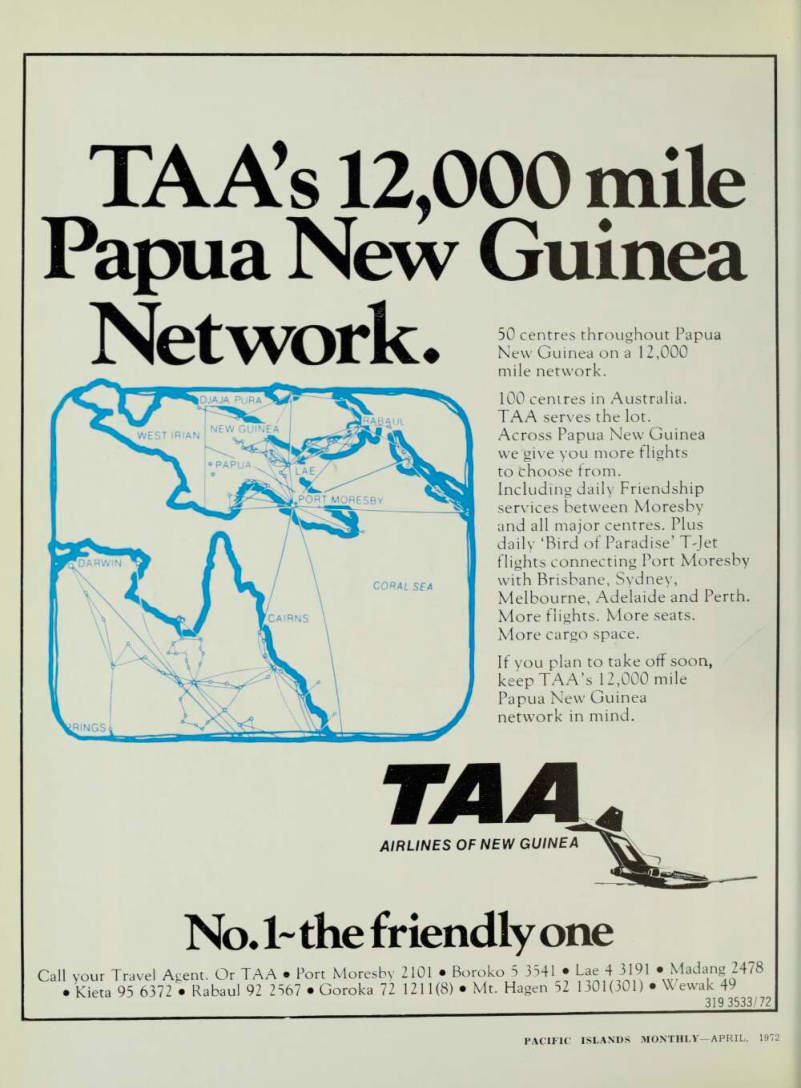 2
2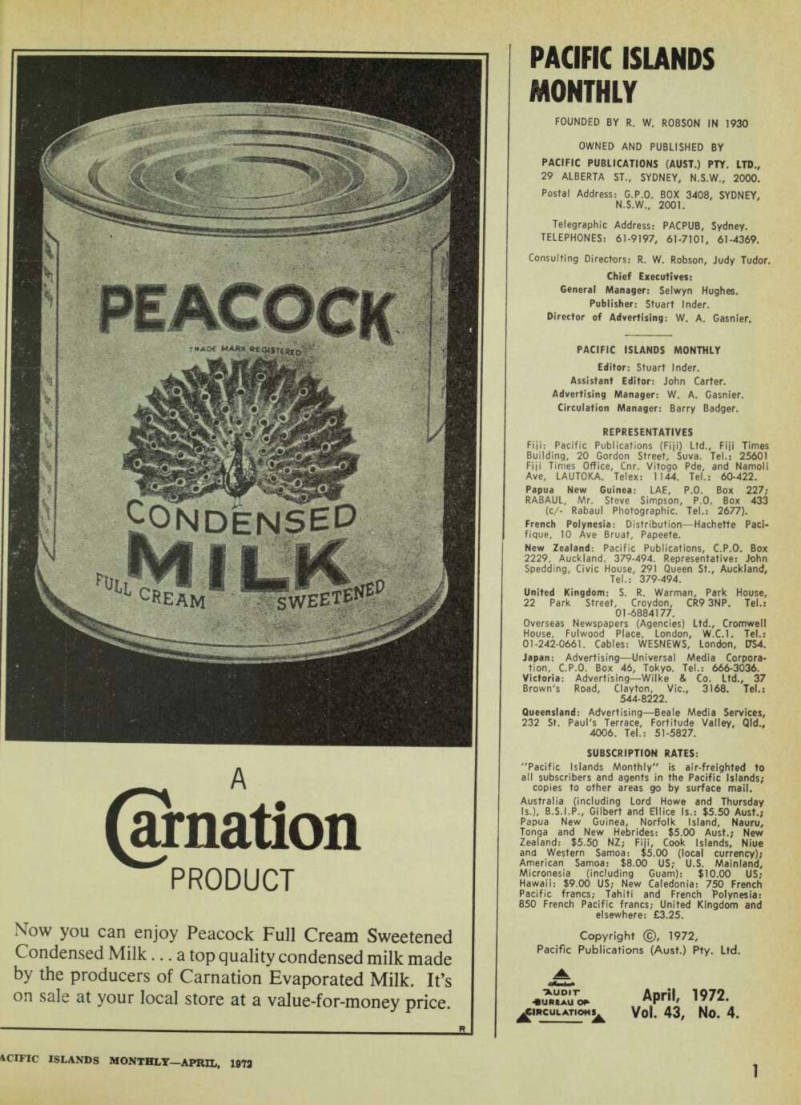 3
3 4
4 5
5 6
6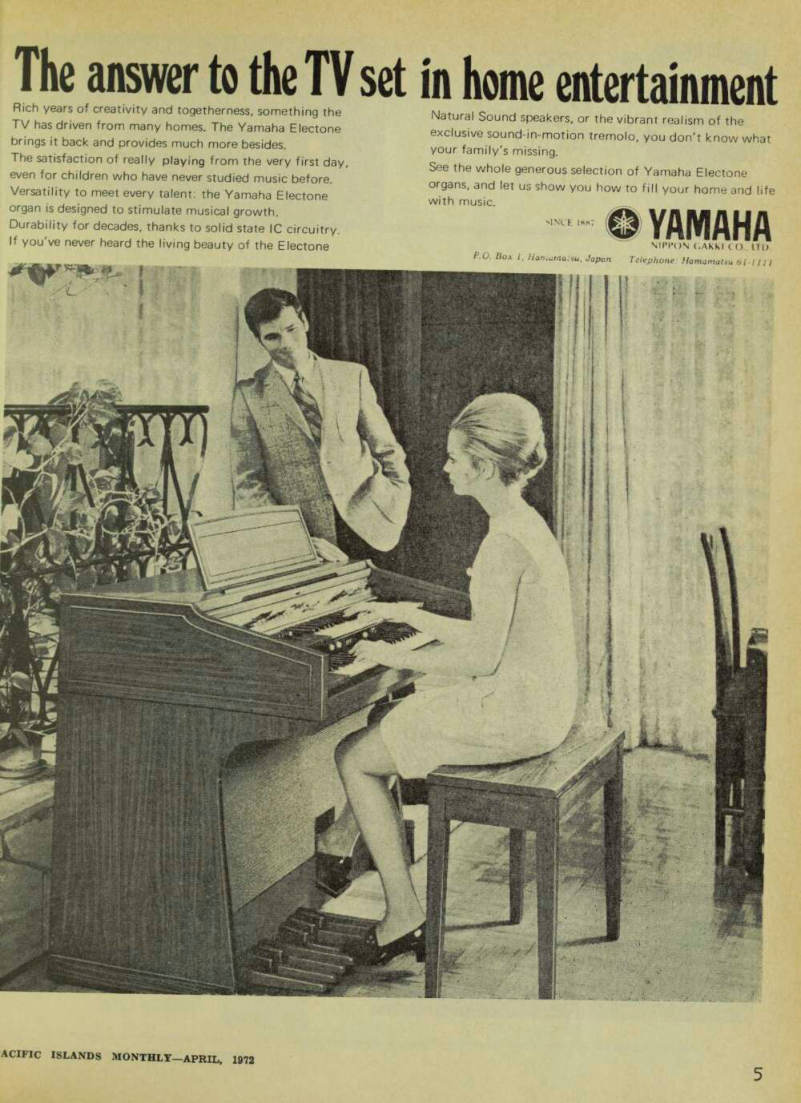 7
7 8
8 9
9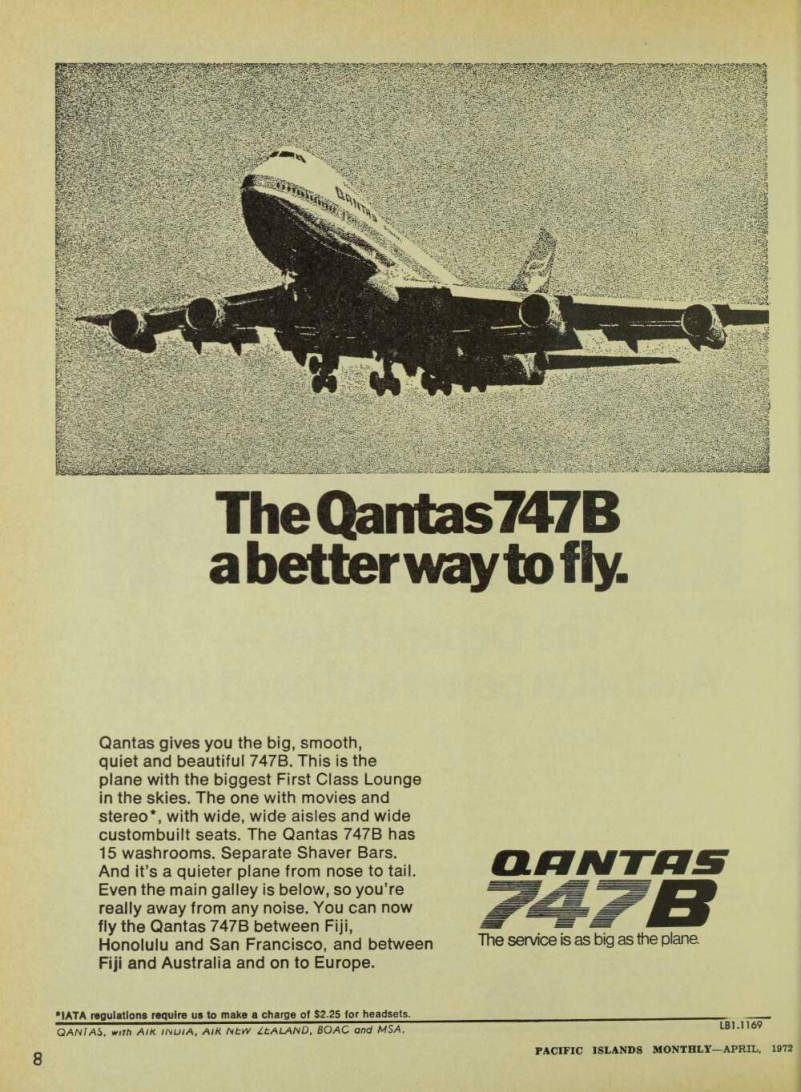 10
10 11
11 12
12 13
13 14
14 15
15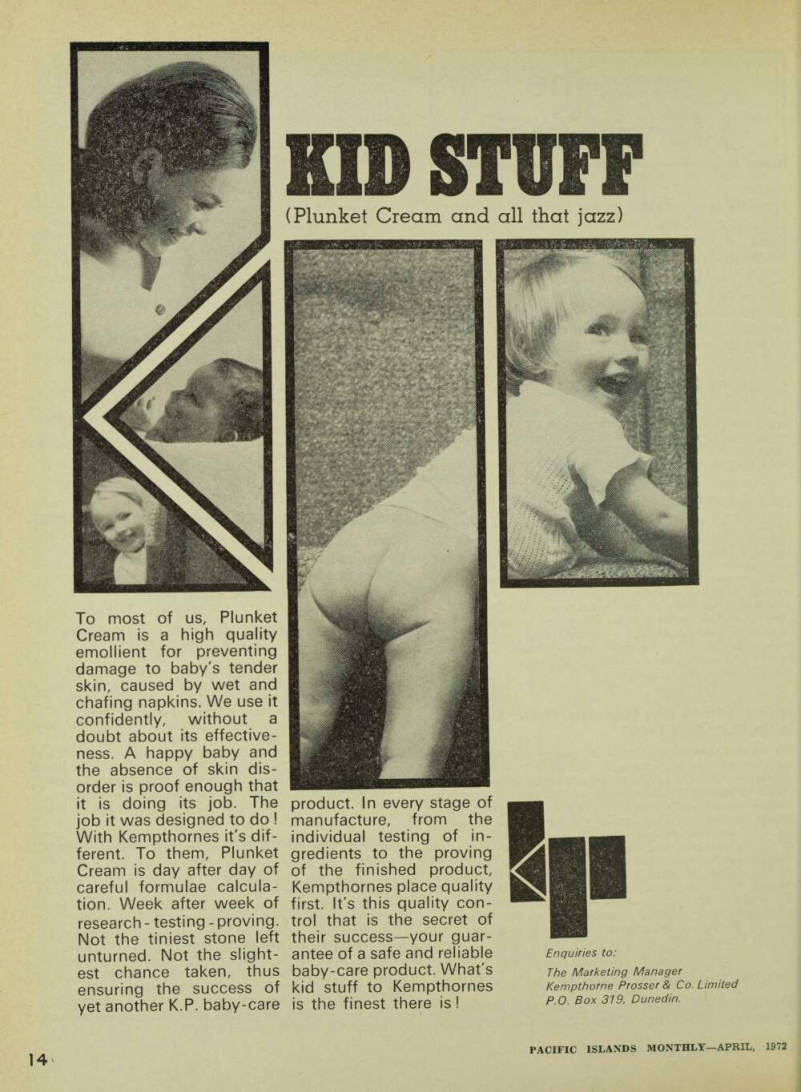 16
16 17
17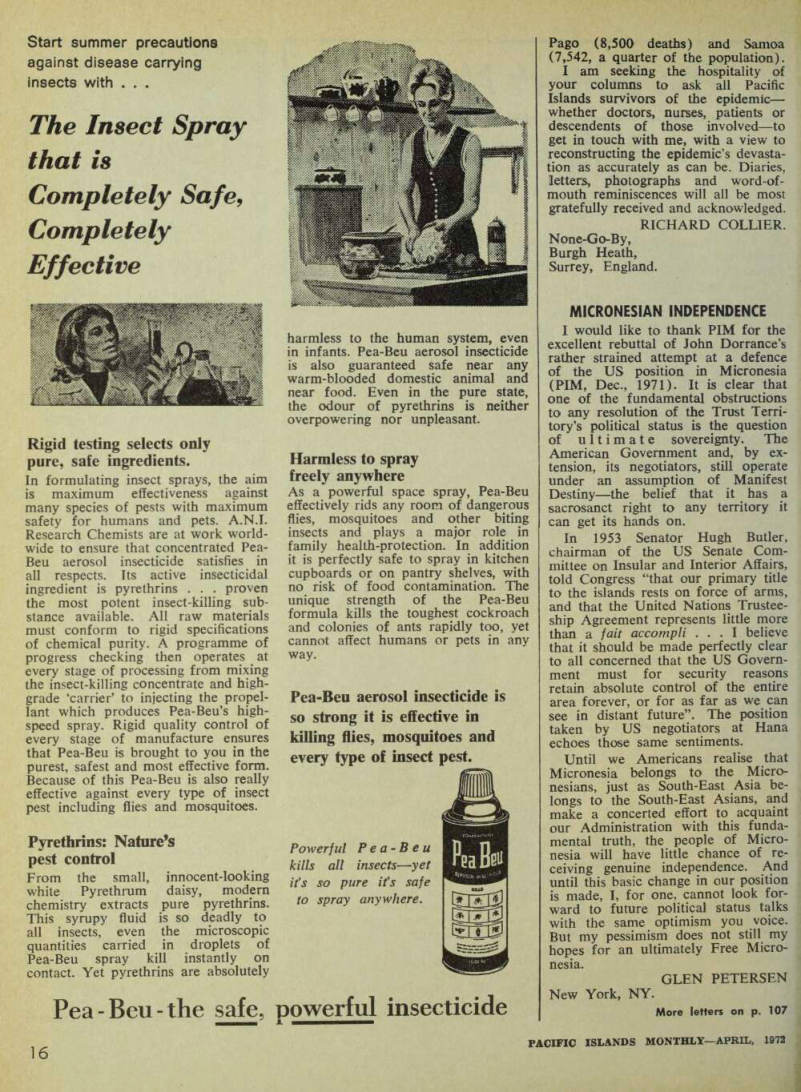 18
18 19
19 20
20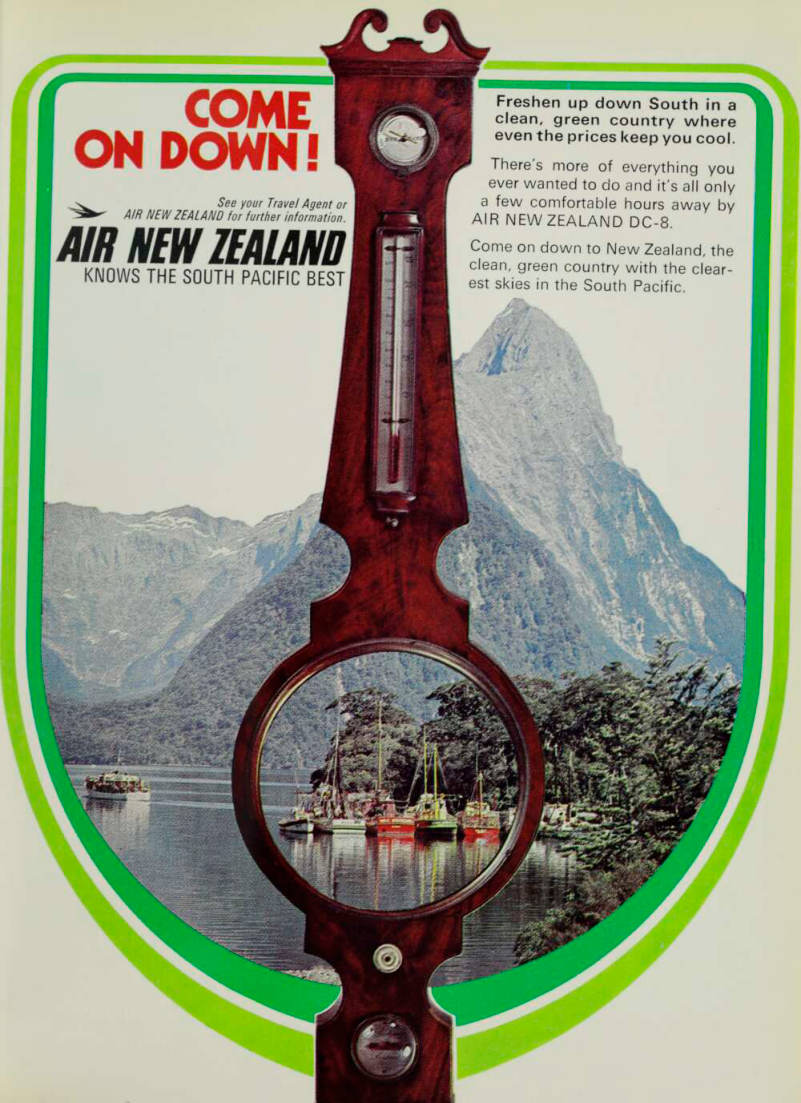 21
21 22
22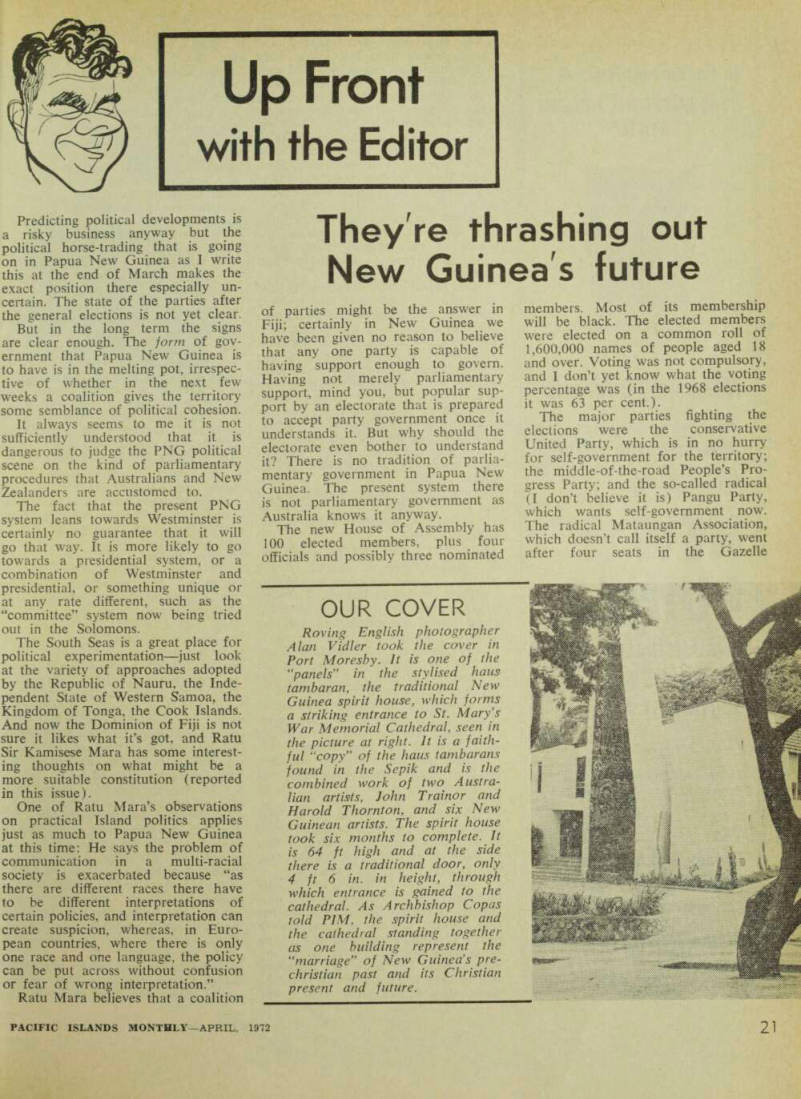 23
23 24
24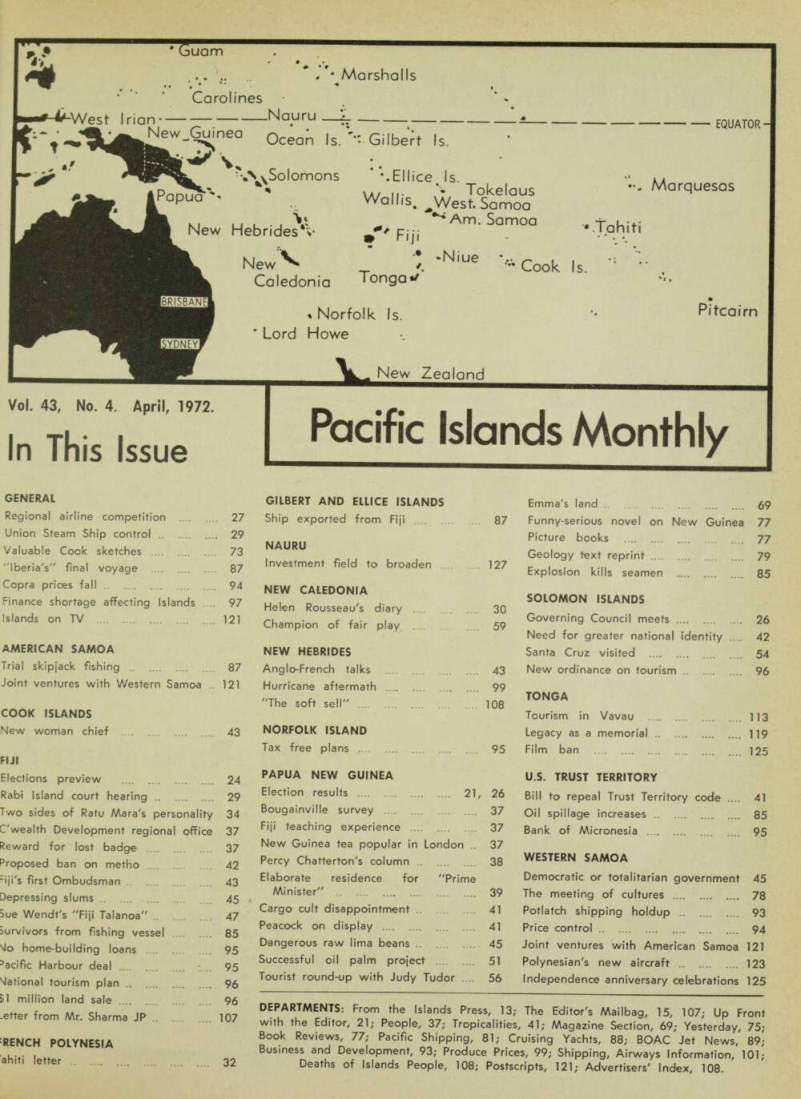 25
25 26
26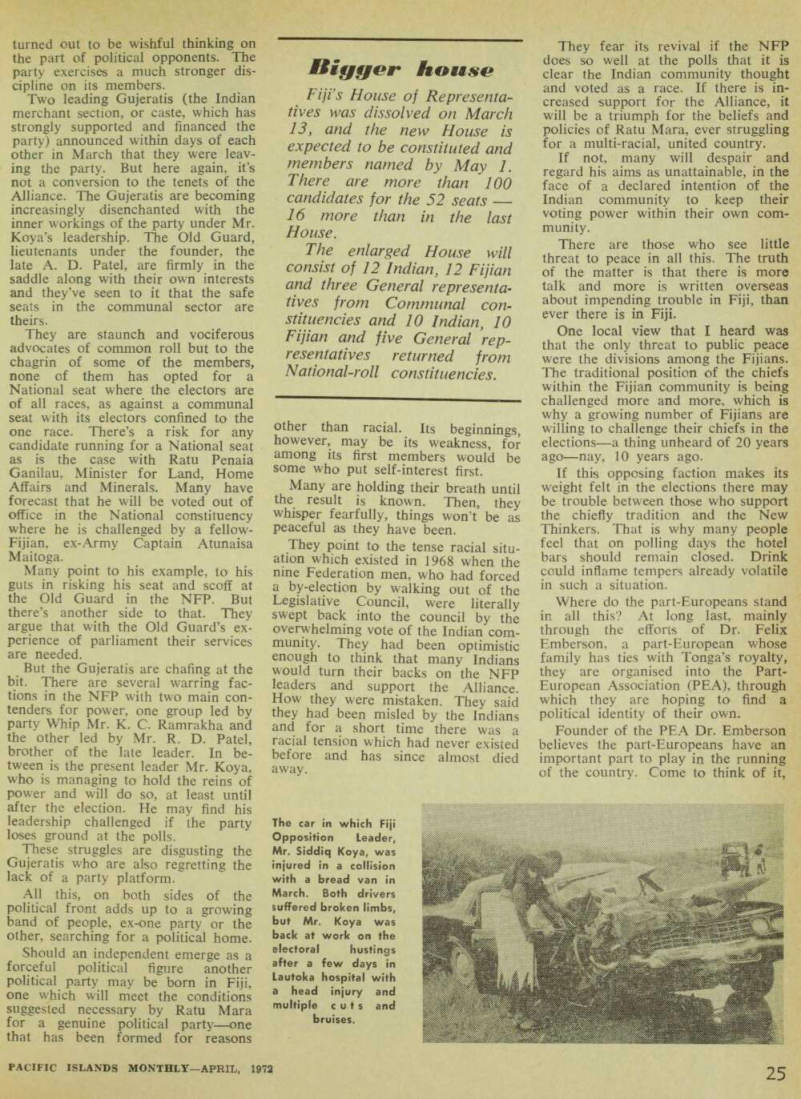 27
27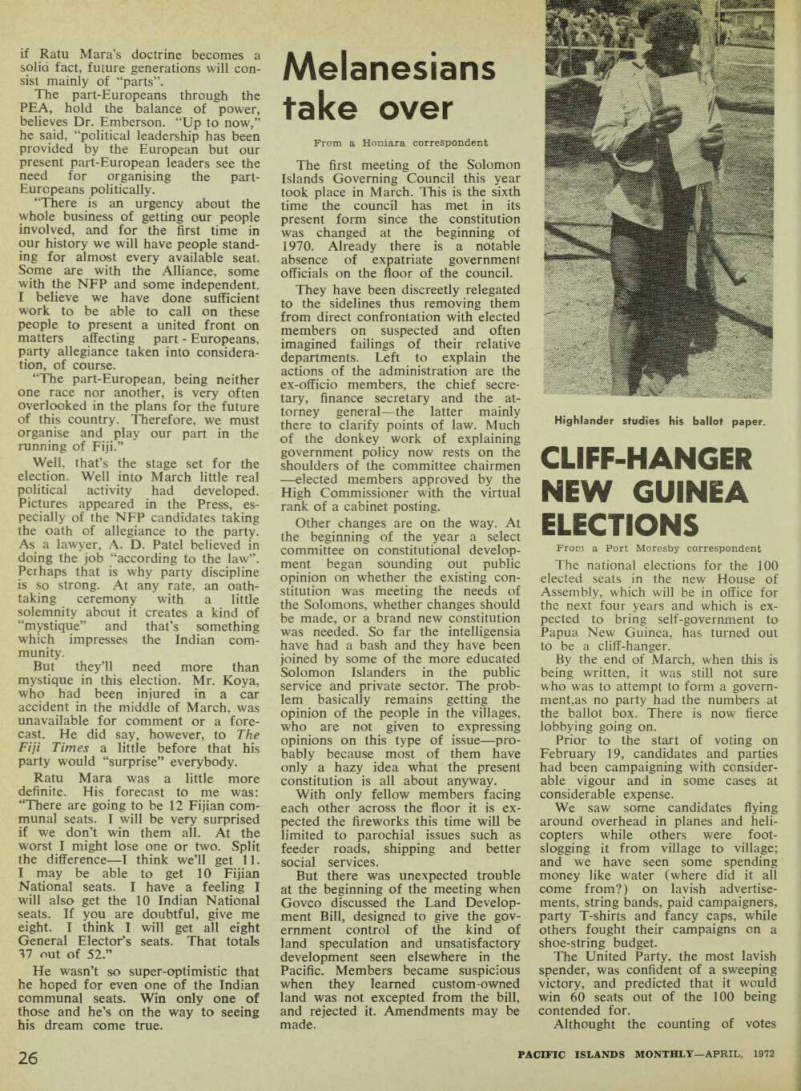 28
28 29
29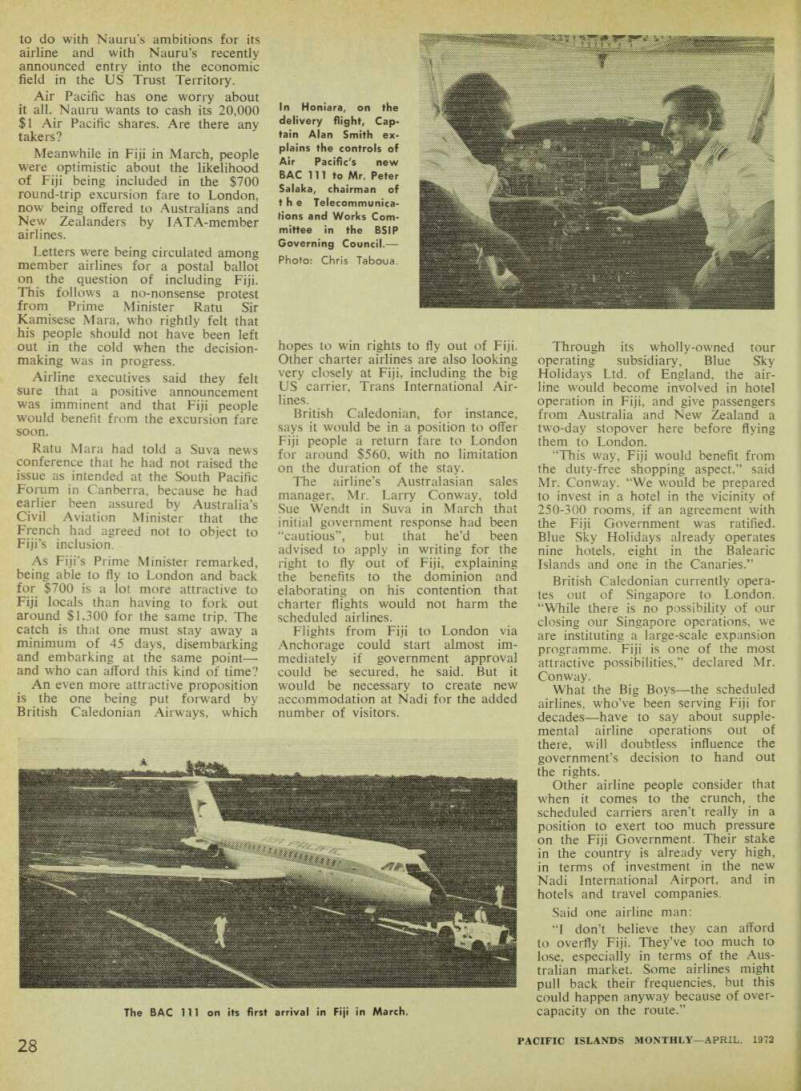 30
30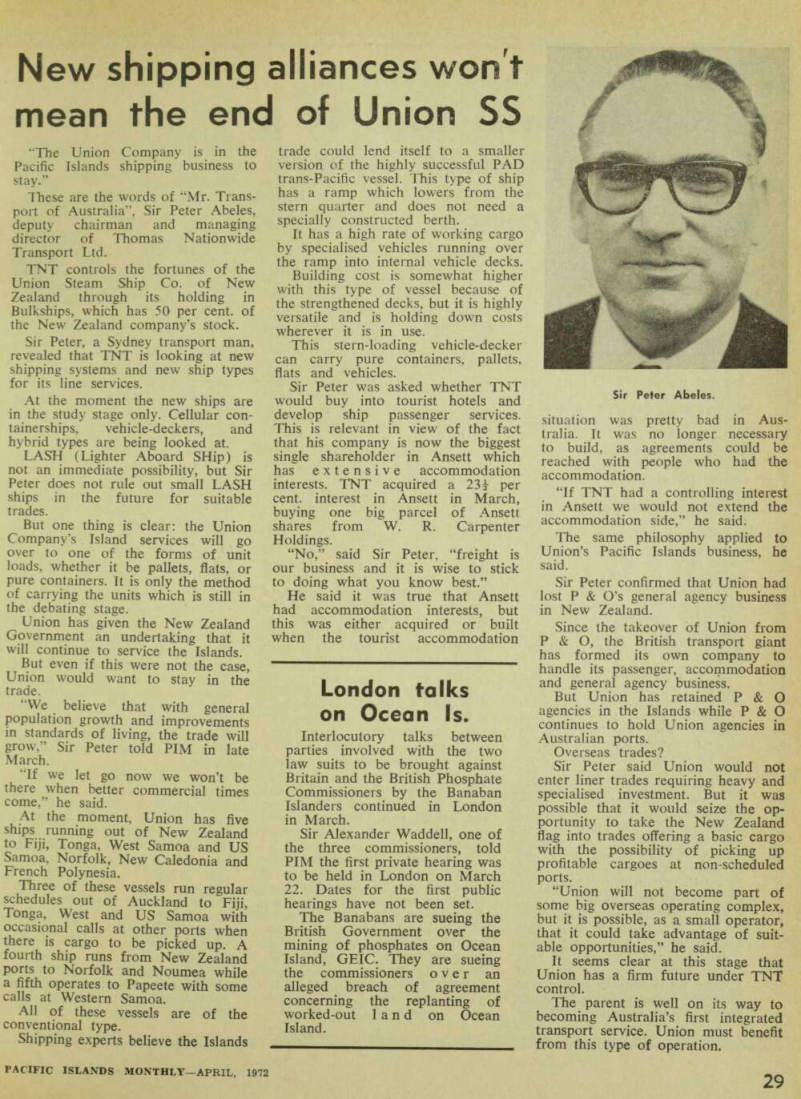 31
31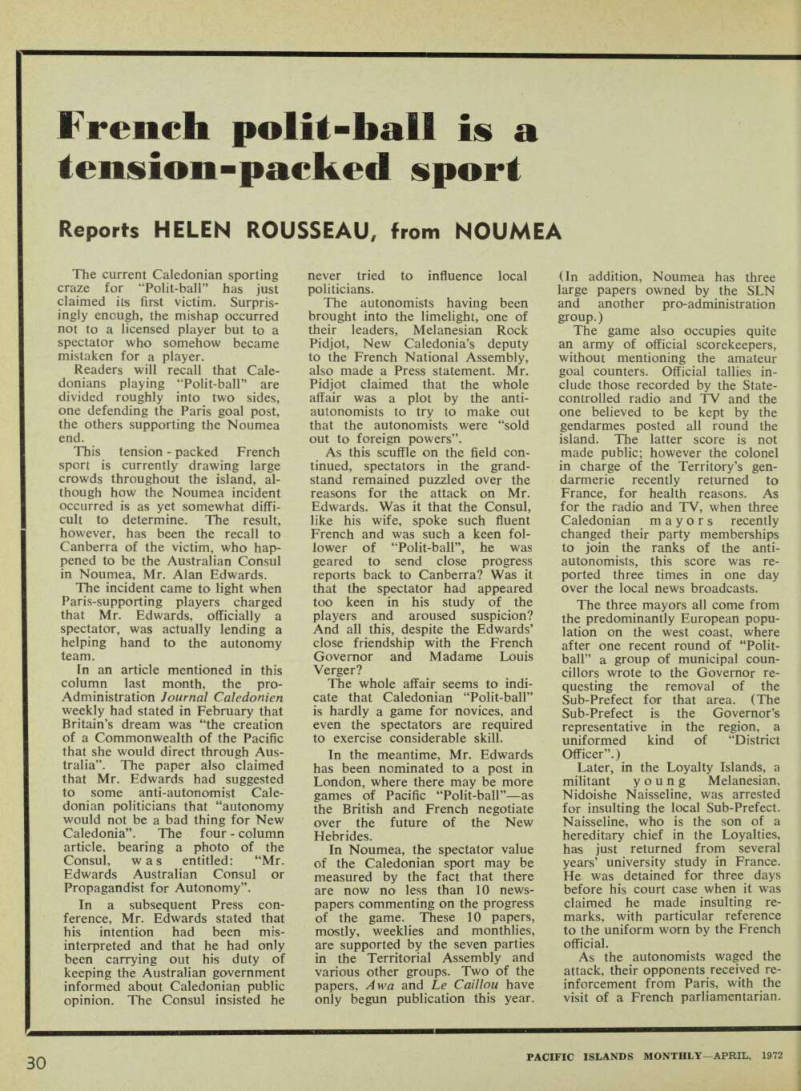 32
32 33
33 34
34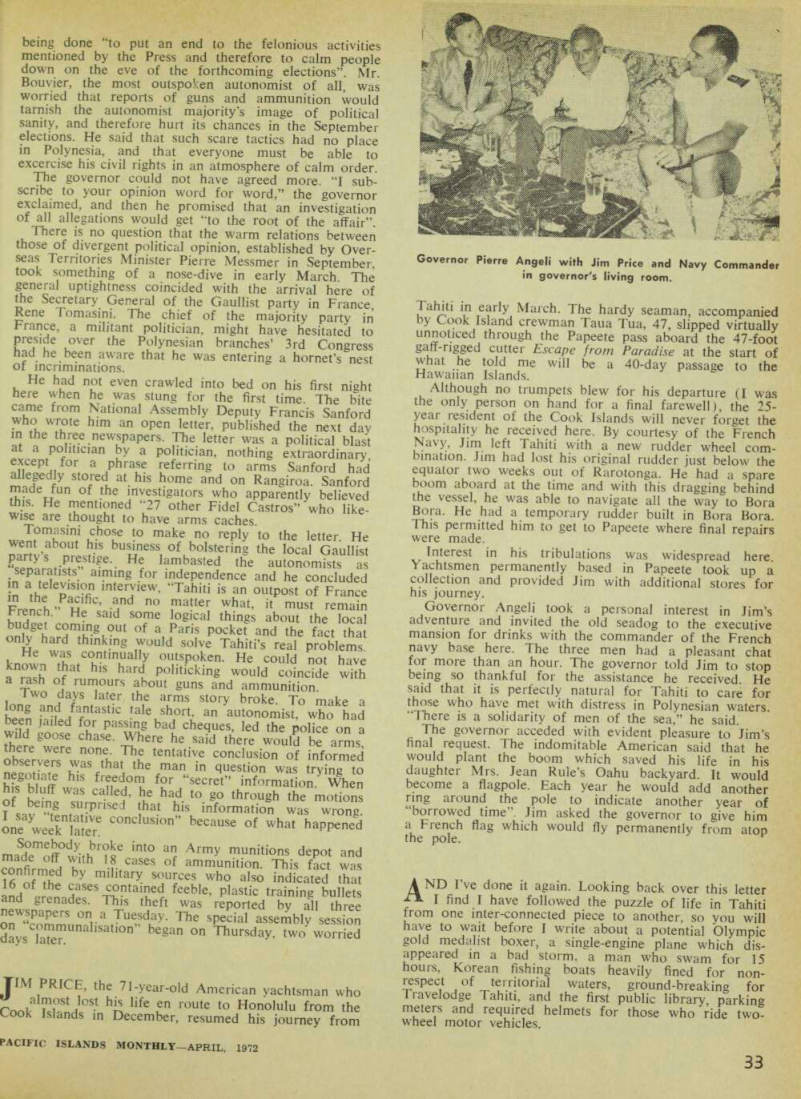 35
35 36
36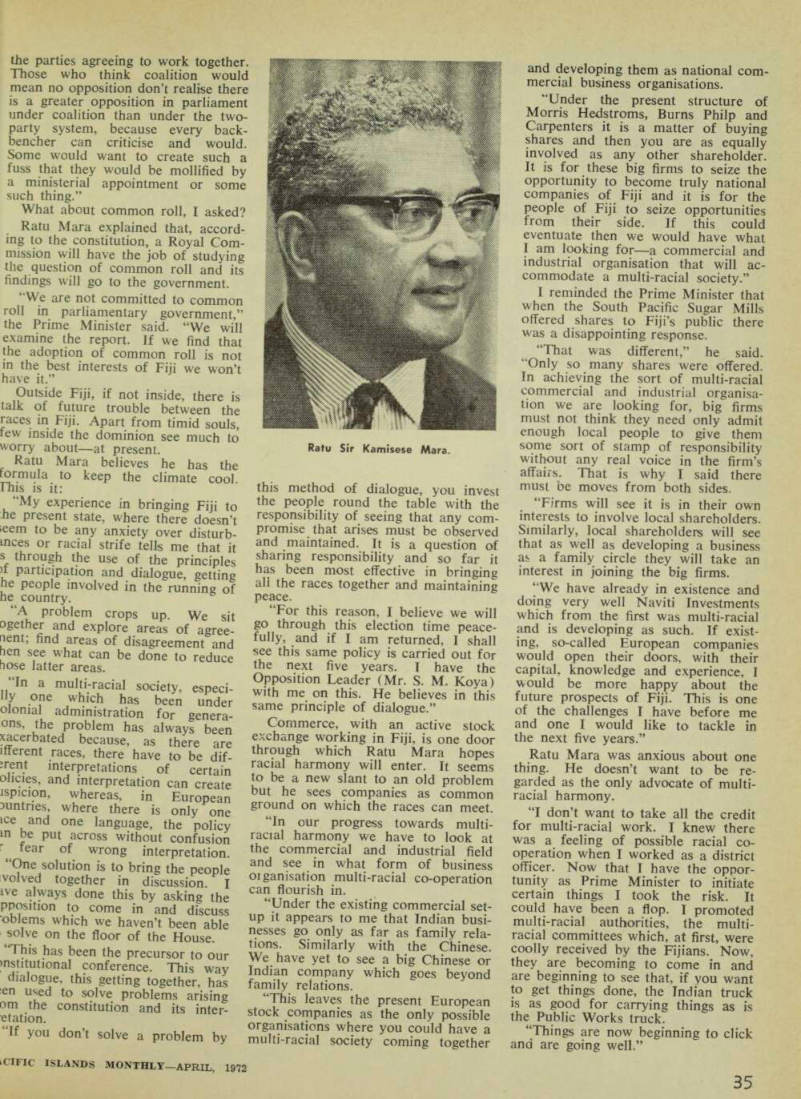 37
37 38
38 39
39 40
40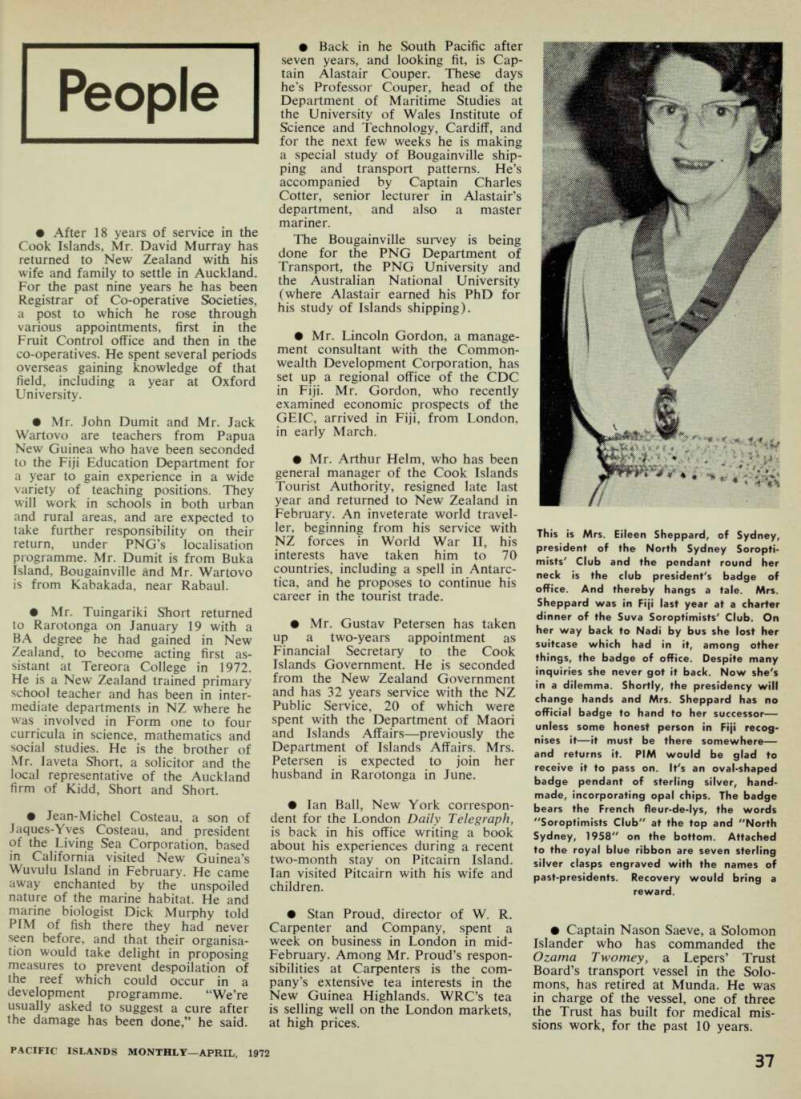 41
41 42
42 43
43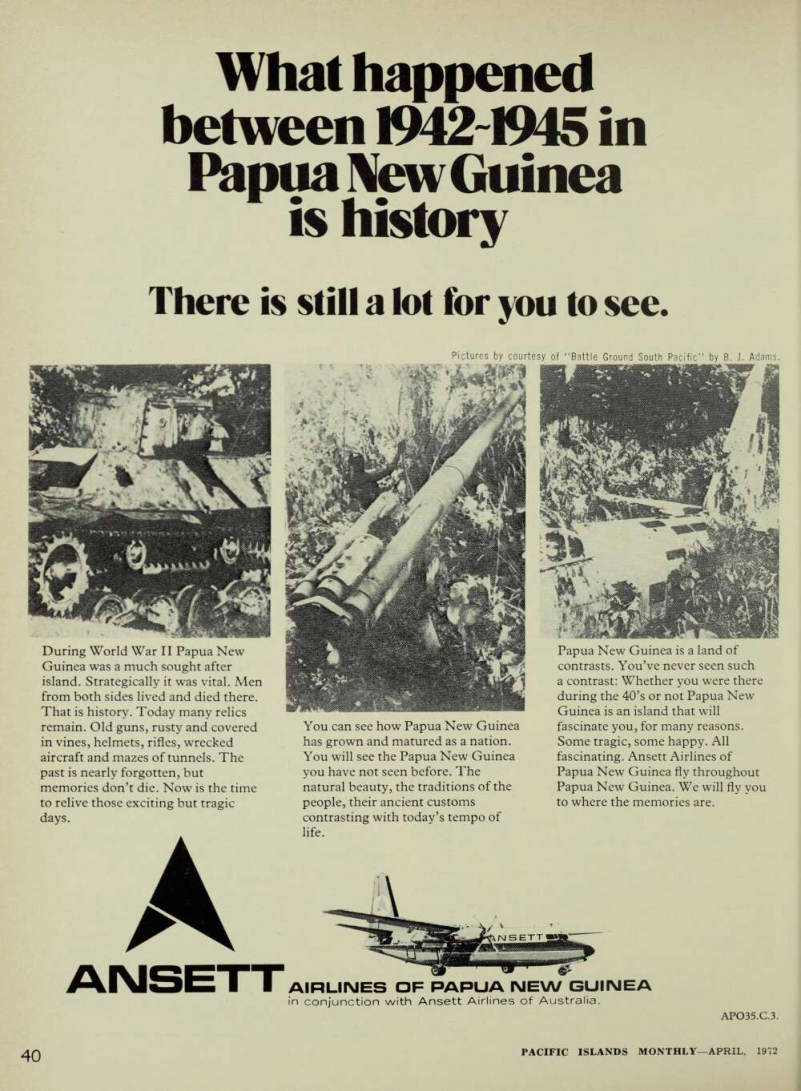 44
44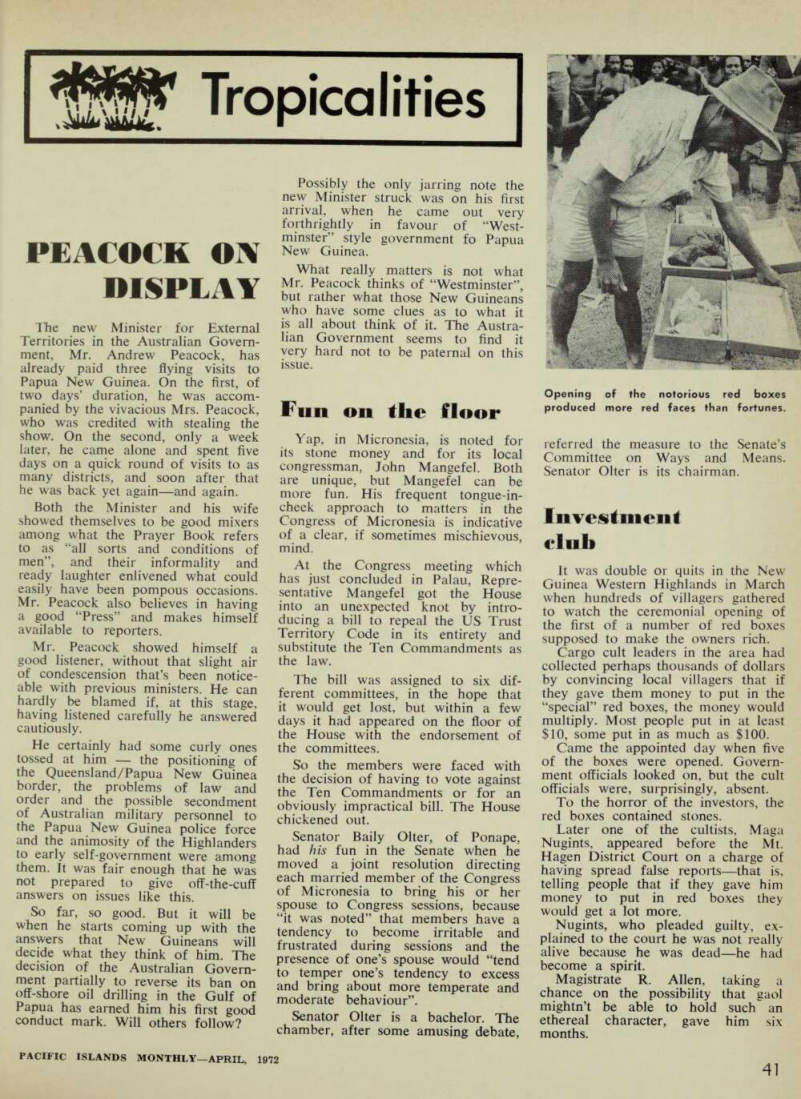 45
45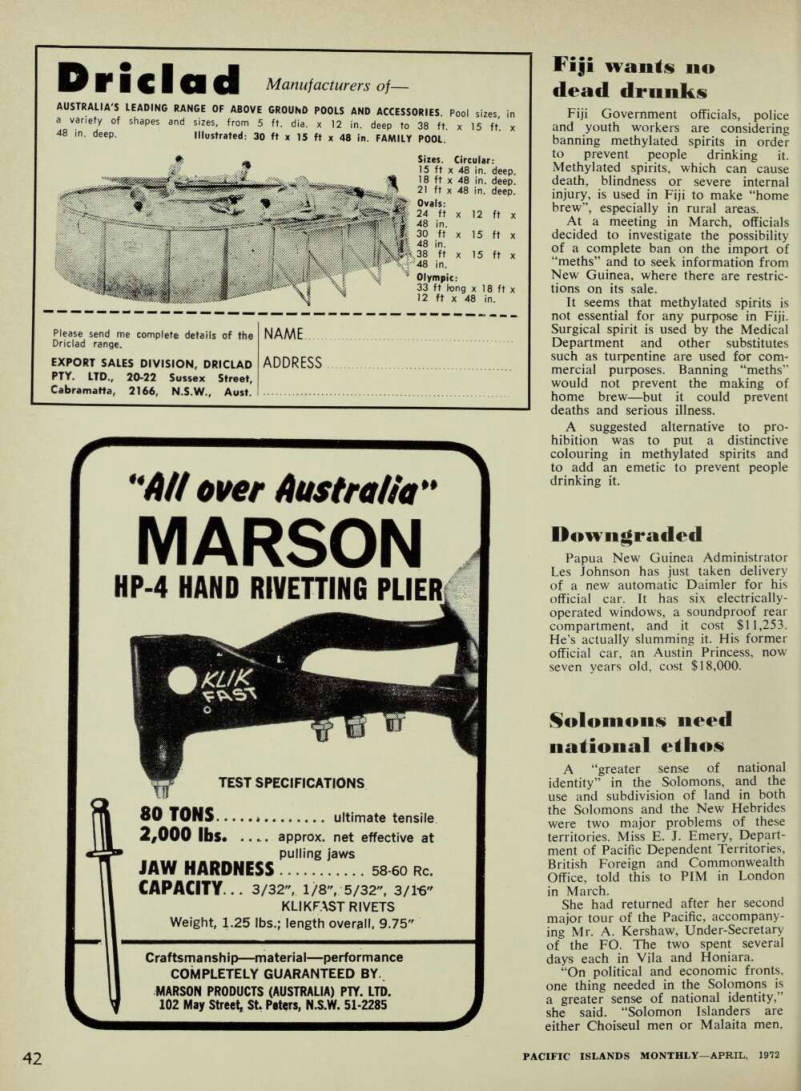 46
46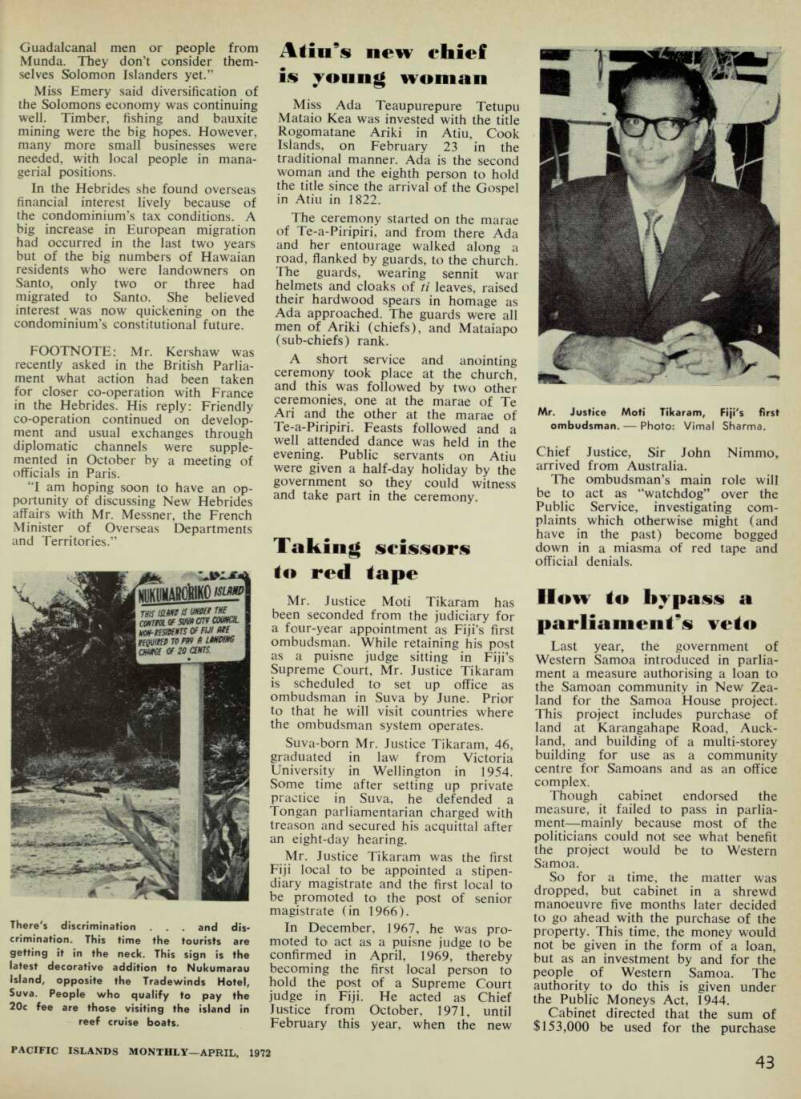 47
47 48
48 49
49 50
50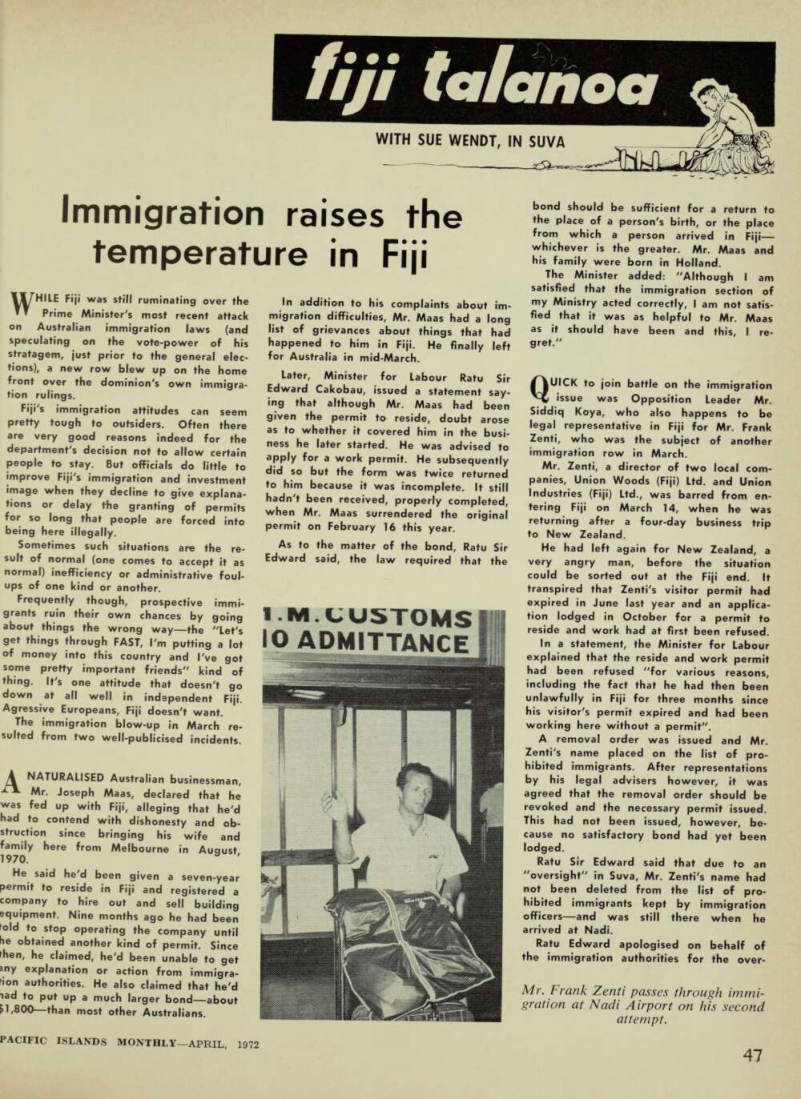 51
51 52
52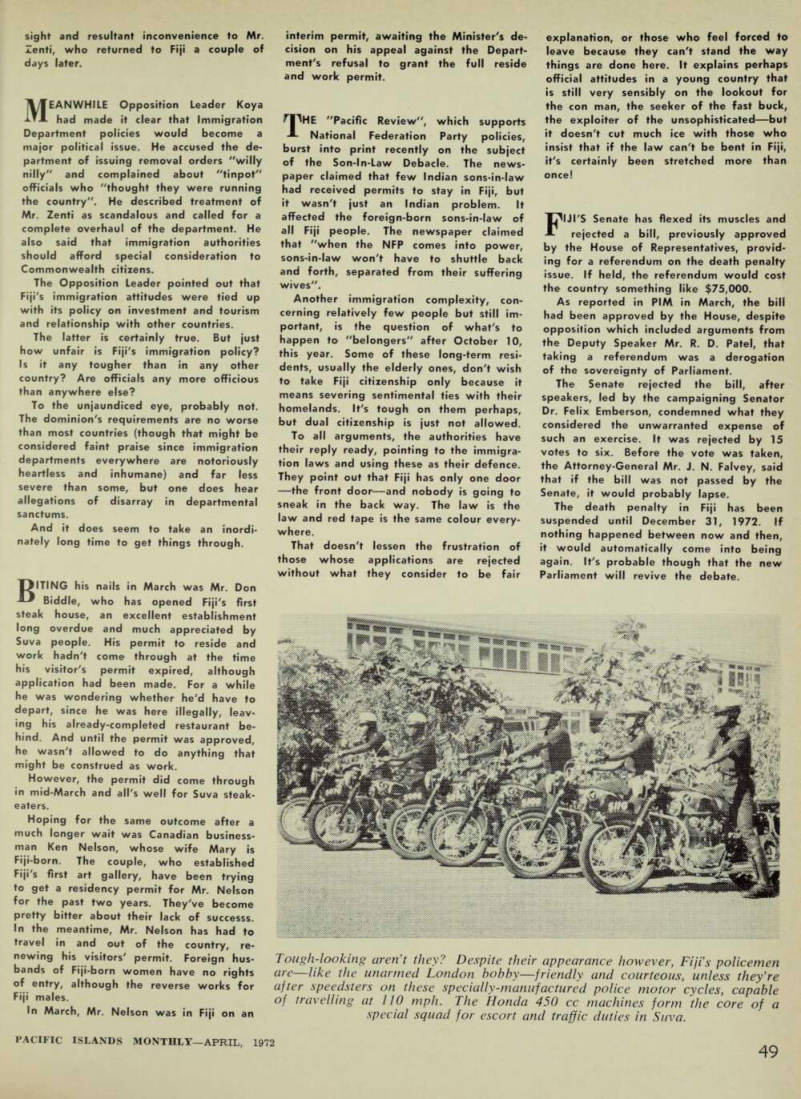 53
53 54
54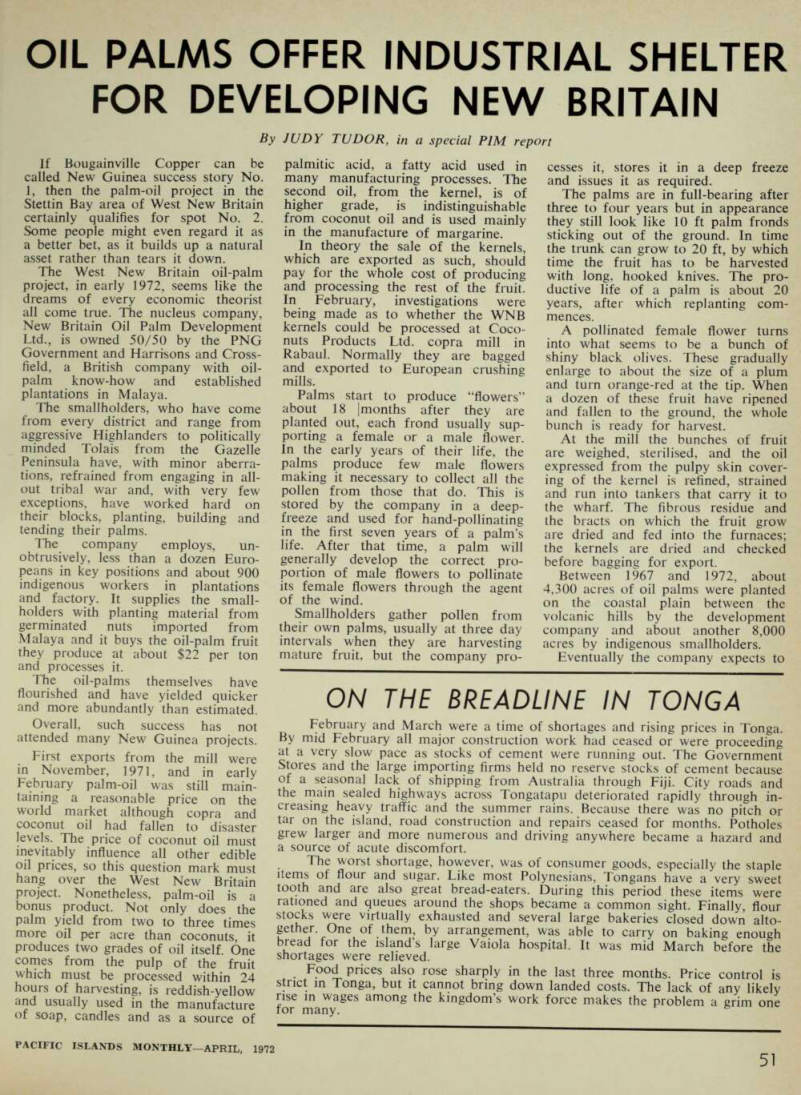 55
55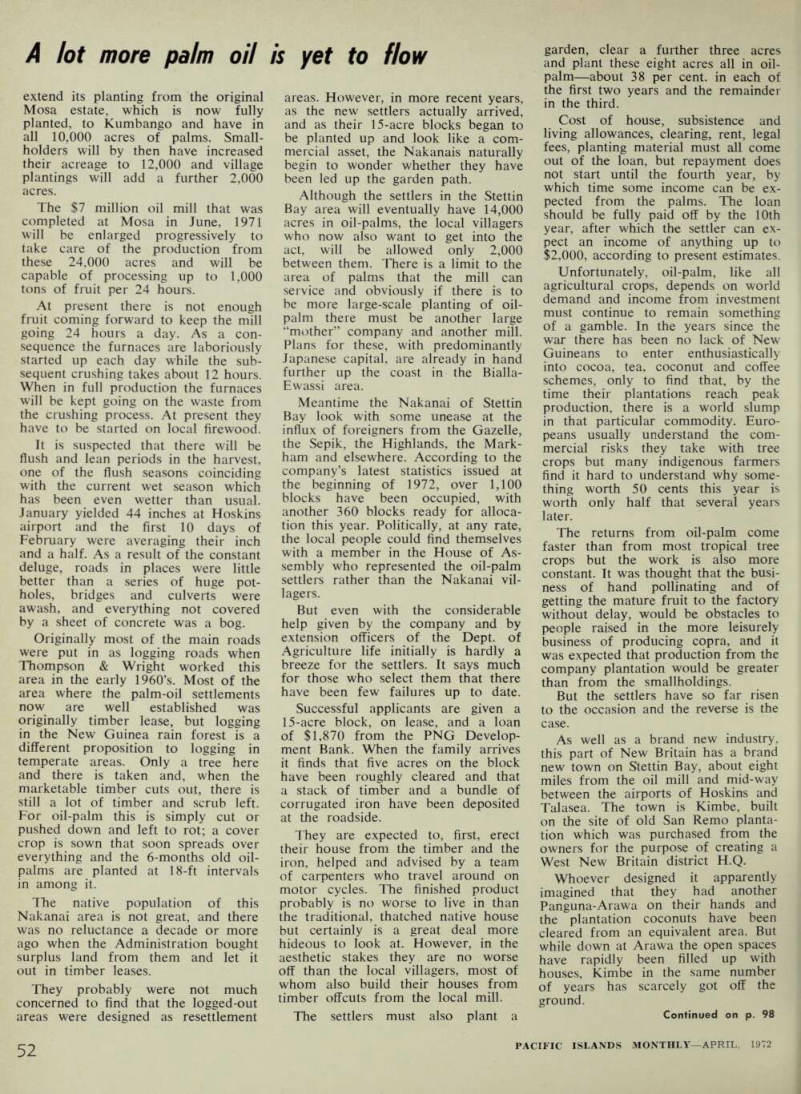 56
56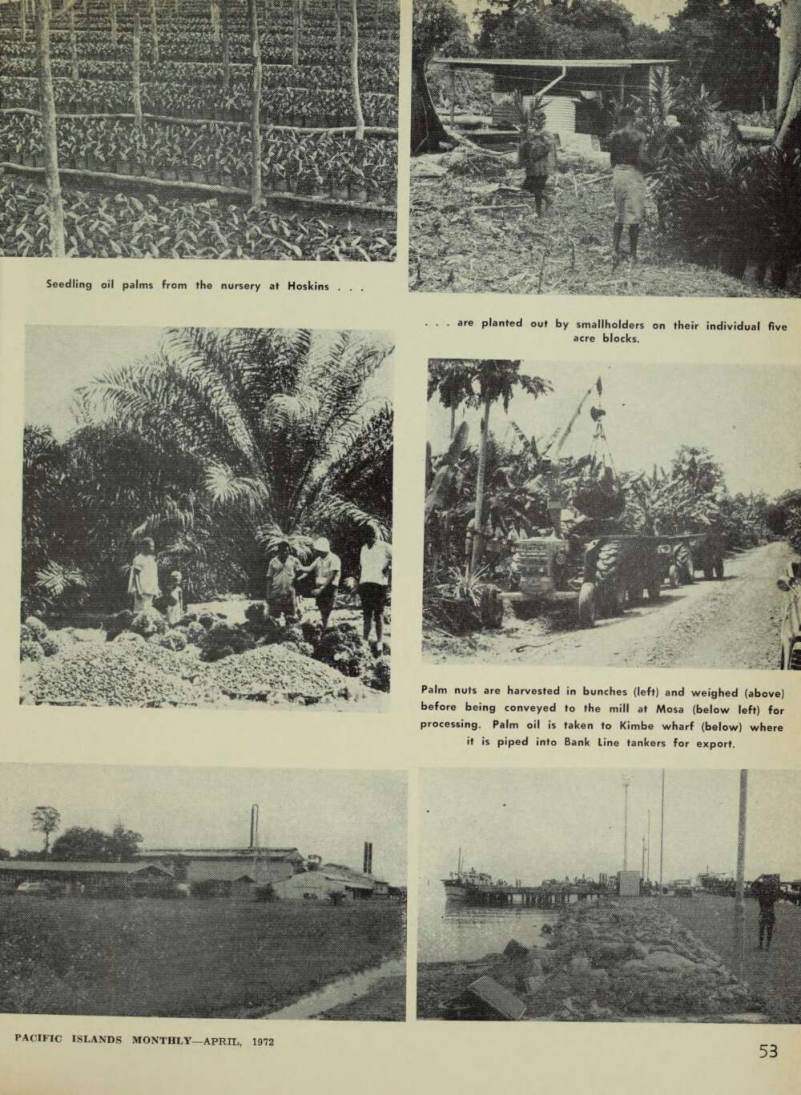 57
57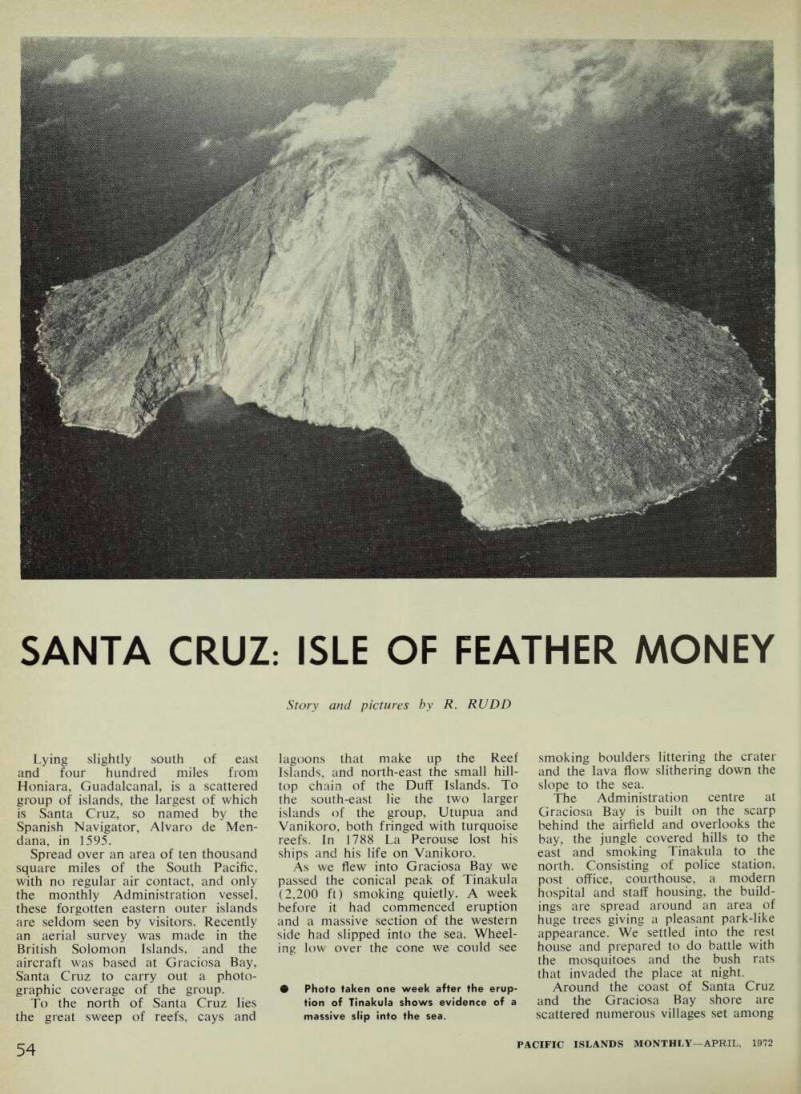 58
58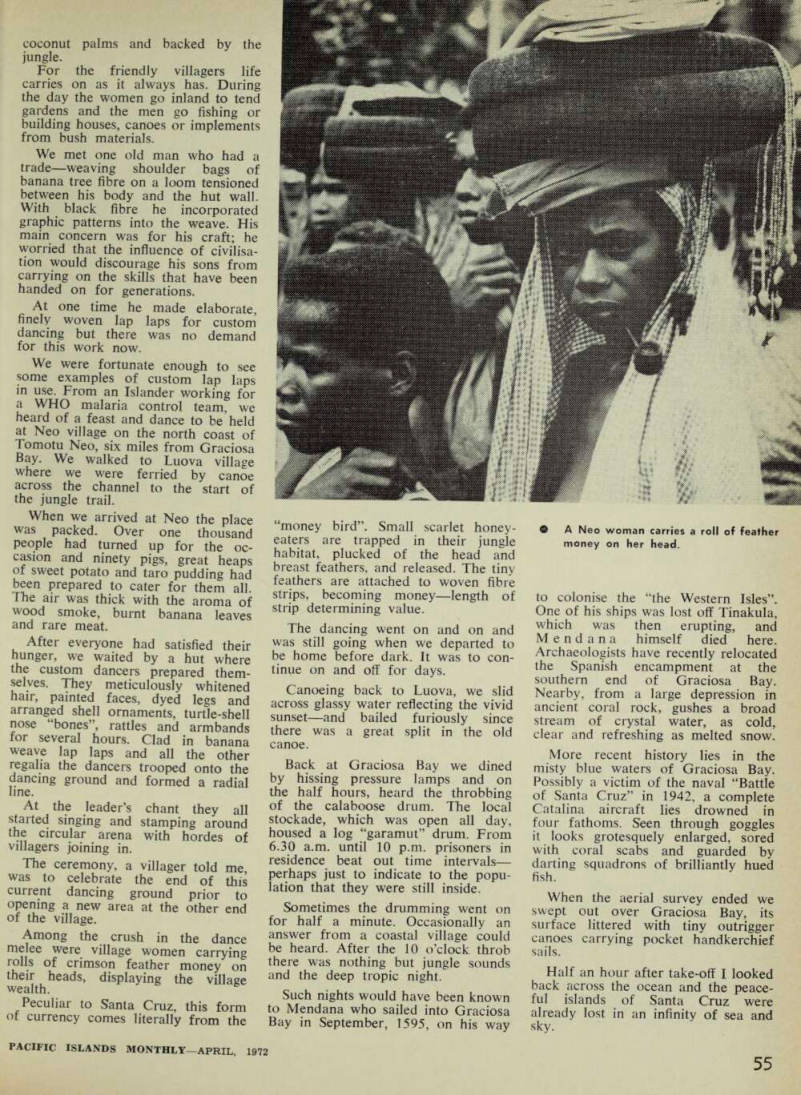 59
59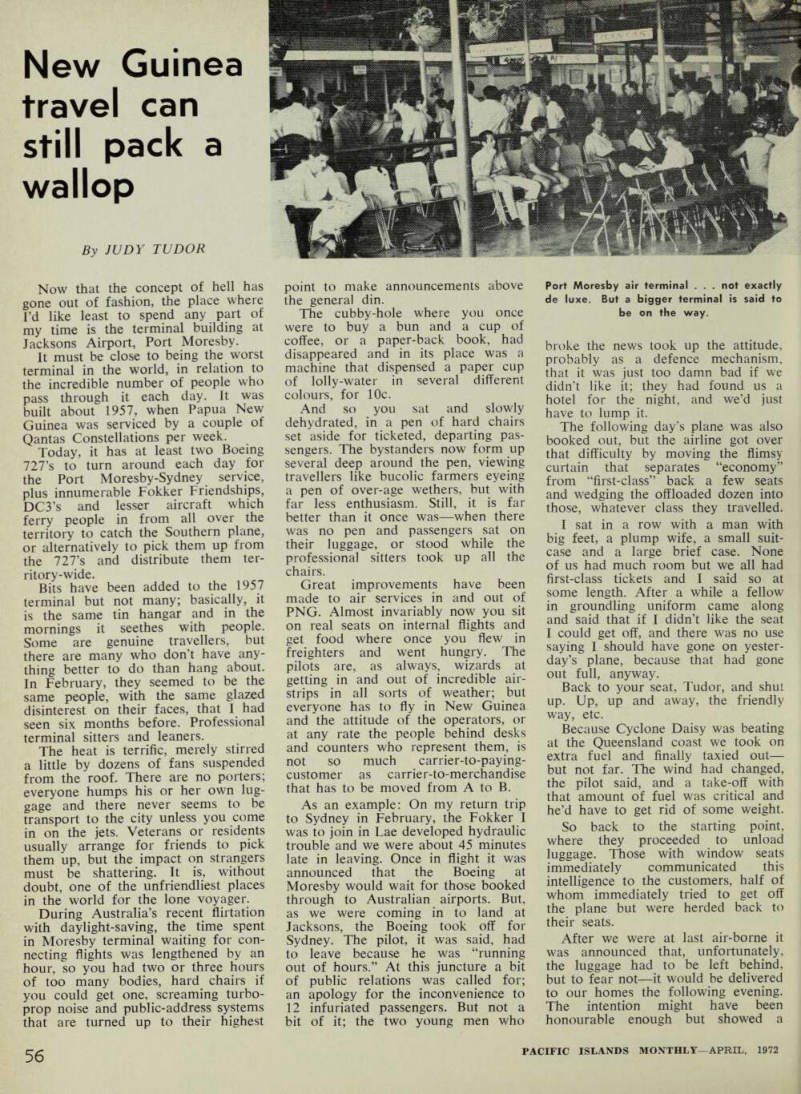 60
60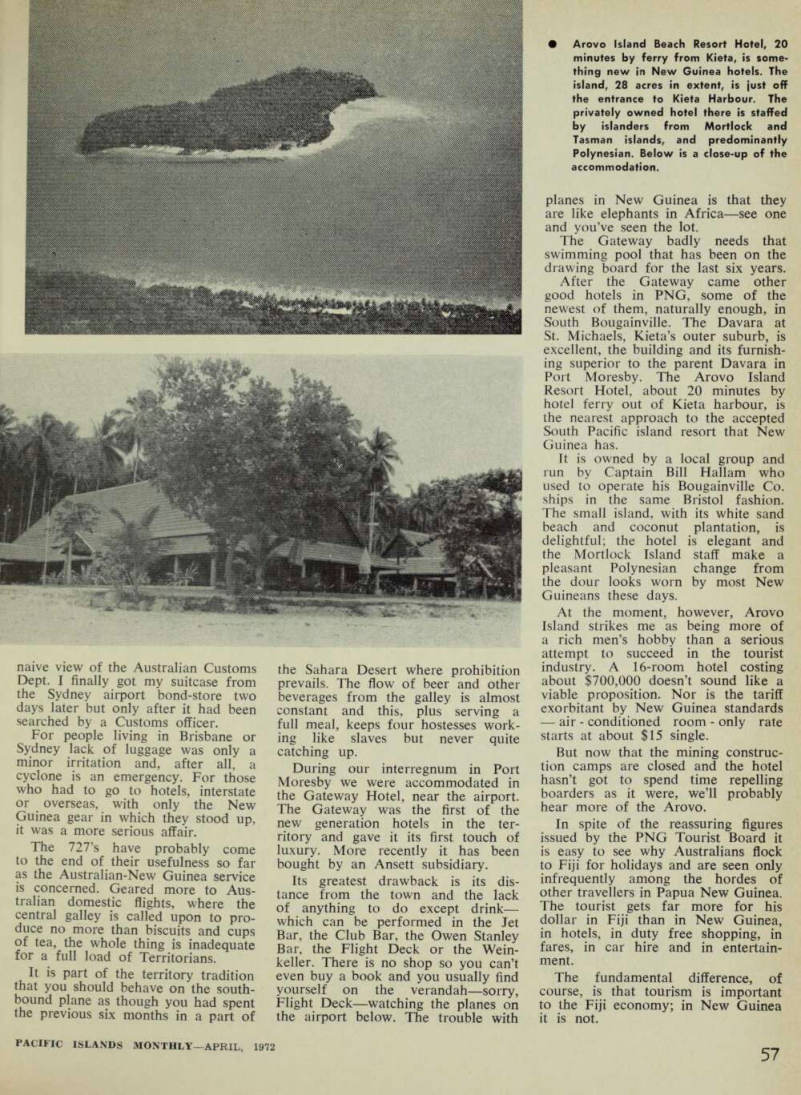 61
61 62
62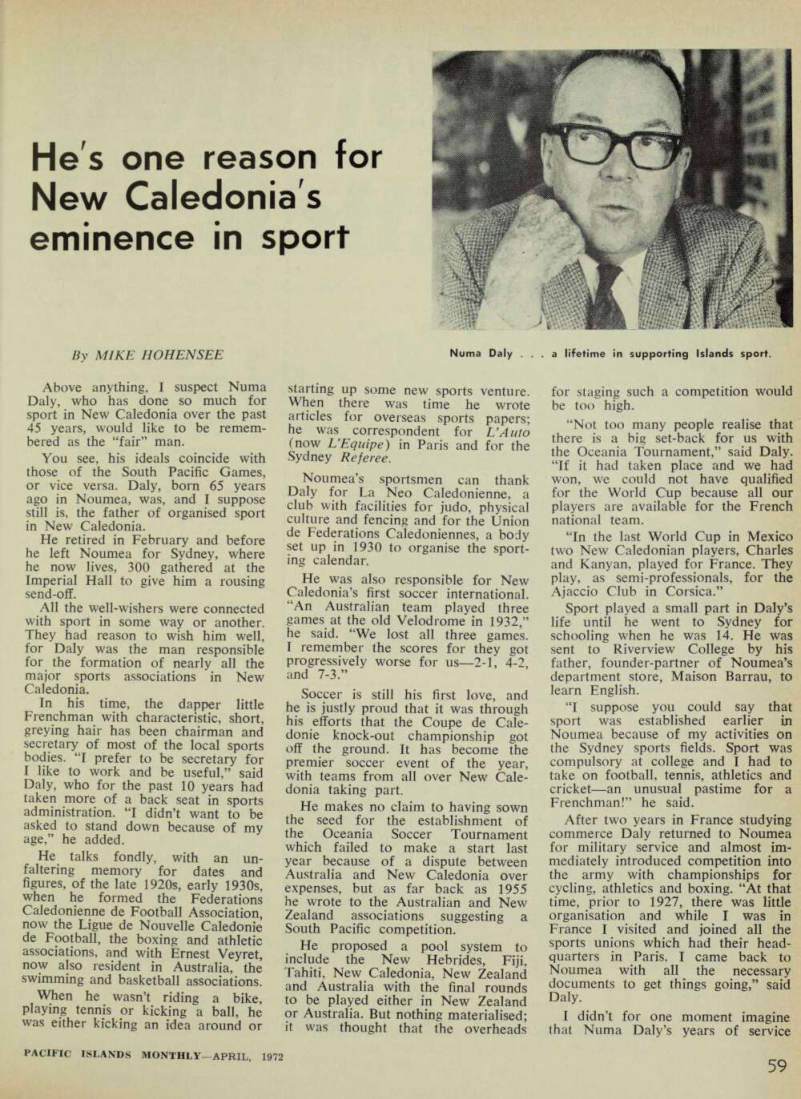 63
63 64
64 65
65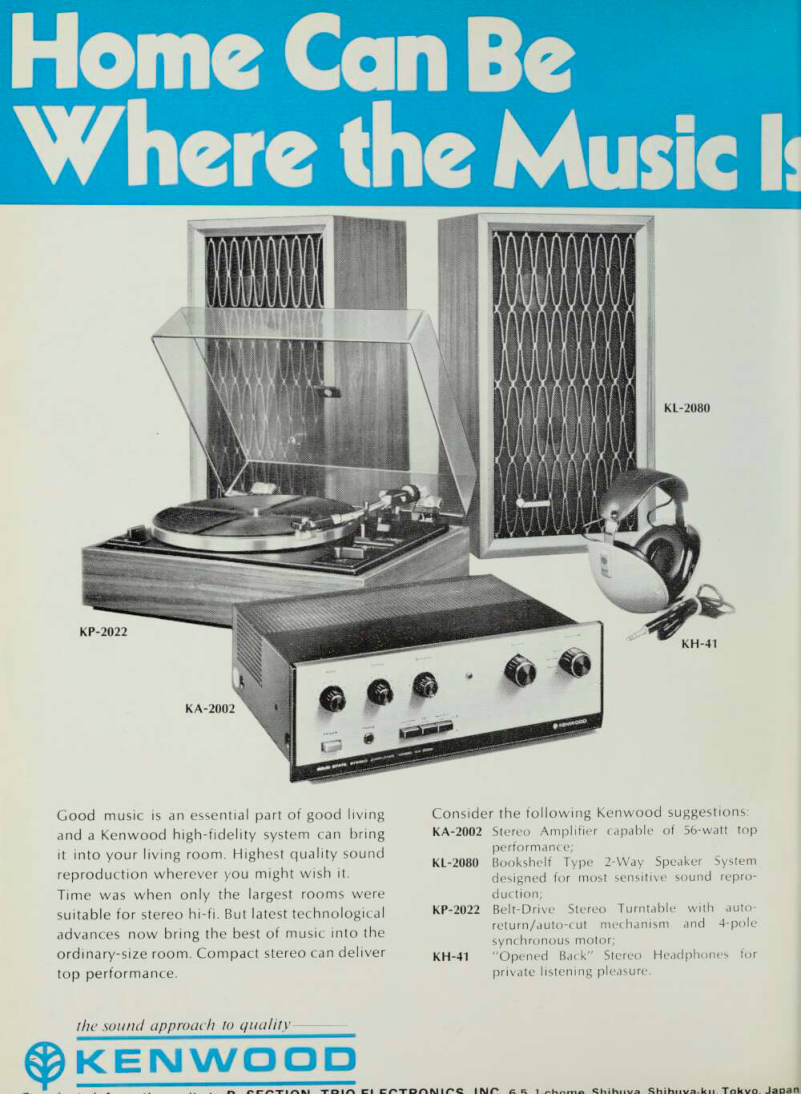 66
66 67
67 68
68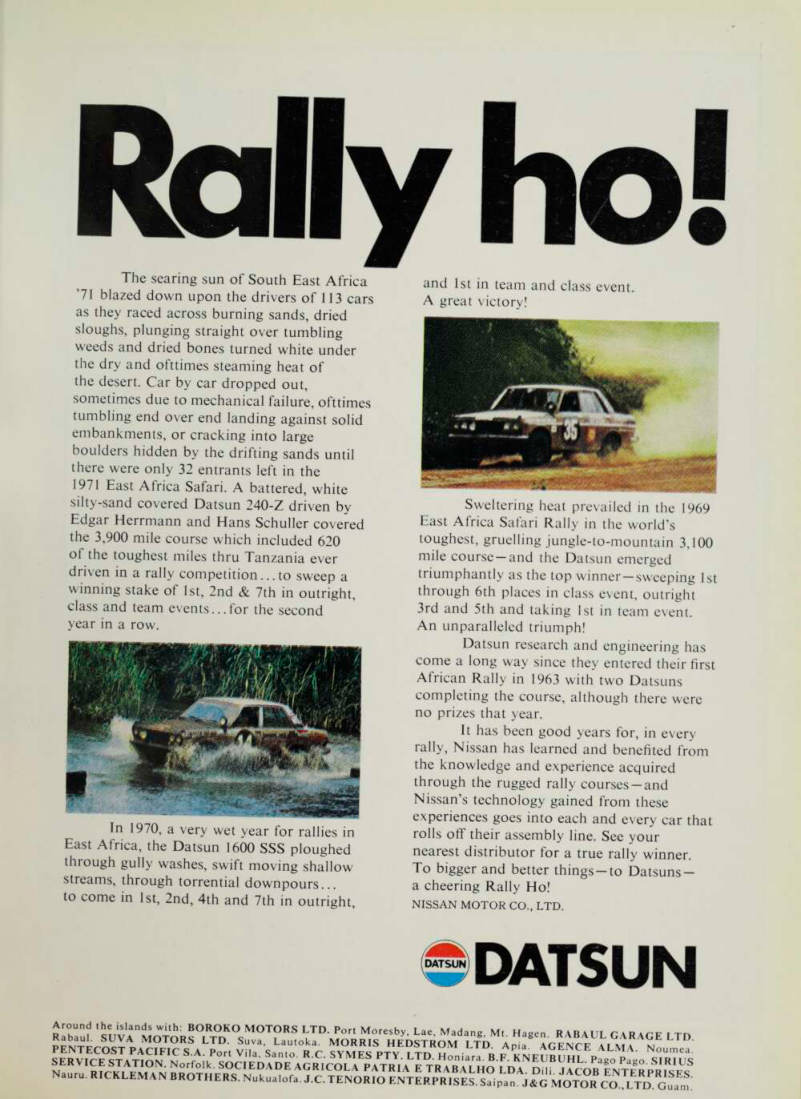 69
69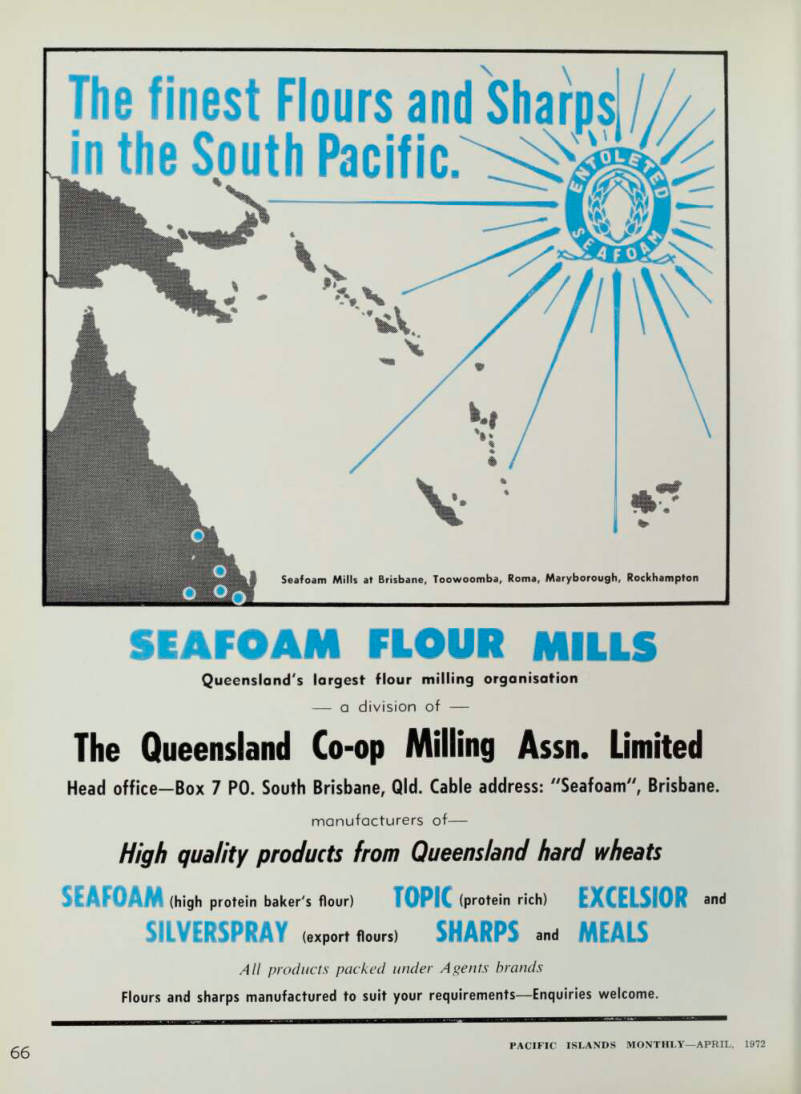 70
70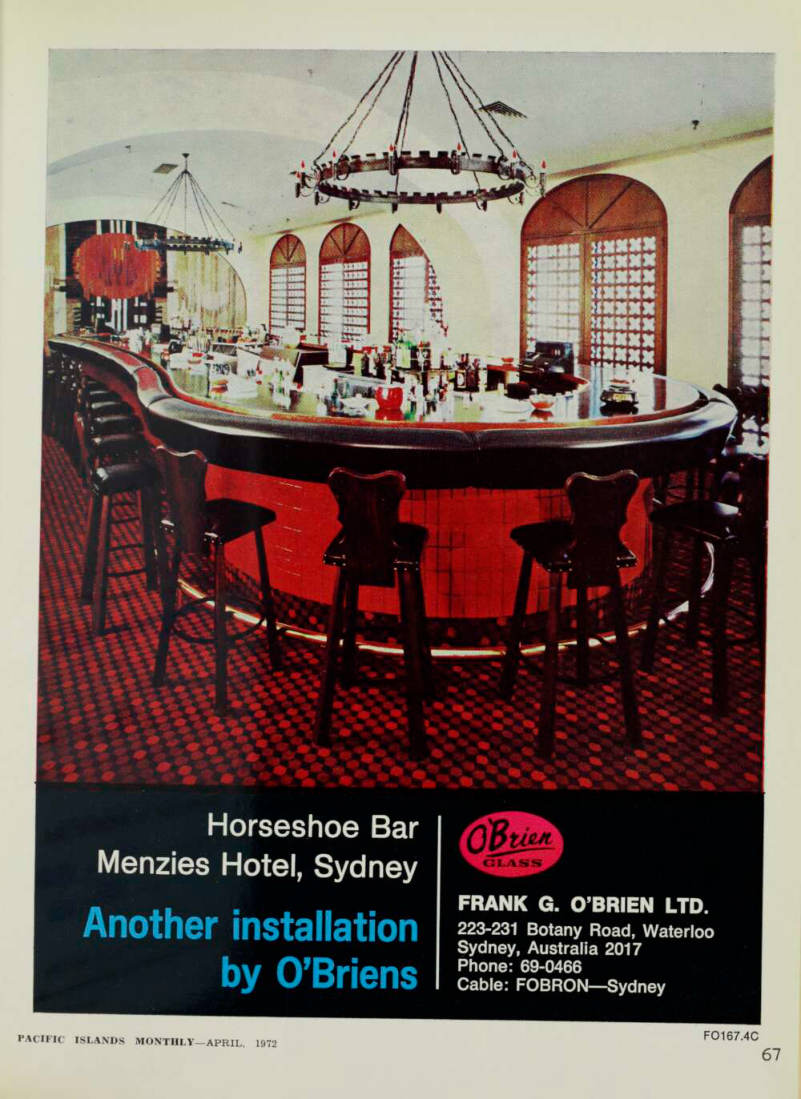 71
71 72
72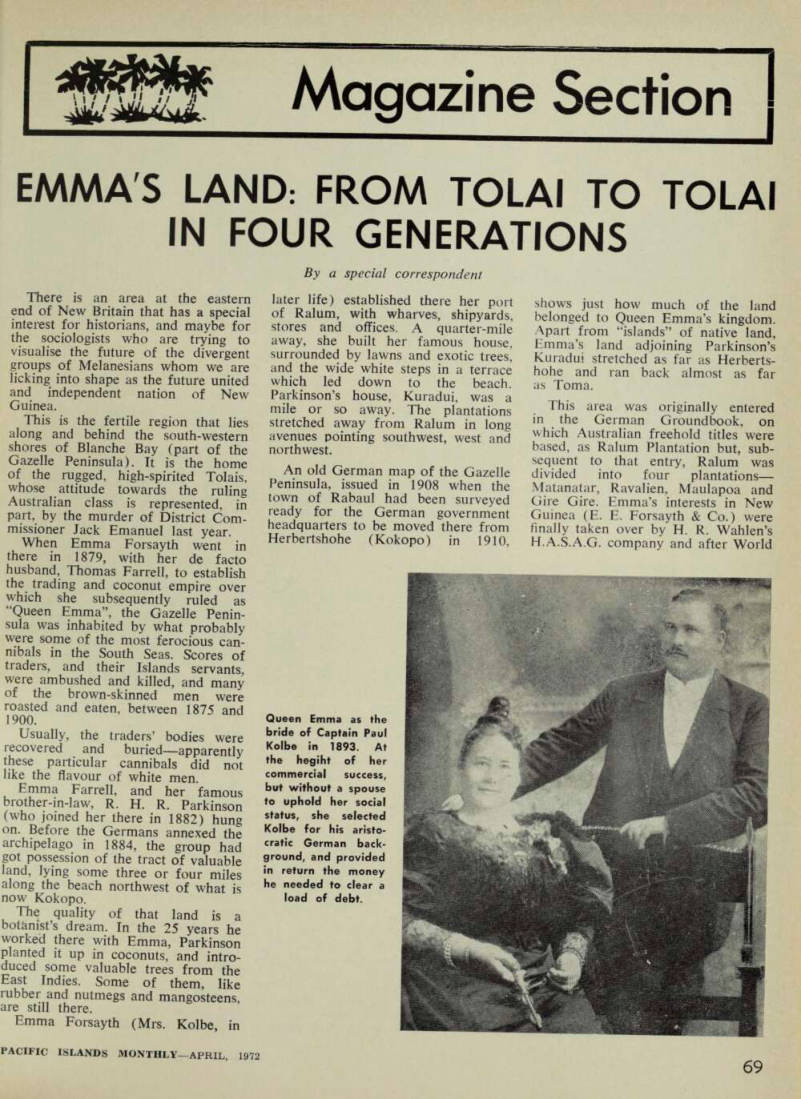 73
73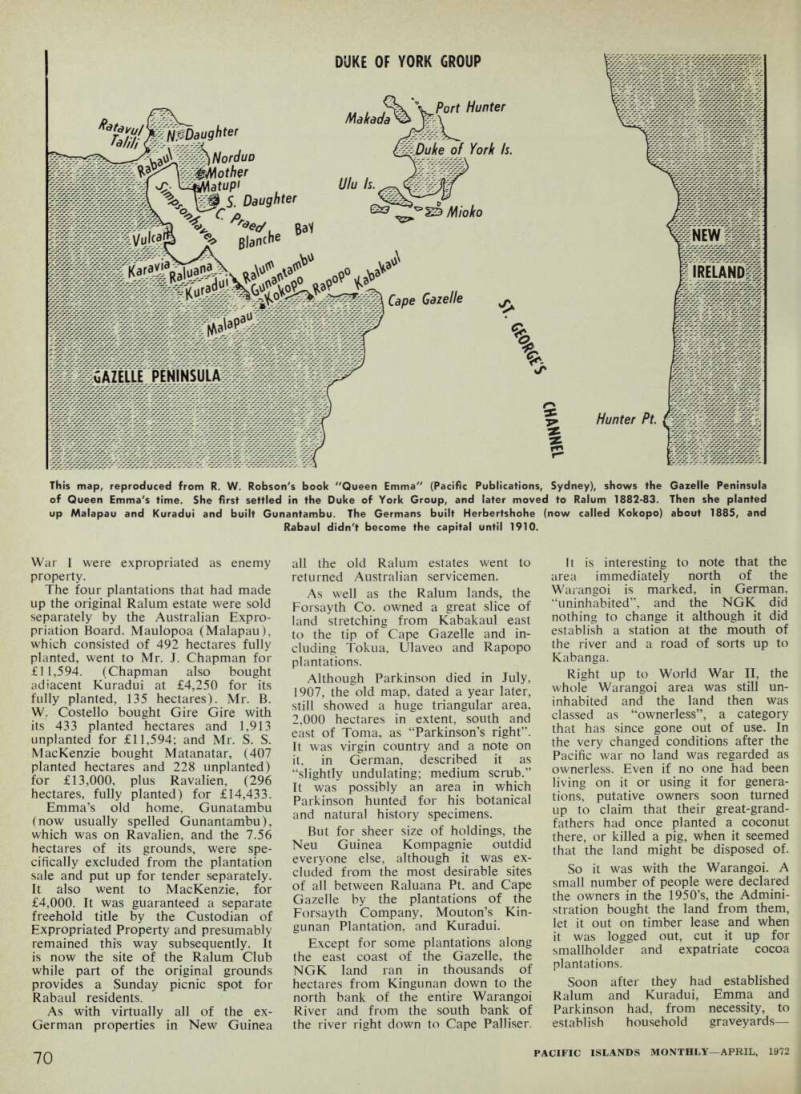 74
74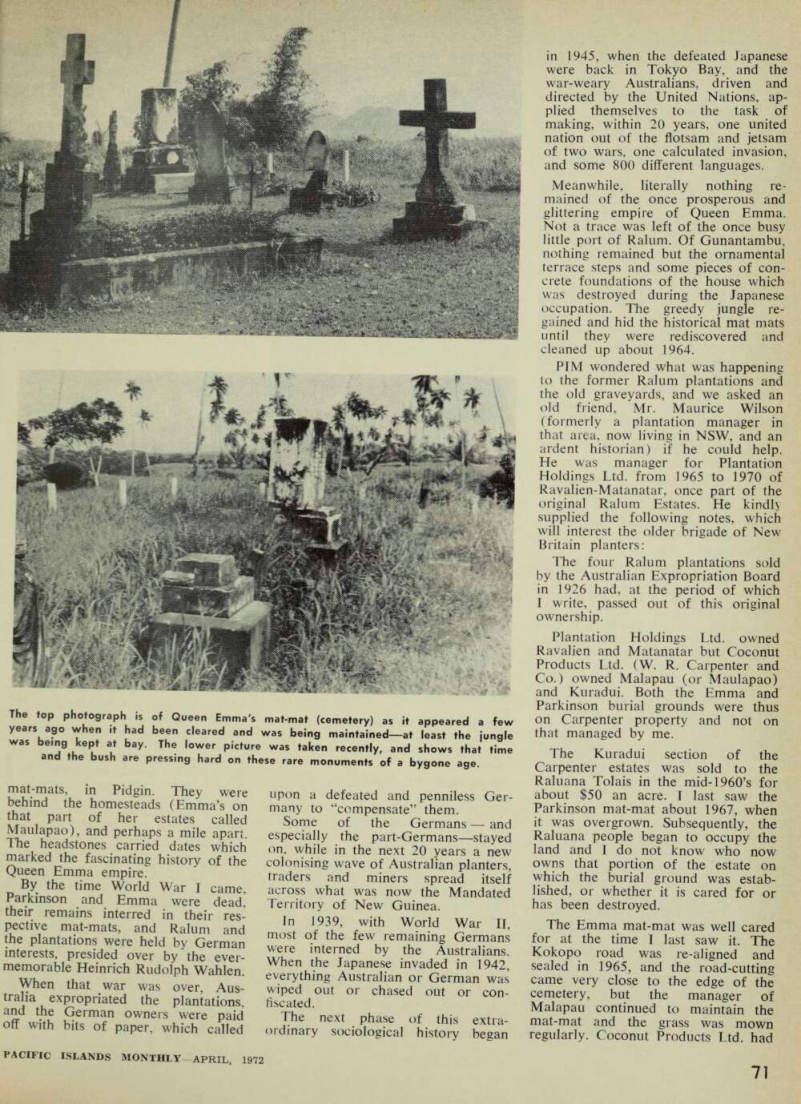 75
75 76
76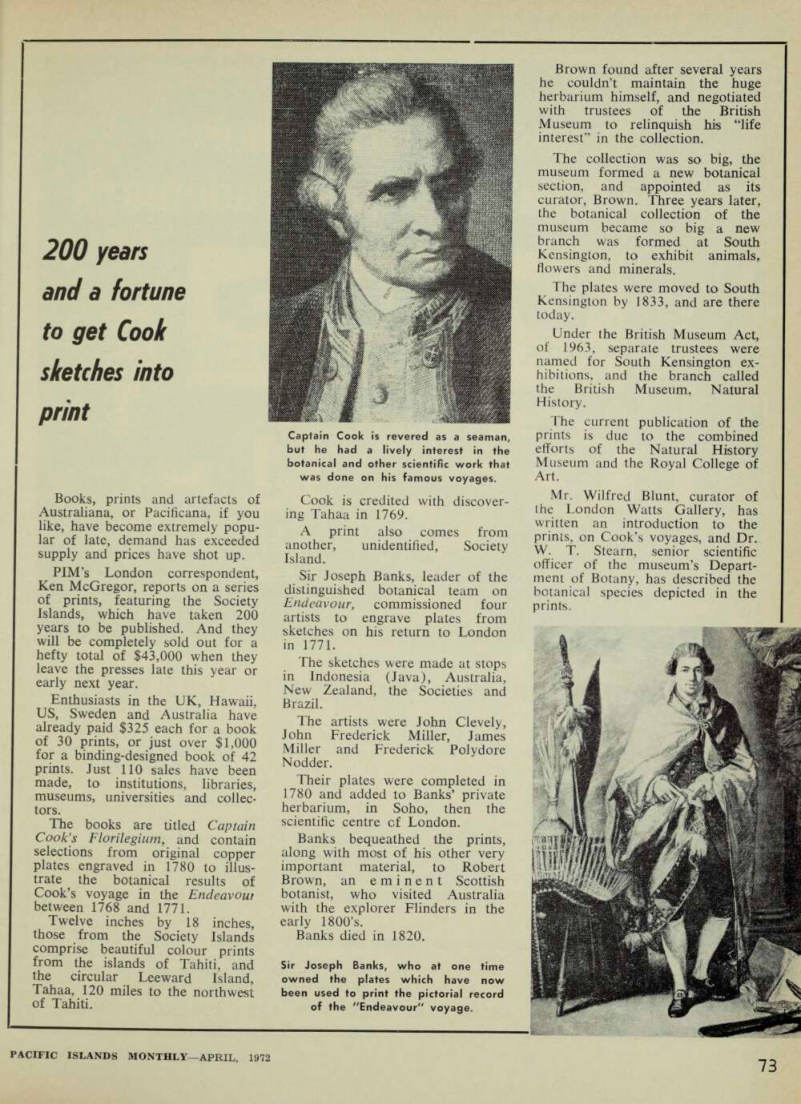 77
77 78
78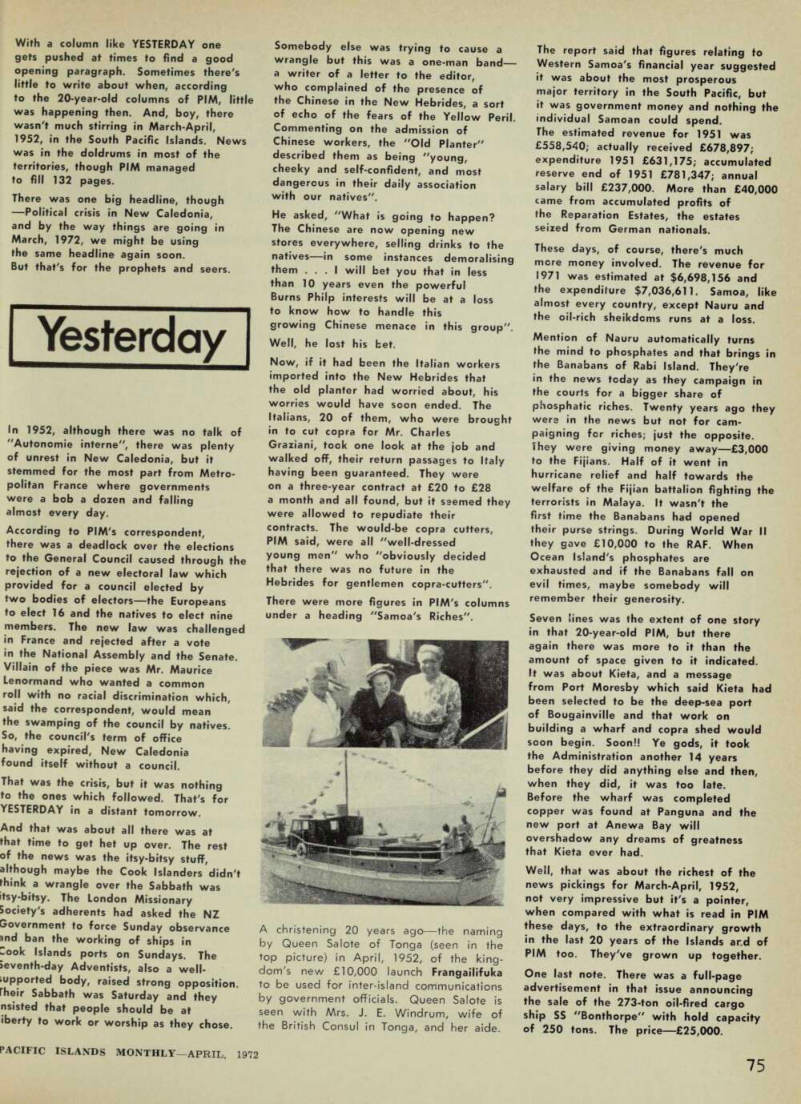 79
79 80
80 81
81 82
82 83
83 84
84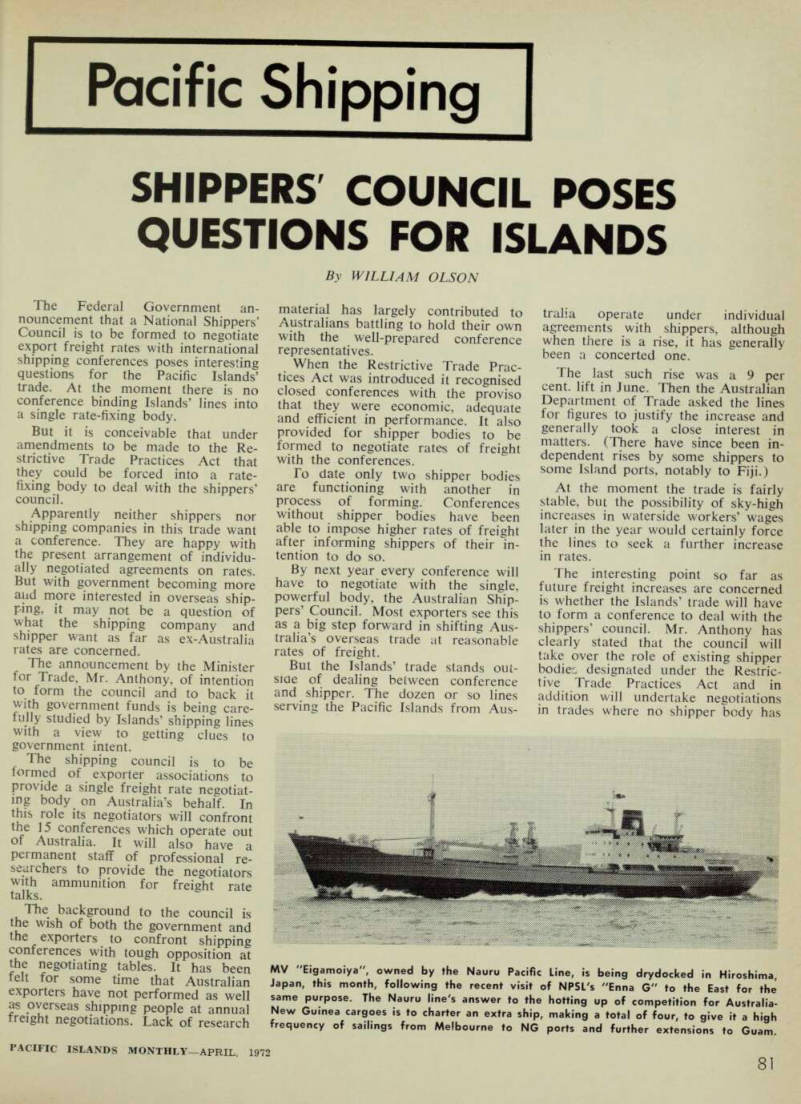 85
85 86
86 87
87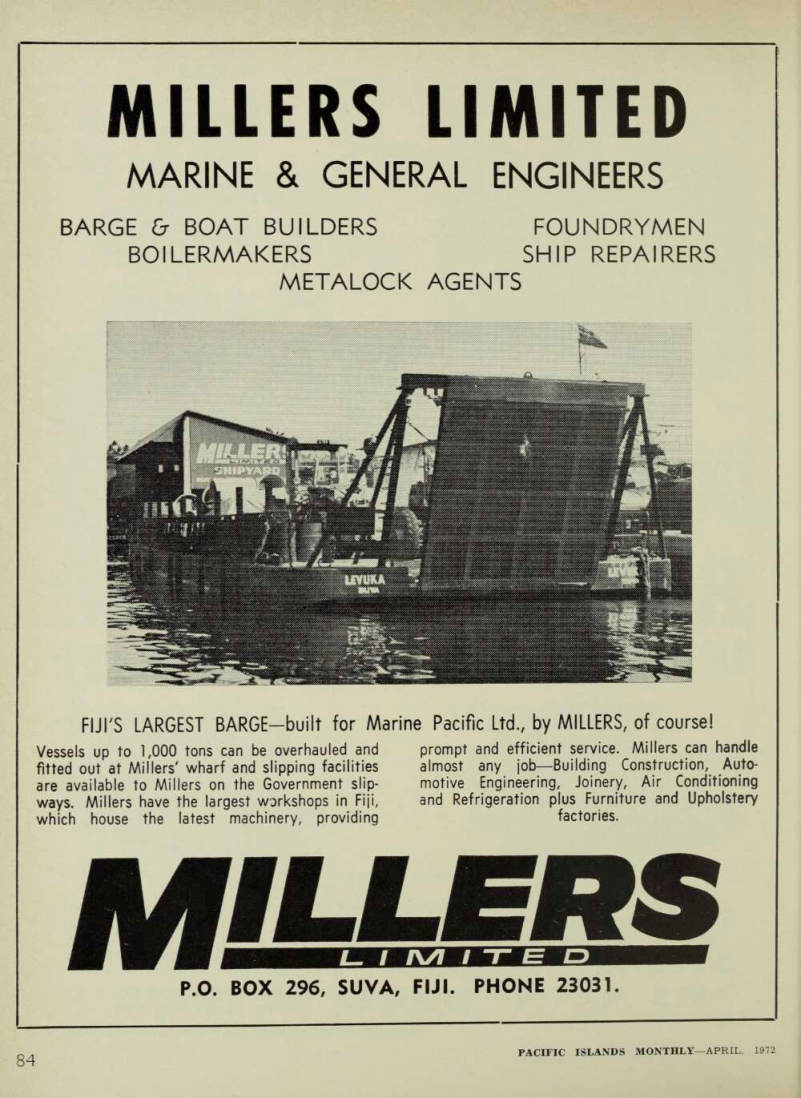 88
88 89
89 90
90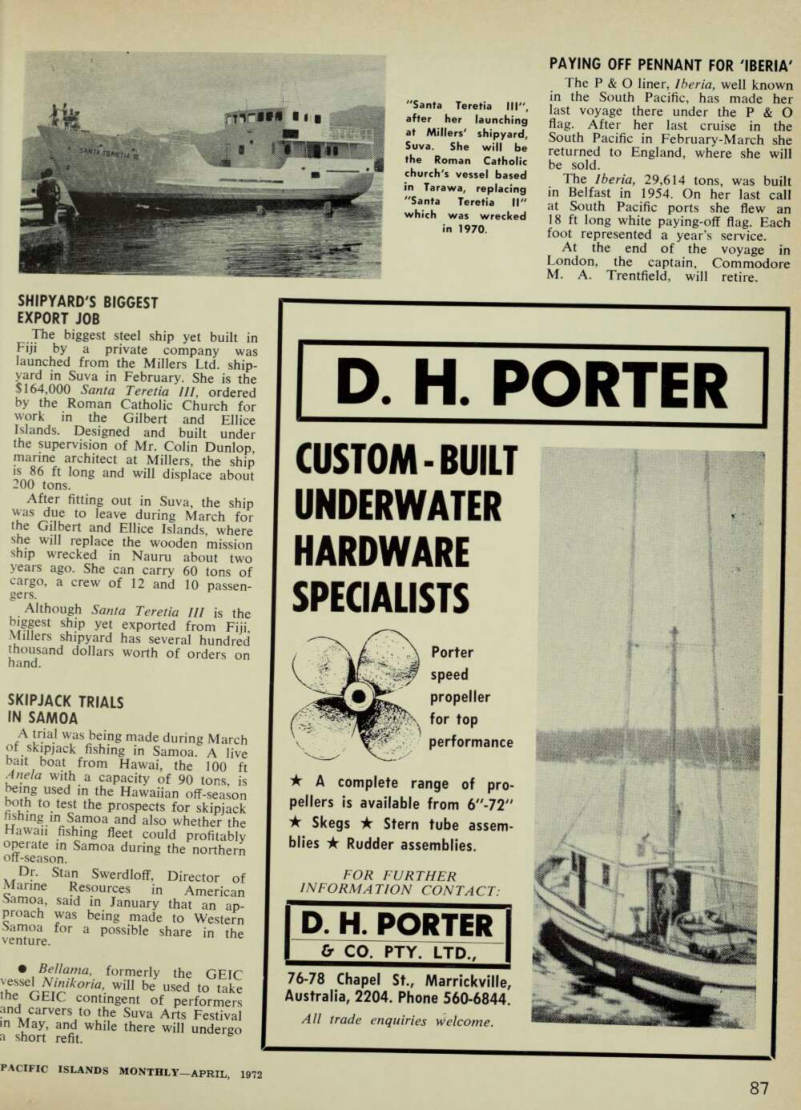 91
91 92
92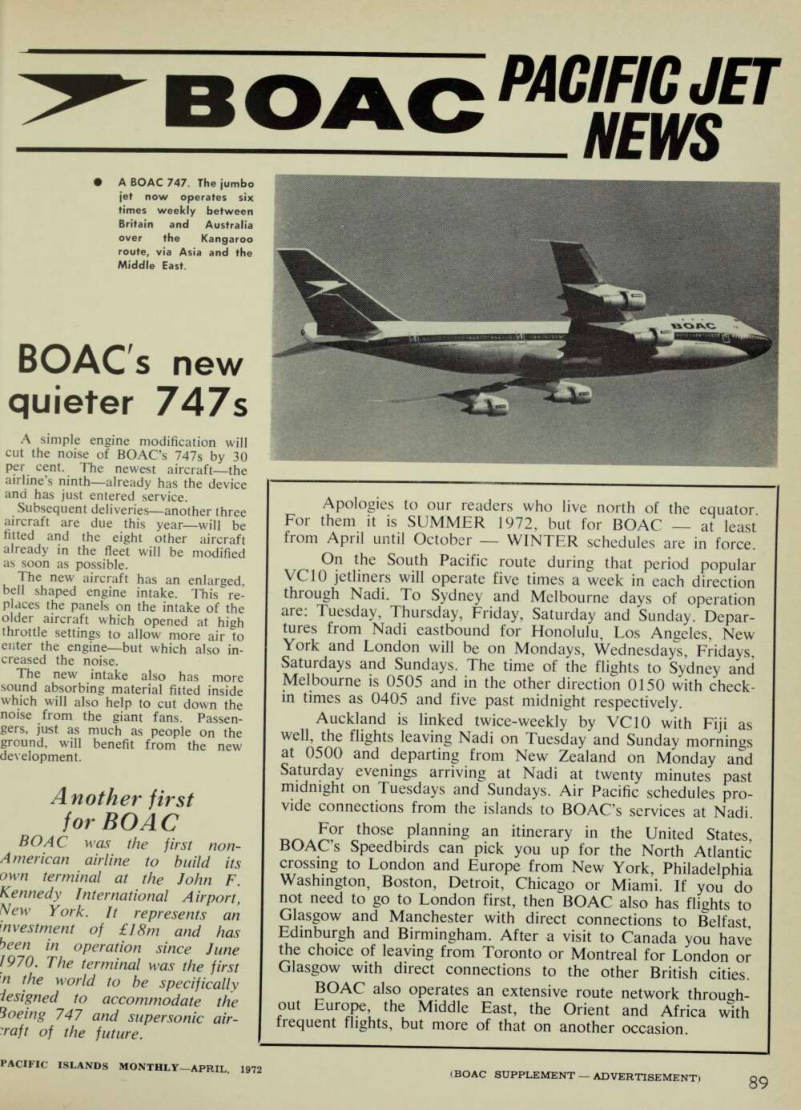 93
93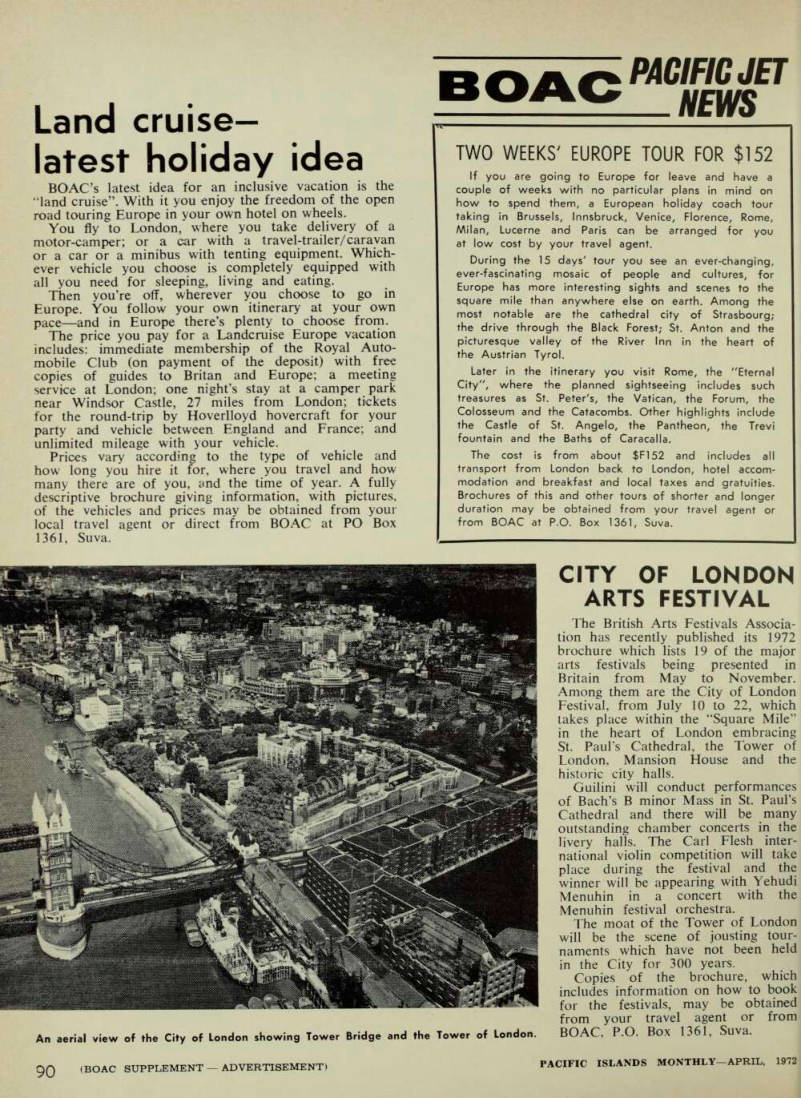 94
94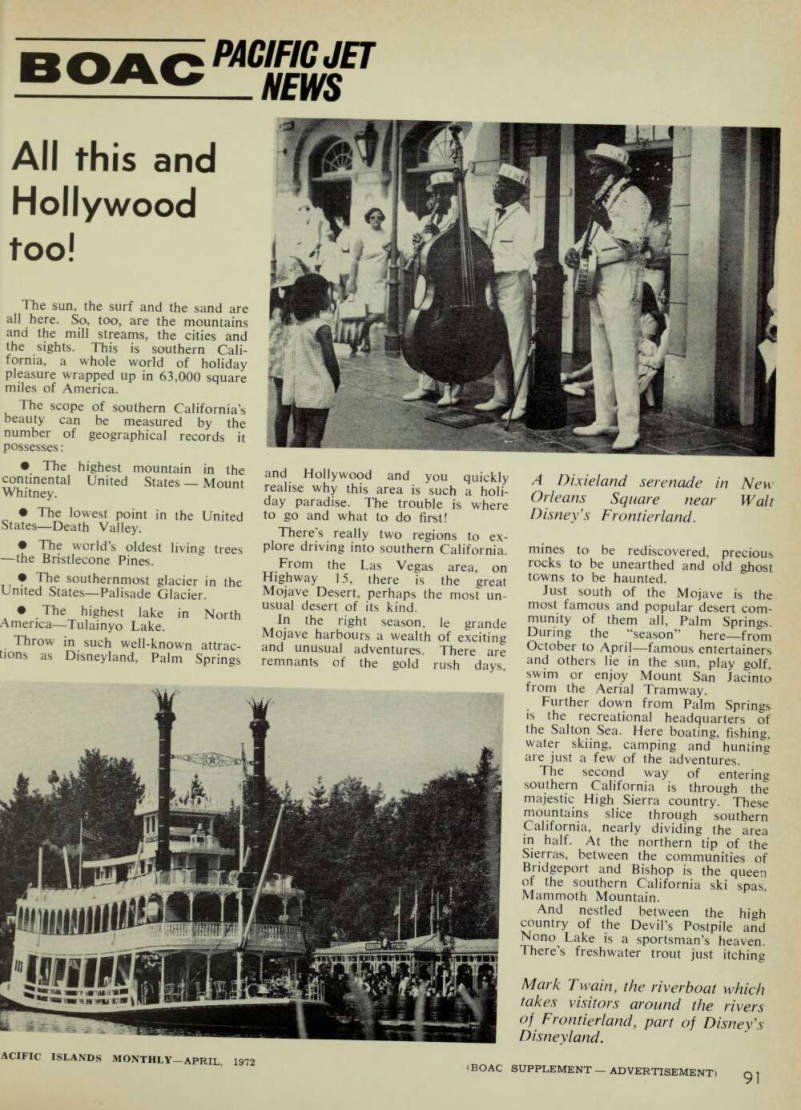 95
95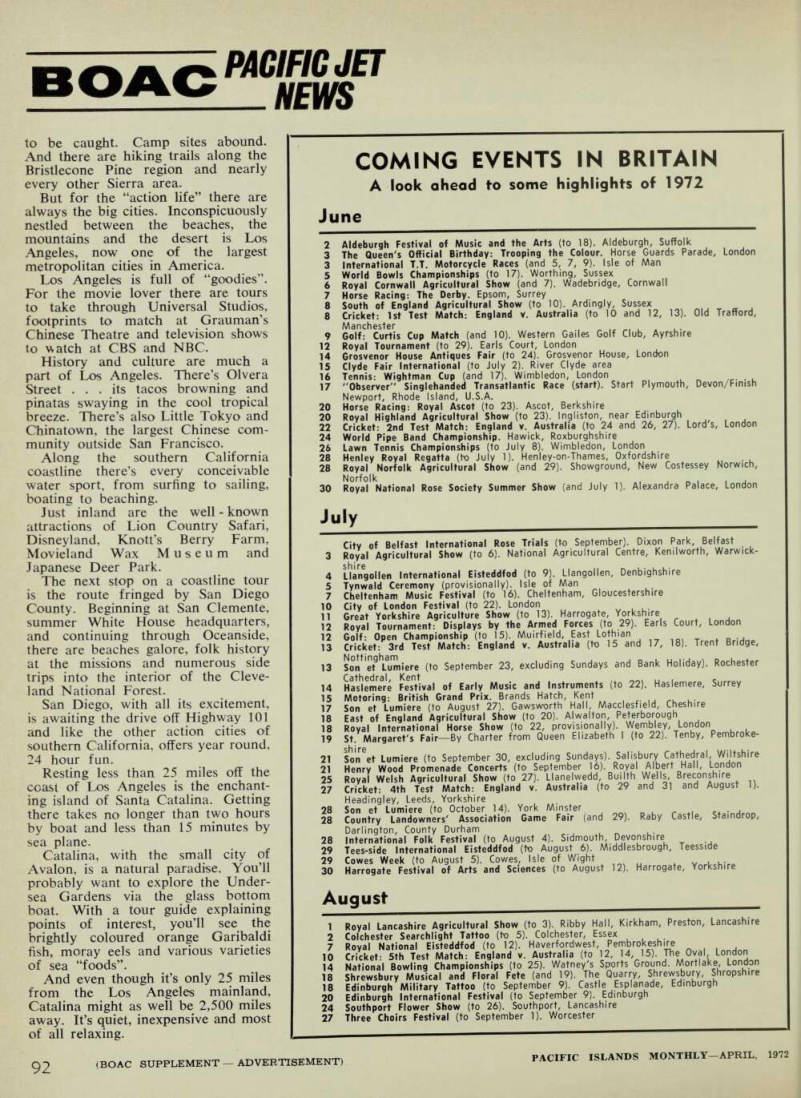 96
96 97
97 98
98 99
99 100
100 101
101 102
102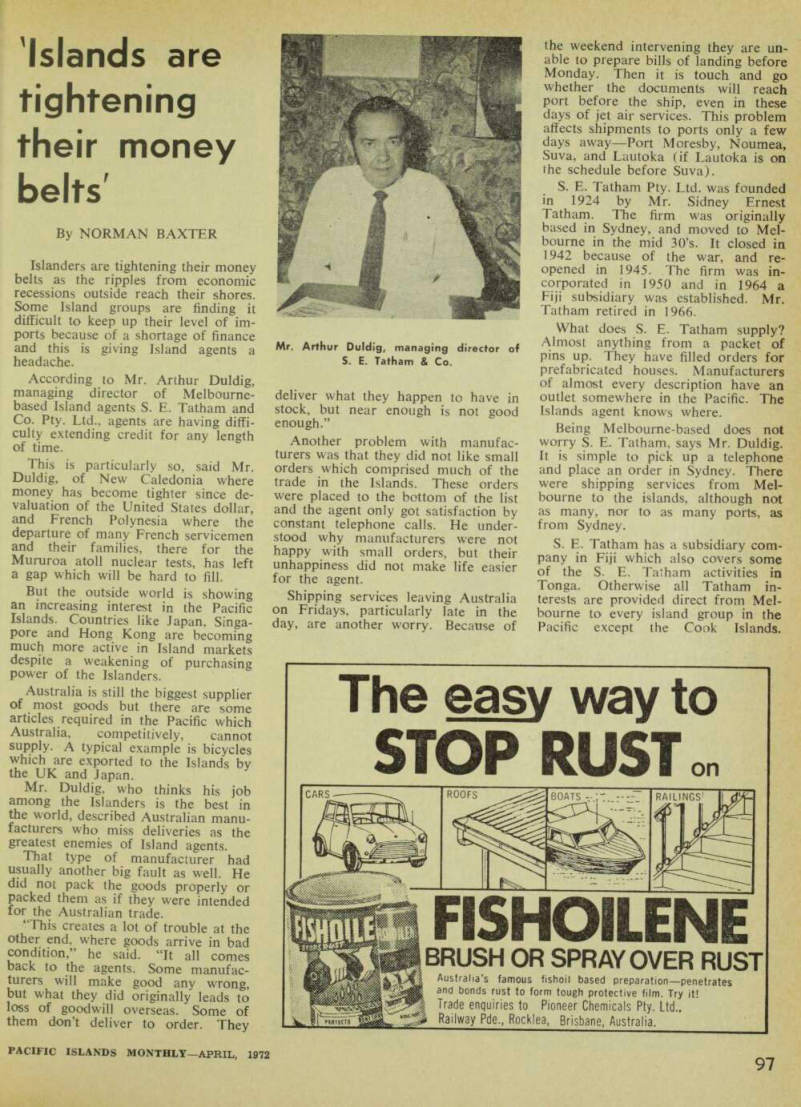 103
103 104
104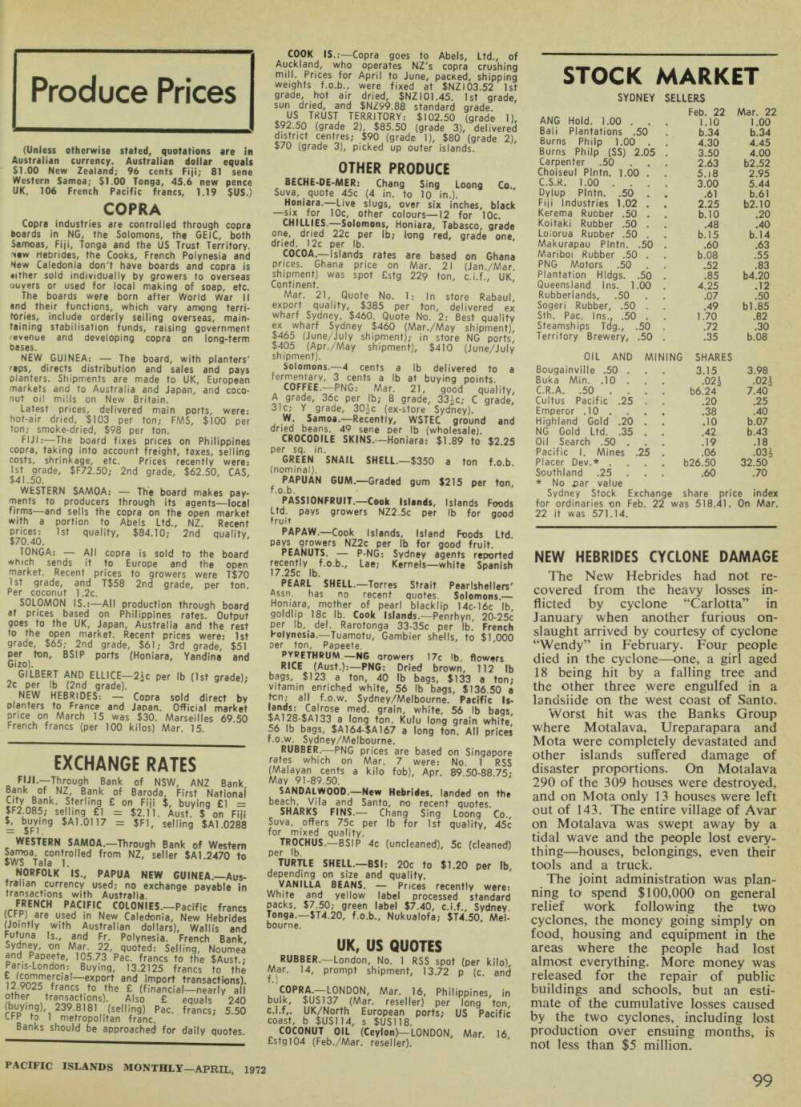 105
105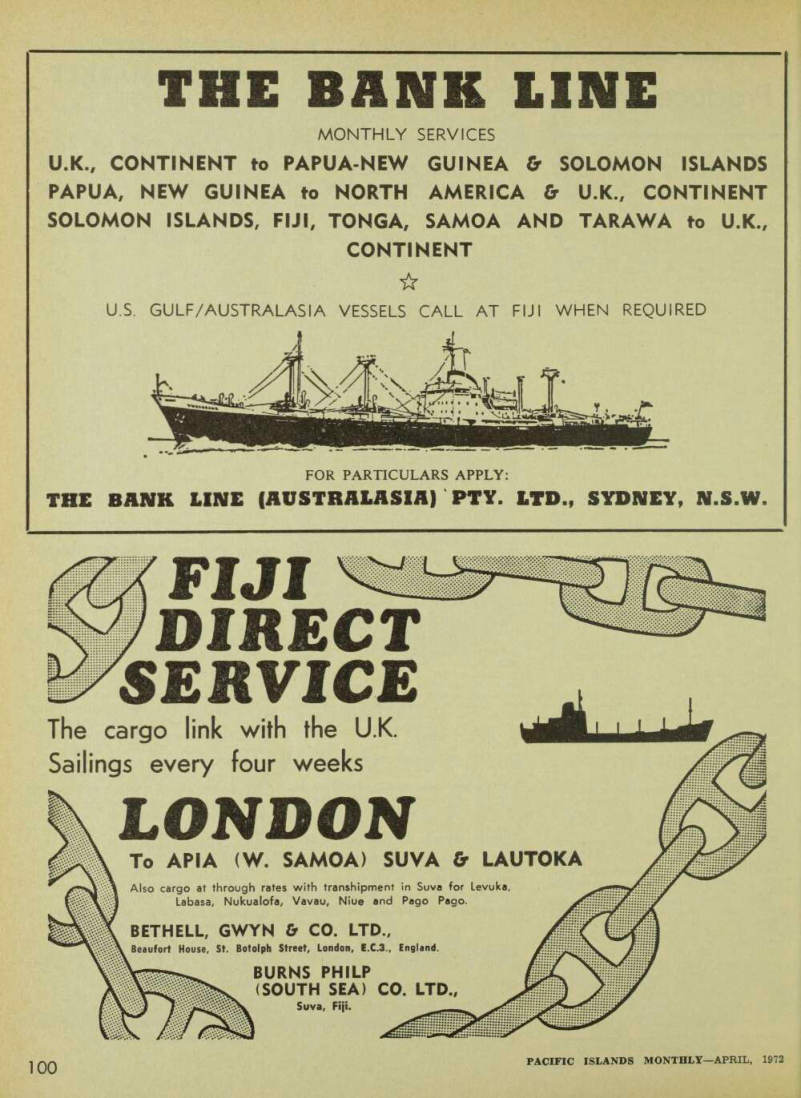 106
106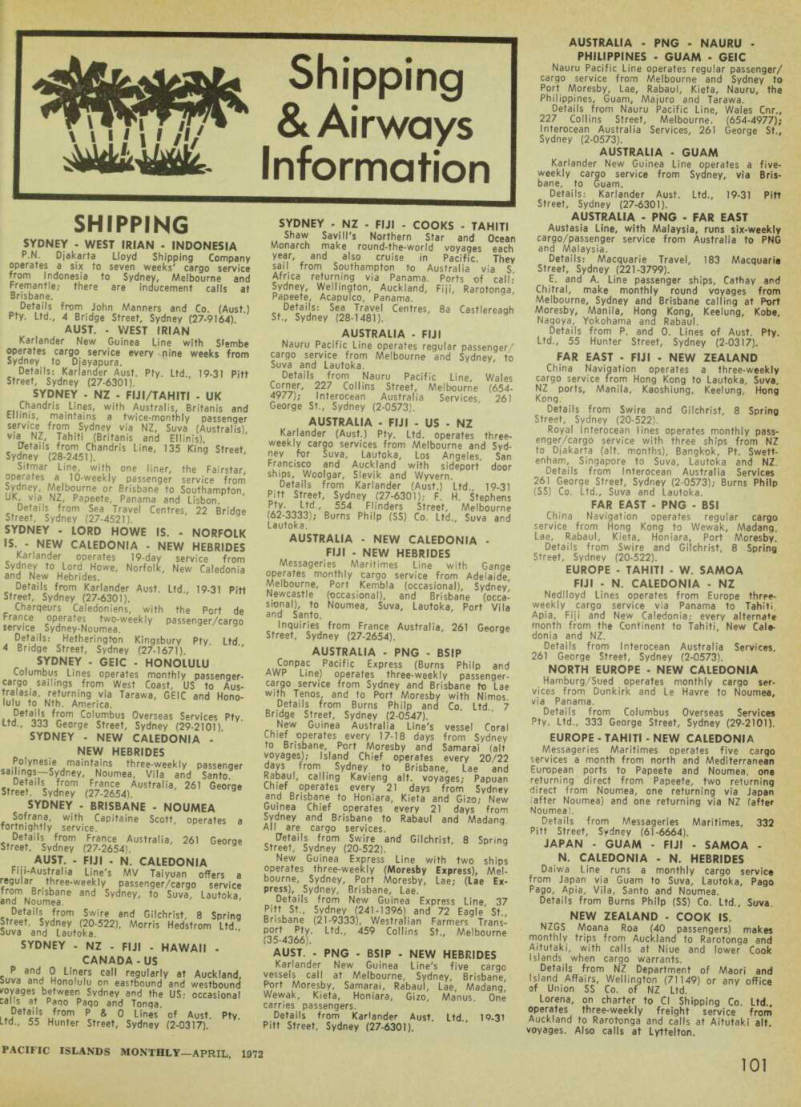 107
107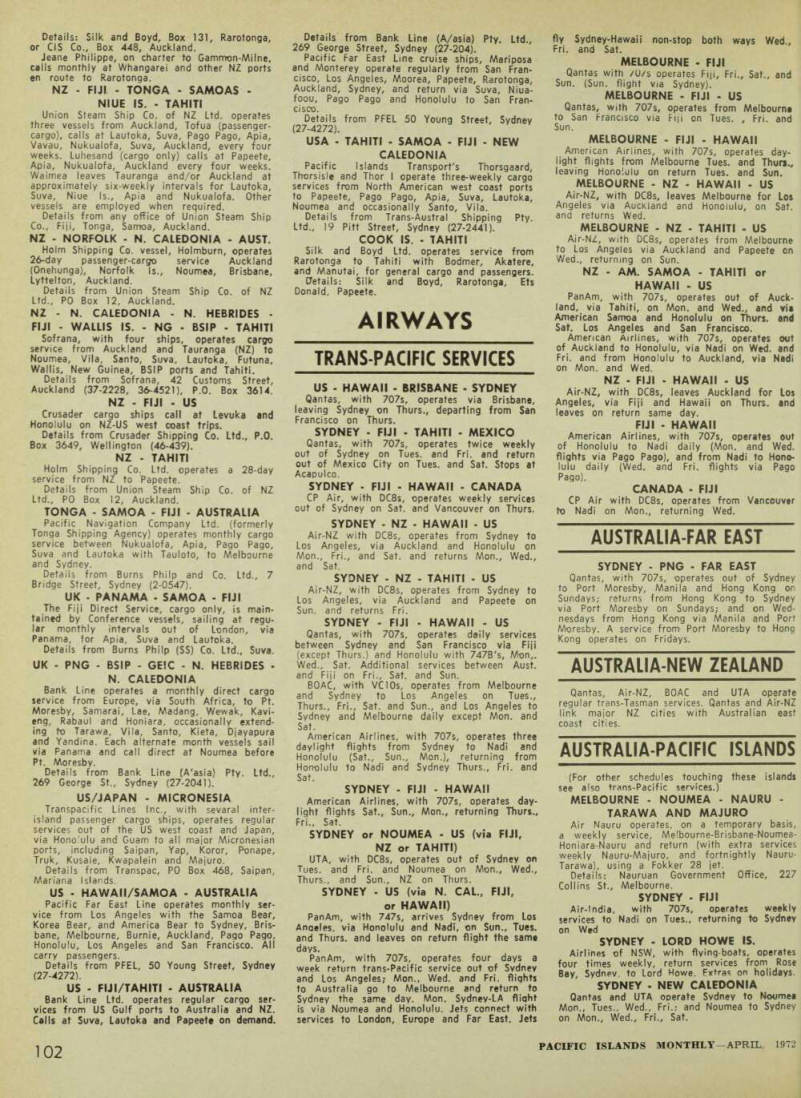 108
108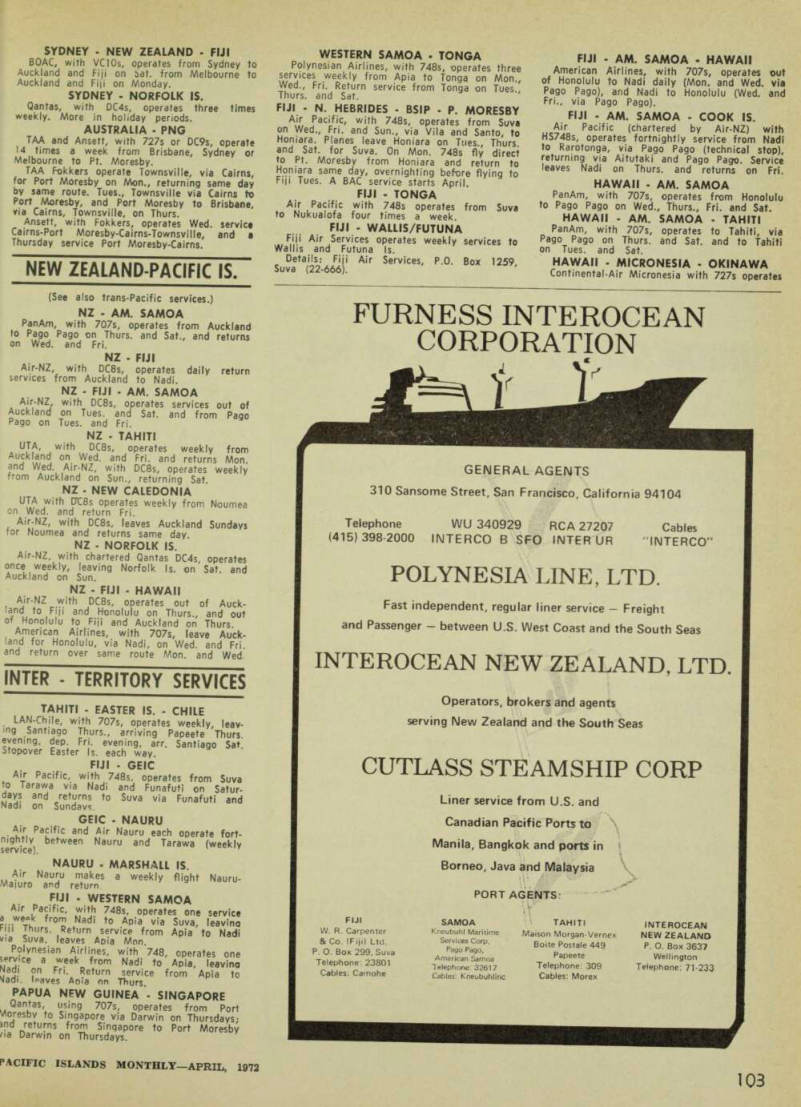 109
109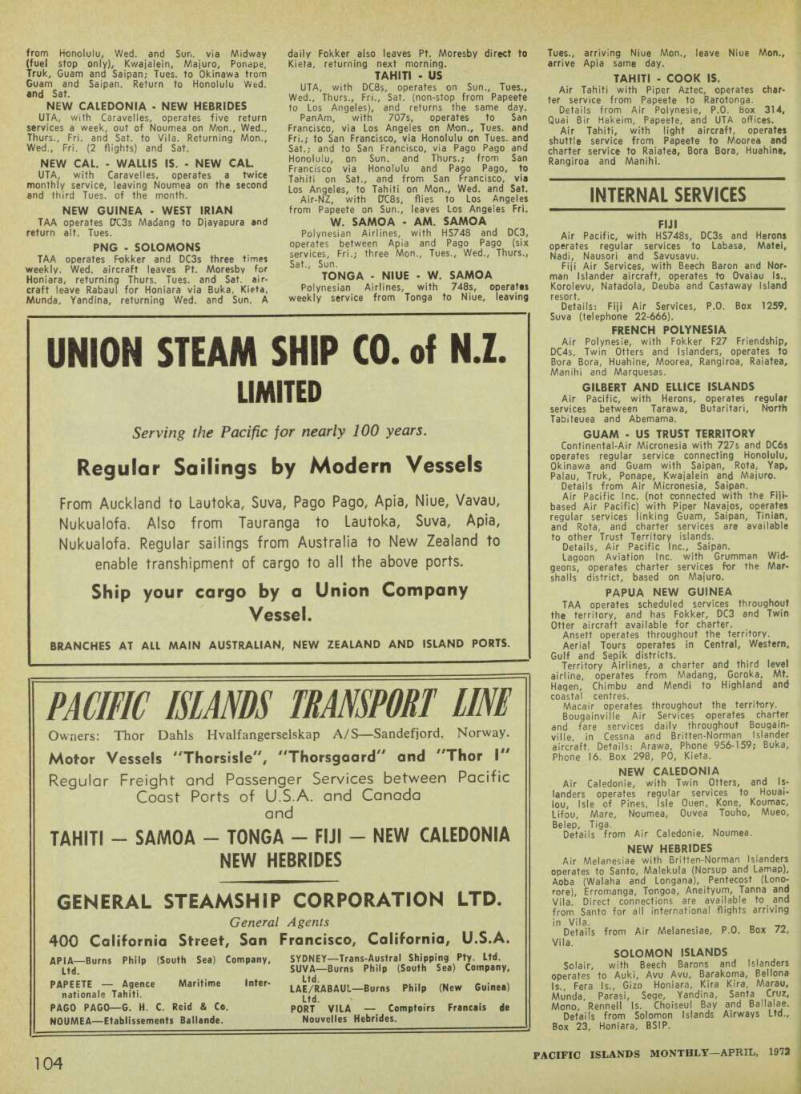 110
110 111
111 112
112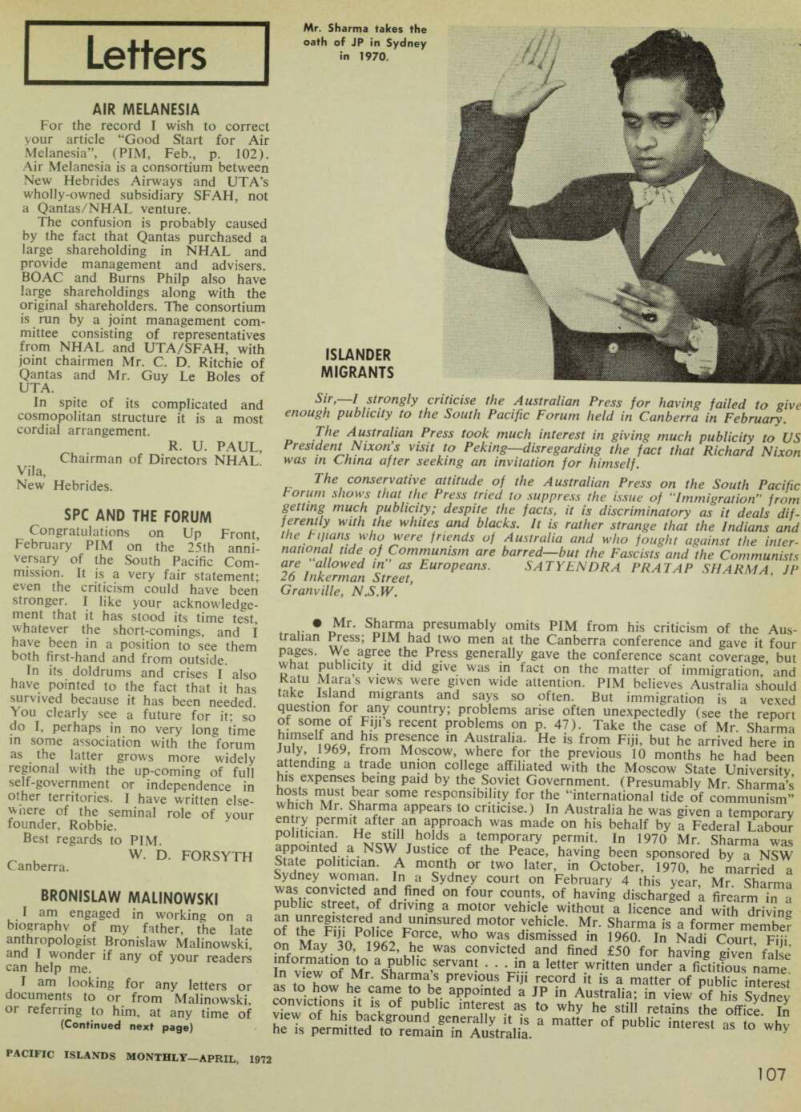 113
113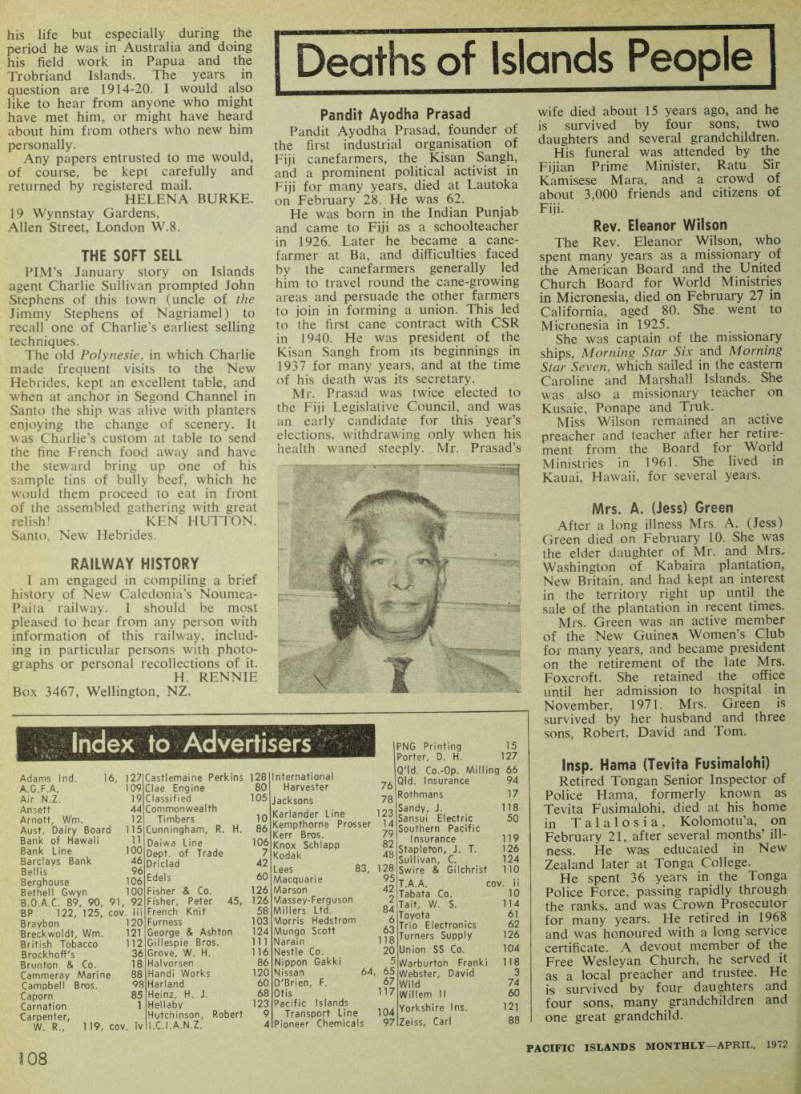 114
114 115
115 116
116 117
117 118
118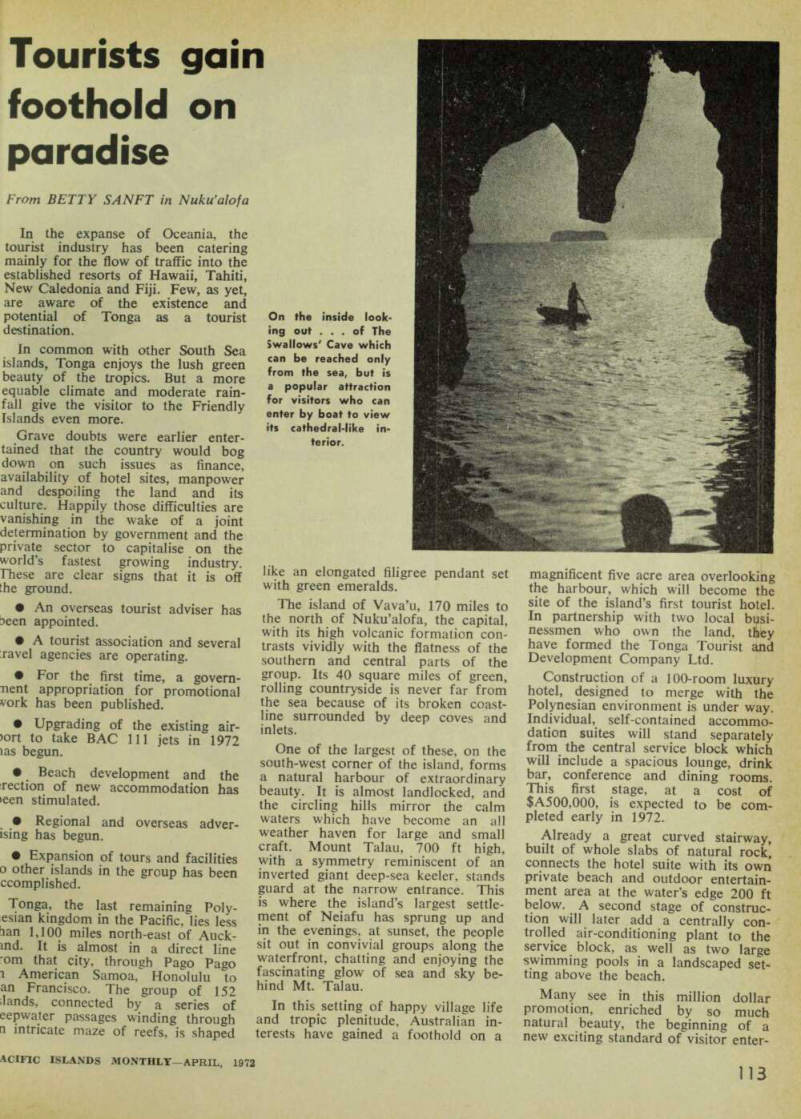 119
119 120
120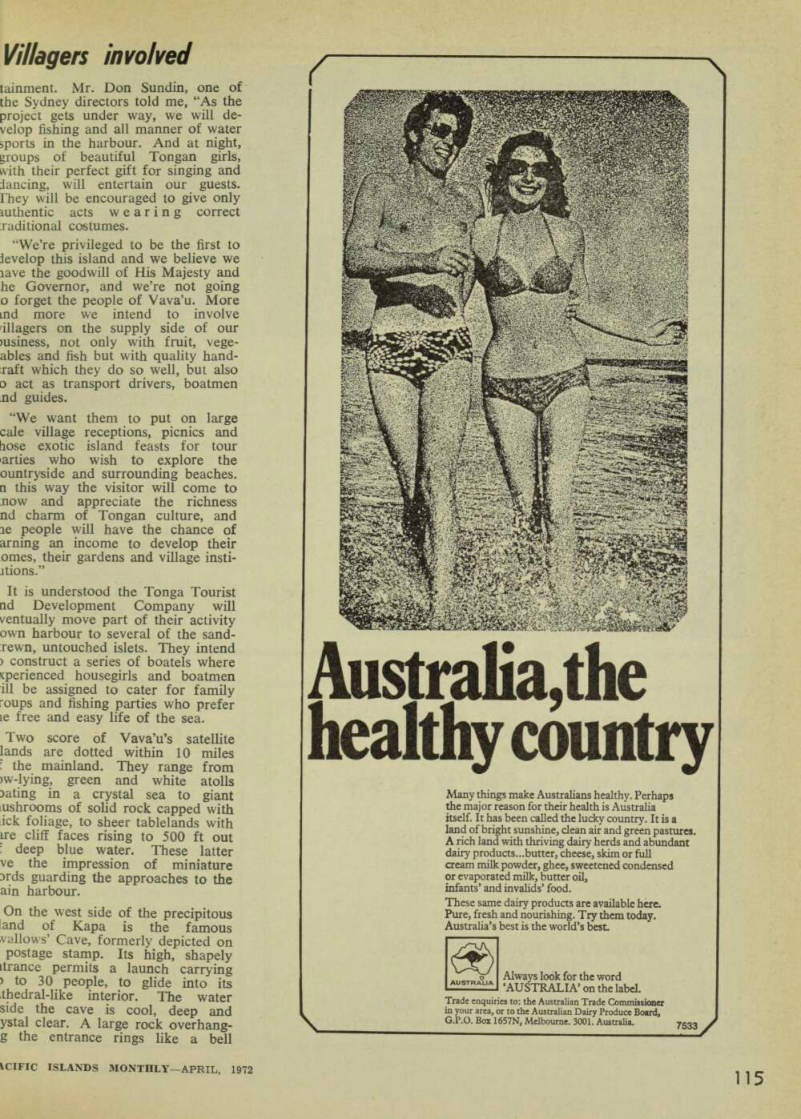 121
121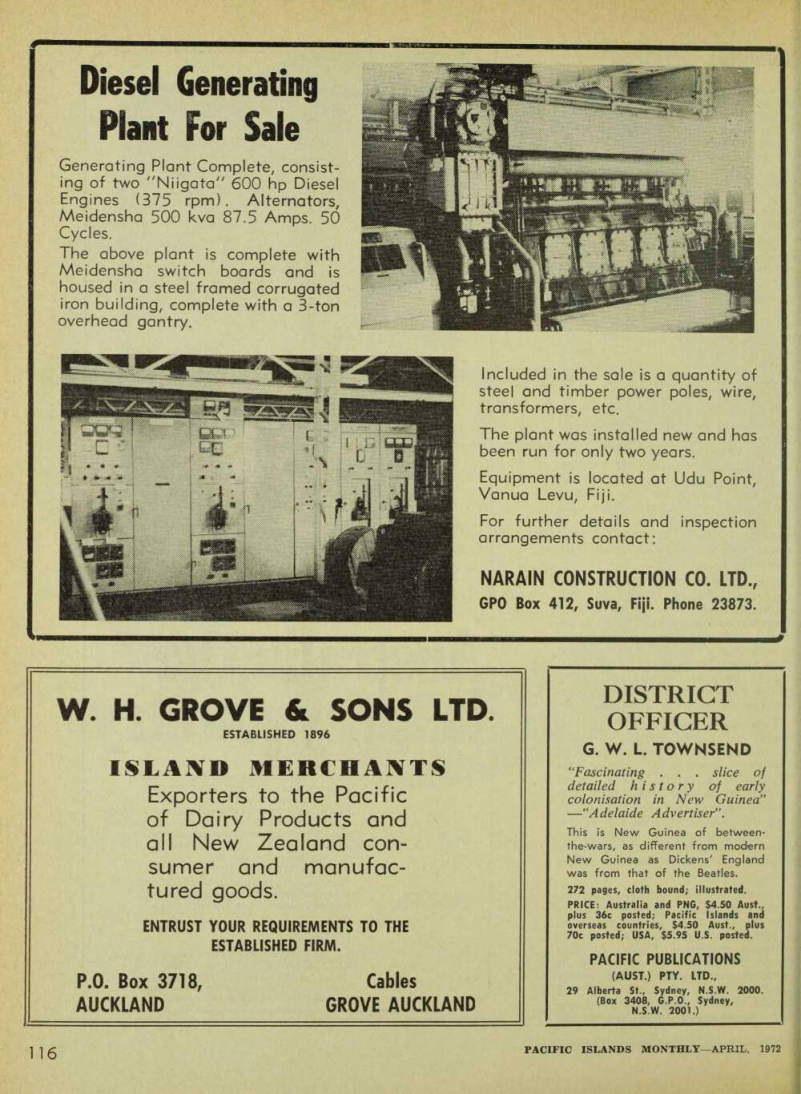 122
122 123
123 124
124 125
125 126
126 127
127 128
128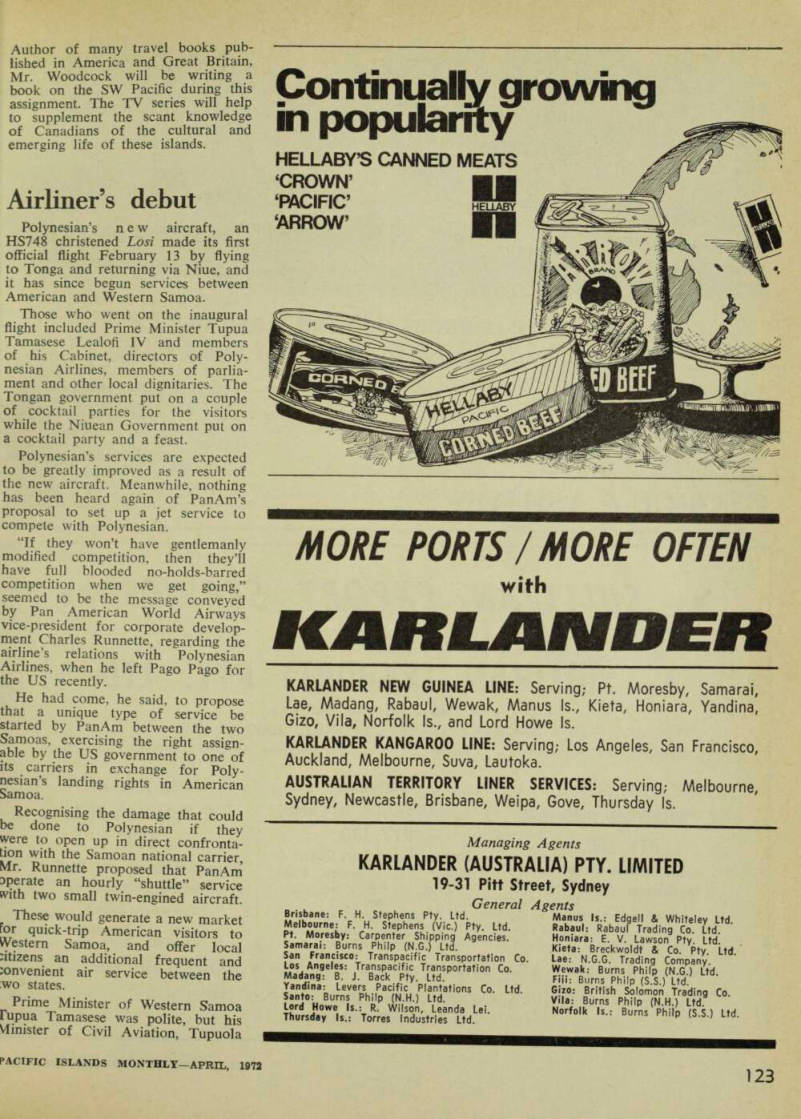 129
129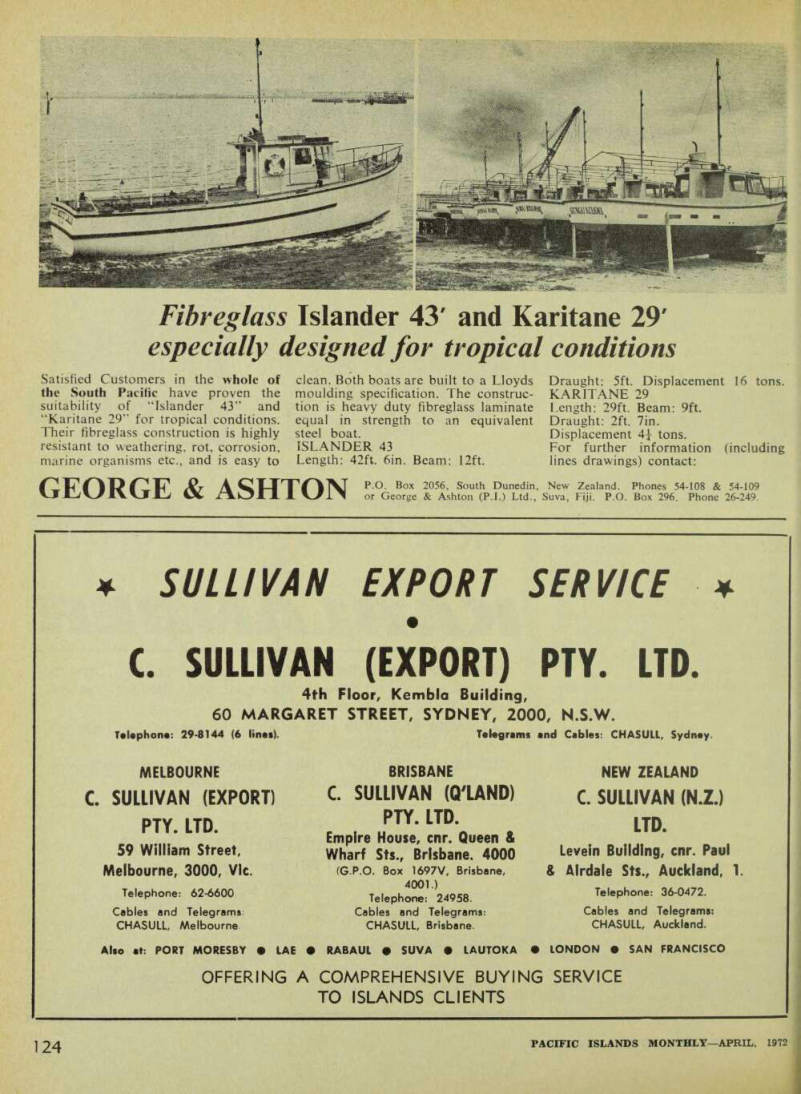 130
130 131
131 132
132 133
133 134
134 135
135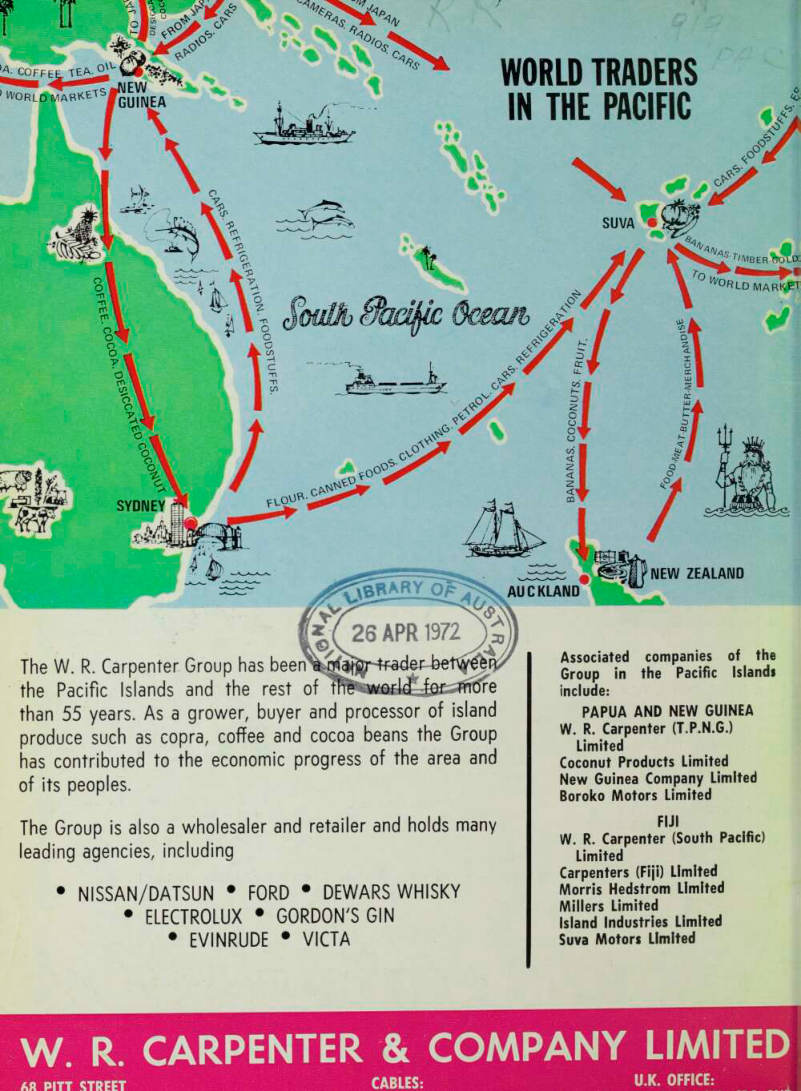 136
136