Yesterday
p. 79 · Read in the full issue
With a column like YESTERDAY one gets pushed at times to find a good opening paragraph. Sometimes there's little to write about when, according to the 20-year-old columns of PIM, little was happening then. And, boy, there wasn't much stirring in March-April, 1952, in the South Pacific Islands. News was in the doldrums in most of the territories, though PIM managed to fill 132 pages.
There was one big headline, though —Political crisis in New Caledonia, and by the way things are going in March, 1972, we might be using the same headline again soon.
But that's for the prophets and seers.
In 1952, although there was no talk of "Autonomie interne", there was plenty of unrest in New Caledonia, but it stemmed for the most part from Metro politan France where governments were a bob a dozen and falling almost every day.
According to PlM's correspondent, there was a deadlock over the elections to the General Council caused through the rejection of a new electoral law which provided for a council elected by two bodies of electors—the Europeans to elect 16 and the natives to elect nine members. The new law was challenged in France and rejected after a vote in the National Assembly and the Senate.
Villain of the piece was Mr. Maurice Lenormand who wanted a common roll with no racial discrimination which, said the correspondent, would mean the swamping of the council by natives.
So, the council's term of office having expired, New Caledonia found itself without a council.
That was the crisis, but it was nothing to the ones which followed. That's for YESTERDAY in a distant tomorrow.
And that was about all there was at that time to get het up over. The rest of the news was the itsy-bitsy stuff, although maybe the Cook Islanders didn't think a wrangle over the Sabbath was
itsy-bitsy. The London Missionary
Society's adherents had asked the NZ Government to force Sunday observance and ban the working of ships in -ook Islands ports on Sundays. The Seventh-day Adventists, also a well supported body, raised strong opposition.
Fheir Sabbath was Saturday and they
nsisted that people should be at iberty to work or worship as they chose.
Somebody else was trying to cause a wrangle but this was a one-man band— a writer of a letter to the editor, who complained of the presence of the Chinese in the New Hebrides, a sort of echo of the fears of the Yellow Peril.
Commenting on the admission of Chinese workers, the "Old Planter" described them as being "young, cheeky and self-confident, and most dangerous in their daily association with our natives".
He asked, "What is going to happen?
The Chinese are now opening new stores everywhere, selling drinks to the natives—in some instances demoralising them ... I will bet you that in less than 10 years even the powerful Burns Philp interests will be at a loss to know how to handle this growing Chinese menace in this group".
Well, he lost his bet.
Now, if it had been the Italian workers imported into the New Hebrides that the old planter had worried about, his worries would have soon ended. The Italians, 20 of them, who were brought in to cut copra for Mr. Charles Graziani, took one look at the job and walked off, their return passages to Italy having been guaranteed. They were on a three-year contract at £2O to £2B a month and all found, but it seemed they were allowed to repudiate their contracts. The would-be copra cutters, PIM said, were all "well-dressed young men" who "obviously decided that there was no future in the Hebrides for gentlemen copra-cutters".
There were more figures in PlM's columns under a heading "Samoa's Riches".
The report said that figures relating to Western Samoa's financial year suggested it was about the most prosperous major territory in the South Pacific, but it was government money and nothing the individual Samoan could spend.
The estimated revenue for 1951 was £558,540; actually received £678,897; expenditure 1951 £631,175; accumulated reserve end of 1951 £781,347; annual salary bill £237,000. More than £40,000 came from accumulated profits of the Reparation Estates, the estates seized from German nationals.
These days, of course, there's much more money involved. The revenue for 1971 was estimated at $6,698,156 and the expenditure $7,036,611. Samoa, like almost every country, except Nauru and the oil-rich sheikdoms runs at a loss.
Mention of Nauru automatically turns the mind to phosphates and that brings in the Banabans of Rabi Island. They're in the news today as they campaign in the courts for a bigger share of phosphatic riches. Twenty years ago they were in the news but not for cam paigning for riches; just the opposite.
Ihey were giving money away—£3,ooo to the Fijians. Half of it went in hurricane relief and half towards the welfare of the Fijian battalion fighting the terrorists in Malaya. It wasn't the first time the Banabans had opened their purse strings. During World War II they gave £lO,OOO to the RAF. When Ocean Island's phosphates are exhausted and if the Banabans fall on evil times, maybe somebody will remember their generosity.
Seven lines was the extent of one story in that 20-year-old PIM, but there again there was more to it than the amount of space given to it indicated.
It was about Kieta, and a message from Port Moresby which said Kieta had been selected to be the deep-sea port of Bougainville and that work on building a wharf and copra shed would soon begin. Soon!! Ye gods, it took the Administration another 14 years before they did anything else and then, when they did, it was too late.
Before the wharf was completed copper was found at Panguna and the new port at Anewa Bay will overshadow any dreams of greatness that Kieta ever had.
Well, that was about the richest of the news pickings for March-April, 1952, not very impressive but it's a pointer, when compared with what is read in PIM these days, to the extraordinary growth in the last 20 years of the Islands ar.d of PIM too. They've grown up together.
One last note. There was a full-page advertisement in that issue announcing the sale of the 273-ton oil-fired cargo ship SS "Bonthorpe" with hold capacity of 250 tons. The price—£25,000.
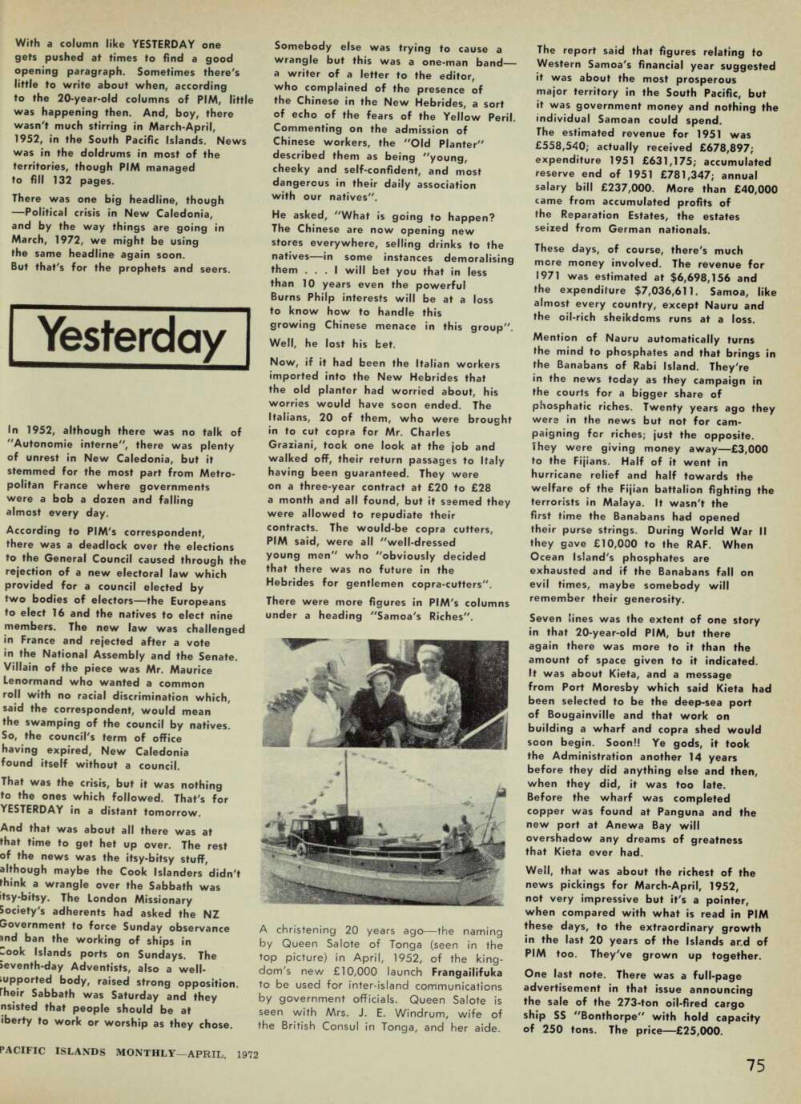
A christening 20 years ago—the naming by Queen Salote of Tonga (seen in the top picture) in April, 1952, of the king dom's new £10,000 launch Frangailifuka to be used for inter-island communications by government officials. Queen Salote is seen with Mrs. J. E. Windrum, wife of the British Consul in Tonga, and her aide.