Magazine Section
pp. 73-76 · Read in the full issue
Emma's Land: From Tolai To Tolai
In Four Generations
By a special correspondent
There is an area at the eastern end of New Britain that has a special interest for historians, and maybe for the sociologists who are trying to visualise the future of the divergent groups of Melanesians whom we are licking into shape as the future united and independent nation of New Guinea.
This is the fertile region that lies along and behind the south-western shores of Blanche Bay (part of the Gazelle Peninsula). It is the home of the rugged, high-spirited Tolais, whose attitude towards the ruling Australian class is represented, in part, by the murder of District Com missioner Jack Emanuel last year.
When Emma Forsayth went in there in 1879, with her de facto husband, Thomas Farrell, to establish the trading and coconut empire over which she subsequently ruled as “Queen Emma”, the Gazelle Penin sula was inhabited by what probably were some of the most ferocious can nibals in the South Seas. Scores of traders, and their Islands servants, were ambushed and killed, and many of the brown-skinned men were roasted and eaten, between 1875 and 1900.
Usually, the traders’ bodies were recovered and buried—apparently these particular cannibals did not like the flavour of white men.
Emma Farrell, and her famous brother-in-law, R. H. R. Parkinson (who joined her there in 1882) hung on. Before the Germans annexed the archipelago in 1884, the group had got possession of the tract of valuable land, lying some three or four miles along the beach northwest of what is now Kokopo.
The quality of that land is a botanist’s dream. In the 25 years he worked there with Emma, Parkinson planted it up in coconuts, and intro duced some valuable trees from the East Indies. Some of them, like rubber and nutmegs and mangosteens, are still there.
Emma Forsayth (Mrs. Kolbe, in
later life) established there her port of Ralum, with wharves, shipyards, stores and offices. A quarter-mile away, she built her famous house, surrounded by lawns and exotic trees, and the wide white steps in a terrace which led down to the beach.
Parkinson’s house, Kuradui, was a mile or so away. The plantations stretched away from Ralum in long avenues pointing southwest, west and northwest. . , , An old German map of the Gazelle Peninsula, issued in 1908 when the town of Rabaul had been surveyed ready for the German government headquarters to be moved there from Herbertshohe (Kokopo) in 1910,
shows just how much of the land belonged to Queen Emma’s kingdom Apart from “islands” of native land, Emma’s land adjoining Parkinson’s Kuradui stretched as far as Herberts hohe and ran back almost as far as Toma. _.. . rh * s area was originally entered ,n . . “ ie German Groundbook, on which Australian freehold titles were based, as Ralum Plantation but, sub sequent to that entry, Ralum was divided into four plantations— Matanatar, Ravalien, Maulapoa and Gire Gire. Emma’s interests in New Guinea (E. E. Forsayth & Co.) were finally taken over by H. R. Wahlen’s H.A.S.A.G. company and after World
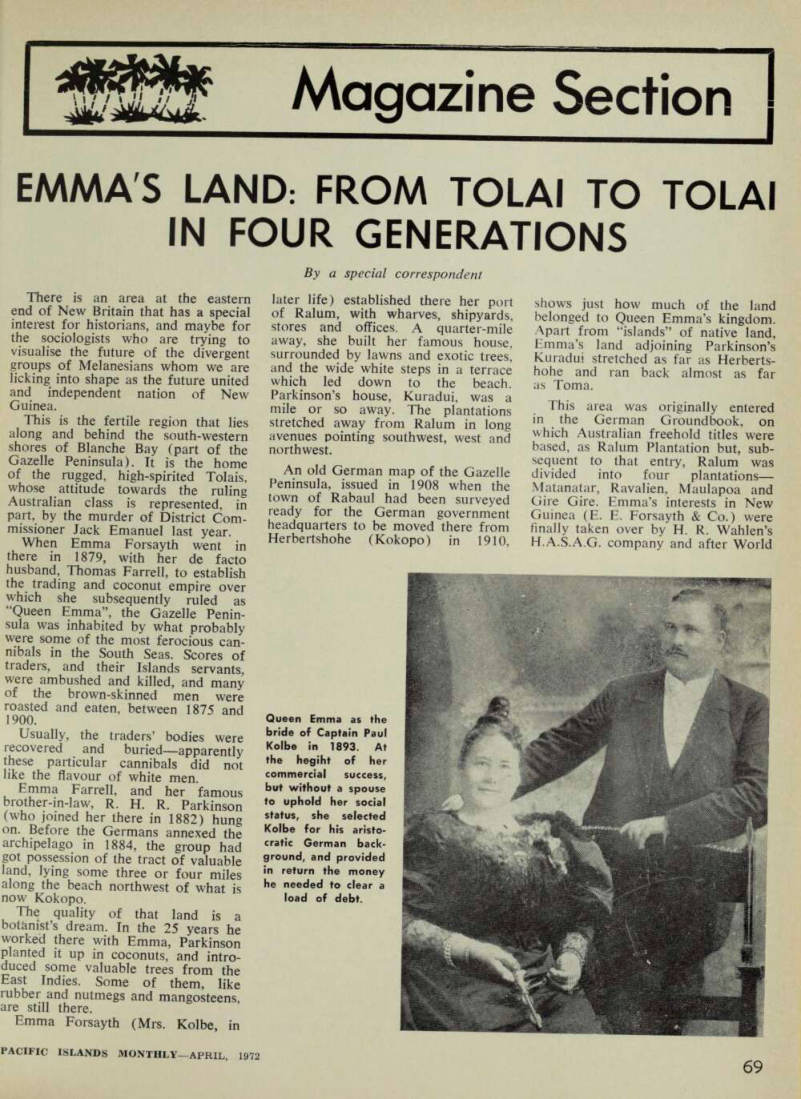
Queen Emma as the bride of Captain Paul Kolbe in 1893. At the hegiht of her commercial success, but without a spouse to uphold her social status, she selected Kolbe for his aristo cratic German back ground, and provided in return the money he needed to clear a load of debt.
War I were expropriated as enemy property.
The four plantations that had made up the original Ralum estate were sold separately by the Australian Expropriation Board. Maulopoa (Malapau), which consisted of 492 hectares fully planted, went to Mr. J. Chapman for £11,594. (Chapman also bought adiacent Kuradui at £4,250 for its j r, , L c c unplanted for £11,594 and Mr. S S MacKenzie bought Matanatar, (407
M^0 C r eS nl^ d
f ,m E l K mm hEE, d) f 7„ £ , ll 3 ' Emmas old home, Gunatambu (now usually spelled Gunantambu), which was on Ravalien, and the 7.56 hectares of its grounds, were specifically excluded from the plantation sale and nut un for tender seoaratelv It also went to MacLS for £4 000° It was separate
freehoid tide Custodian rf
Expropriated Property and presumably remained this way subsequently. It is now the site of the Ralum Club while part of the original grounds provides a Sunday picnic spot for Rabaul residents.
As with virtually all of the ex- German properties in New Guinea
all the old Ralum estates went to returned Australian servicemen. well as the Ralum lands, the Forsayth Co. owned a great slice of i and stretching from Kabakaul east to t h e tip of Cape Gazelle and ineluding Tokua, Ulaveo and Rapopo plantations Although Parkinson died in Julv the old man dated a vear later s.m showed a m h P ugffrian a X 2.T 2,000 hectares in extent, south and east of Toma, as “Parkinson’s right”. „ was vi in country and a note on • • rf~ rrnan described it as “slightly undulating; medium scrub.”
It was possibly an area in which Parkinson hunted for his botanical , t , historv specimens ,7 ’ , Bllt for sheer size of holdings, the Neu Guinea Kompagme outdid everyone else, although it was exeluded from the most desirable sites of all between Raluana Pt. and Cape Gazelle b V the Plantations of the Forsayth Company, Mouton’s, Kin- «tman Plantation, and Kuradui.
Except for some plantations along the east coast of the Gazelle, the NGK land ran in thousands of hectares from Kingunan down to the north bank of the entire Warangoi River and from the south bank of the river right down to Cape Palliser.
It is interesting to note that the area immediately north of the Warangoi is marked, in German, “uninhabited”, and the NGK did nothing to change it although it did establish a station at the mouth of the river and a road of sorts up to Kabanga.
Right U P to World War n > the whole Warangoi area was still un inhabited and* the land then was passed as ownerless a category that has since gone out of use. In the very changed conditions after the Pacific war no land was regarded as ownerless. Even if no one had been bvmg on it or using it for genera tions, putative owners soon turned U P to claim that their great-grand fathers had once planted a coconut t jj ere or billed a pj gj when it seemed t fiat i and m jght be disposed of.
Warsmuni A So it was with the Warangoi. A small number of people were declared the owners in the 1950 s the Admim when et itou onlease ““ w hen . ma iihnlHp? g nnd exoatriate cocoa and ex P atnate cocoa p c c Soon after they had established Ralum and Kuradui, Emma and Parkinson had, from necessity, to establish household graveyards—
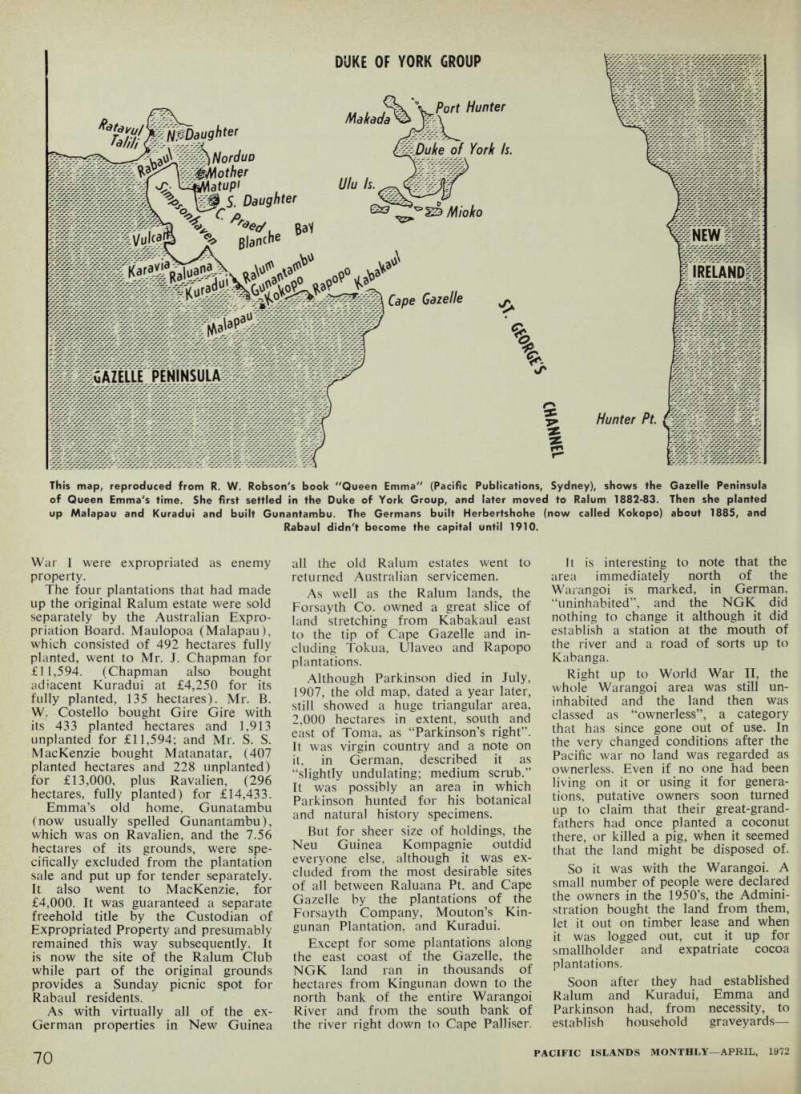
This map, reproduced from R. W. Robson's book "Queen Emma" (Pacific Publications, Sydney), shows the Gazelle Peninsula of Queen Emma's time. She first settled in the Duke of York Group, and later moved to Ralum 1882-83. Then she planted up Malapau and Kuradui and built Gunantambu.The Germans built Herbertshohe (now called Kokopo) about 1885, and Rabaul didn't become the capital until 1910.
EwS 818 *!. *5 Pid , gil !i r? ey , were behmd the homesteads (Emmas on Manlananl w estates ca^e( * TV S perhaps a mile apart. marked thf ° f nes . car . ned dates which
fascinating history of the
Q Bv thJ T* e w P,r m w y Parkinson anH rld War 1 cam( r’
Parkinson and Emma were dead, their remains interred in their respective mat-mats, and Ralum and the plantations were held by German interests, presided over by the evermemorable Heinrich Rudolph Wahlen When that P wanien traHa exnmiriS Tif US ‘ tra * ia u exp [ opnated the plantations, off Whh owners u were paid ith blts of P a Per, which called
upon a defeated and penniless Ger many to “compensate” them.
Some of the Germans—and especially the part-Germans—stayed on , while in the next 20 years a new colonising wave of Australian planters, and miners spread itself across what was now the Mandated Territory of New Guinea mq w w TT * ♦ f lth W ? r ! d )Y ar n » 1 - f / he remaining Germans J? 6 by the Australians, when (he Japanese invaded in 1942, everything Australian or German was wiped out or chased out or con fiscated.
The next phase of this extra ordinary sociological history began
in 1945, when the defeated Japanese were back in Tokyo Bay, and the war-weary Australians, driven and directed by the United Nations, ap plied themselves to the task of making, within 20 years, one united nation out of the flotsam and jetsam of two wars, one calculated invasion, and some 800 different languages.
Meanwhile, literally nothing re mained of the once prosperous and glittering empire of Queen Emma.
Not a trace was left of the once busy little port of Ralum. Of Gunantambu, nothing remained but the ornamental terrace steps and some pieces of con crete foundations of the house which was destroyed during the Japanese occupation. The greedy jungle re gained and hid the historical mat mats until they were rediscovered and cleaned up about 1964.
PIM wondered what was happening to the former Ralum plantations and the old graveyards, and we asked an old friend, Mr. Maurice Wilson (formerly a plantation manager in that area, now living in NSW, and an ardent historian) if he could help.
He was manager for Plantation Holdings Ltd. from 1965 to 1970 of Ravalien-Matanatar, once part of the original Ralum Estates. He kindly supplied the following notes, which will interest the older brigade of New Britain planters: The four Ralum plantations sold by the Australian Expropriation Board in 1926 had, at the period of which I write, passed out of this original ownership.
Plantation Holdings Ltd. owned Ravalien and Matanatar but Coconut Products Ltd. (W. R. Carpenter and Co.) owned Malapau (or Maulapao) and Kuradui. Both the Emma and Parkinson burial grounds were thus on Carpenter property and not on that managed by me.
The Kuradui section of the Carpenter estates was sold to the Raluana Tolais in the mid-1960’s for about $5O an acre. I last saw the Parkinson mat-mat about 1967, when it was overgrown. Subsequently, the Raluana people began to occupy the land and I do not know who now owns that portion of the estate on which the burial ground was estab lished, or whether it is cared for or has been destroyed.
The Emma mat-mat was well cared for at the time I last saw it. The Kokopo road was re-aligned and sealed in 1965, and the road-cutting came very close to the edge of the cemetery, but the manager of Malapau continued to maintain the mat-mat and the grass was mown regularly. Coconut Products Ltd. had
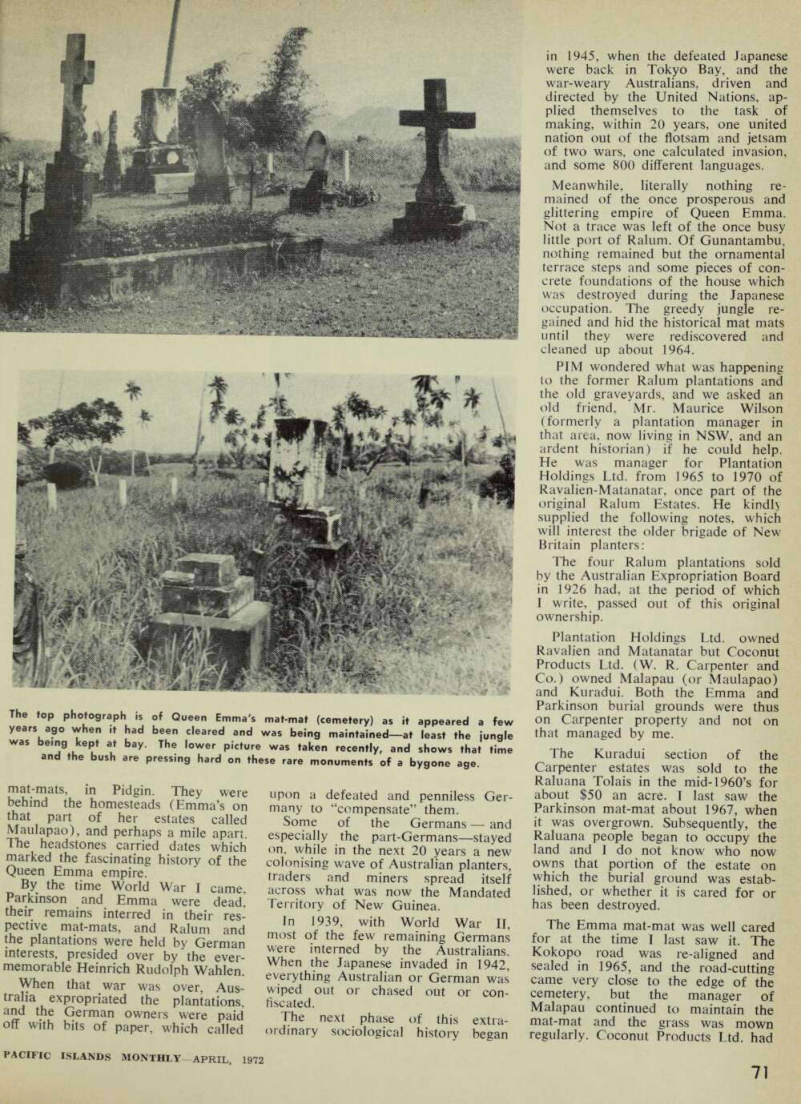
The top photograph is of Queen Emma's mat-mat (cemetery) as it appeared a few years ago when it had been cleared and was being maintained—at least the jungle was being kept at bay. The lower picture was taken recently, and shows that time and the bush are pressing hard on these rare monuments of a bygone age
Club building now where Emma ruled
provided concrete steps leading from the road to the cemetery.
There was originally a third cemetery in the Kokopo area—that of the German community at Herbertshohe. This cemetery was situated adjacent to what is Burns Philp’s compound area, at Kenabot Plantation. It was a charming place, well-cared for, with marble head stones and tablets in the form of porcelain Bibles, in the fashion of the 19th century.
However, the German Ambassador to Australia visited Rabaul in 1965 and decided to have the graveyard re-modelled. The West German Government provided the necessary funds, and rows of concrete tablets, surrounded by a textured concrete wall, replaced the old cemetery.
The Procurator at Vunapope Catholic Mission arranged for the work to be carried out, and may know the whereabouts of the old headstones.
The Ralum Club is now wedged on a site between the foundations of Gunantambu and the Gunantambu gateposts. Mr. August Larsen is manager and cares for the famous terrace steps.
Mr. Jim Dick, managing director of Plantation Holdings Ltd. lives next to the Ralum Club, and his wife Betty has restored much of the garden around Gunantambu. Indeed, her house at Ravalien is now famed throughout the Gazelle for the extent of the well-cared for lawns and the avenues of trees.
When I left, early in 1970, there were still reminders of Parkinson’s activity. On Matanatar there were about 18 nutmeg trees, stands of coffee and Hevea rubber, as well as about 200 acres of Ficus rubber, and one lone mangenstein tree, near the weir where Emma once built landscaped lawns where she held picnics.
I restored these lawns and had barbecues and swimming parties there most Sundays. My house was about 100 yards from the Matanatar weir which is made of bricks. I have wondered if these bricks could be remnants of the materials brought out from Europe for the Marquis de Ray settlement at Port Breton, New Ireland and soon abandoned. Farrell.
Emma’s de facto husband, rescued some of the unfortunate would-be colonists, and took over a lot of the abandoned gear. Bricks could well have been part of it; certainly
nothing of the sort has ever been made in New Britain.
Most of the coconut palms on Ravalien and Matanatar were show ing signs of acute sulphur deficiency when I arrived there in 1965 and the Department of Agriculture at Keravat was conducting experiments.
As a result, palms were receiving 1 lb of sulphur per palm per year.
Production increased dramatically and areas where formerly there were no nuts were, by late 1969, producing 10 cwt of copra per acre, with higher returns expected. These palms were all over 80 years old.
Between 1965 and 1969 much of Ravalien and Matanatar was re planted with coconuts. These palms were well cared for and the first were beginning to bear their first nuts when I left in 1970.
The land pressure by the ever in creasing and politically minded Tolais is considerable and in order to give some relief, negotiations were begun in 1969 between Plantation Holdings Ltd. and the Administration for the sale of Ravalien and Mata natar. These were concluded in mid -1970 at a price said to be in the vicinity of $238,000 for the 1,700 acre property, Plantation Holdings Ltd. retaining a section of Ravalien adjoining Kokopo township area which they have cut up for selling as residential sites.
The rest of Ravalien was sub divided into five acre lots and sold to the Vunamami people.
The Ulagunan people, in early 1969, had got together and purchased 100 acres of Ficus rubber on Mata natar. After the Administration purchased the remainder of the estate in 1970, it too was subdivided into five acre lots for resale to the same people.
By this time Matanatar, through treatment of old palms and replant ing of new, was again a going con cern as a plantation and the Ula gunan people protested over the sub division. They wanted to form a company and run it as a plantation.
It seems a pity that they were not allowed to have their way as it would have been a useful experiment and perhaps a proving ground for John Kaputin’s proposed Development Corporation.
District Commissioner Jack Emanuel was constantly on the job at Ravalien-Matanatar while negotia tions were going on, realising no doubt that the release of this land would do something towards ap
peasing Tolai land-hunger. By a coincidence, he lost his life at another of Plantation Holdings estates— Kabaira, which is on the eastern side of Ataliklikun Bay on the north coast of the Gazelle. It is the opinion of some people that if the Admini stration had also bought Kabaira, much of the trouble that erupted in that area in 1971 would have been avoided.
The Tolais almost missed out on Ravalien and Matanatar, After bad earthquakes at Rabaul in 1967 the Administration sent its valuers to look at these plantations with the idea of their becoming a satellite town, to serve a proposed new jet airstrip at Rapopo or Cape Gazelle.
Nothing came of the plan however.
It is of interest that the Kokopo Golf Club now owns the foreshore from Kokopo town to the foot of the terrace steps at Gunantambu so that the view from the old house site, across the bay to the Duke of York Islands, now has a beautiful fore ground.
FOOTNOTE: Judy Tudor of PIM was in Rabaul recently and has this to report: “I visited Queen Emma’s mat-mat early in February. The grass is no longer mowed regularly and was, in fact, waist high. The chain between the fence posts seemed to have disappeared—probably pinched for anchor-chain; and the big memorial stone that Emma erected to the memory of her favourite lover, Agostino Stalio, teetered on the edge of its foundations. Another couple of earthquakes should throw it down.
“No one knew where the Parkinson mat-mat was, and there was no indication of it along the Rabaul- Kokopo Road. At Ralum the club was functioning normally and there were a few people taking advantage of the sun and the lawns but the famous steps appear to be crumbling away. About three steps down from the top terrace, a couple of large bushes are growing out of the middle of them. It is unlikely that they will last much longer.
“The fact is, of course, that Rabaul and the Gazelle Peninsula are far more concerned with living through the present than with past history.
With a sunny Sunday afternoon to spare I was eager to explore more of the Gazelle Peninsula’s past, and a friend tried for an hour by tele phone to find someone who supplied this sort of service. But no tour or information was available. I finally hired a car and we found the mat mat and Ralum for ourselves.”