New Caledonia's
pp. 63-64 · Read in the full issue
He's one reason for New Caledonia's eminence in sport
By Mike Hohensee
Above anything, I suspect Numa Daly, who has done so much for sport in New Caledonia over the past 45 years, would like to be remem bered as the “fair” man.
You see, his ideals coincide with those of the South Pacific Games, or vice versa. Daly, born 65 years ago in Noumea, was, and I suppose still is, the father of organised sport in New Caledonia.
He retired in February and before he left Noumea for Sydney, where he now lives, 300 gathered at the Imperial Hall to give him a rousing send-off.
All the well-wishers were connected with sport in some way or another.
They had reason to wish him well, for Daly was the man responsible for the formation of nearly all the major sports associations in New Caledonia.
In his time, the dapper little Frenchman with characteristic, short, greying hair has been chairman and secretary of most of the local sports bodies. “I prefer to be secretary for I like to work and be useful,” said Daly, who for the past 10 years had taken more of a back seat in sports administration. “I didn’t want to be asked to stand down because of my age,” he added.
He talks fondly, with an un faltering memory for dates and figures, of the late 19205, early 19305, when he formed the Federations Caledonienne de Football Association, now the Ligue de Nouvelle Caledonie de Football, the boxing and athletic associations, and with Ernest Veyret, now also resident in Australia, the swimming and basketball associations.
When he wasn’t riding a bike, playing tennis or kicking a ball, he was either kicking an idea around or
starting up some new sports venture.
When there was time he wrote articles for overseas sports papers; he was correspondent for L’Auto (now L’Equipe ) in Paris and for the Sydney Referee.
Noumea’s sportsmen can thank Daly for La Neo Caledonienne, a club with facilities for judo, physical culture and fencing and for the Union de Federations Caledoniennes, a body set up in 1930 to organise the sport ing calendar.
He was also responsible for New Caledonia’s first soccer international.
“An Australian team played three games at the old Velodrome in 1932,” he said. “We lost all three games.
I remember the scores for they got progressively worse for us—2-1, 4-2, and 7-3.”
Soccer is still his first love, and he is justly proud that it was through his efforts that the Coupe de Cale donie knock-out championship got off the ground. It has become the premier soccer event of the year, with teams from all over New Cale donia taking part.
He makes no claim to having sown the seed for the establishment of the Oceania Soccer Tournament which failed to make a start last year because of a dispute between Australia and New Caledonia over expenses, but as far back as 1955 he wrote to the Australian and New Zealand associations suggesting a South Pacific competition.
He proposed a pool system to include the New Hebrides, Fiji, Tahiti, New Caledonia, New Zealand and Australia with the final rounds to be played either in New Zealand or Australia. But nothing materialised; it was thought that the overheads
for staging such a competition would be too high.
“Not too many people realise that there is a big set-back for us with the Oceania Tournament,” said Daly, “If it had taken place and we had won, we could not have qualified for the World Cup because all our players are available for the French national team.
“In the last World Cup in Mexico two New Caledonian players, Charles and Kanyan, played for France. They play, as semi-professionals, for the Ajaccio Club in Corsica.”
Sport played a small part in Daly’s life until he went to Sydney for schooling when he was 14. He was sent to Riverview College by his father, founder-partner of Noumea’s department store, Maison Barrau, to learn English.
“I suppose you could say that sport was established earlier in Noumea because of my activities on the Sydney sports fields. Sport was compulsory at college and I had to take on football, tennis, athletics and cricket—an unusual pastime for a Frenchman!” he said.
After two years in France studying commerce Daly returned to Noumea for military service and almost im mediately introduced competition into the army with championships for cycling, athletics and boxing. “At that time, prior to 1927, there was little organisation and while I was in France I visited and joined all the sports unions which had their head quarters in Paris. I came back to Noumea with all the necessary documents to get things going,” said Daly.
I didn’t for one moment imagine that Numa Daly’s years of service
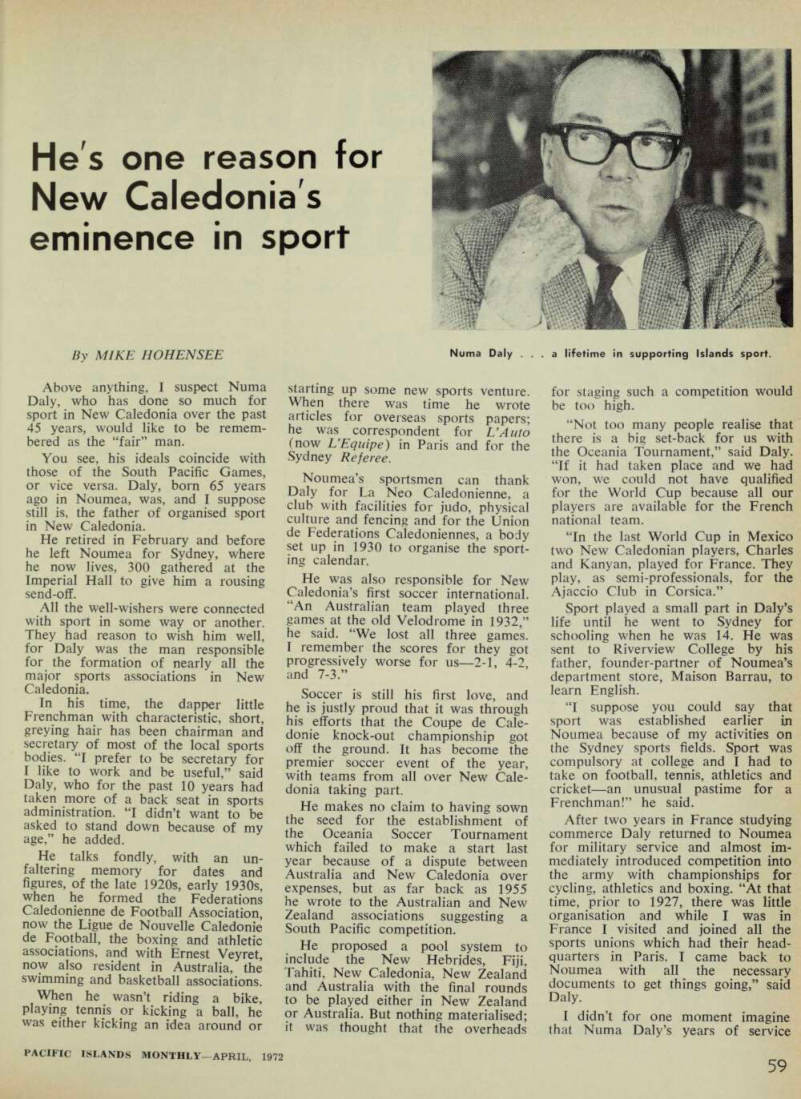
Numa Daly ... a lifetime in supporting Islands sport.
to sport could go unheralded. In fact, he has been honoured by France more than once. A little reluctantly, but with a certain amount of pride, he showed me four medals. He has received the French Football Associa tion’s silver medal (1960), the Merite Sportif (1953), the National Order of Merit (1966) and the Gold Medal of Sport (1970).
He received the National Order of Merit—he is now a knight of that order—at the closing of the 1966 South Pacific Games held in Noumea.
“A number were given medals and mine was for sport and social work,” he said. For believe it or not Daly also managed to find time to act as vice-chairman of the Red Cross and as representative of the New Zealand Lepers Trust Board.
Daly was vice-chairman of the New Caledonian organising committee for the 1966 Games and was assistant team manager for the 1963 and the 1969 Games.
He strongly believes that New Caledonia attaches too much import ance to the winning of medals. To him, taking part is the criterion. “Of course, I’m happy that New Cale donia has come out on top in the last two Games but I have also been embarrassed by our show of wealth.
One year we had a French designer to design our girls’ uniforms!
“If the Solomons want to run the Games it doesn’t matter if they haven’t got all the proper facilities.
The thing is to run on equal terms.
As long as the track is the correct length we should forget about whether it is grass or cinder,” said Daly. “We have been successful because we have all the equipment and the coaches, with a great deal of help coming from France.”
At past Games there have been mumblings from other territories that some competitors were more French than New Caledonian, in that men like champion shot-putter Arnjolt Beer and top tennis player Wanaro N’Godrela, spent more time in France than in Noumea.
“The South Pacific Games charter says that any territory can call on athletes who were born within that territory. We haven’t taken full ad vantage of that ruling. I can assure you that I would protest if we used competitors who hadn’t spent at least 20 years in New Caledonia,” said Daly.
Numa Daly has competed many times on the sports field but he is the champion of fair play. Now in Sydney, he has gone looking for a local French soccer team. “If I can help them I will. 1 believe they’re doing quite well,” he said.