wallop
pp. 60-61 · Read in the full issue
New Guinea travel can still pack a wallop
By Judy Tudor
Now that the concept of hell has gone out of fashion, the place where I’d like least to spend any part of my time is the terminal building at Jacksons Airport, Port Moresby.
It must be close to being the worst terminal in the world, in relation to the incredible number of people who pass through it each day. It was built about 1957, when Papua New Guinea was serviced by a couple of Qantas Constellations per week.
Today, it has at least two Boeing Ill's to turn around each day for the Port Moresby-Sydney service, plus innumerable Fokker Friendships, DC3’s and lesser aircraft which ferry people in from all over the territory to catch the Southern plane, or alternatively to pick them up from the Ill's and distribute them ter ritory-wide.
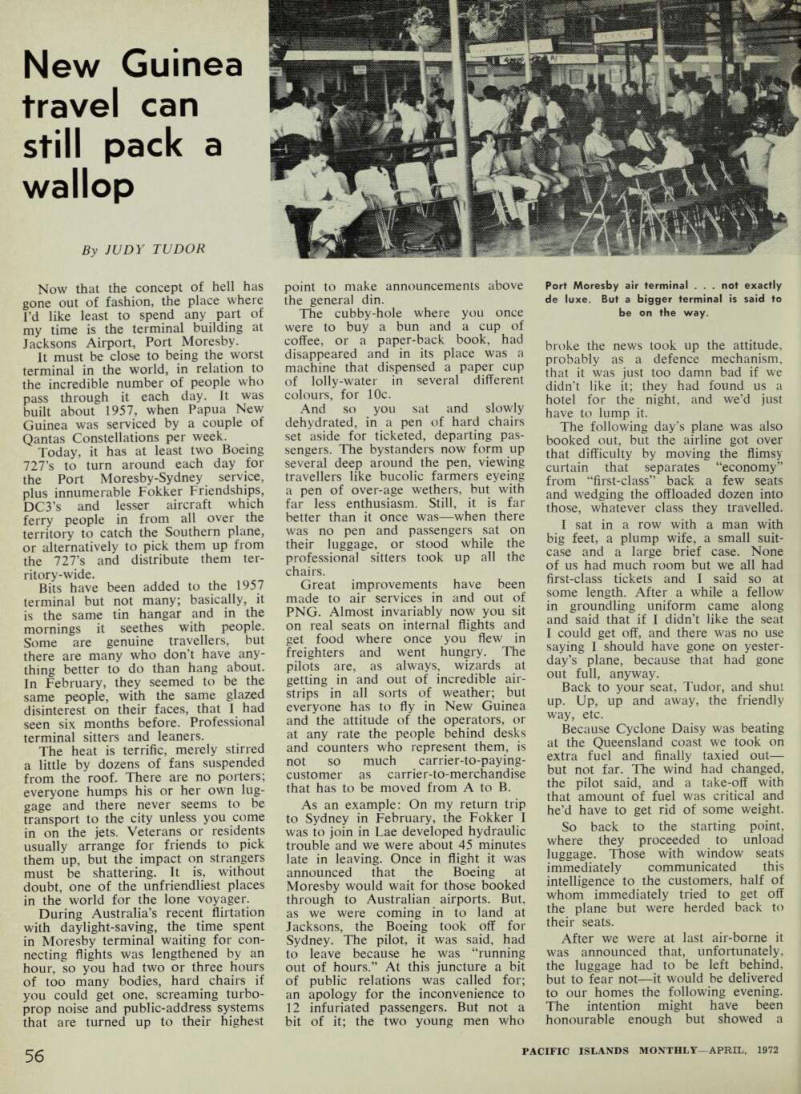
Bits have been added to the 1957 terminal but not many; basically, it is the same tin hangar and in the mornings it seethes with people.
Some are genuine travellers, but there are many who don’t have any thing better to do than hang about.
In February, they seemed to be the same people, with the same glazed disinterest on their faces, that I had seen six months before. Professional terminal sitters and leaners.
The heat is terrific, merely stirred a little by dozens of fans suspended from the roof. There are no porters; everyone humps his or her own lug gage and there never seems to be transport to the city unless you come in on the jets. Veterans or residents usually arrange for friends to pick them up, but the impact on strangers must be shattering. It is, without doubt, one of the unfriendliest places in the world for the lone voyager.
During Australia’s recent flirtation with daylight-saving, the time spent in Moresby terminal waiting for con necting flights was lengthened by an hour, so you had two or three hours of too many bodies, hard chairs if you could get one, screaming turbo prop noise and public-address systems that are turned up to their highest
point to make announcements above the general din.
The cubby-hole where you once were to buy a bun and a cup of coffee, or a paper-back book, had disappeared and in its place was a machine that dispensed a paper cup of lolly-water in several different colours, for 10c.
And so you sat and slowly dehydrated, in a pen of hard chairs set aside for ticketed, departing pas sengers. The bystanders now form up several deep around the pen, viewing travellers like bucolic farmers eyeing a pen of over-age wethers, but with far less enthusiasm. Still, it is far better than it once was—when there was no pen and passengers sat on their luggage, or stood while the professional sitters took up all the chairs.
Great improvements have been made to air services in and out of PNG. Almost invariably now you sit on real seats on internal flights and get food where once you flew in freighters and went hungry. The pilots are, as always, wizards at getting in and out of incredible air strips in all sorts of weather; but everyone has to fly in New Guinea and the attitude of the operators, or at any rate the people behind desks and counters who represent them, is not so much carrier-to-paying customer as carrier-to-merchandise that has to be moved from A to B.
As an example: On my return trip to Sydney in February, the Fokker 1 was to join in Lae developed hydraulic trouble and we were about 45 minutes late in leaving. Once in flight it was announced that the Boeing at Moresby would wait for those booked through to Australian airports. But, as we were coming in to land at Jacksons, the Boeing took off for Sydney. The pilot, it was said, had to leave because he was “running out of hours.” At this juncture a bit of public relations was called for; an apology for the inconvenience to 12 infuriated passengers. But not a bit of it; the two young men who
broke the news took up the attitude, probably as a defence mechanism, that it was just too damn bad if we didn’t like it; they had found us a hotel for the night, and we’d just have to lump it.
The following day’s plane was also booked out, but the airline got over that difficulty by moving the flimsy curtain that separates “economy” from “first-class” back a few seats and wedging the offloaded dozen into those, whatever class they travelled.
I sat in a row with a man with big feet, a plump wife, a small suit case and a large brief case. None of us had much room but we all had first-class tickets and I said so at some length. After a while a fellow in groundling uniform came along and said that if I didn’t like the seat I could get off, and there was no use saying I should have gone on yester day’s plane, because that had gone out full, anyway.
Back to your seat, Tudor, and shut up. Up, up and away, the friendly way, etc.
Because Cyclone Daisy was beating at the Queensland coast we took on extra fuel and finally taxied out — but not far. The wind had changed, the pilot said, and a take-off with that amount of fuel was critical and he’d have to get rid of some weight.
So back to the starting point, where they proceeded to unload luggage. Those with window seats immediately communicated this intelligence to the customers, half of whom immediately tried to get off the plane but were herded back to their seats.
After we were at last air-borne it was announced that, unfortunately, the luggage had to be left behind, but to fear not —it would be delivered to our homes the following evening.
The intention might have been honourable enough but showed a
Port Moresby air terminal . . . not exactly de luxe. But a bigger terminal is said to be on the way.
naive view of the Australian Customs Dept. I finally got my suitcase from the Sydney airport bond-store two days later but only after it had been searched by a Customs officer.
For people living in Brisbane or Sydney lack of luggage was only a minor irritation and, after all, a cyclone is an emergency. For those who had to go to hotels, interstate or overseas, with only the New Guinea gear in which they stood up, it was a more serious affair.
The 727’s have probably come to the end of their usefulness so far as the Australian-New Guinea service is concerned. Geared more to Aus tralian domestic flights, where the central galley is called upon to pro duce no more than biscuits and cups of tea, the whole thing is inadequate for a full load of Territorians.
It is part of the territory tradition that you should behave on the south bound plane as though you had spent the previous six months in a part of
the Sahara Desert where prohibition prevails. The flow of beer and other beverages from the galley is almost constant and this, plus serving a full meal, keeps four hostesses work ing like slaves but never quite catching up.
During our interregnum in Port Moresby we were accommodated in the Gateway Hotel, near the airport.
The Gateway was the first of the new generation hotels in the ter ritory and gave it its first touch of luxury. More recently it has been bought by an Ansett subsidiary.
Its greatest drawback is its dis tance from the town and the lack of anything to do except drink— which can be performed in the Jet Bar, the Club Bar, the Owen Stanley Bar, the Flight Deck or the Wein keller. There is no shop so you can’t even buy a book and you usually find yourself on the verandah—sorry, Flight Deck—watching the planes on the airport below. The trouble with
planes in New Guinea is that they are like elephants in Africa—see one and you’ve seen the lot.
The Gateway badly needs that swimming pool that has been on the drawing board for the last six years.
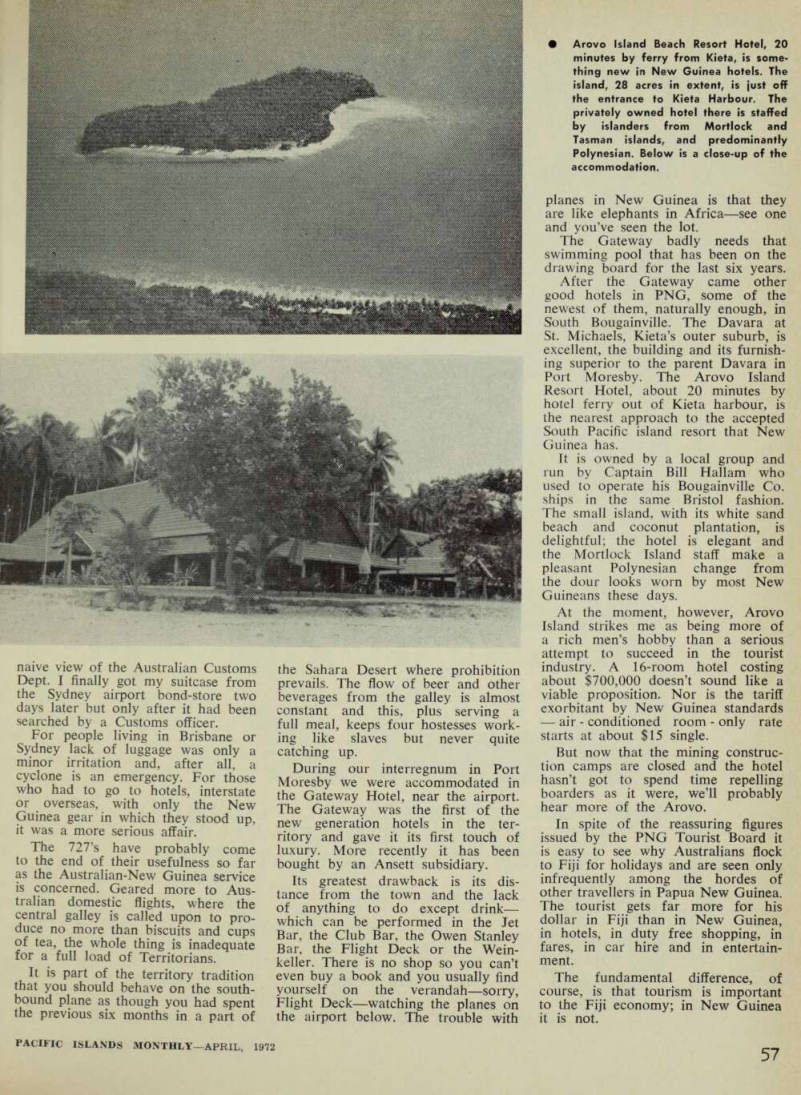
After the Gateway came other good hotels in PNG, some of the newest of them, naturally enough, in South Bougainville. The Davara at St. Michaels, Kieta’s outer suburb, is excellent, the building and its furnish ing superior to the parent Davara in Port Moresby. The Arovo Island Resort Hotel, about 20 minutes by hotel ferry out of Kieta harbour, is the nearest approach to the accepted South Pacific island resort that New Guinea has.
It is owned by a local group and run by Captain Bill Hallam who used to operate his Bougainville Co. ships in the same Bristol fashion.
The small island, with its white sand beach and coconut plantation, is delightful; the hotel is elegant and the Mortlock Island staff make a pleasant Polynesian change from the dour looks worn by most New Guineans these days.
At the moment, however, Arovo Island strikes me as being more of a rich men’s hobby than a serious attempt to succeed in the tourist industry. A 16-room hotel costing about $700,000 doesn’t sound like a viable proposition. Nor is the tariff exorbitant by New Guinea standards air - conditioned room - only rate starts at about $l5 single.
But now that the mining construc tion camps are closed and the hotel hasn’t got to spend time repelling boarders as it were, we’ll probably hear more of the Arovo.
In spite of the reassuring figures issued by the PNG Tourist Board it is easy to see why Australians flock to Fiji for holidays and are seen only infrequently among the hordes of other travellers in Papua New Guinea.
The tourist gets far more for his dollar in Fiji than in New Guinea, in hotels, in duty free shopping, in fares, in car hire and in entertain ment.
The fundamental difference, of course, is that tourism is important to the Fiji economy; in New Guinea it is not.
• Arovo Island Beach Resort Hotel, 20 minutes by ferry from Kieta, is some thing new in New Guinea hotels. The island, 28 acres in extent, is just off the entrance to Kieta Harbour. The privately owned hotel there is staffed by islanders from Mortlock and Tasman islands, and predominantly Polynesian. Below is a close-up of the accommodation.