Santa Cruz: Isle Of Feather Money
pp. 58-59 · Read in the full issue
Story and pictures by R. RUDD
Lying slightly south of east and four hundred miles from Honiara, Guadalcanal, is a scattered group of islands, the largest of which is Santa Cruz, so named by the Spanish Navigator, Alvaro de Mendana, in 1595.
Spread over an area of ten thousand square miles of the South Pacific, with no regular air contact, and only the monthly Administration vessel, these forgotten eastern outer islands are seldom seen by visitors. Recently an aerial survey was made in the British Solomon Islands, and the aircraft was based at Graciosa Bay, Santa Cruz to carry out a photographic coverage of the group.
To the north of Santa Cruz lies the great sweep of reefs, cays and
lagoons that make up the Reef Islands, and north-east the small hill top chain of the Duff Islands. To the south-east lie the two larger islands of the group, Utupua and Vanikoro, both fringed with turquoise reefs. In 1788 La Perouse lost his ships and his life on Vanikoro.
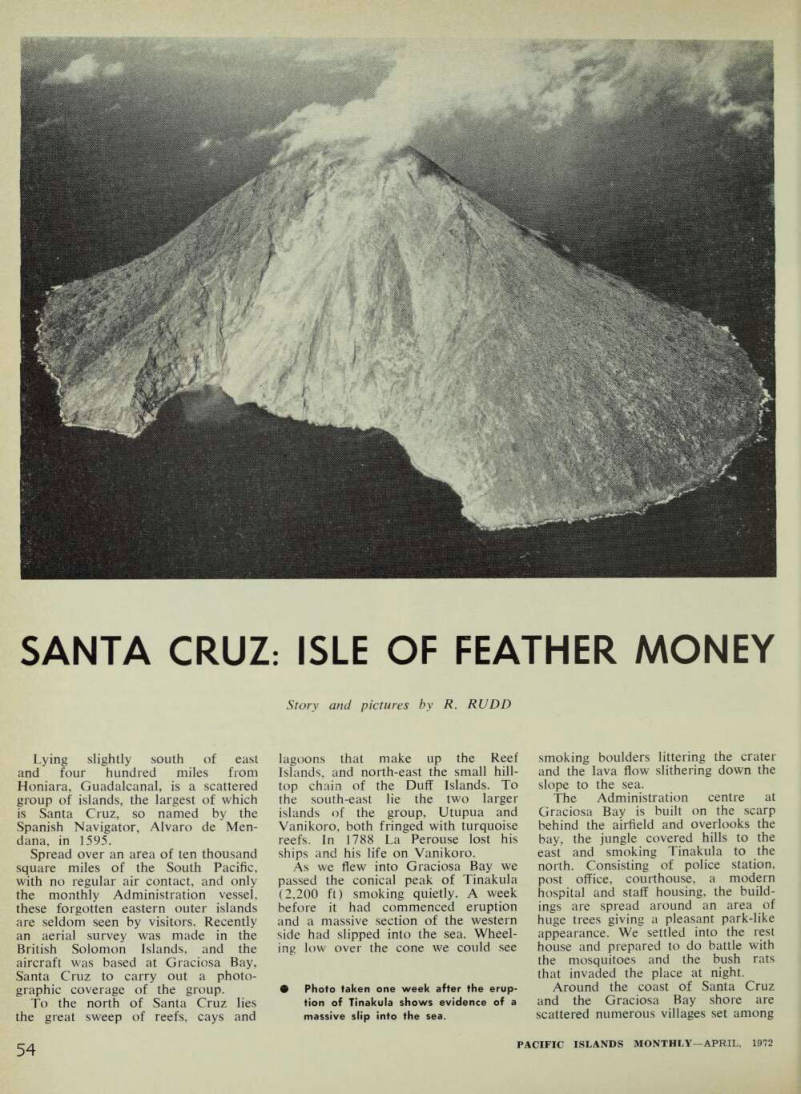
As we flew into Graciosa Bay we passed the conical peak of Tinakula (2,200 ft) smoking quietly. A week before it had commenced eruption and a massive section of the western side had slipped into the sea. Wheel ing low over the cone we could see
smoking boulders littering the crater and the lava flow slithering down the slope to the sea.
The Administration centre at Graciosa Bay is built on the scarp behind the airfield and overlooks the bay, the jungle covered hills to the east and smoking Tinakula to the north. Consisting of police station, post office, courthouse, a modem hospital and staff housing, the build ings are spread around an area of huge trees giving a pleasant park-like appearance. We settled into the rest house and prepared to do battle with the mosquitoes and the bush rats that invaded the place at night, Around the coast of Santa Cruz and the Graciosa Bay shore are scattered numerous villages set among
9 Photo taken one week after the erup tion of Tinakula shows evidence of a massive slip into the sea.
coconut palms and backed by the jungle.
For the friendly villagers life carries on as it always has. During the day the women go inland to tend gardens and the men go fishing or building houses, canoes or implements from bush materials.
We met one old man who had a trade—weaving shoulder bags of banana tree fibre on a loom tensioned between his body and the hut wall.
With black fibre he incorporated graphic patterns into the weave. His main concern was for his craft; he worried that the influence of civilisa tion would discourage his sons from carrying on the skills that have been handed on for generations.
At one time he made elaborate, finely woven lap laps for custom dancing but there was no demand for this work now.
We were fortunate enough to see some examples of custom lap laps in use. From an Islander working for a WHO malaria control team, we heard of a feast and dance to be held at Neo village on the north coast of Tomotu Neo, six miles from Graciosa Bay. We walked to Luova village where we were ferried by canoe across the channel to the start of the jungle trail.
When we arrived at Neo the place was packed. Over one thousand people had turned up for the oc casion and ninety pigs, great heaps of sweet potato and taro pudding had been prepared to cater for them all.
The air was thick with the aroma of wood smoke, burnt banana leaves and rare meat.
After everyone had satisfied their hunger, we waited by a hut where the custom dancers prepared them selves. They meticulously whitened hair, painted faces, dyed legs and arranged shell ornaments, turtle-shell nose “bones”, rattles and armbands for several hours. Clad in banana weave lap laps and all the other regalia the dancers trooped onto the dancing ground and formed a radial line.
At the leader’s chant they all started singing and stamping around the circular arena with hordes of villagers joining in.
The ceremony, a villager told me, was to celebrate the end of this current dancing ground prior to opening a new area at the other end of the village.
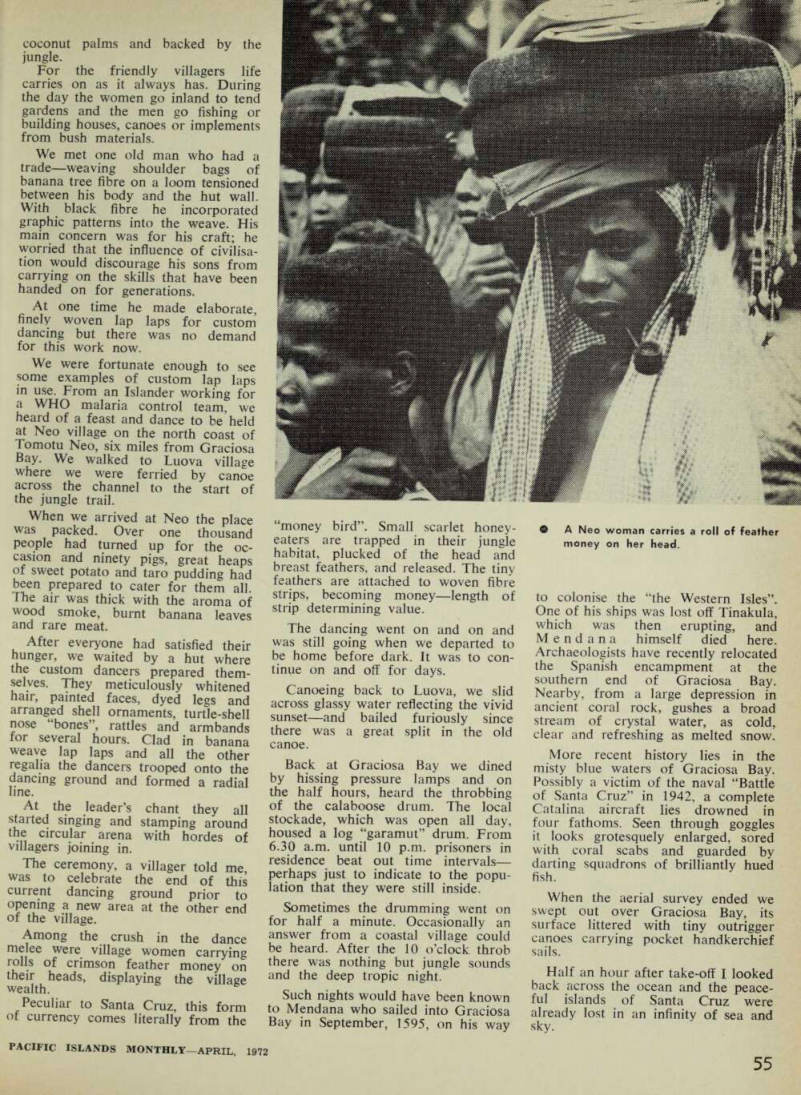
Among the crush in the dance melee were village women carrying rolls of crimson feather money on their heads, displaying the village wealth.
Peculiar to Santa Cruz, this form of currency comes literally from the
money bird . Small scarlet honeyeaters are trapped in their jungle habitat, plucked of the head and breast feathers, and released. The tiny feathers are attached to woven fibre strips, becoming money—length of stnp determining value.
The dancing went on and on and was still going when we departed to be home before dark. It was to continue on and off for days. . .
Canoeing back to Luova, we slid across glassy water reflecting the vivid sunset and bailed furiously since there was a great split in the old canoe. . .
Back at Graciosa Bay we dined by hissing pressure lamps and on the half hours, heard the throbbing of the calaboose drum. The local stockade, which was open all day, housed a log “garamut” drum. From 6.30 a.m. until 10 p.m. prisoners in residence beat out time intervals— perhaps just to indicate to the population that they were still inside. .
Sometimes the drumming went on for half a minute. Occasionally an answer from a coastal village could be heard. After the 10 o’clock throb there was nothing but jungle sounds and the deep tropic night. c , . , . ... , .
Such nights would have been known to Mendana who sailed into Graciosa Bay m September, 1595, on his way
to colonise the “the Western Isles”.
One of his ships was lost off Tinakula, which was then erupting, and Mend a n a himself died here.
Archaeologists have recently relocated the Spanish encampment at the southern end of Graciosa Bay.
Nearby, from a large depression in ancient coral rock, gushes a broad stream of crystal water, as cold, clear and refreshing as melted snow.
More recent history lies in the misty blue waters of Graciosa Bay.
Possibly a victim of the naval “Battle of Santa Cruz” in 1942, a complete Catalina aircraft lies drowned in four fathoms. Seen through goggles it looks grotesquely enlarged, sored with coral scabs and guarded by darting squadrons of brilliantly hued fish.
When the aerial survey ended we swept out over Graciosa Bay, its surface littered with tiny outrigger canoes carrying pocket handkerchief sails.
Half an hour after take-off I looked back across the ocean and the peace ful islands of Santa Cruz were already lost in an infinity of sea and sky.
A Neo woman carries a roll of feather money on her head.