fiji talanoa
pp. 51-53 · Read in the full issue

Immigration raises the temperature in Fiji
With Sue Wendt, In Suva
Fiji was still ruminating over the » » Prime Minister's most recent attack on Australian immigration laws (and speculating on the vote-power of his stratagem, just prior to the general elec tions), a new row blew up on the home front over the dominion's own immigra tion rulings.
Fiji's immigration attitudes can seem pretty tough to outsiders. Often there are very good reasons indeed for the department's decision not to allow certain people to stay. But officials do little to improve Fiji's immigration and investment image when they decline to give explana tions or delay the granting of permits for so long that people are forced into being here illegally.
Sometimes such situations are the re sult of normal (one comes to accept it as normal) inefficiency or administrative foul ups of one kind or another.
Frequently though, prospective immi grants ruin their own chances by going about things the wrong way—the "Let's get things through FAST, I'm putting a lot of money into this country and I've got some pretty important friends" kind of thing. It's one attitude that doesn't go down at all well in independent Fiji.
Agressive Europeans, Fiji doesn't want.
The immigration blow-up in March re sulted from two well-publicised incidents.
A NATURALISED Australian businessman, Mr. Joseph Maas, declared that he was fed up with Fiji, alleging that he'd had to contend with dishonesty and ob struction since bringing his wife and family here from Melbourne in Auaust 1970. ' He said he'd been given a seven-year permit to reside in Fiji and registered a company to hire out and sell building equipment. Nine months ago he had been fold to stop operating the company until fie obtained another kind of permit. Since fhen, he claimed, he'd been unable to get my explanation or action from immigra ion authorities. He also claimed that he'd lad to put up a much larger bond—about £l,BO0 —than most other Australians.
In addition to his complaints about im migration difficulties, Mr. Maas had a long list of grievances about things that had happened to him in Fiji. He finally left for Australia in mid-March.
Later, Minister for Labour Ratu Sir Edward Cakobau, issued a statement say ing that although Mr. Maas had been given the permit to reside, doubt arose as to whether it covered him in the busi ness he later started. He was advised to apply for a work permit. He subsequently did so but the form was twice returned to him because it was incomplete. It still hadn't been received, properly completed, when Mr. Maas surrendered the original permit on February 16 this year.
As to the matter of the bond, Ratu Sir Edward said, the law required that the
bond should be sufficient for a return to the place of a person's birth, or the place from which a person arrived in Fiji— whichever is the greater. Mr. Maas and his family were born in Holland.
The Minister added: "Although I am satisfied that the immigration section of my Ministry acted correctly, I am not satis fied that it was as helpful to Mr. Maas as it should have been and this, I re gret."
QUICK to join battle on the immigration issue was Opposition Leader Mr.
Siddiq Koya, who also happens to be legal representative in Fiji for Mr. Frank Zenti, who was the subject of another immigration row in March.
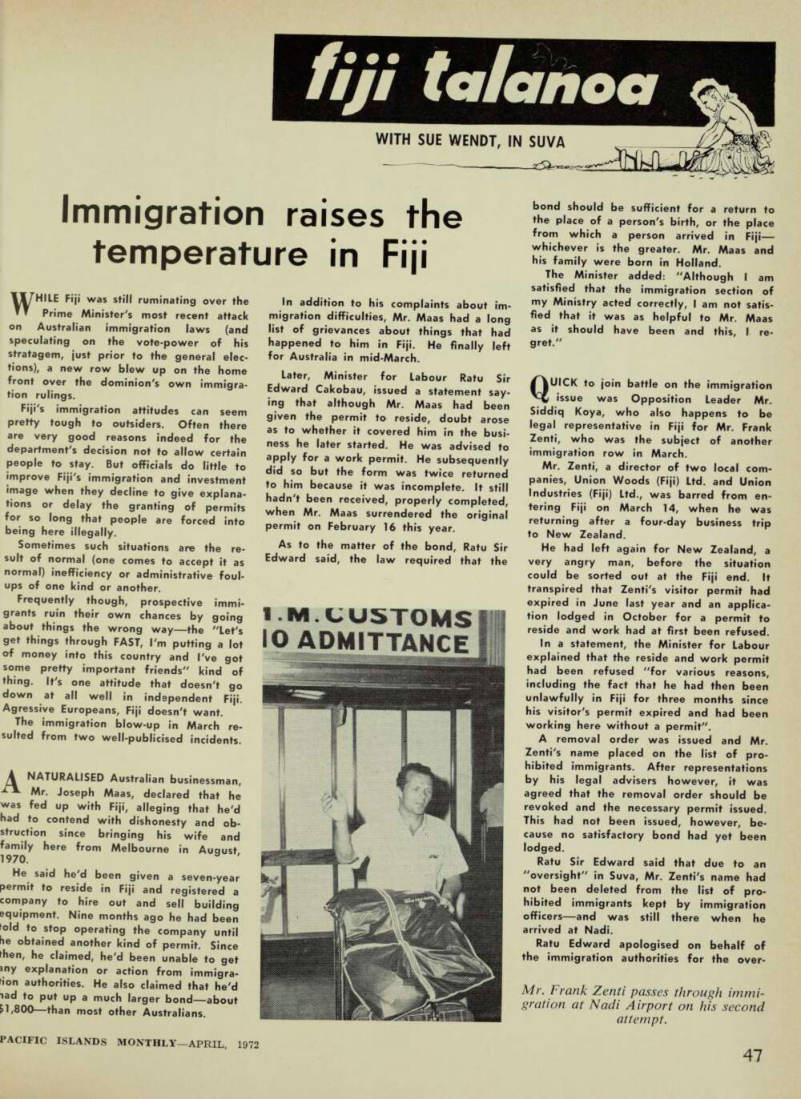
Mr. Zenti, a director of two local com panies, Union Woods (Fiji) Ltd. and Union Industries (Fiji) Ltd., was barred from en tering Fiji on March 14, when he was returning after a four-day business trip to New Zealand.
He had left again for New Zealand, a very angry man, before the situation could be sorted out at the Fiji end. It transpired that Zenti's visitor permit had expired in June last year and an applica tion lodged in October for a permit to reside and work had at first been refused.
In a statement, the Minister for Labour explained that the reside and work permit had been refused "for various reasons, including the fact that he had then been unlawfully in Fiji for three months since his visitor's permit expired and had been working here without a permit".
A removal order was issued and Mr.
Zenti's name placed on the list of pro hibited immigrants. After representations by his legal advisers however, it was agreed that the removal order should be revoked and the necessary permit issued.
This had not been issued, however, be cause no satisfactory bond had yet been lodged.
Ratu Sir Edward said that due to an "oversight" in Suva, Mr. Zenti's name had not been deleted from the list of pro hibited immigrants kept by immigration officers —and was still there when he arrived at Nadi, Ratu Edward apologised on behalf of the immigration authorities for the over
Mr. Frank Zenti passes through immi gration at Nadi Airport on his second attempt.
sight and resultant inconvenience to Mr.
Zenti, who returned to Fiji a couple of days later.
MEANWHILE Opposition Leader Koya had made it clear that Immigration Department policies would become a major political issue. He accused the de partment of issuing removal orders "willy nilly" and complained about "tinpot" officials who "thought they were running the country". He described treatment of Mr. Zenti as scandalous and called for a complete overhaul of the department. He also said that immigration authorities should afford special consideration to Commonwealth citizens.
The Opposition Leader pointed out that Fiji's immigration attitudes were tied up with its policy on investment and tourism and relationship with other countries.
The latter is certainly true. But just how unfair is Fiji's immigration policy?
Is it any tougher than in any other country? Are officials any more officious than anywhere else?
To the unjaundiced eye, probably not.
The dominion's requirements are no worse than most countries (though that might be considered faint praise since immigration departments everywhere are notoriously heartless and inhumane) and far less severe than some, but one does hear allegations of disarray in departmental sanctums.
And it does seem to take an inordi nately long time to get things through.
OITING his nails in March was Mr. Don Biddle, who has opened Fiji's first steak house, an excellent establishment long overdue and much appreciated by Suva people. His permit to reside and work hadn't come through at the time his visitor's permit expired, although application had been made. For a while he was wondering whether he'd have to depart, since he was here illegally, leav ing his already-completed restaurant be hind. And until the permit was approved, he wasn't allowed to do anything that might be construed as work.
However, the permit did come through in mid-March and all's well for Suva steak eaters.
Hoping for the same outcome after a much longer wait was Canadian business man Ken Nelson, whose wife Mary is Fiji-born. The couple, who established Fiji's first art gallery, have been trying to get a residency permit for Mr. Nelson for the past two years. They've become pretty bitter about their lack of successs.
In the meantime, Mr. Nelson has had to travel in and out of the country, re newing his visitors' permit. Foreign hus bands of Fiji-born women have no rights of entry, although the reverse works for Fiji males.
In March, Mr. Nelson was in Fiji on an
interim permit, awaiting the Minister's decision on his appeal against the Department's refusal to grant the full reside and work permit.
THE "Pacific Review", which supports National Federation Party policies, burst into print recently on the subject of the Son-In-Law Debacle. The newspaper claimed that few Indian sons-in-law had received permits to stay in Fiji, but it wasn't just an Indian problem. It affected the foreign-born sons-in-law of all Fiji people. The newspaper claimed that "when the NFP comes into power, sons-in-law won't have to shuttle back and forth, separated from their suffering w ' ves / * Another immigration complexity, concerning relatively few people but still important, is the question of what's to happen to "belongers" after October 10, this year. Some of these long-term residents, usually the elderly ones, don't wish to take Fiji citizenship only because it means severing sentimental ties with their homelands. It's tough on them perhaps, but dual citizenship is just not allowed.
To all arguments, the authorities have their reply ready, pointing to the immigration laws and using these as their defence.
They point out that Fiji has only one door the front door—and nobody is going to sneak in the back way. The law is the law and red tape is the same colour everywbere - That doesn't lessen the frustration of those whose applications are rejected without what they consider to be fair
explanation, or those who feel forced to leave because they can't stand the way things are done here. It explains perhaps official attitudes in a young country that is still very sensibly on the lookout for the con man, the seeker of the fast buck, the exploiter of the unsophisticated—but doesn't cut much ice with those who insist that tbe ,aw can,f be bent ' n F 'i'» 't' s certainly been stretched more than once!
Senate has flexed its muscles and -T rejected a bill, previously approved by the House of Representatives, provid ing for a referendum on the death penalty issue. If held, the referendum would cost the country something like $75,000.
As reported in PIM in March, the bill had been approved by the House, despite opposition which included arguments from the Deputy Speaker Mr. R. D. Patel, that taking a referendum was a derogation of the sovereignty of Parliament, The Senate rejected the bill, after speakers, led by the campaigning Senator Dr. Felix Emberson, condemned what they considered the unwarranted expense of such an exercise. It was rejected by 15 votes to six. Before the vote was taken, the Attorney-General Mr. J. N. Falvey, said that if the bill was not passed by the Senate, it would probably lapse, The death penalty in Fiji has been suspended until December 31, 1972. If nothing happened between now and then, it would automatically come into being again. It's probable though that the new Parliament will revive the debate.
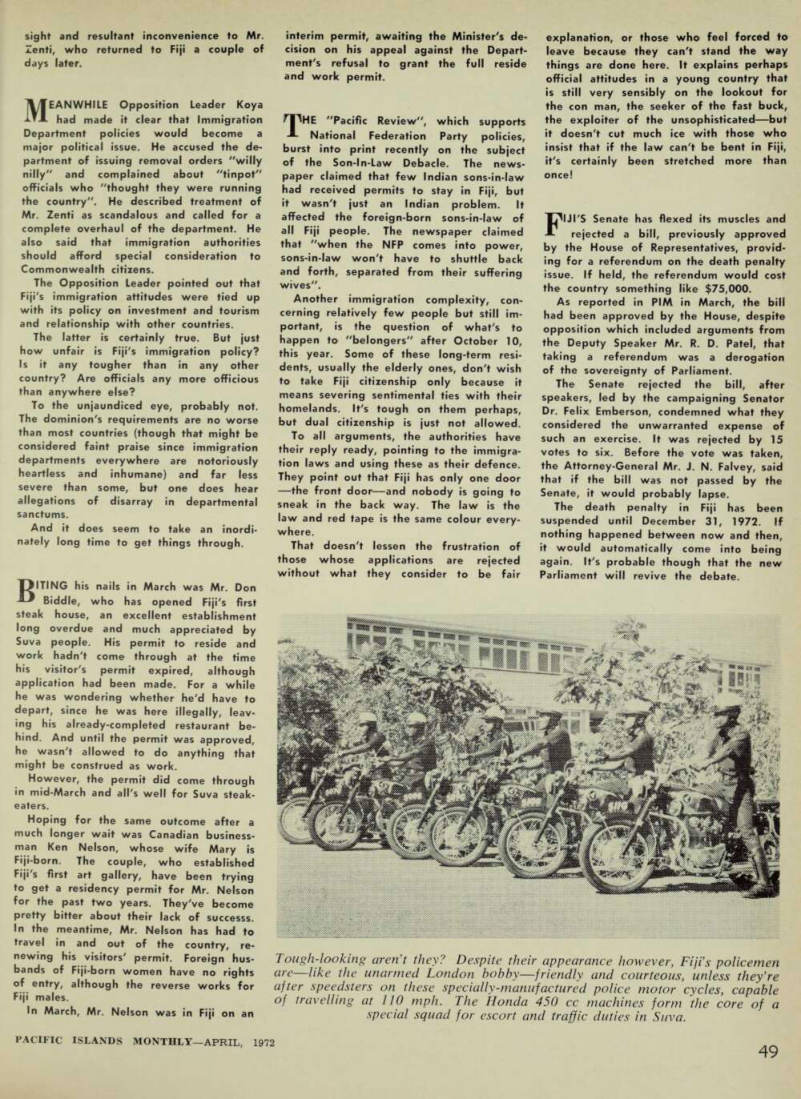
Tough-looking aren’t they? Despite their appearance however, Fiji’s policemen are —like the unarmed London bobby—friendly and courteous, unless they’re after speedsters on these specially-manufactured police motor cycles, capable of travelling at 110 mph. The Honda 450 cc machines form the core of a special squad for escort and traffic duties in Suva.