Oil Palms Offer Industrial Shelter
pp. 55-104 · Read in the full issue
For Developing New Britain
By JUDY TUDOR, in a special PIM report
If Bougainville Copper can be called New Guinea success story No. 1, then the palm-oil project in the Stettin Bay area of West New Britain certainly qualifies for spot No. 2.
Some people might even regard it as a better bet, as it builds up a natural asset rather than tears it down.
The West New Britain oil-palm project, in early 1972, seems like the dreams of every economic theorist all come true. The nucleus company, New Britain Oil Palm Development Ltd., is owned 50/50 by the PNG Government and Harrisons and Cross field, a British company with oil palm know-how and established plantations in Malaya.
The smallholders, who have come from every district and range from aggressive Highlanders to politically minded Tolais from the Gazelle Peninsula have, with minor aberra tions, refrained from engaging in all out tribal war and, with very few exceptions, have worked hard on their blocks, planting, building and tending their palms.
The company employs, un obtrusively, less than a dozen Euro peans in key positions and about 900 indigenous workers in plantations and factory. It supplies the small holders with planting material from germinated nuts imported from Malaya and it buys the oil-palm fruit they produce at about $22 per ton and processes it.
The oil-palms themselves have flourished and have yielded quicker and more abundantly than estimated.
Overall, such success has not attended many New Guinea projects.
First exports from the mill were in November, 1971, and in early February palm-oil was still main taining a reasonable price on the world market although copra and coconut oil had fallen to disaster levels. The price of coconut oil must inevitably influence all other edible oil prices, so this question mark must hang over the West New Britain project. Nonetheless, palm-oil is a bonus product. Not only does the palm yield from two to three times more oil per acre than coconuts, it produces two grades of oil itself. One comes from the pulp of the fruit which must be processed within 24 hours of harvesting, is reddish-yellow and usually used in the manufacture of soap, candles and as a source of
palmitic acid, a fatty acid used in many manufacturing processes. The second oil, from the kernel, is of higher grade, is indistinguishable from coconut oil and is used mainly in the manufacture of margarine.
In theory the sale of the kernels, which are exported as such, should pay for the whole cost of producing and processing the rest of the fruit.
In February, investigations were being made as to whether the WNB kernels could be processed at Coconuts Products Ltd. copra mill in Rabaul. Normally they are bagged and exported to European crushing Palms start to produce “flowers” about 18 |months after they are planted out, each frond usually supporting a female or a male flower.
In the early years of their life, the palms produce few male flowers making it necessary to collect all the pollen from those that do. This is stored by the company in a deepfreeze and used for hand-pollinating in the first seven years of a palm’s life. After that time, a palm will generally develop the correct proportion of male flowers to pollinate its female flowers through the agent of the wind.
Smallholders gather pollen from their own palms, usually at three day intervals when they are harvesting mature fruit, but the company pro-
cesses it, stores it in a deep freeze and issues it as required, The palms are in full-bearing after three to four years but in appearance they still look like 10 ft palm fronds sticking out of the ground. In time the trunk can grow to 20 ft, by which time the fruit has to be harvested with long, hooked knives. The pro ductive life of a palm is about 20 years, after which replanting corn mences.
A pollinated female flower turns into what seems to be a bunch of shiny black olives. These gradually enlarge to about the size of a plum and turn orange-red at the tip. When a dozen of these fruit have ripened and fallen to the ground, the whole bunch is ready for harvest, At the mill the bunches of fruit are weighed, sterilised, and the oil expressed from the pulpy skin cover ing of the kernel is refined, strained and run into tankers that carry it to the wharf. The fibrous residue and the bracts on which the fruit grow are dried and fed into the furnaces; the kernels are dried and checked before bagging for export, Between 1967 and 1972, about 4,300 acres of oil palms were planted on the coastal plain between the volcanic hills by the development company and about another 8,000 acres by indigenous smallholders, Eventually the company expects to
A lot more palm oil is yet to flow
extend its planting from the original Mosa estate, which is now fully planted, to Kumbango and have in all 10,000 acres of palms. Small holders will by then have increased their acreage to 12,000 and village plantings will add a further 2,000 acres.
The $7 million oil mill that was completed at Mosa in June, 1971 will be enlarged progressively to take care of the production from these 24,000 acres and will be capable of processing up to 1,000 tons of fruit per 24 hours.
At present there is not enough fruit coming forward to keep the mill going 24 hours a day. As a con sequence the furnaces are laboriously started up each day while the sub sequent crushing takes about 12 hours.
When in full production the furnaces will be kept going on the waste from the crushing process. At present they have to be started on local firewood.
It is suspected that there will be flush and lean periods in the harvest, one of the flush seasons coinciding with the current wet season which has been even wetter than usual.
January yielded 44 inches at Hoskins airport and the first 10 days of February were averaging their inch and a half. As a result of the constant deluge, roads in places were little better than a series of huge pot holes, bridges and culverts were awash, and everything not covered by a sheet of concrete was a bog.
Originally most of the main roads were put in as logging roads when Thompson & Wright worked this area in the early 1960’5. Most of the area where the palm-oil settlements now are well established was originally timber lease, but logging in the New Guinea rain forest is a different proposition to logging in temperate areas. Only a tree here and there is taken and, when the marketable timber cuts out, there is still a lot of timber and scrub left.
For oil-palm this is simply cut or pushed down and left to rot; a cover crop is sown that soon spreads over everything and the 6-months old oil palms are planted at 18-ft intervals in among it.
The native population of this Nakanai area is not great, and there was no reluctance a decade or more ago when the Administration bought surplus land from them and let it out in timber leases.
They probably were not much concerned to find that the logged-out areas were designed as resettlement
areas. However, in more recent years, as the new settlers actually arrived, and as their 15-acre blocks began to be planted up and look like a com mercial asset, the Nakanais naturally begin to wonder whether they have been led up the garden path.
Although the settlers in the Stettin Bay area will eventually have 14,000 acres in oil-palms, the local villagers who now also want to get into the act, will be allowed only 2,000 between them. There is a limit to the area of palms that the mill can service and obviously if there is to be more large-scale planting of oil palm there must be another large “mother” company and another mill.
Plans for these, with predominantly Japanese capital, are already in hand further up the coast in the Bialla- Ewassi area.
Meantime the Nakanai of Stettin Bay look with some unease at the influx of foreigners from the Gazelle, the Sepik, the Highlands, the Mark ham and elsewhere. According to the company’s latest statistics issued at the beginning of 1972, over 1,100 blocks have been occupied, with another 360 blocks ready for alloca tion this year. Politically, at any rate, the local people could find themselves with a member in the House of As sembly who represented the oil-palm settlers rather than the Nakanai vil lagers.
But even with the considerable help given by the company and by extension officers of the Dept, of Agriculture life initially is hardly a breeze for the settlers. It says much for those who select them that there have been few failures up to date.
Successful applicants are given a 15-acre block, on lease, and a loan of S 1,870 from the PNG Develop ment Bank. When the family arrives it finds that five acres on the block have been roughly cleared and that a stack of timber and a bundle of corrugated iron have been deposited at the roadside.
They are expected to, first, erect their house from the timber and the iron, helped and advised by a team of carpenters who travel around on motor cycles. The finished product probably is no worse to live in than the traditional, thatched native house but certainly is a great deal more hideous to look at. However, in the aesthetic stakes they are no worse off than the local villagers, most of whom also build their houses from timber offcuts from the local mill.
The settlers must also plant a
garden, clear a further three acres and plant these eight acres all in oil palm—about 38 per cent, in each of the first two years and the remainder in the third.
Cost of house, subsistence and living allowances, clearing, rent, legal fees, planting material must all come out of the loan, but repayment does not start until the fourth year, by which time some income can be ex pected from the palms. The loan should be fully paid off by the 10th year, after which the settler can ex pect an income of anything up to $2,000, according to present estimates.
Unfortunately, oil-palm, like all agricultural crops, depends on world demand and income from investment must continue to remain something of a gamble. In the years since the war there has been no lack of New Guineans to enter enthusiastically into cocoa, tea, coconut and coffee schemes, only to find that, by the time their plantations reach peak production, there is a world slump in that particular commodity. Euro peans usually understand the com mercial risks they take with tree crops but many indigenous farmers find it hard to understand why some thing worth 50 cents this year is worth only half that several years later.
The returns from oil-palm come faster than from most tropical tree crops but the work is also more constant. It was thought that the busi ness of hand pollinating and of getting the mature fruit to the factory without delay, would be obstacles to people raised in the more leisurely business of producing copra, and it was expected that production from the company plantation would be greater than from the smallholdings.
But the settlers have so far risen to the occasion and the reverse is the case.
As well as a brand new industry, this part of New Britain has a brand new town on Stettin Bay, about eight miles from the oil mill and mid-way between the airports of Hoskins and Talasea. The town is Kimbe, built on the site of old San Remo planta tion which was purchased from the owners for the purpose of creating a West New Britain district H.Q.
Whoever designed it apparently imagined that they had another Panguna-Arawa on their hands and the plantation coconuts have been cleared from an equivalent area. But while down at Arawa the open spaces have rapidly been filled up with houses, Kimbe in the same number of years has scarcely got off the ground.
Continued on p. 98
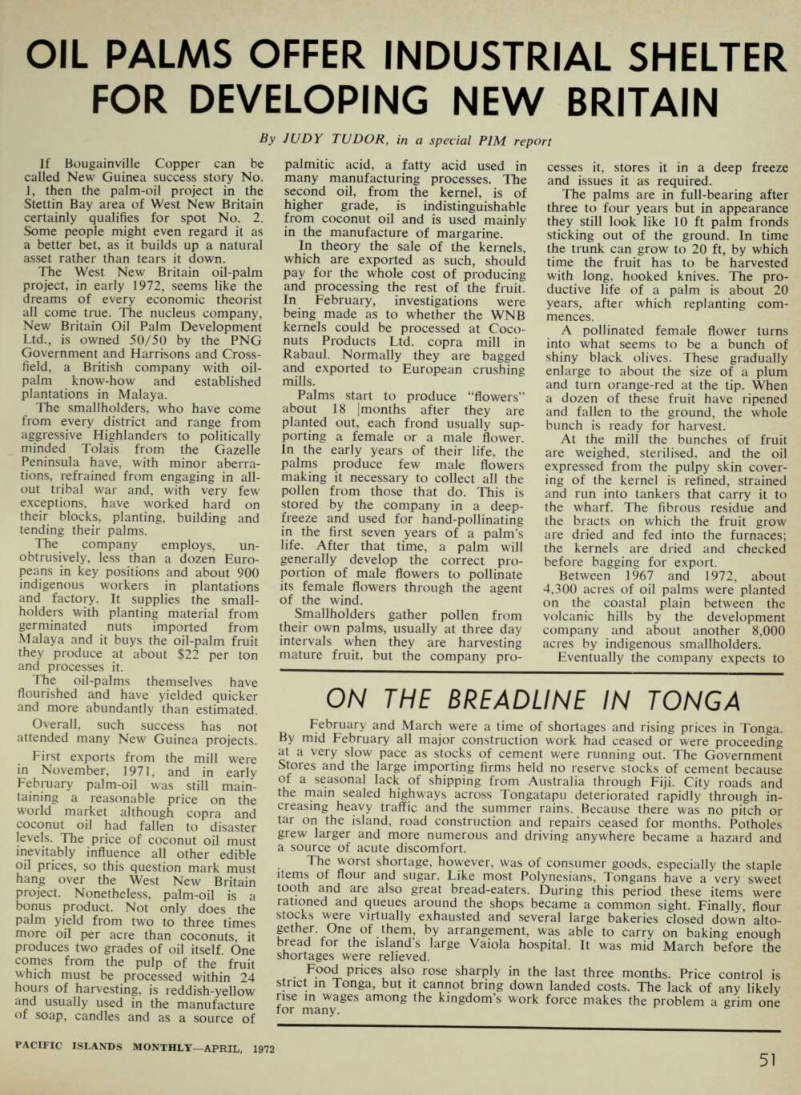
Seedling oil palms from the nursery at Hoskins . . .
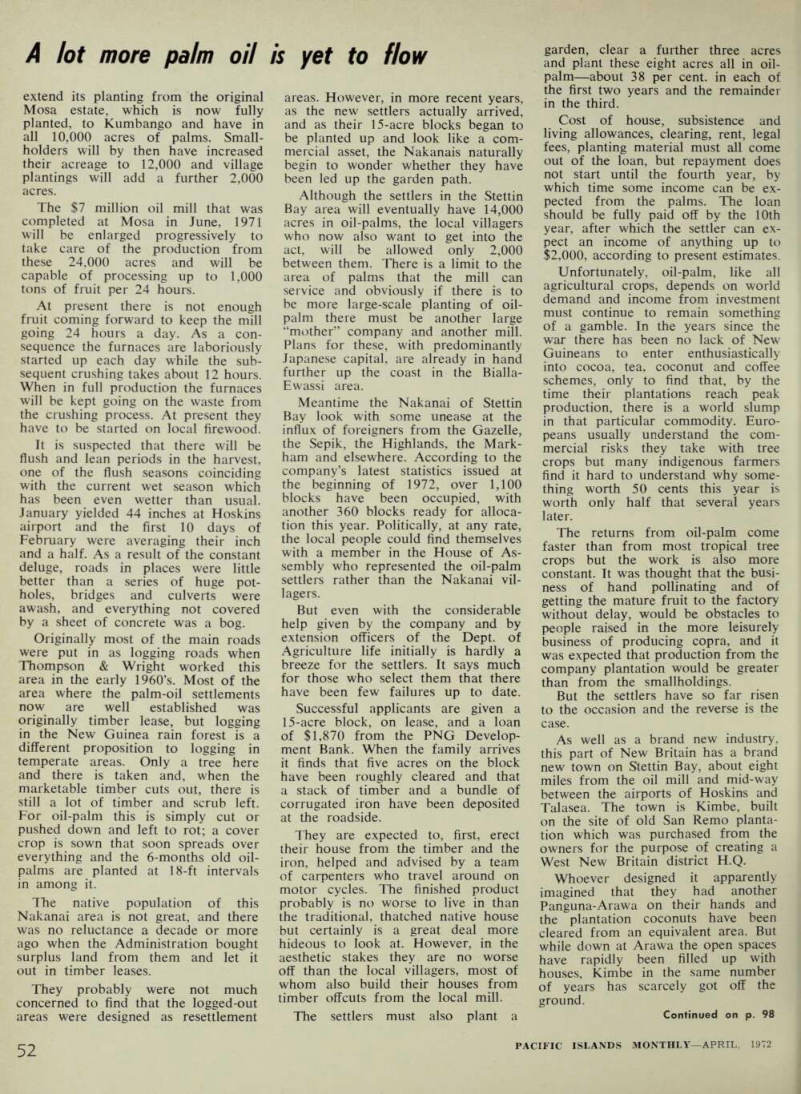
...are planted out by smallholders on their individual five acre blocks.
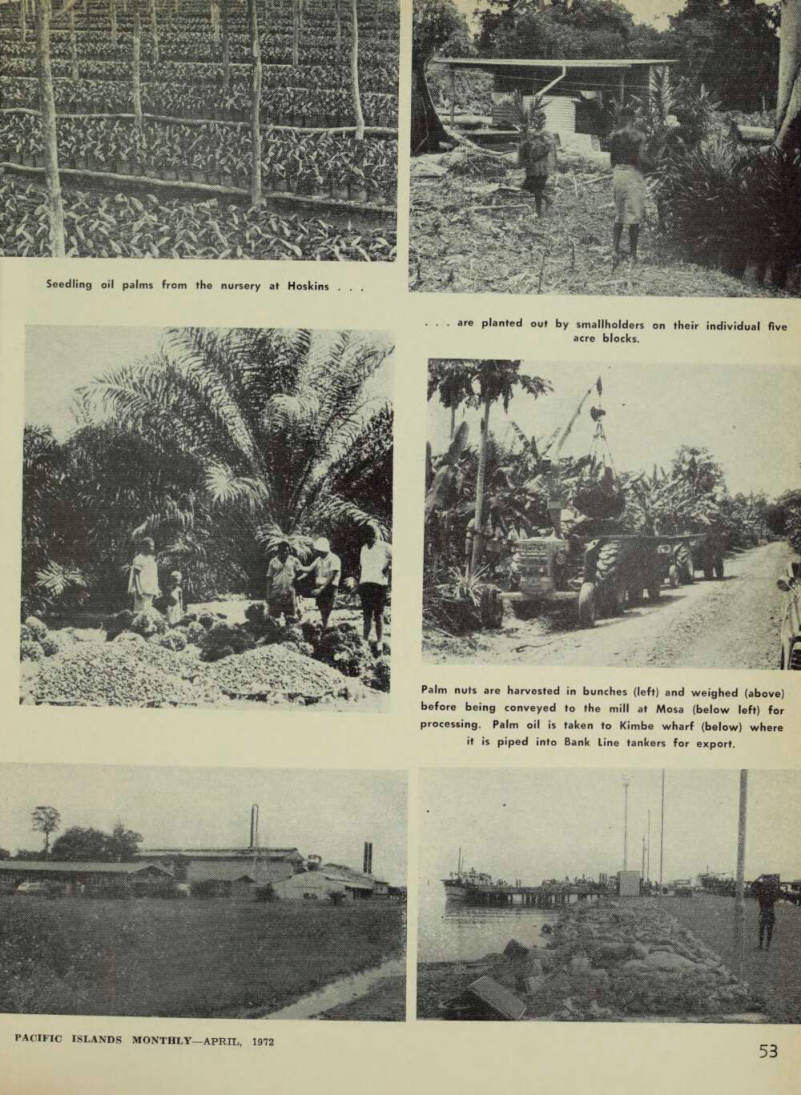
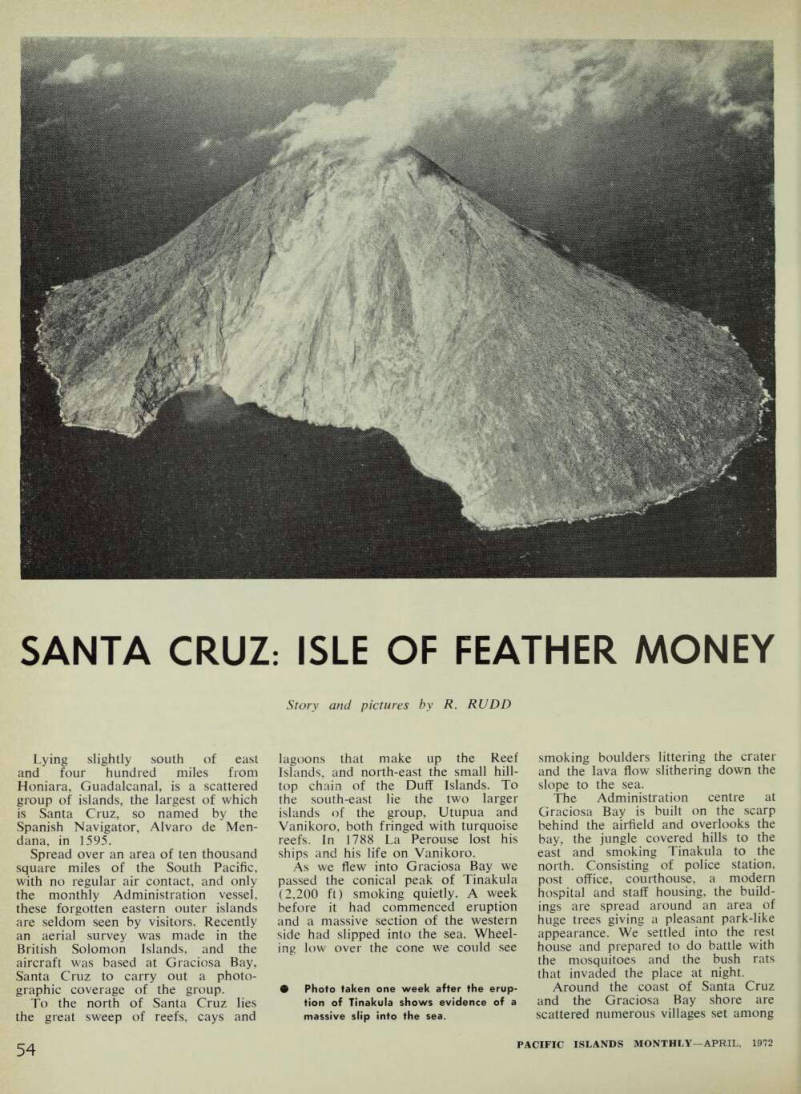
Palm nuts are harvested in bunches (left) and weighed (above) before being conveyed to the mill at Mosa (below left) for processing. Palm oil is taken to Kimbe wharf (below) where it is piped into Bank Line tankers for export.
To make it seem even less developed than it is, building has started from the perimeter evidently with the idea of building inwards.
The small housing area is shoved up in one corner with its back up against the hills while the tavern, in course of construction for Mr. Max Wright of Hoskins, will occupy a prime site on the beach.
The hotel sites on the road, midway between the housing and the District Office. The District Office stands in the shadow of one of the largest cordial factories ever built in New Guinea and looks capable of flooding all of West New Britain with lolly water. Nearby is a row of four new shops, only one occupied—by a branch of the Bank of NSW.
Half a mile to seaward is the new Kimbe overseas wharf, capable of berthing Bank Line ships which up lift the palm-oil from holding tanks.
That’s Kimbe.
About 20 miles to the east is Hoskins, which used to be District HQ and which still is the main air port. Originally built there by the Japs it is now covered with broken bitumen and is considered of DC3 standard. It has navigational aids and planes get in there in what would be regarded elsewhere as impossible weather and when all neighbouring airstrips are closed tight.
Hoskins still has a sub-district office and a number of officials, but in other ways it might be regarded as Max Wright’s town. He was the pioneer timber miller in the area, built many of the roads and now owns the hotel and is a airline agent.
Max Wright and his pub are now fulfilling the same sort of role for West New Britain as Ellen Pitt and her guest house did in the early fifties for Goroka and the New Guinea Highlands. For this reason WNB, for all the success of its new project, seems a lingering reminder of what New Guinea used to be 20 or 30 or 40 years ago. The people are friendly, helpful and without pretensions. Best of all, it seems free of the tensions that occupy the thoughts and the conversations of most people in the rest of the ter ritory. How long this state of affairs will last is anyone’s guess but one opinion is that there will be a notice able warming up of the political atmosphere once the settlers have got their holdings to the stage where they have time on their hands. As the first of them moved in in 1968 that could be any time from now.