Tropicaities
pp. 45-49 · Read in the full issue
Peacock On
Display
The new Minister for External Territories in the Australian Govern ment, Mr. Andrew Peacock, has already paid three flying visits to Papua New Guinea. On the first, of two days’ duration, he was accom panied by the vivacious Mrs. Peacock, who was credited with stealing the show. On the second, only a week later, he came alone and spent five days on a quick round of visits to as many districts, and soon after that he was back yet again—and again.
Both the Minister and his wife showed themselves to be good mixers among what the Prayer Book refers to as “all sorts and conditions of men”, and their informality and ready laughter enlivened what could easily have been pompous occasions.
Mr. Peacock also believes in having a good “Press” and makes himself available to reporters.
Mr. Peacock showed himself a good listener, without that slight air of condescension that’s been notice able with previous ministers. He can hardly be blamed if, at this stage, having listened carefully he answered cautiously.
He certainly had some curly ones tossed at him the positioning of the Queensland/Papua New Guinea border, the problems of law and order and the possible secondment of Australian military personnel to the Papua New Guinea police force and the animosity of the Highlanders to early self-government were among them. It was fair enough that he was not prepared to give off-the-cuff answers on issues like this.
So far, so good. But it will be when he starts coming up with the answers that New Guineans will decide what they think of him. The decision of the Australian Govern ment partially to reverse its ban on off-shore oil drilling in the Gulf of Papua has earned him his first good conduct mark. Will others follow?
Possibly the only jarring note the new Minister struck was on his first arrival, when he came out very forthrightly in favour of “West minster” style government fo Papua New Guinea.
What really matters is not what Mr. Peacock thinks of “Westminster”, but rather what those New Guineans who have some clues as to what it is all about think of it. The Austra lian Government seems to find it very hard not to be paternal on this issue.
Fun on the floor
Yap, in Micronesia, is noted for its stone money and for its local congressman, John Mangefel. Both are unique, but Mangefel can be more fun. His frequent tongue-in cheek approach to matters in the Congress of Micronesia is indicative of a clear, if sometimes mischievous, mind.
At the Congress meeting which has just concluded in Palau, Repre sentative Mangefel got the House into an unexpected knot by intro ducing a bill to repeal the US Trust Territory Code in its entirety and substitute the Ten Commandments as the law.
The bill was assigned to six dif ferent committees, in the hope that it would get lost, but within a few days it had appeared on the floor of the House with the endorsement of the committees.
So the members were faced with the decision of having to vote against the Ten Commandments or for an obviously impractical bill. The House chickened out.
Senator Baily Olter, of Ponape, had his fun in the Senate when he moved a joint resolution directing each married member of the Congress of Micronesia to bring his or her spouse to Congress sessions, because “it was noted” that members have a tendency to become irritable and frustrated during sessions and the presence of one’s spouse would “tend to temper one’s tendency to excess and bring about more temperate and moderate behaviour”.
Senator Olter is a bachelor. The chamber, after some amusing debate,
referred the measure to the Senate’s Committee on Ways and Means.
Senator Olter is its chairman.
Investment
elnb
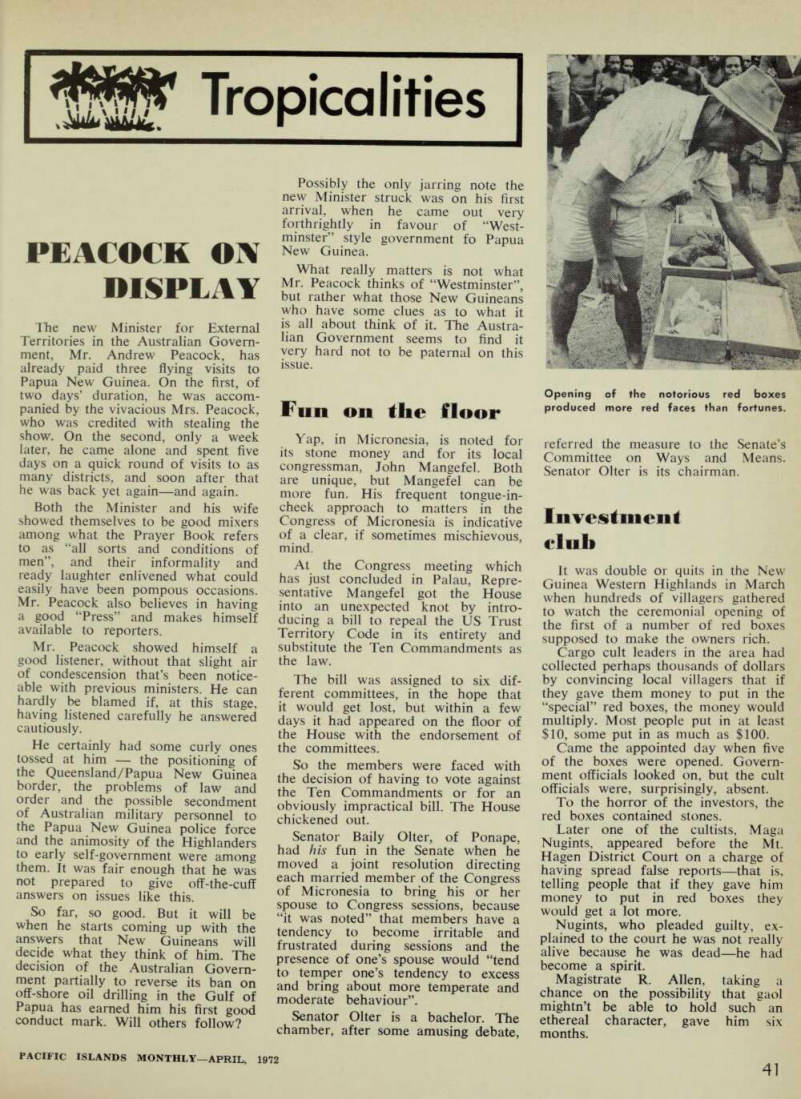
It was double or quits in the New Guinea Western Highlands in March when hundreds of villagers gathered to watch the ceremonial opening of the first of a number of red boxes supposed to make the owners rich.
Cargo cult leaders in the area had collected perhaps thousands of dollars by convincing local villagers that if they gave them money to put in the “special” red boxes, the money would multiply. Most people put in at least $lO, some put in as much as $lOO.
Came the appointed day when five of the boxes were opened. Govern ment officials looked on, but the cult officials were, surprisingly, absent.
To the horror of the investors, the red boxes contained stones.
Later one of the cultists, Maga Nugints, appeared before the Mt.
Hagen District Court on a charge of having spread false reports—that is, telling people that if they gave him money to put in red boxes they would get a lot more.
Nugints, who pleaded guilty, ex plained to the court he was not really alive because he was dead—he had become a spirit.
Magistrate R. Allen, taking a chance on the possibility that gaol mightn’t be able to hold such an ethereal character, gave him six months.
Opening of the notorious red boxes produced more red faces than fortunes.
Fiji wants no
dead drunks
Fiji Government officials, police and youth workers are considering banning methylated spirits in order to prevent people drinking it.
Methylated spirits, which can cause death, blindness or severe internal injury, is used in Fiji to make “home brew”, especially in rural areas.
At a meeting in March, officials decided to investigate the possibility of a complete ban on the import of “meths” and to seek information from New Guinea, where there are restric tions on its sale.
It seems that methylated spirits is not essential for any purpose in Fiji.
Surgical spirit is used by the Medical Department and other substitutes such as turpentine are used for com mercial purposes. Banning “meths” would not prevent the making of home brew—but it could prevent deaths and serious illness.
A suggested alternative to pro hibition was to put a distinctive colouring in methylated spirits and to add an emetic to prevent people drinking it.
Downgraded
Papua New Guinea Administrator Les Johnson has just taken delivery of a new automatic Daimler for his official car. It has six electrically operated windows, a soundproof rear compartment, and it cost $11,253.
He’s actually slumming it. His former official car, an Austin Princess, now seven years old, cost $lB,OOO.
Solomons need
national ethos
A “greater sense of national identity” in the Solomons, and the use and subdivision of land in both the Solomons and the New Hebrides were two major problems of these territories. Miss E. J. Emery, Depart ment of Pacific Dependent Territories, British Foreign and Commonwealth Office, told this to PIM in London in March.
She had returned after her second major tour of the Pacific, accompany ing Mr. A. Kershaw, Under-Secretary of the FO. The two spent several days each in Vila and Honiara.
“On political and economic fronts, one thing needed in the Solomons is a greater sense of national identity,” she said. “Solomon Islanders are either Choiseul men or Malaita men.
Guadalcanal men or people from Munda. They don’t consider them selves Solomon Islanders yet.”
Miss Emery said diversification of the Solomons economy was continuing well. Timber, fishing and bauxite mining were the big hopes. However, many more small businesses were needed, with local people in mana gerial positions.
In the Hebrides she found overseas financial interest lively because of the condominium’s tax conditions. A big increase in European migration had occurred in the last two years but of the big numbers of Hawaian residents who were landowners on Santo, only two or three had migrated to Santo. She believed interest was now quickening on the condominium’s constitutional future.
FOOTNOTE; Mr. Kershaw was recently asked in the British Parlia ment what action had been taken for closer co-operation with France in the Hebrides. His reply: Friendly co-operation continued on develop ment and usual exchanges through diplomatic channels were supple mented in October by a meeting of officials in Paris.
“I am hoping soon to have an op portunity of discussing New Hebrides affairs with Mr. Messner, the French Minister of Overseas Departments and Territories.”
Alin’s new ehief
is young woman
Miss Ada Teaupurepure Tetupu Mataio Kea was invested with the title Rogomatane Ariki in Atiu, Cook Islands, on February 23 in the traditional manner. Ada is the second woman and the eighth person to hold the title since the arrival of the Gospel in Atiu in 1822, The ceremony started on the marae of Te-a-Piripiri, and from there Ada and her entourage walked along a road, flanked by guards, to the church.
The guards, wearing sennit war helmets and cloaks of ti leaves, raised their hardwood spears in homage as Ada approached. The guards were all men of Ariki (chiefs), and Mataiapo (sub-chiefs) rank.
A short service and anointing ceremony took place at the church, and this was followed by two other ceremonies, one at the marae of Te Ari and the other at the marae of Te-a-Piripiri. Feasts followed and a well attended dance was held in the evening. Public servants on Atiu were given a half-day holiday by the government so they could witness and take part in the ceremony.
Taking scissors
to red tape
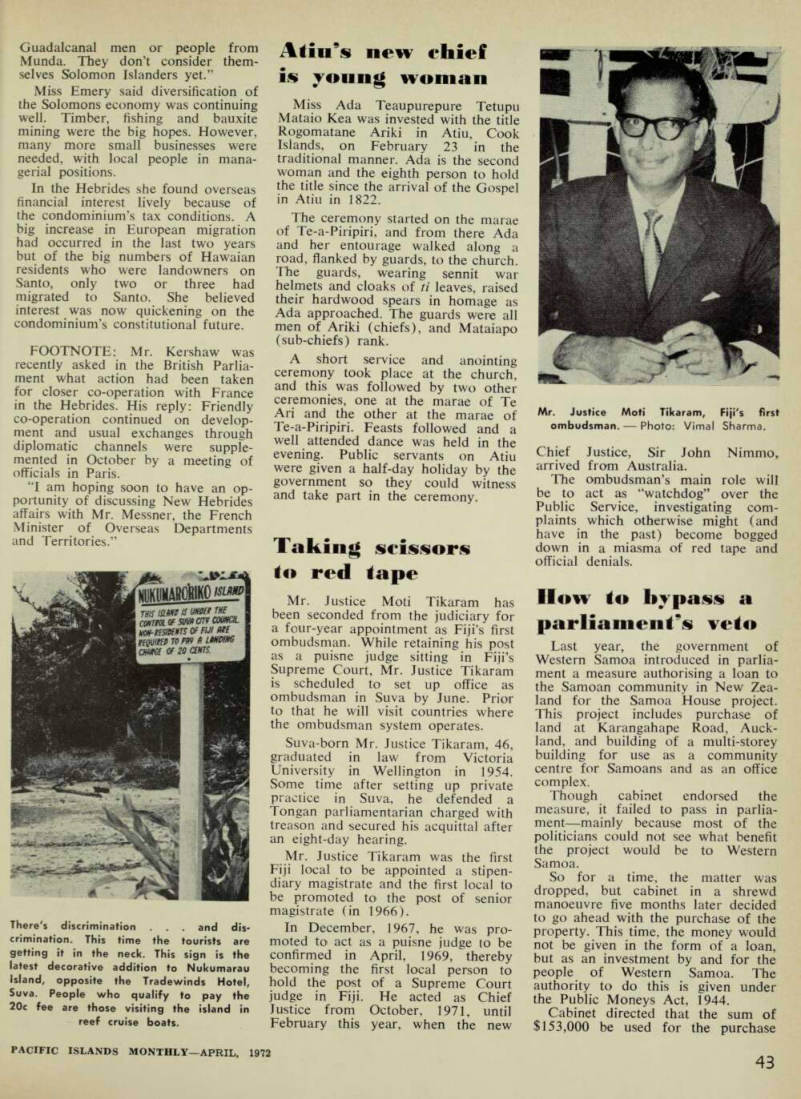
Mr. Justice Moti Tikaram has been seconded from the judiciary for a four-year appointment as Fiji’s first ombudsman. While retaining his post as a puisne judge sitting in Fiji’s Supreme Court, Mr. Justice Tikaram is scheduled to set up office as ombudsman in Suva by June. Prior to that he will visit countries where the ombudsman system operates.
Suva-born Mr. Justice Tikaram, 46, graduated in law from Victoria University in Wellington in 1954.
Some time after setting up private practice in Suva, he defended a Tongan parliamentarian charged with treason and secured his acquittal after an eight-day hearing.
Mr. Justice Tikaram was the first Fiji local to be appointed a stipen diary magistrate and the first local to be promoted to the post of senior magistrate (in 1966).
In December, 1967, he was pro moted to act as a puisne judge to be confirmed in April, 1969, thereby becoming the first local person to hold the post of a Supreme Court judge in Fiji. He acted as Chief Justice from October, 1971, until February this year, when the new
Chief Justice, Sir John Nimmo, arrived from Australia.
The ombudsman’s main role will be to act as “watchdog” over the Public Service, investigating com plaints which otherwise might (and have in the past) become bogged down in a miasma of red tape and official denials.
How to bypass a
parliament’s veto
Last year, the government of Western Samoa introduced in parlia ment a measure authorising a loan to the Samoan community in New Zea land for the Samoa House project.
This project includes purchase of land at Karangahape Road, Auck land, and building of a multi-storey building for use as a community centre for Samoans and as an office complex.
Though cabinet endorsed the measure, it failed to pass in parlia ment—mainly because most of the politicians could not see what benefit the project would be to Western Samoa.
So for a time, the matter was dropped, but cabinet in a shrewd manoeuvre five months later decided to go ahead with the purchase of the property. This time, the money would not be given in the form of a loan, but as an investment by and for the people of Western Samoa. The authority to do this is given under the Public Moneys Act, 1944.
Cabinet directed that the sum of $153,000 be used for the purchase
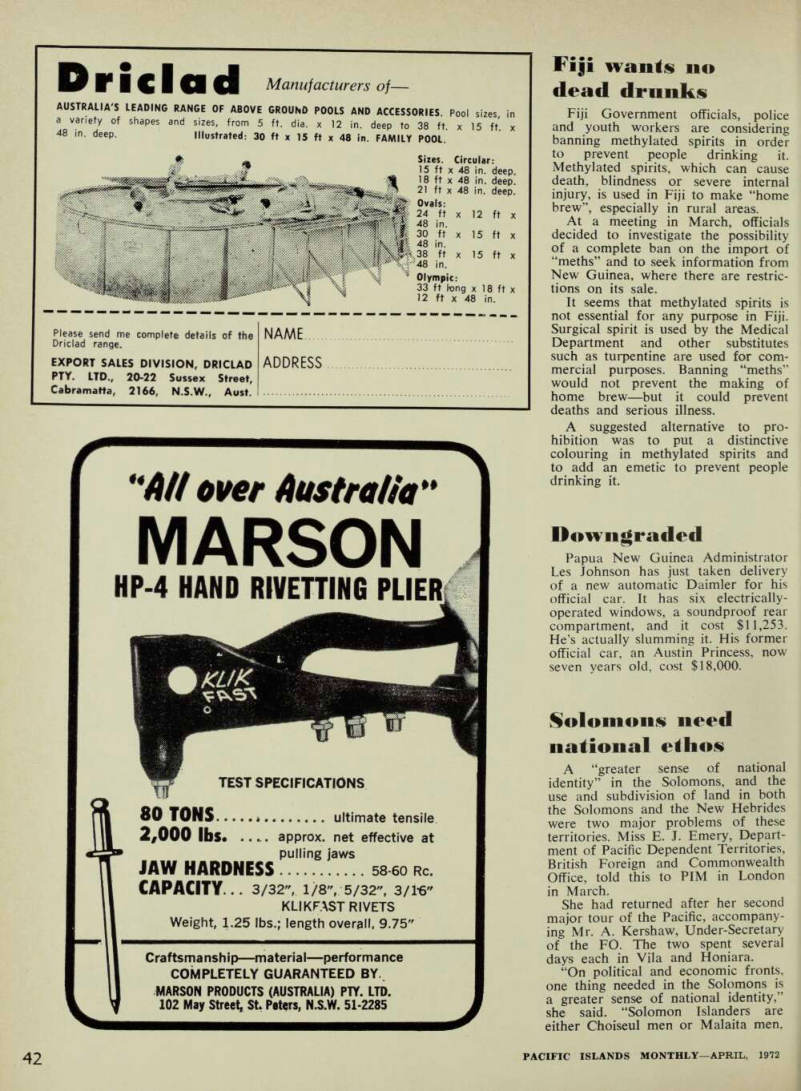
There's discrimination . . . and dis crimination. This time the tourists are getting it in the neck. This sign is the latest decorative addition to Nukumarau Island, opposite the Tradewinds Hotel, Suva. People who qualify to pay the 20c fee are those visiting the island in reef cruise boats.
Mr. Justice Moti Tikaram, Fiji's first ombudsman. Photo: Vimal Sharma.
of the land effective by February 15 —and that the rent be collected by a certain Mr. Duncan of McElroy, Duncan and Freddie. The govern ment is also believed to have entered into some sort of agreement with the Samoan community in New Zealand whereby the land will eventually be sold to them.
Government officials have defended the cabinet’s action by saying it was taken to fulfil a promise made by the cabinet before the matter was brought to parliament. But though the govern ment may have used the right method, some people are asking whether it acted wisely, in view of the fact that parliament had specifi cally opposed the purchase of the property in its refusal to back up the loan.
Clearly the relationship between parliament and the cabinet needs to be redefined. The issue could well be that between democracy and a totalitarian form of government.
Report slates
Suva slums
Despite much-touted beautification programmes and Keep Suva Clean campaigns, Fiji’s capital city becomes dirtier and more tattered year by year.
The city is littered with rubbish, some of it in great piles outside offices and shops; strange smells assail passers-by in such busy thoroughfares as Gumming Street and Victoria Parade; rats emerge from holes in the footpath and from the foundations of buildings; Nubukalou Creek, which could be a major attrac tion, resembles an open sewer—and one is still likely to step in a gob of spit although rumour has it that spit ting is illegal.
For residents and visitors alike, Suva is visually depressing. But far more serious than the aesthetic aspect is the existence of real slums, some as bad as any in the world.
A survey by the city council’s health department has revealed that at least 10 per cent, of the popu lation of Suva lives in illegal shacks.
To be precise, 7,672 people are living m 1,039 illegal dwellings within the city limits.
According to the report, the build ings are mostly substandard lean-to types with corrugated iron walls and roofs and floors made out of packing cases. Most are over-crowded and badly ventilated. Water supplies for
these desperately inadequate dwel
lings are from standpipes or from roof-fed drums or shallow wells.
Household rubbish is dumped nearby in the bush.
The report says 865 of the homes are occupied by the owners, 95 by owners and tenants and 79 by tenants only. It lists 197 illegal homes on land owned by the Jittu Estate, 136 on Morris Hedstrom Ltd. land, 131 on Fiji Muslim League land and 104 on land owned by Mr. Sethi Narain.
Death beans
The death of a brother and sister, aged two and four, of Menyamya, in New Guinea’s Morobe District, brought a warning in March about the danger of eating uncooked lima beans. The children died in hospital
shortly after eating the beans.
Mr. Don Murty, the PNG Depart ment of Agriculture’s chief chemist, warned that lima beans may contain chemical compounds classified as cyano-genetic glycosides, which can be broken down to release poisonous hydrocyanic acid (prussic acid).
Cooking stopped the reaction, which was found in both red and white beans.
Said Mr. Murty: “Many instances of cyanide poisoning have occurred in Papua New Guinea and no doubt will continue until the people as a whole are educated to appreciate the danger of eating raw lima beans.”