'it means business'
pp. 103-104 · Read in the full issue
Republic of Minerva says 'it means business'
From SUE WENDT in Suva
The first positive response to letters addressed by the “Secretary of State for the Republic of Minerva” (PIM, February, p. 104) has come from the Sultanate of Ocussi-Ambeno, a territory which is part of the island of Timor in the Indonesian group. It has offered to enter into diplomatic and consular relations with the Republic of Minerva.
Other sovereign states throughout the world have been more cagey.
Fiji had received a letter signed by a person designating himself by the above title. Prime Minister Ratu Sir Kamisese Mara admitted this but was not enthusiastic about any official response.
Spokesman for the Ocean Life Re search Foundation, Mike (he has been called Mark) Oliver, 43-year old Lithuanian-born US electronics engineer, hopes that Tonga, at pre sent rather hostile to the idea of the republic on its doorstep, will eventu ally appreciate the peaceful intentions of the new nation and recognise it officially.
He stresses that the Minerva idea is not some sort of super-unique land development seeking publicity in order to attract finance. He is only interested to show that the Republic of Minerva means business, he says.
For the uninitiated, it’s rather difficult to grasp Mike Oliver’s con cept of how the Ideal Society might work (though those who’ve read the hefty novels by authoress Ayn Rand may detect an echo of a philosophy they’ve heard somewhere before) but he has a certain persuasiveness about him.
He digresses a lot into lengthy illustrations of injustices perpetrated against individuals by governments (“For example ... but don’t quote this”) but somehow succeeds in half convincing one that it just might be possible—-if the rest of the world allowed it—for a determined band of financially-independent people to conjure up a whole new nation out of nothing. And live in it, governed by nothing but their own concepts of how they ought to be governed.
Pinned down, Mr, Oliver describes himself as a believer in the “non initiation of forced principle”. At the same time, he asserts that he’s “no
milk toast either”. In other words, if you don’t like what’s being forced down your throat, get up, get out and create an alternative.
It’s not as simple as throwing off the shackles of civilisation and re turning to nature. Minerva is en visaged as a sophisticated, technolo logically-oriented community.
“We are not revolutionaries, we are not militarists. Nor are we fugi tives from anything. But we have had enough of certain things and we don’t want them any more,” he de clares.
“It is no use being an ivory-tower philosopher—the trick is to make things work. We make no promise of Utopia, because that is not possible, but we believe we can build a better society than exists else where.”
During the Ocean Life Research Foundation’s long search for a suit able place to build a “sea city”, says Mr. Oliver, many thousands of people have shown interest in the principle of creating a new nation, based on the premise that no government should be allowed powers that in fringe on the freedom of individuals or entities. “We believe that govern ments should not be delegated rights that are denied to individuals,” he explained.
Primarily, the aim was to create a society from which “economic facism” had been eliminated. “Just as 300 years ago we separated Church from State to the everlasting benefit of people in the Western world, we must go one step further and separate government from the economic sphere,” said Mr. Oliver.
“Governments today act to create rather than avoid monopolies. Why should there be control of commerce?
The Republic of Minerva will operate on the principle of free trade, with no duty and no taxes.
“The elected government will act as an arbitrating agency when an act of force or fraud is performed. It is envisaged that people will make a voluntary contribution for the run ning of a small police force and courts of law. They will be under no compulsion to contribute, but it is expected that they would wish to
do so for the success of the project.”
While Minerva could not become self-sufficient in food, said Mr. Oliver, it could be economically viable with the production of technological equip ment, chemicals, electronics, etc.
British sovereigns minted before 1932 had been considered as a possible currency for the republic, because there were enough of these coins available for the purpose.
The republic already had a con stitution, he said. Provisional presi dent was Mr. Maurice C. Davis of Orange, California, an electronics project engineer who was also one of the directors of the Ocean Life Research Foundation.
The third director, and provisional vice-president of the republic, was a London businessman ‘‘with varied interests”, Mr. Richard King, of Westminster.
Mr. Oliver would himself hold no government office. ‘‘Any person who has contributed funds to this project, or who is actively involved in its de velopment, is automatically dis-
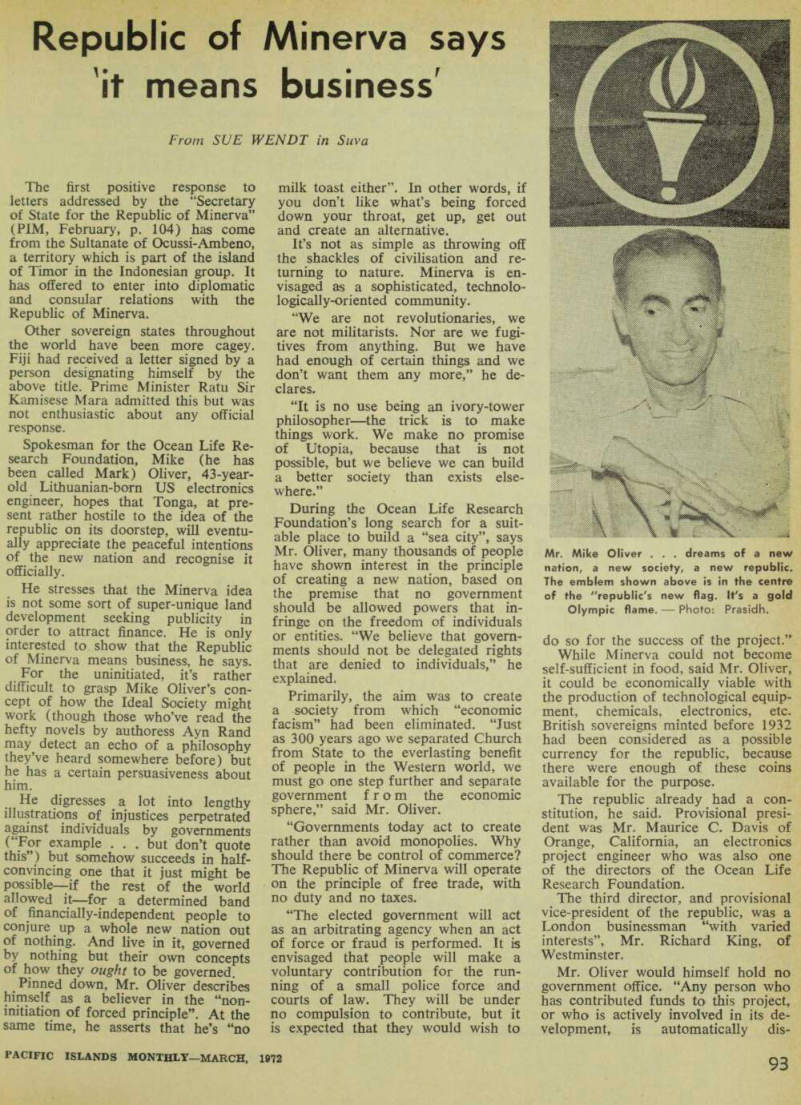
Mr. Mike Oliver . . . dreams of a new nation, a new society, a new republic.
The emblem shown above is in the centre of the "republic's new flag. It's a gold Olympic flame. Photo: Prasidh.
Rllllflmn "cm rlfu”
uUllUiny SCO Illy
qualified from government,” he said.
He claimed that there would be no problem in obtaining money to finance the building of a “sea city”.
Nor did he foresee any construction or engineering problems that could not be overcome.
Initially, pole-construction dwellings would be erected on the reclaimed land. “It will look like any other island community, with trees, gardens, houses and a sea wall,” he said “All the land will be for sale to individuals.”
Among those who share Mr.
Oliver’s hopes for a “better society” are Canadian couple Matthew and Betty Burpee, who sailed their 65 ft trimaran Triptych into Fiji waters last year. They had hoped to start a charter business in Fiji, but were prevented from doing so because of local restrictions (see last month’s
Pim, P. 96).
In January they said they were now hoping to help pioneer the Republic of Minerva and the Triptych would prove very useful m carrying representatives of the Ocean Life Research Foundation be tween Suva and the Minerva Reefs, Meanwhile, Tonga was not taking it all lying down. She raised the
question of the Minerva Reef take over at the Canberra Forum (see p. 21) and, at about the time that Prime Minister Prince Tui’pelehake asked the forum for assistance in establishing sovereignty over it, the Tongan fishing vessel Eliaki was actually at South Minerva Reef and her crew was erecting a survival kit for shipwrecked mariners.
This was stated to be a gesture by the Tongan government both for strong sentimental and practical reasons, to contribute to the welfare of wayfaring seamen who may be in need by providing the nucleus of fishing equipment, medical supplies and provisions. It is intended that these should be replenished from time to time.
In Canberra, the Prime Minister talked to PIM about the move. Yes, it was to indicate to the world—and, no doubt, to the Republic of Minerva —that Tonga had an interest in the reef.
HRH smiled and his eyes twinkled an affirmative to the query as to whether it was a kind of take-over act.
The forum is backing Tonga for sovereignty and the Geneva Con ference on Law of the Sea will be told so.
Keeping killing
out of politics
Fiji will hold a referendum this year on the question of retaining or abolishing the death penalty. A Bill providing for the referendum was approved by the House of Represen tatives, despite onposition from the Deputy Speaker, Mr. R. D. Patel, on the grounds that taking a referendum was a derogation of the sovereignty of Parliament.
The House also decided that the current suspension of the death penalty in Fiji should be continued until the end of this year, pending the holding of the referendum. Except for certain categories of murder, capital punishment was suspended for five years in 1965. This period was later extended until May this year.
The Attorney-General. Mr. J. N.
Falvey, said the referendum would not be taken until after the forth coming general elections in April/ May, because it should be kept out of
the hurly-burly of political campaigns.
Only citizens of Fiji would be allowed to vote in the referendum and the issue would be determined on the basis of numbers and not communities, he said.