Business and Development
pp. 105-108 · Read in the full issue

Island leaders move towards free trade
The South Pacific took a step further towards forming itself into a Free Trade Area as a result of discussions at the Second South Pacific Forum in Canberra in late February.
The forum countries—Australia, NZ, Fiji, Western Samoa, Tonga, Nauru and the Cook Islands— decided to carry out full investiga tions into the possible development of free trade among themselves. It will be one of the matters to be handled by the newly-formed South Pacific Bureau for Economic Co operation. The bureau is to have its headquarters in Suva.
The next meeting of the forum, also to be held in Suva, in Sep tember, will hear a report on progress on the free trade plan.
It s not likely, however, there will be quick progress, because there are many difficulties to be resolved before such a scheme is possible, even though most of the member countries are in favour of it.
The idea has been mooted for some time, but it became a live issue only last November when the member countries of the forum met in Wellington to discuss South Pacific trade matters generally.
This meeting, of the Committee of South Pacific Trade, had before it a report from the Cook Islands Government recommending the im mediate establishment of a South Pacific Islands Free Trade Associa aon, with the aim of getting free rade between the forum countries mder way by the middle of this fear.
The Cooks suggested that Fiji be mcouraged, as “the Pacific island nore industrialised than any other,” o develop a role as trading hub of he islands, and that regional trade n manufactured goods and in some igncultural products be developed.
The Cooks submitted that revenue rom duties and tax on regional xchange of commodities among the
forum countries was “so small that any movement to abolish tariffs will not cause any noticeable depletion in the general revenue account of the territories concerned”.
The Cook Islanders also proposed that the Islands combine in a bulk ordering scheme for goods they all use, as one way of keeping prices down. It commented on the develop ment of inflation throughout the Islands in recent years, and said that Island territories that were depen dent on one or two countries for their imports were at the mercy of inflationary pressures which developed in those countries.
The Wellington meeting was wary about rushing into a free trade scheme, especially after hearing from Australia that economic integration had in the past posed many problems for countries attempting to achieve it. But it felt something could be done meanwhile about rationalising investment, and about closer co-opera tion in planning.
Fiji pointed out that even ex panded Island markets would not be large enough to support inter island trade, and that in the long term it would be best for Australian and New Zealand manufacturers to set up plants in the Islands to make component parts for re-export into the dominions or for export to Island and world markets.
This would help give work to Islanders and at the same time raise
their purchasing power.
The bulk purchasing scheme re commended by the Cooks was not seen as a significant suggestion, and it was proposed that such an idea might best be suited to purchases for government use. This is another of the matters that will be the responsibility of the new Bureau for Economic Co-operation.
The new bureau will also act as a clearing house for information on trade and economic matters, carry out statistical studies on trade* identify opportunities for the widen ing of Pacific trade, plan rationalisa tion of manufacturing and processing industries, and generally promote regional trade co-operation in the region.
One thing which is weighing heavily on the side of inter-island co operation is the knowledge that a co ordinating body will save money and effort wasted through duplication. Ail the forum countries are selling the same things, copra, bananas, produce.
Any development they might make will be along identical lines with wasted effort resulting if they plan separately and then find themselves cutting across plans already made by their neighbours.
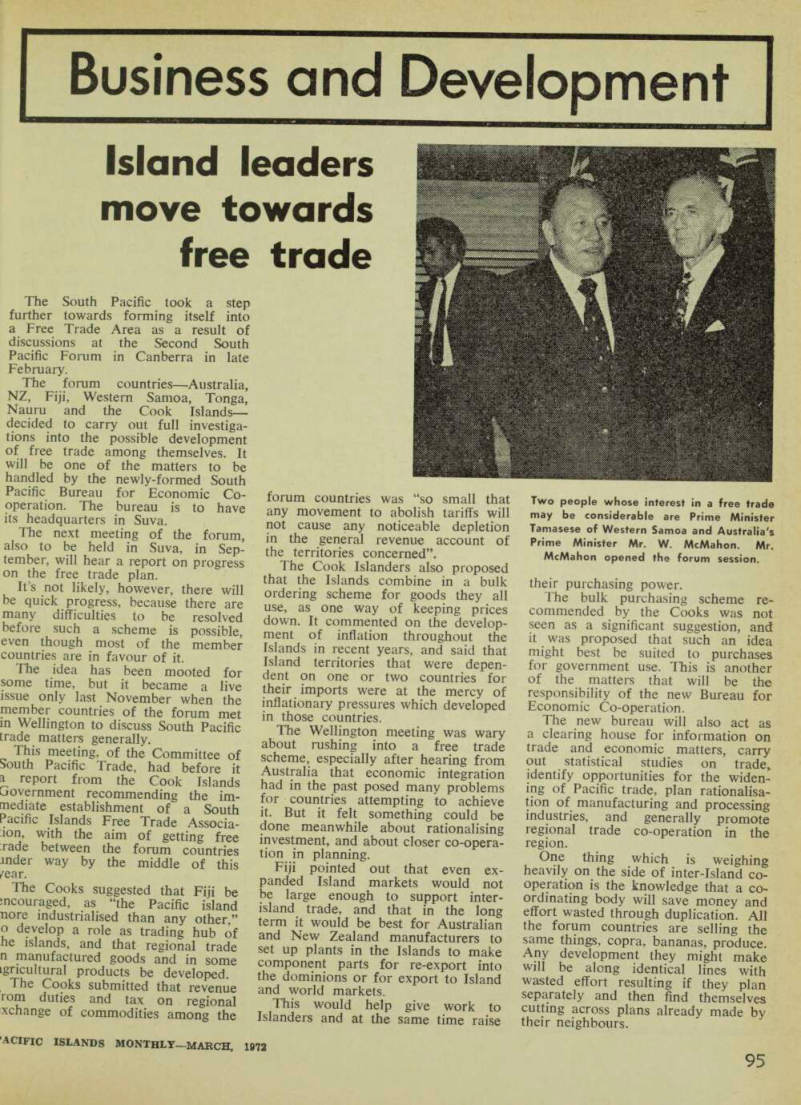
Two people whose interest in a free trade may be considerable are Prime Minister Tamasese of Western Samoa and Australia's Prime Minister Mr. W. McMahon. Mr.
McMahon opened the forum session.
West Samoa content
with growth rate
A preliminary report issued by the Department of Economic Develop ment indicates a rise in the value of exports in 1971 of 33 per cent., i.e. $4,502,098 against $3,387,888 in 1970.
Copra accounted for most of this, exports being up 85 per cent, at 17,781 tons (9,619 tons) but only 48 per cent, up in value because of the drop in copra prices ($2,018,756 against $1,366,241).
Imports were down 5 per cent, at about $9.2 m., bank deposits were up 18 per cent., tourists came in greater numbers, and retail sales in Apia were estimated to be 20 per cent, better than the previous year. Cocoa exports were worth $1,276,998 against $1,036,437, bananas were steady at $535,323, but the first year’s export of timber by Potlatch reached only $200,000, a fifth of that hoped for.
Non-completion of dredging of Asau Harbour prevented ships entering to pick up the timber scheduled for mil ling.
Western Samoa’s accumulated trade deficit was reduced from $6,389,888 to an estimated $4.7 m. The year’s surplus is attributed to foreign inflow in the form of remittances by Samoans living overseas (now nearly $2 m. annually), foreign loans and investment, donations by church groups and tourist spending.
Government revenue receipts rose 13.7 per cent, for the first 10 months of the year to $6,303,213, with ex penditure in the corresponding period up only 8.1 per cent, at $5,913,453.
The Bank of Western Samoa reported greater activity, and this was reflected in the generally brighter pattern of business in Samoa.
Loan for Tonga
In addition to continuing British technical aid in the form of training in Britain and the provision of experts and equipment for the kingdom, the UK government has made an interest free loan of £250,000 to Tonga. In an agreement signed in Nukualofa on February 2, the Overseas Develop ment Department undertook to sup port with the loan a wide range of projects in Tonga’s development programme during the financial year 1972-73.
Suva-based Australian Trade Com missioner for SW Pacific, Mr. L. J.
Martin has completed his first visit to Tonga together with a familiarisa tion sweep of Western and American Samoa and Tahiti. He said in Nukualofa that the establishment of a Fiji office showed the importance his government attached to the area.
Overall he thought Tonga was heading in the right direction, with good possibilities in shipping, fisheries and the wide range of vegetables she was able to produce. But it was important to study the requirements of the export market and fit local industry to supplying. He instanced as a possibility the canning of pulp tomato which he said could be ex ported to Australia and many other countries during their off season.
20 million dollar loan
for New Caledonia
New Caledonia is to receive a loan of approx. SA2O million from the French bank Banque de Paris et des Pays Bas (PARIBAS). Governor Louis Verger said the loan is expected to finance projects which will provide mainly for building up the territory’s infrastructure, principally roadworks.
These loan funds will thus be in ad dition to the SAI4 million worth of investment and equipment expenditure which the Territorial Assembly recently approved in the Territory’s budget for 1972.
The PARIBAS bank, which is providing the loan at ten per cent, interest, is the fourth and latest bank installed in New Caledonia. It is expected to be officially opened this month.
Japanese in
Fiji land deal
Sole rights for the sale in Japan of sites at Pacific Harbour, the $32 million resort and residential project at Deuba, on Fiji’s Viti Levu have been granted by Pacific Hotels and Developments Ltd. to a major Japan ese development firm, the Nomura Real Estate Company of Tokyo.
The Fiji firm’s managing director, Mr. Ralph Grierson, told PIM the Nomura organisation was expected to open a major sales campaign in Japan in February, depending on receipt of final approval from the Bank of Japan to remit foreign cur rency. Application for the bank’s ap proval was lodged in January.
Mr. Grierson commented: “In creased trade links between Fiji and Japan, which supplies a large pro portion of duty-free goods for Fiji’s tourist trade, plus the growth in numbers of Japanese visitors to Fiji, makes Japan a logical place for an extension of our activities.”
Pacific Hotels and Developments Ltd., have established major sales centres in the USA, Australia, New Zealand, Thailand and Hong Kong, as well as Britain and Japan.
New directors for
Polynesian Airlines
Mr. E. Annandale, manager of the O. F. Nelson Company in Apia, has been appointed chairman of the Board of Directors of Polynesian Airlines. He was already a member of the board and had been acting as chairman during the illness of the late Mr. E. F. Paul.
As majority shareholder, the Western Samoa Government has nomi nated for board membership Mr.
Tofilau Eti, a member of parliament and former Minister of Health, and Mr. Lew Taylor, New Zealand Director of Civil Aviation.
To fill the vacancy caused by the death of Mr. Paul, Mr. Alan Grey has been appointed to the board.
GEIC goes into an
uncommon market
Islanders of the GEIC have moved into the world of commerce. Once they bartered or sold their produce privately, but now marketing has caught on—ever since February when villagers on Nabeina stocked four canoes with produce and paddled to
Bikenibeu where they set up a stall in the maneaha (meeting house).
Trade was brisk and within two hours they’d disposed of the lot, for $4O. It was a successful experiment in marketing which will be repeated, with Radio Tarawa announcing the opening of GEIC’s second market in its history.
Maybe, it won’t be long before the middle-man makes his appearance on the scene and the Gilbertese get really into the world of commerce.
Some BSIP farmers
planted rubbish
In terms of acres, copra planters in BSIP’s Central District have gone to town over the subsidised new coconut planting programme. Total new planting in all parts of the district last year was 1,786 acres, of which 1,400 acres belonged to the small landowners. Total planting in 1970 was only 490 acres under subsidy.
But agricultural field officer for the Central District, Mr. J. Janke, isn’t satisfied. Too many of the seed nuts used were rubbish, he complained.
The department had plenty of im proved seed nut for new plantings, and these were being offered at 5c each, delivered free. Yet, few planters had taken advantage of the offer.
Among sub-districts, Santa Ysabel planted 221 acres compared with 29 acres in 1970; Guadalcanal South planted 456 acres (120 acres in 1970), Guadalcanal East, including Gela and Bellona, 381 acres (215 acres), and Guadalcanal West, in cluding Russells and Savo, 728 acres (126 acres). • The people of Niue will pay more for best cuts of meat but less for gravy beef although the Niue Development Board has increased the price of its meat sold to Burns Philp Ltd. by more than a third. Announcing a rise of S6 —from $l6 per 100 lb dressed weight for steer or prime beef to s22—the board said the new price allowed for the largest portion of the carcass, which is sold as gravy beef, to be retailed at 26c a lb against the previous 34c lb. The retail price for dearer cuts had been substantially increased, but was still considerably below that for imported meat.
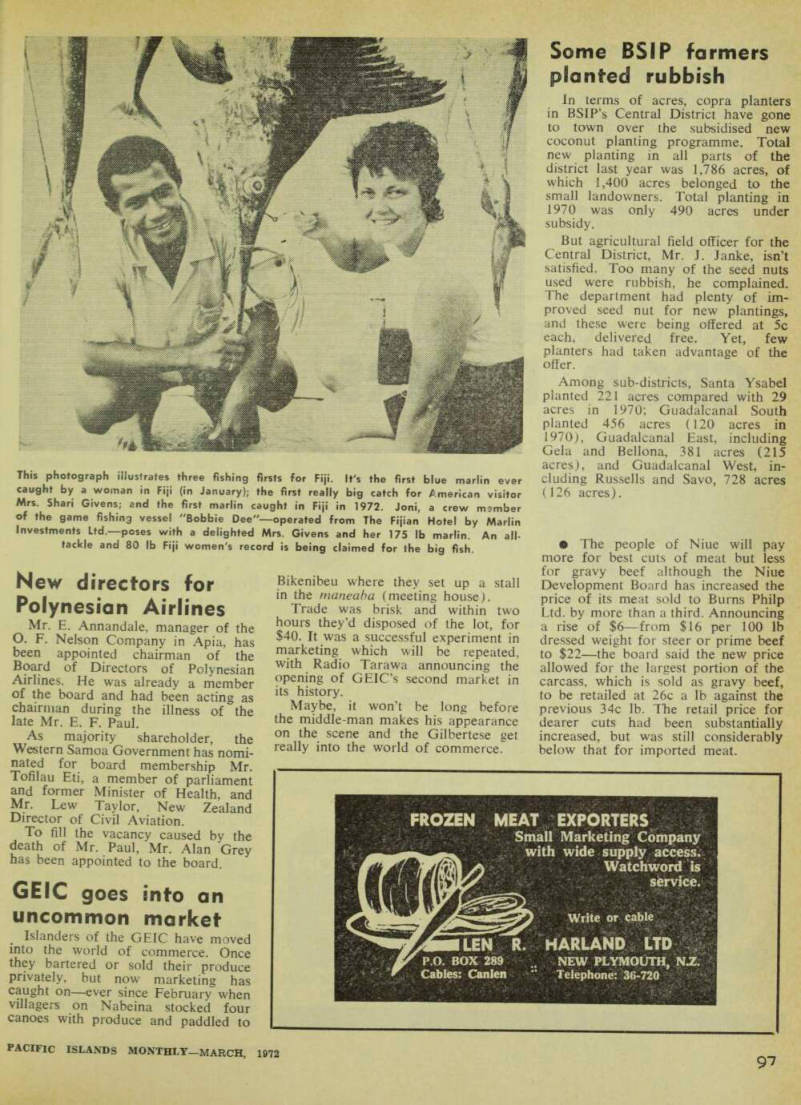
This photograph illustrates three fishing firsts for Fiji. It's the first blue marlin ever caught by a woman in Fiji (in January); the first really big catch for American visitor Mrs. Shari Givens; and the first marlin caught in Fiji in 1972. Joni, a crew member of the game fishing vessel "Bobbie Dee"—operated from The Fijian Hotel by Marlin Investments Ltd.—poses with a delighted Mrs. Givens and her 175 Ib marlin. An all tackle and 80 Ib Fiji women's record is being claimed for the big fish.
The high c. 0.1. of
F. ••/ • r
1)1 s c.i.f.
The Fiji Government, which is now having some sort of trauma about the rate of local inflation, might first look at its own contribu tion to this.
Its incredibly high rate of import duty, for instance.
Based on c.i.f. values that rise every time overseas shipping com panies up their freight rates, it is all augmented by a Port & Service Tax loaded on top of everything else.
Recently a woman we know bought a discontinued line of Japan
ese stoneware at bargain rates in a Sydney department store for the kitchen of her house in Fiji. It cost her $25, was packed in a case and despatched from Sydney by sea.
Surprise, surprise—and no little consternation—at the Suva end to find a bill from the customs agent for over $3O, making that bargain crockery now worth, landed, $55.
Serves her right, of course. Why shouldn’t she eat her victuals off a banana leaf and drink her tea from one of those plastic cups manufac tured in Lautoka?
People have been howling about Fiji’s c.i.f. system of import duties for years and are always answered
by a stream of official gobbledegook.
But even without a c.i.f. basis, the dominion has the highest rate of duty in the Pacific. As an example, the duty on crockery in Papua New Guinea is 5 per cent.; in Western Samoa it is 25 per cent. Commonwealth and 37i per cent, foreign; in the New Hebrides you can choose between paying 15 per cent, on the c.i.f. value or 16i per cent, on f.o.b. value.
But Fiji levies a rate of 25 per cent, preferential and 50 per cent, general, plus all the trimmings of freight, insurance, port and service tax, etc.
Fiji’s high rate of import taxes should stimulate local industry and, to an extent, this has been the case.
But all too often the local product is geared not to local wage costs, which are still low, but to the im ported article which is manufactured in a high-wage country and has to pay freight and Fiji duty.
The end result of this is that Fiji is becoming the most expensive place in the Pacific in which to live.
Nor does this affect only the person who fancies eating off a Japanese stoneware breakfast set, but filters right down to the most menial of Fijian labourers who increasingly depend on store food and market vegetables. It takes a lot to fill a Fijian stomach and with dalo at 20 cents per miserable tuber, it’s an ex pensive business these days.
Population explosion
or drift to towns?
The population of urban areas in Papua New Guinea increased spectacularly in the five years between the 1966 and 1971 censuses. Accord ing to preliminary figures of the 1971 census, there were increases of more than 100 per cent, in Lae, Rabaul, Goroka, Mr. Hagen and Kieta.
The 1971 census figures for the various urban areas, with the increase on the 1966 census in brackets, are: Port Moresby, 66,244 (24,396); Lae, 34,699 (18,153); Rabaul, 24,778 (14,217); Goroka, 10,756 (5,930); Mt. Hagen, 9,609 (6,294); Kundiawa, 2,056 (468); Kieta, 2,402 (1,647); Wewak, 12,154 (3,209).
Other towns also had major and minor increases in population. • Fiji’s airline, Air Pacific, joined giant Pan American World Airways, Continental/Air Micronesia and Japan Airlines for talks at Saipan in the Marianas at the end of January.
On the agenda were the proposed regulations for charter flights to Saipan and use of Saipan’s Klobler airfield.