They seek
pp. 51-53 · Read in the full issue

chance to come out fighting
By Mike Hohensee,
PIM's Sports Writer
It is not surprising that Tonga’s Mani Vaka, the current South Seas heavyweight champion and rated number five in the Commonwealth, has turned to Australia for work.
The South Pacific boxing scene has become too parochial for this stocky champion who in less than six months has methodically disposed of his nearest rivals—three Fijian heavy weights.
He cut the big Fiji heavyweight titleholder, Filimone Naliva, down to size in six rounds, outpointed the revered former champion Leweni Waqa over 10 rounds, and more recently took the South Seas belt off Marika Naivalu with a 14-round tko.
And that really is about the measure of the professional heavy weight situation in the South Pacific.
Vaka is short in stature and possesses a build more associated with a light heavyweight, yet in ability he stands head and shoulders above his heavier and less nimble challengers.
Vaka wants to move to Australia now that he has run the full, if some what narrow, islands course. Last month he contacted Sydney-based Ernie McQuillan, Australia’s number one trainer and promoter, who in his 50 years in the fight game has steered 44 boxers to Australian titles and two to Empire titles.
McQuillan (67) fosters 50 boxers mostly professionals, at his modern gymnasium in Newtown, a Sydney mburb, and although much of his energies in recent weeks has been Jirected towards his star pupil Tony SJundine, the Australian middleweight mampion shortly a contender for the commonwealth crown, he had suf
ficient time on his hands to tell me that he would be only too willing to sign up the Tongan.
“Yes, I’d definitely take him on,” said McQuillan emphatically. “I’ve seen him box a number of times and he has sparred in this gymnasium with Mundine. He defeated the Aus tralian heavyweight champion Foster Bibron a year or so ago. I’ve been very impressed with him,” he added.
Which is praise indeed from McQuillan who considers that “nine out of 10 island boxers are not worth a light! They are unreliable and hard to handle. It’s difficult to get them to train.”
However, he admits to having made a South Pacific talent-spotting tour in January; he visited Western Samoa, New Zealand and Fiji.
“There wasn’t much to see,” said McQuillan, “although I did find an up-and-coming lightweight in Apia.
He’s 20, but I won’t tell you his name for all the other promoters will be after him!”
McQuillan, a shrewd businessman with a commercial TV contract to fill the Sydney screens with bouts once a week, can rest easy in the knowledge that he is not committing himself to an “island gamble”. Vaka must pay off.
He has proved himself in the rings of Fiji and Australia and there is no one wearing leather gloves, as far as I can see, to stop him punching his way to the Australian heavyweight title. And Australia could be the springboard to full Commonwealth recognition.
I saw Vaka finish off Fiji’s Filimone Naliva last year with a competent,
calculated display which left no doubts in anyone’s mind that the Tongan was far superior.
Vaka, looking almost diminutive against the big man from Ba, weaved, ducked and successfully evaded the long reach of his opponent. He threw punches only when he knew they could do damage; he refused to mix it; he dictated the pace.
It was all over in the sixth. Naliva was failing fast and, although he was never flattened, he took comfort from his trainer’s nod which suggested that 10 rounds would be four too many.
Naliva took the full count on one knee. He was under no misapprehen sion that this boy was too fast and too good.
It was reported that Vaka was prepared to give Naliva a return fight—but on his terms. Vaka demanded a $F2,000 purse, two return air tickets from Tonga to Fiji, and accommodation.
No promoter has stepped forward as far as I know and it is unlikely that anyone will for prize-money of such proportions is unheard of around the rings of the South Pacific.
But it is not so unrealistic when the men with the “belts” fight else where in the world. Vaka could ex pect to take home purses three or four times that figure if he manages to buckle up an Australian title.
It is not remarkable, therefore, that Vaka sees Australia as a land of boxing opportunity where he can move up the ladder and, at the same time, earn more money.
“If I do get hold of Vaka,” said McQuillan, “I’d like to trim him down
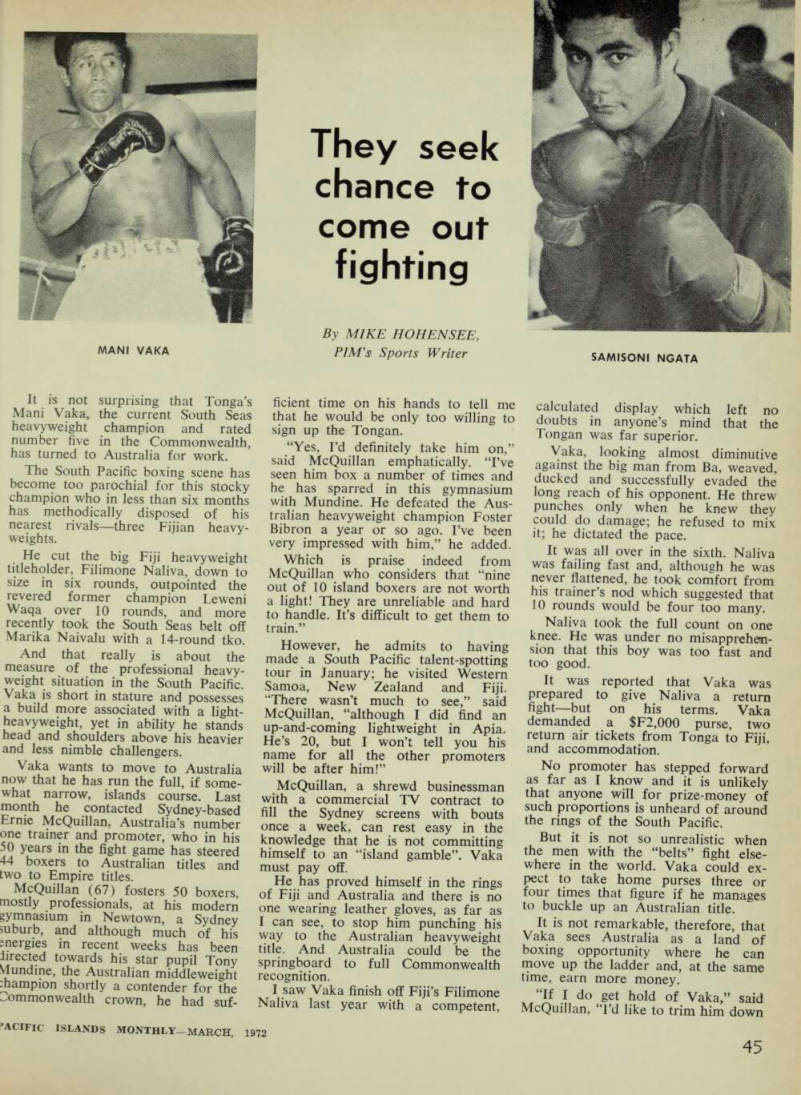
Mani Vaka
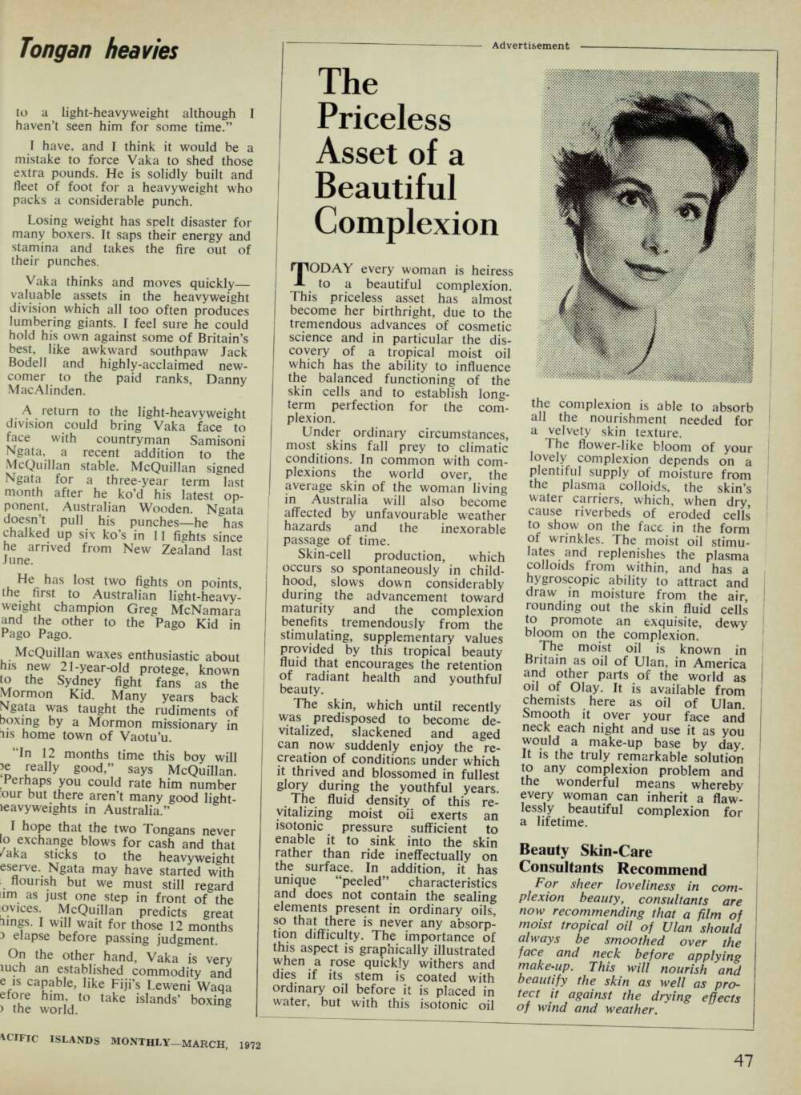
Samisoni Ngata
Tongan heavies
to a light-heavyweight although I haven’t seen him for some time.”
I have, and I think it would be a mistake to force Vaka to shed those extra pounds. He is solidly built and fleet of foot for a heavyweight who packs a considerable punch.
Losing weight has spelt disaster for many boxers. It saps their energy and stamina and takes the fire out of their punches.
Vaka thinks and moves quickly— valuable assets in the heavyweight division which all too often produces lumbering giants. I feel sure he could hold his own against some of Britain’s best, like awkward southpaw Jack Bodell and highly-acclaimed new comer to the paid ranks, Danny MacAlinden.
A return to the light-heavyweight division could bring Vaka face to face with countryman Samisoni Ngata, a recent addition to the McQuillan stable. McQuillan signed Ngata for a three-year term last month after he ko’d his latest op ponent, Australian Wooden. Ngata doesn’t pull his punches—he has chalked up six ko’s in 11 fights since he arrived from New Zealand last June.
He has lost two fights on points, the first to Australian light-heavy weight champion Greg McNamara and the other to the Pago Kid in Pago Pago.
McQuillan waxes enthusiastic about his new 21-year-old protege, known to the Sydney fight fans as the Mormon Kid. Many years back Ngata was taught the rudiments of boxing by a Mormon missionary in iis home town of Vaotu’u.
“In 12 months time this boy will ?e really good,” says McQuillan.
Perhaps you could rate him number our but there aren’t many good light leavyweights in Australia.”
I hope that the two Tongans never lo exchange blows for cash and that /aka sticks to the heavyweight eserve. Ngata may have started with flourish but we must still regard im as just one step in front of the McQuillan predicts great bmgs. I will wait for those 12 months 3 elapse before passing judgment.
On the other hand, Vaka is very luch an established commodity and e is capable, like Fiji’s Leweni Waqa efore him, to take islands’ boxing ) the world.