* Footnotes
pp. 54-55 · Read in the full issue
Is Backwards
The Way Ahead
For Paguineans?
T'HOSE in our midst who prepare material in simple English for broadcasting to Paguineans make great play with the phrase “go ahead”. It crops up with almost wearisome frequency. The country must go ahead; education must go ahead; economic development must go ahead; we must all go ahead like mad.
Fair enough. But which way is “ahead”?
Is the western world going ahead? Or is it, like the Gadarene swine, rushing down a steep place into the sea? (At least the Sea of Galilee was unpolluted and they drowned in nice, clean water.) Until quite recently it was assumed almost universally by Paguineans that the white man’s world was the best possible of worlds, and one which they should strive to emulate. This assump tion is still widespread, if not universal, in the Highlands, whose people have not been in contact with that world for very long and are by tem perament “go-getters” anyway.
But in other parts of the country with a longer story of contact with the western world, the values of that world are being increasingly questioned, and it is perhaps not without significance that this questioning is most articulate in Bougainville, where westernization has come with a rush. They are being questioned too, over in the British Solomons, if Francis Bogotu’s play “This Man”, first written for the con secration of the new Anglican
Cathedral in Honiara, is anything to go by.
It is an ironic thought that the most dis satisfied groups in Papua New Guinea today (if we leave out the Mataungans) are the Papuans with too little development and the Bougam villeans with too much! Not only the Paguineans but some, at any rate, of their western mentors are beginning to have their doubts.
“I question whether we are doing the right thing by dragging them (the people of Papua New Guinea) into our rat race”. No, it wasnt the sentimental old retired missionary who writes “Footnotes” who said that. It was Mr. Doug Parrish, who, after 25 years in Papua New
Guinea’s Administration, latterly as Secretary for Labour (an unsentimental sort of job), recently resigned to enter industry in Australia.
Disenchantment is certainly in the air, not only in economics, but in the field of education too. Take this, for instance: “Personally I am fed up with many of the things that have been promised with the progress and increase of westernized education in our New Guinea, that have instead brought more poison in us and spoiled us”. No, not a primary school dropout, but one of the “lucky” few who have reached the
tertiary level of education.
If he feels like that, how do the unemployed urban dropouts feel. The beginning of a new school year is always a depressing, and sometimes a heart-breaking, time for me. Youngsters whose parents were once my pupils come to me as a last resort when all other doors have been closed to them, hoping against hope that I can work a miracle for them.
Some of their stories cause me to wonder where our present edu
cational system is taking us.
For instance, there was the lad who had completed his primary school course but had not done well enough in his final examination to win a place in a high school. He is 12. He will not be eligible to enrol at a vocational centre till he is 15, and not employable till he is 16, (or with special permission from the Department of Labour at 14). By the time he arrives at any of these ages he will probably have joined a juvenile gang like the one which recently broke into a car dealer’s yard, started one of the cars, and drove it around bashing up the rest.
What else is there for him to do? If ms
With Percy Chatterton
in Port Moresby
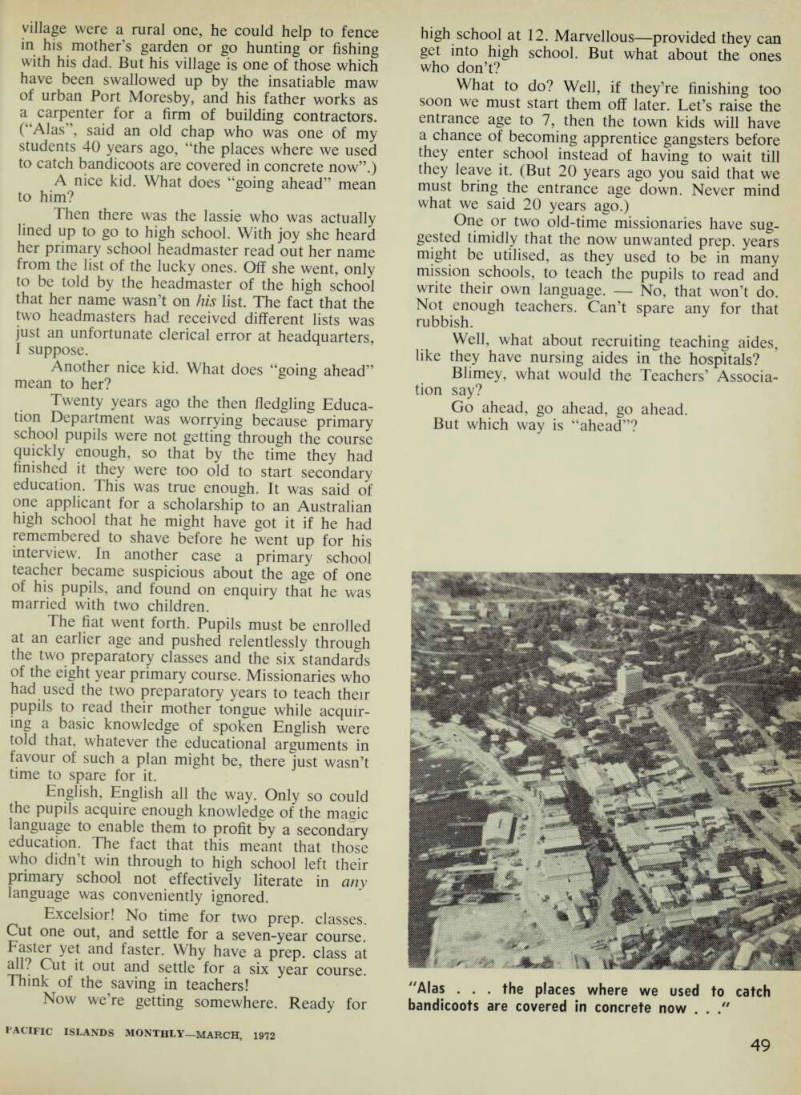
village were a rural one, he could help to fence in his mother’s garden or go hunting or fishing with his dad. But his village is one of those which have been swallowed up by the insatiable maw of urban Port Moresby, and his father works as a « car Pf nter for a firm of building contractors. (“Alas”, said an old chap who was one of my students 40 years ago, “the places where we used to catch bandicoots are covered in concrete now”.) A nice kid. What does “going ahead” mean to him?
Then there was the lassie who was actually lined up to go to high school. With joy she heard her primary school headmaster read out her name from the list of the lucky ones. Off she went, only to be told by the headmaster of the high school that her name wasn’t on his list. The fact that the two headmasters had received different lists was just an unfortunate clerical error at headquarters, I suppose.
Another nice kid. What does “going ahead” mean to her?
Twenty years ago the then fledgling Educa tion Department was worrying because primary school pupils were not getting through the course quickly enough, so that by the time they had finished it they were too old to start secondary education. This was true enough. It was said of one applicant for a scholarship to an Australian high school that he might have got it if he had remembered to shave before he went up for his interview. In another case a primary school teacher became suspicious about the age of one of his pupils, and found on enquiry that he was married with two children.
The fiat went forth. Pupils must be enrolled at an earlier age and pushed relentlessly through the two preparatory classes and the six standards of the eight year primary course. Missionaries who had used the two preparatory years to teach their pupils to read their mother tongue while acquir ing a basic knowledge of spoken English were told that, whatever the educational arguments in favour of such a plan might be, there just wasn’t time to spare for it.
English, English all the way. Only so could the pupils acquire enough knowledge of the magic language to enable them to profit by a secondary education. The fact that this meant that those who didn’t win through to high school left their primary school not effectively literate in any
language was conveniently ignored.
Excelsior! No time for two prep, classes.
Cut one out, and settle for a seven-year course.
Faster yet and faster. Why have a prep, class at all? Cut it out and settle for a six year course.
Think of the saving in teachers!
Now we’re getting somewhere. Ready for
high school at 12. Marvellous—provided they can get into high school. But what about the ones who don’t?
What to do? Well, if they’re finishing too soon we must start them off later. Let’s raise the entrance age to 7, then the town kids will have a chance of becoming apprentice gangsters before they enter school instead of having to wait till they leave it. (But 20 years ago you said that we must bring the entrance age down. Never mind what we said 20 years ago.) One or two old-time missionaries have sug gested timidly that the now unwanted prep, years might be utilised, as they used to be in many mission schools, to teach the pupils to read and write their own language. No, that won’t do.
Not enough teachers. Can’t spare any for that rubbish.
Well, what about recruiting teaching aides, like they have nursing aides in the hospitals?
Blimey, what would the Teachers’ Associa tion say?
Go ahead, go ahead, go ahead.
But which way is “ahead”?
"Alas ... the places where we used to catch bandicoots are covered in concrete now . . ."