Your House Defines Your Status
pp. 43-49 · Read in the full issue

Among The Lavocrats Of Arawa
By Judy Tudor
The coast of the south-east corner of Bougainville is beautiful. Dark green hills that go down to the sea; long shorelines of mostly volcanic sand but here and there interspersed by a tiny, golden beach; romantic small islands set off-shore in pic turesque situations.
All this you see from the plane as you sweep in to land at Aropa. The rest comes as aesthetic anti-climax, an affront to the eyes: Kieta’s untidy squalidness, wedged in between bay side and the first hills, its growing pains erupting in the new satellite of St. Michaels; and, half a dozen miles further west of Kieta, the new dor mitory town for the $4OO million Panguna copper project, stark in its
soul-destroying newness—Arawa.
Experience tells you that one more wet season and Arawa’s ghastliness will have grass; that some people will feel permanent enough to plant
a shrub or two; and that the present starkness will then be decently screened by greenery.
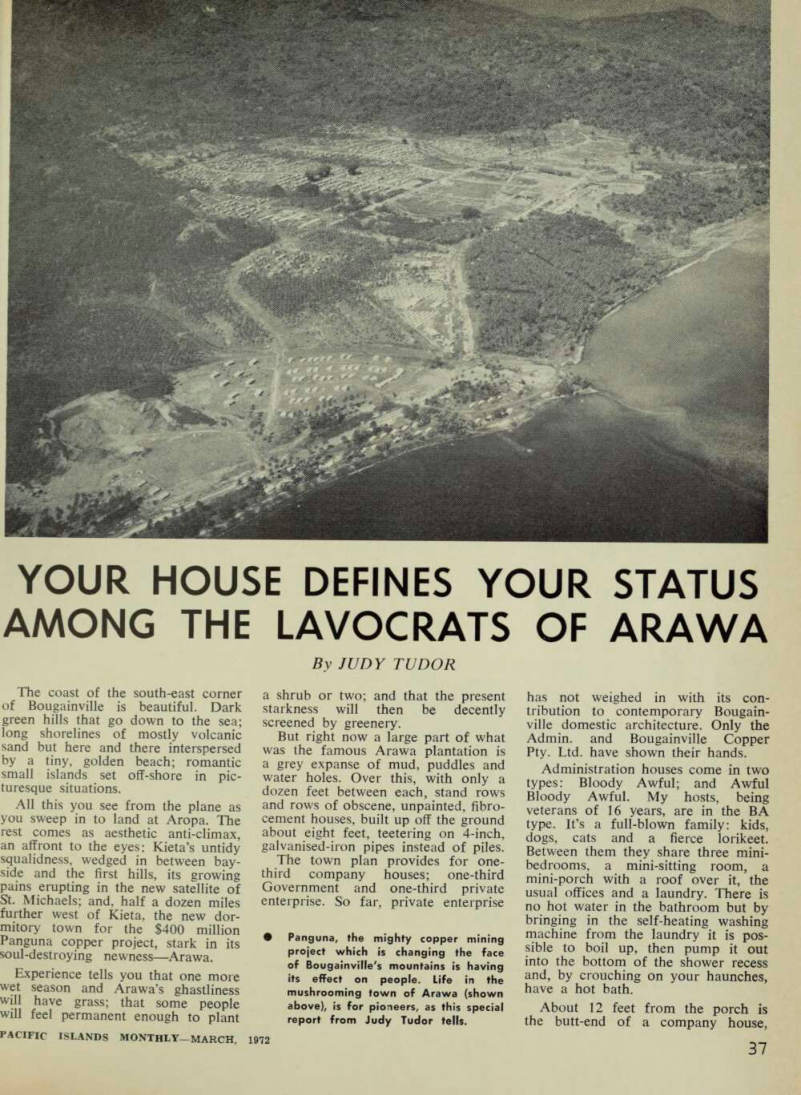
But right now a large part of what was the famous Arawa plantation is a grey expanse of mud, puddles and water holes. Over this, with only a dozen feet between each, stand rows and rows of obscene, unpainted, fibro cement houses, built up off the ground about eight feet, teetering on 4-inch, galvanised-iron pipes instead of piles.
The town plan provides for one third company houses; one-third Government and one-third private enterprise. So far, private enterprise
has not weighed in with its con tribution to contemporary Bougain ville domestic architecture. Only the Admin, and Bougainville Copper Pty. Ltd. have shown their hands.
Administration houses come in two types: Bloody Awful; and Awful Bloody Awful. My hosts, being veterans of 16 years, are in the BA type. It’s a full-blown family: kids, dogs, cats and a fierce lorikeet.
Between them they share three mini bedrooms, a mini-sitting room, a mini-porch with a roof over it, the usual offices and a laundry. There is no hot water in the bathroom but by bringing in the self-heating washing machine from the laundry it is pos sible to boil up, then pump it out into the bottom of the shower recess and, by crouching on your haunches, have a hot bath.
About 12 feet from the porch is the butt-end of a company house,
• Panguna, the mighty copper mining project which is changing the face of Bougainville's mountains is having its effect on people. Life in the mushrooming town of Arawa (shown above), is for pioneers, as this special report from Judy Tudor tells.
with the exhaust-end of an air conditioner going full blast, so that those in the Admin, house get all the irritations of mechanical air-conditioning without any of its benefits.
The back bedroom, where I took up my temporary quarters, looked out on another air-conditioned house.
This, said my hostess, obviously had a fault because at regular intervals it made a noise like a coconut falling to the ground, followed by a sound like a small but determined tornado. Sure enough, all through the first night, that air-conditioner dropped its coconut, the small tornado followed and I counted off the seconds in between each performance in an effort to woo myself to sleep.
Another intriguing item in that room was a trap-door in the floor, under a built-in shelf. In the event of fire you have to fling it open, squeeze yourself through the hole (providing, of course, that you don’t weigh more
than seven or eight stone) and climb down a sort of galvanised-pipe, jungle-gym to the ground, You can’t say that government architects, who put the two entrances to the house in one corner, don’t provide something for the comfort and well-being of their public servants.
Underneath the house which because of the thin pipe legs, trembles with every step like a con slant earthquake—there is a sea of mud, a sheet of water or loose earth, according to the season and the weather. Tenants may have it cemented if they wish, at a cost of about S2BO to themselves, The Awful Bloody Awful Admin. house has two bedrooms, no roof on the porch and no laundry. Under the house there is, instead of this last convenience, a cement tub and a washing machine and there the lady of the house does her laundry in full
view of everyone for half a block around. If anything further is needed to cut the expatriate down to size, this must be it.
There are no fences, no boundary marks, each household mentally set ting the lines of demarcation and with its strip of earth fore and aft, probably occupies an area of 80 ft by 40 ft.
Company houses of several grades are mixed in with the Admin, houses but semi-VIPs of the company are apt to find themselves with a house on one of the knolls around the perimeter of the town. Outwardly company houses are as tasteless as those of the Administration —stuck up on high piles, unpainted fibro cement, undistinguished in every particular. Inside it’s another story.
Even the lowest grade has one air conditioned room, ceiling fans every where else; adequate furniture. Under the house there is a full cement slab, a small room that can be used as a box room, a shower/toilet and a laundry with washer and dryer. The lady of the manor doesn’t have to be seen toiling at the wash-tub.
Further up the scale are fully air conditioned houses, some with family rooms, and umpteen bathrooms and countless lavatories. Because the tenants of Admin, houses have none of these luxuries they feel that they are on the outer, socially speaking, and are therefore not counted in the housing hierarchy. As a consequence, fantastic tales circulate amongst them about the mod. cons, of company houses, some of which they allege have five lavatories.
Even among company people this
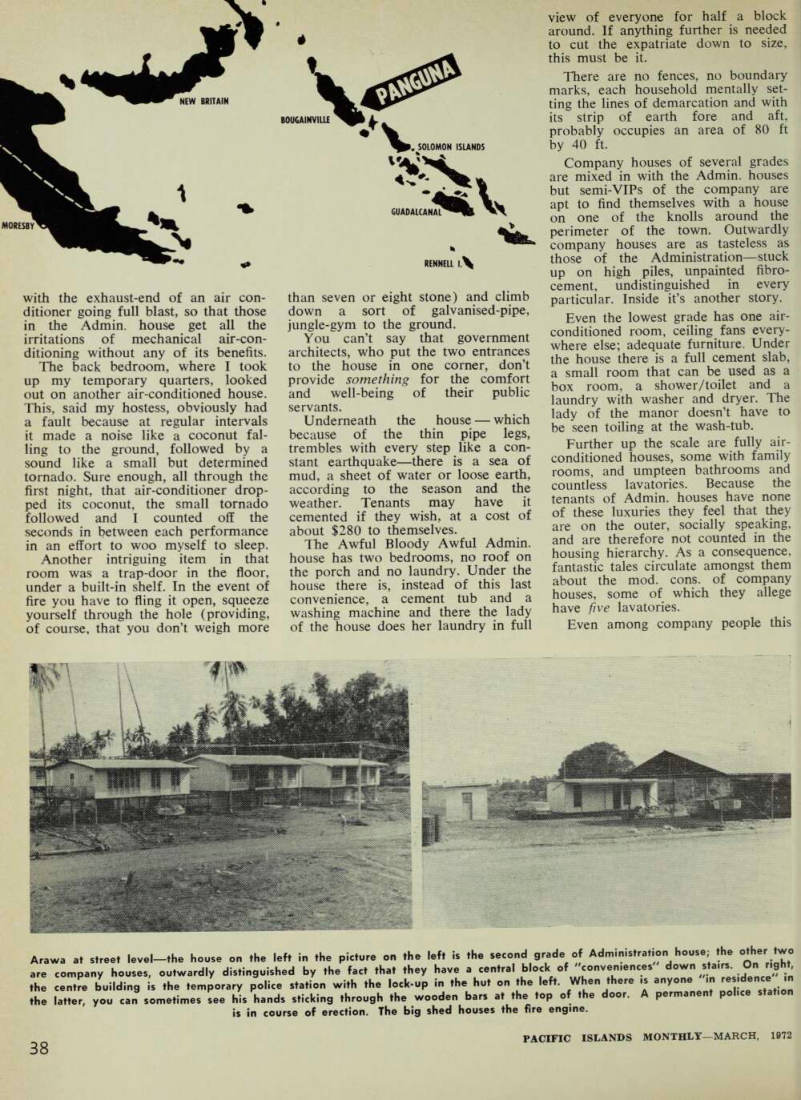
Arawa at street level-the house on the left in the picture on the left is the second grade of Administration house; the other two are company houses, outwardly distinguished by the fact that they have a central block of "conveniences" down stairs. On right, the centre building is the temporary police station with the lock-up in the hut on the left. When there is anyone "in residence" in the latter, you can sometimes see his hands sticking through the wooden bars at the top of the door. A permanent police station is in course of erection. The big shed houses the fire engine.
sense of being fixed in a Lavocracy exists because a man’s position socially is judged by his importance in the company and the type of house he lives in becomes the outward sign of his status. The whole set-up provides extraordinary opportunities for ego-building and snobbery. Giant companies and company towns were ever thus, but as Bougainville Copper Pty. Ltd. is the biggest commercial enterprise ever to hit New Guinea, the belief that it is nearer to God than ordinary mortals is consequently more easily maintained.
Certainly, the company has leaned over backwards to counter criticism before it can begin; it has paid out vast sums of money for land, leases, and in compensation; it gives local Guineans job opportunities that didn t exist before, it has big training schemes, and has men in its employ whose only purpose is to foster good relations between the company and the indigenous community. The com pany believes that it can supply new answers to old questions and, super ficially anyway, black in South Bougainville is not only beautiful but downright lucky.
However, there are no indications to date that Bougainvilleans think any more of the company than they did of the old-time planter and trader who had quite different answers to the same old questions.
The people stay in their villages, which are plastered with keep-out notices and are out of bounds to
company employees. Non-company
expatriates establish relations from
the roadside before entering and find, when they do, a cold reception from the arrogant young, but a friendly enough reaction from the older generation.
Nor do the locals see any sense in the fact that Mr. F. R. McKillop’s plantation was in 1969 forcibly resumed by the Administration and gutted for the new town of Arawa.
Some political capital might have
been made of it in Port Moresby if this European land had remained inviolate while native land was resumed, but locally this destruction of such a valuable commercial asset was regarded as ridiculous. Further more, the plantation processed local village cocoa and as this is now no longer possible, tree crops represent a depressed industry thereabouts.
The only signs now that Arawa
Plantation ever existed are a sprin kling of tall coconuts left amongst the houses; the copra and cocoa shed, with a rotary drier still in one comer now used as the “community centre” (movies three times a week, bring your own chairs); and the plantation guest house that has become the District Office. The District Com missioner sensibly commutes to Kieta each day where he has a house
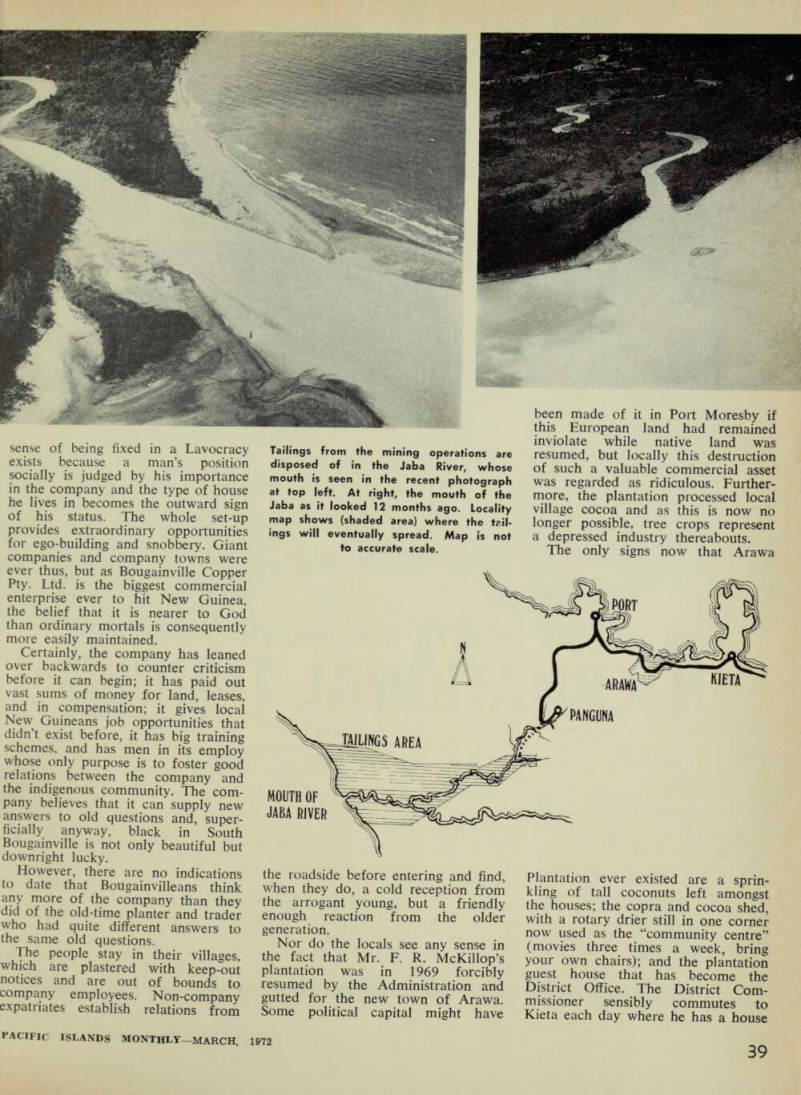
Tailings from the mining operations are disposed of in the Jaba River, whose mouth is seen in the recent photograph at top left. At right, the mouth of the Jaba as it looked 12 months ago. Locality map shows (shaded area) where the tail ings will eventually spread. Map is not to accurate scale.
at the top of a hill, with views out over the bay and the off-shore islands, Up to recently the people most affected by the mining project and compensated therefrom were at the Panguna site of the mine or on the east coast but now some people on the west coast are coming in for their chop.
When the mine is in full operation up to 90,000 short tons of ore can be processed each day. From each ton the company expects to recover 0.48 per cent, copper and 0.36 pennyweights of gold The rest is waste and the dknnsal of taflines is Sore a nrohlem nJ some magnitude and one it whirt company" officials are exceed in plv CO y ® . ... . , .. - . taill Jg s are, m fact, disposed of m the Jaba River, which discharges into hmpress Augusta Bay on the west
coast, but it is expected that a large percentage of the spoil will be run off into swamp land before it reaches the sea. The company has leased 25,000 acres of land for this purpose and compensated the 150 people who h y c in the area to the tune of $84,000 for the loss of the fish in the river.
Nonetheless, the turbid, brown stream flowing into the sea is the first sight a visitor on the direct flight from Port Moresby gets of Bougainville and * n e ? e da y s when everyone is on the pollution bandwagon, the company is naturally sensitive on the subject. . J he building phase of the Bougainville co PP er P ro i ect is now complete.
Most of the constructi °n camps are c l° sed and the workers shipped out; at Panguna, 100-ton dump trucks shuttle ore from the open cut to the crushers round the clock; the ore is ground, pulverised, concentrated and piped over the Crown Prince Range in the
form of slurry, down to filtering and drying plant at Loloho on Anewa Bay, where it is stored ready for shipment, In spite of the fall in world price of copper and the now accepted Japanese back-out from contracts, the company appears confident of dis posing of its annual production in Spain, Germany and Japan all of which have the installations to refine and separate the 500,000 oz of gold from the estimated 150,000 tons of copper. Somewhere in the plans is a refinery for New Guinea but this is a project for the far future and one that carries with it in-built pollution and conservation problems, At Arawa the first housing phase is over, the huge hospital is almost ready for staff and company personnel not directly concerned with mining activity are being moved down there from Panguna. Initially, the town will have a population of about 3,000
The changing face of the mountains.
Arawa is an open town
and this is expected to gradually in crease to 8,000.
At the moment Arawa can be said to be breathing but hardly living. In a full blaze of outside lighting, because electricity is not charged for by meter, it starts to go to bed at 8 p.m. to awake with a bang at six, when most of the men of the town roar off in their vehicles, 16 miles by all-weather road, over the range at 3,400 ft., to their jobs at Panguna.
Wives remain behind to the house hold chores, their neuroses and large slices of boredom.
Domestic help is hard to come by, expensive and impossible to house in Administration homes and difficult in those of the company—to such an extent that there appears to be, on the part of authority, a deliberate policy of preventing the development of a servant class.
Arawa is suburbia, tropical certainly, but suburbia, peopled by family units from Australia, New Zealand, America and Europe who might just as well have dropped in on Bougainville from outer space. In time, New Guinea will rub off on those who stay long enough but for the present, these company towns could, except for the climate, as easily be in Peru or Patagonia.
For the majority, contacts with the indigenous inhabitants and the rest of the territory are seen through company eyes and company policies so that the whole atmosphere of Arawa is unreal and un-New Guinea, badly in need of a leavening of des pised private enterprise to bring it down to earth.
At present there are two shops in the town—a chemist and the super market, the supermarket being com monly referred to as the trade store.
The chemist is privately owned; the supermarket is run by the Panguna Development Foundation set up by the company with the idea of attract ing local shareholders and “in support of indigenisation”. The PDF intends to build the hotel and a tavern and it brings snorts from other intending local entrepreneurs who see it more as a formidable competitor than as a support.
In line with established policy, the first commercial leases have been let to enterprises with at least 49 per cent, indigenous participation. Later, other blocks will be put up for which anyone can tender. Already there are branches of Commonwealth and National Banks operating in tem porary premises.
Although Panguna is strictly com pany, Arawa is an open town, tech nically maintained by the Admin
istration and the company on a 60/40 basis. Local government consists of the Arawa Municipal Commission, with the District Commissioner as chief commissioner, and on which the company has one member, the town’s people one member, and the Bougain villeans one member, each with his deputy. Nonetheless, it is a company dominated town, with vastly more company houses than Administration, and none at all from private individuals.
The development of commercial and private enterprise in Arawa will be at a much slower pace than the
miracle wrought by the company within the last few years. It has literally moved mountains, built roads, two new towns, a port, a power station, sophisticated mining installations and spent over $4OO mil lion in the process.
Even if you recoil from the first, raw physical manifestations of this fantastic effort in an undeveloped corner of the world where previously nothing more sophisticated than a mechanical cocoa-drier existed, in the long term you have to admit that Bougainville Copper Pty. Ltd. could mean the difference between New Guinea with a viable economy and New Guinea as a perpetual pensioner of the Australian tax-paver.