Visitors make
pp. 36-37 · Read in the full issue
the scene in Noumea
New Caledonia Diary
with
Helen Rousseau
February in Noumea was a month of visitors—from the un identified to the uninvited and the uninitiated.
The unidentified visitor was the presumed carrier who brought dengue fever to the island. The fever was diagnosed by virus specialist Dr. Leon Rosen, who flew in from Hawaii, invited by the SPC to work in collaboration with Noumea authorities who were concerned at the spreading of the epidemic.
From blood samples of local patients, Dr. Rosen identified the fever in his Honolulu laboratories.
By mid-February the epidemic had subsided: it was believed the virus had been brought to the territory by an unidentified traveller from overseas.
It was the uninvited visitor who next dominated the scene in Noumea, arriving in time for the 25th anniversary celebrations at the South Pacific Commission.
Wendy came from the north and so monopolised the situation that she prevented one important guest from reaching the SPC festivities: Mr. Tom R. Smith of Wellington, an SPC secretary-general of 10 years back, had to cancel his trip after international air flights were temporarily suspended.
Cyclone Wendy brought devas tating rain and wind—particularly in the north of the island. In Noumea she provided a wet week end for the Commission celebra
tions, February 5 to 7. Guests who flew in for the occasion in cluded islanders such as Ratu George Cakobau from Fiji, Dr.
Ma’afu Tupou from Tonga and Tofa Lauofo Meti from Western Samoa, besides Mr. Robert W.
Skiff from the United States Em bassy in Suva, Mr. Bhagwan Singh, High Commissioner for India in Fiji and Mr. L. S. Price, new British Deputy High Commis sioner in Suva.
The celebrations opened against an eruption of the eternal French suspicion of Anglo-Saxon domina tion. A local weekly had just come out with another variation on the popular theme that foreign powers are hovering to snatch the nickel spoils in New Caledonia. The paper charged that Britain has a great dream: “the creation of a Commonwealth of the Pacific, that she would direct through Aus tralia”. t , This statement was made by the Journal Caledonien, which is owned by the three sons of Senator Henri Lafleur, a supporter of President Georges Pompidou and of the local administration. Besides taking a look at independent Fiji, the weekly saw the growing im plantation in the New Hebrides of such firms as Qantas, Australian banks and trading houses, as part of a manoeuvre to reinforce British influence in the Pacific.
Meanwhile, the Caledonians seemed quite unconcerned at this
threat of invasion and they lined up at the SPC headquarters to collect their first day covers of the 25th anniversary stamp. A tem porary post office had been pro vided at the Commission Open Day on February 5 to sell the new 18 francs stamp. In blue, green, red and white it depicts the Commission headquarters with the flags of the 8 member govern ments flying from the balcony of the secretary-general’s apartment above.
The SPC flag-raising ceremony planned outdoors for February 7 was abandoned because of Wendy and an exchange of speeches was held indoors, as scheduled, before an audience including the Aus tralian consul Mr. Alan Edwards as well as French military, civil service and business personalities.
The ceremony still had its own colour, with proceedings opened by a fanfare from the French military band as Governor Louis Verger entered the hall.
Addresses were delivered by the SPC secretary-general Mr. Fred Betham, of Western Samoa, by Ratu George Cakobau, Lauofo Meti and Governor Louis Verger.
Everyone was so much con cerned about what the French and Anglo-Saxons might say that it was good to hear one of the opening ecumenical prayers include a plea for “our Pacific people which after all is what the SPC is working for. As for the French Governor’s speech, no sooner had copies of the text been distributed
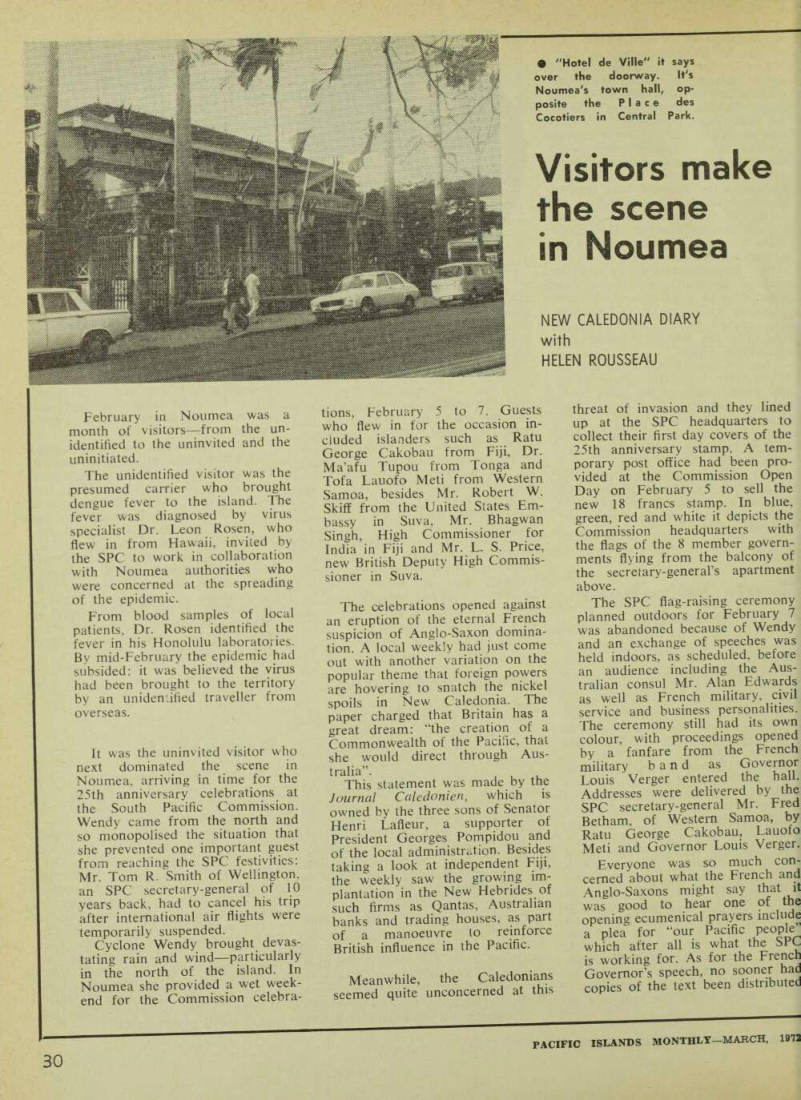
• "Hotel de Ville" it says over the doorway. It's Noumea's town hall, op posite the Place des Cocotiers in Central Park.
than there came a hurried mes sage to say that certain underlined words were not meant to be under lined.
In both English and French, the text of the Governor’s address concluded with the underline: “may the Commission continue for many years, within the scope set, the exciting task it so rightfully cherishes”. How those words (set here in italics) ever came to be underlined was still being in vestigated at the evening’s official reception.
Both toasts at the reception were made in French and when one visiting Senior Commissioner queried what had been said, a staff member promptly issued her warning “not to get political”, especially in front of the press!
In the meantime, the SPC has received some interesting staff reinforcements over the past months, particularly on the side af social development work among slanders.
Dr. Frank Mahony, the new lirector of the Social Program, las come from the University of Hawaii and made his first island dsits. He is supported in his sec ion by fellow Americans Peter ligginson (Youth Work Officer) nd Morris G. Fox, UN Social Velfare Adviser.
In the health section, Miss Jguyen-Thi-Tuyet, the new Health mucation Officer, has arrived in Joumea from Saigon. Miss Tuyet as studied in the USA and so ?eaks fluent English and French esides Vietnamese. Her graceful o-dai makes a colourful addition > international dress at the Com ussion.
Meanwhile, the Economic sec -3n of the SPC was somewhat Tleted in early February, with ily one programme officer re aming (agriculturalist Michel unbert). This was after the cent departure of Fisheries Eficer Val Hinds, UN Agricul rahst Ed. Hugh, Economist Bob cCumstie and Business Training ficer Hal Croft. Hal returned Australia after spending 14 * n ..^ e Pac ific, including NG, Fiji and 5 years at the >mmission.
Diere were other international :ivities in Noumea during Feb iry—in the sporting field.
A spectacular basketball ex hibition from the Harlem Globe trotters and a visit by Australian and Fijian boxers had opened this year’s sporting season. In February the territory welcomed two tennis teams of four men each from Australia and France.
The Australians included such experienced players as Frank Sedgman and Neil Frazer, while in the French team was a young Caledonian—Wanaro N’Godrella, from the Loyalty islands. Now aged 22, Wanaro is revelling in big international tennis after play ing in several series of South Pacific Games.
Caledonian swimmers took over the sporting relay from the tennis men. From first indications, 12year-old Patrick Legras was dominating the boys’ events, while a 13-year-old newcomer from France, Daniele Maussion, showed up well among the girls. Marie- Jose Kersaudy has now retired from swimming and returned to France. In the meantime, Cale donian coach Jacques Mouren says he detects lots of promise among a group of young 9 and 10 year olds, this season.
From the swimming, attention was centred on Noumea’s indoor stadium with a contest on Feb ruary 12 between boxers from Australia, Fiji, Tahiti and Tonga.
Stars of the evening included the Munich Olympics hope Maco Nena of Tahiti and the Fijian Alipate Korovou, who was called in at the last moment to replace an Australian declared overweight.
Korovou, who was not strictly in training, was defeated by Samisoni N Gata of Tonga with a knockout in the 6th round.
The Tahitian boxers were among a group of 53 sportsmen who flew across to Noumea for a week from the Central Sport Club of Tahiti. The club, including basketball and soccer teams, raised $A 12,000 to finance their visit, which was a most welcome initia tive, this being the first time a club, rather than a territorial selection, had made such a trip.
Finally, to come to the “un initiated” visitors: they were the ones who disembarked in the port of Noumea mid-February and nonchalantly entered the new dockers’ canteen. They were not dockers, certainly. And as they admired the floral decorations, the
shrubs from the Forestry Depart ment, the authentic artefacts from the Noumea Museum and the big Bienvenue sign above the door way, they were probably far from suspecting that they were being welcomed into a dockers’ canteen.
But this was indeed the case for the 1,000-odd millionaires-or nearly who arrived in Noumea aboard the most prestigeous French liner afloat—the “France’ 9 . The new canteen was hurriedly finished and decorated to make up for the lack of visitor facilities in the port of Noumea—a lack which present plans expect to remedy shortly, however.
The coming of the “France” had the French Administration mobilised for weeks before its arrival, involving all the top echelon up to the Governor’s right hand man.
Special detachments of police, military band, naval escort were employed for this momentous occasion, together with all manner of Administrative and private per sonnel, to make sure that all went well for this one day visit to Noumea on the “France’s” world cruise.
Certainly the dockers benefited from the occasion, which thus speeded up completion of their im pressive new recreation and dining hall. In addition, the dock workers are currently being paid a mini mum wage of 5A1.30 per hour.
On the tourist scene, however, results have not been so impres sive. Figures issued by the Cale donian Tourist Office show that the number of visitors to the Terri tory last year registered only 11,934. Their average length of stay was 5.8 days. That represented a drop of 17 per cent, in the volume of tourists and a drop of 28 per cent, in the number of tourist-days, compared to the pre vious year.
These figures do not include cruise passengers, who tend to number around 20,000 per year.
Improvements are in sight, how ever, with the two new deep-water berths for overseas ships expected to be ready by mid-March and June respectively. At the same time, work continues on the new overseas terminal at Tontouta air port. The construction is scheduled for completion by July 14, with the official opening planned for November this year.