fiji talanoa
pp. 38-39 · Read in the full issue
What's to become of us all in political Fiji?
CRYSTAL ball-gazing is a frustrating business. With Fiji's first general election since independence looming close (late April probably, though this depends on when the Prime Minister instigates the dissolution of Parliament), reading the political portents begins to resemble a game of chance.
The governing Alliance party seemingly has every prospect of retaining power, though almost certainly with a reduced majority. But in some constituencies any thing could happen. One of the most intriguing fights will be in Vanua Levu North and West, where one of Fiji's "big four" chiefs, Ratu Senator Penaia Ganilau (Minister for Home Affairs and Leader of Government Business in the Senate) will do battle with National Federation Party candidate Captain Atunaisa Maitoga.
Captain Maitoga, a former army officer and now a canefarmer at Wailevu, near Labasa, declares that Ratu Penaia is going to the "political gallows"—and he may be right. The constituency has 17,000 registered Indian voters, 7,000 Fijian voters and 300 General electors.
The situation has assured a welter of speculation. Asa Fijian with the utmost respect for his chiefs and for tradition, does Captain Maitoga feel uneasy about the prospect of trouncing Ratu Penaia?
Why didn't the Alliance ensure that this high chief was given a safer seat?
Alliance party and Ratu Penaia's success will depend upon whether Indians as a race vote this time for the NFP. Some may be torn between party loyalty and their respect for Ratu Penaia, whom many hold in the same high esteem as they do the Prime Minister. Some Alliance ob servers say Ratu Penaia will need about 95 per cent, of the Fijian vote —and about 40 per cent, of the Indian.
At the same time, NFP success in some other constituencies will depend upon whether Fijians vote along monolithic lines. If they do not, according to NFP general secretary Mr. K. C. Ramrakha, the Opposition party has a "reasonable" chance of scraping through.
ONE of the greatest difficulties facing Fiji's politicians—and those attempting to assess their chances of success —is the lack of a common political language.
Effective cross-racial party politicking is seriously hindered by the communication breakdown, for it's a rare politician indeed who can espouse the cause with equal fluency in Fijian, Hindustani and English. Even more exceptional is the
political observer with the facility to understand and assess po.iffca. cogent in a I the vernacular publications of Fiji. kep Ramrakha who is Opposition whip pointed out ' that the political lang P ag P of |ndians in Fi ji iSf of course( Hindustani. Among Fijians, political disa|mosf a)ways in Fijian Qnly g sma|| section of the population can read
. understanc! political com-
menf jn fhe Eng [j s h.lan 3 uage daily news- // The Fj .. Times // and the rea dership H fhe vernacu!ar p ress is similarly subject
, limitations.
Much of what appears in the numerous and Hindi . language newspapersof them hj h , influential—passes unnoticed in the overaM sche me of things.
Hindi-language newspapers, according fQ Ramr akha, contain "some very acidic, gross per sonal attacks" on people. jh e same sor t of thing appears in news-
fiji talanoa
With Sue Wendt, In Suva
papers in India, he said, partly because the Indian laws of libel are not the same as English libel laws. He added that Fijian newspapers also contain a lot of "very extreme writing".
It was the duty of politicians in Fiji to throw up a common political language, declared Ramrakha, and in his mind English was the logical choice. "If we were to jettison English in our search for a common identity, that would be a sad day. It would be a tragedy to push English out".
K. C. Ramrakha's audience at the Press Club seminar was illustrative of the com munication problem. Some of those who write for the vernaculars would find it difficult to express themselves in English journalese. Ninety per cent, of English writing journalists in Fiji (mostly ex patriates, perhaps with a smattering of school French or German, but what use is that?) are unable to read a word of Fijian or Hindustani.
When it comes to putting the message across to a desired audience, however,
some of Fiji's politicians aren't averse to
.wffAnff 'LTiTr D Pa.el
™ Vimes" last year, he had say Jhich wouldn't have gone down well in the NFP-supporting ' Pacific Review", "Mr. Patel's action was in fact a very important development in F.,. politics. He was choosing h.s own forum, said Ramrakha. "However, in language Hindus would understand Mr. Patel worshipped on that occasion before the wrong deity, Naturally, the deity tried to suck him in. (In mid-September R. D Patel, who is one of the main contenders for future NFP leadership, gave a statement to The Fiji Times" criticising the y P res . ent NFP leader, Mr. S. M. Koya. The Fiji Times ran several subsequent art cles speculating on the outcome of the Patel-Koya clash and its effect on the party, ome wee s later, at a meeting of M the workmg CO J"* mittee of the NFP, r. a e sai
wished to withdraw what he had written to "The Fiji Times" and requested that the matter be regarded as closed.) K. C. Ramrakha told the seminar that it did seem as though the century-old "Fiji Times" was taking a more indepen dent line than previously, moving away from its pro-government stand. "Five years ago, 'The Fiji Times' would not have fallen into the bad books of the Prime Minister, who is not happy with 'The Fiji Times' services and has talked of the need for a government newspaper," he remarked. (He did not appear to gloat.) The excitable Mr. Ramrakha last year urged the government to "strangle"
"The Fiji Times", the dominion's only daily newspaper and the publication with the widest readership. It did seem a mite undemocratic of him—but at the Press seminar, he pointed out that it had really been another instance of language misinterpretation. "I was just using the English to its extreme," he explained "I meant that the government should compete it out by encouraging the
establishment of another daily news paper."
More newspapers or not (whatever hap pened to actor Raymond Burr's plans to establish a daily paper here?), the local radio station would serve the dominion well if it gave a weekly rundown in English (as the common language) from the vernacular Press. It might help bridge the language gap that prevails in most spheres of Fiji life—and give the various communities a better idea of what the others are thinking!
A TRIUMPH for the National Federation Party in February was the approval of a bill providing for the common roll system of election in Fiji municipalities, a move long opposed by those fearing Indian "takeover" at local government level.
Despite serious misgivings, the gov ernment backed the bill to honour a commitment given during the pre-indepen dence constitutional conference in London.
Attorney-General Mr. J. N. Falvey—who was later attacked by Opposition leader, Mr. S. M. Koya for bringing up "pro vocative" issues—said it was only fair for the government side to declare its views, although it would honour the commitment made in London.
Government was convinced that common roll was not in Fiji's best interests. It was a constitutional form which had failed in multi-racial or multi-religious countries such as Ireland, the United States, Malaysia, Rhodesia and South Africa.
Although given the vote in practice and the opportunity of representation in theory, the minority found themselves in fact either unrepresented or under-represented, a situation leading to bitterness and potential violence.
Mr. Falvey drew a grim picture of civil rights demonstrations, black power move ments and violence in the US, saying that guaranteed representation for the black minority population might have defused bitterness and strife.
The system of cross-voting currently employed in Fiji meant guaranteed re presentation for all groups, he said—thus "giving reality to our professions of tolerance, harmony and goodwill". It was often said that Fiji was different from other multi-racial countries—but the dominion should learn from the mistakes of other countries. Fiji had had a sharp lesson at the time of the 1968 by elections.
The Attorney-General declared that if Fiji's Indians (though he wasn't accusing them of it) had seen common roll as a neans of political domination, surely the unhappy examples he had cited must lave made them relinquish the idea.
Where was the advantage even to the Jominating race, if they had to cope with m unrepresented, disgruntled, bitter and esentful minority? Common roll was a
spent force and not in the interests of Fiji.
An irate Siddiq Koya replied that whenever some sort of agreement was reached—as with the Suva and Lautoka common roll issue, at the London con ference—it was the Attorney-General who brought up provocative matters for debate.
There were people, he said ominously, who wanted to destroy the London con ference and the atmosphere which had been built there.
The Bill approved in February provides that elections on a common roll basis should be held in Suva and Lautoka within six months of the act coming into force. is to have a Royal Commission on representation procedures sometime after the general elections. Under the present system about 6,000 general electors have eight seats in the House, 96,000 Fijians have 22 seats and 98,000 Indians have 22 seats.
Although this representation was un fair, declared Opposition leader Koya, his party would "continue to tolerate this injustice because we are the product of a higher civilisation than the reactionary group we have in Fiji."
He asserted that Indians in Fiji had no intention of dominating any race in Fiji and added: "I have said before and I say again that even at the risk of being criticised by my own party, I don't wish to impose common roll on the Fijian people—and I stand by that."
Mr. Koya took the opportunity too of hitting out at "The Fiji Times"—that "racial newspaper"—and its editor, Mr.
L. G. Usher, whom he described as Public Enemy No. 1 because of his opposition to
common roll and his belief that it would lead to domination of one race by another.
For the record, Mr. Usher later chal lenged Mr. Koya in a letter to repeat his statements in public, protesting against the "vicious personal attack" made from behind the shelter of parliamentary privilege.
POLITICIANS and newspapermen aren't the only ones in Fiji preoccupied just now with the problem of "getting the message across". Travel man Kalyan Ghose complained to RIM that with Fiji's tourist industry so busy not telling the left hand what the right was doing, travel agents found themselves in the dark about such basic questions as hotel tariffs and projected accommodation.
"One reads about planned hotel ven tures and one is, of course, very pleased," said Mr. Ghose. "But so many of them never eventuate. What we need is collated information on what is actually going ahead—not hearsay or what it is hoped might happen. It's simply impos sible to give overseas agents an accurate idea of what accommodation will be available in Fiji in the next couple of years."
To add to the confusion, he said, Fiji hotels raised their tariffs without sufficient warning to agents. They did it different times of the year—and some raised prices more than once in any 12-month period. It was difficult for agents to anticipate what inclusive tour costs were going to be. Why couldn't hoteliers decide their tariffs, increase them altogether (preferably in April, as re commended by the Fiji Hotel Association) and stick to it?
Why not indeed?!
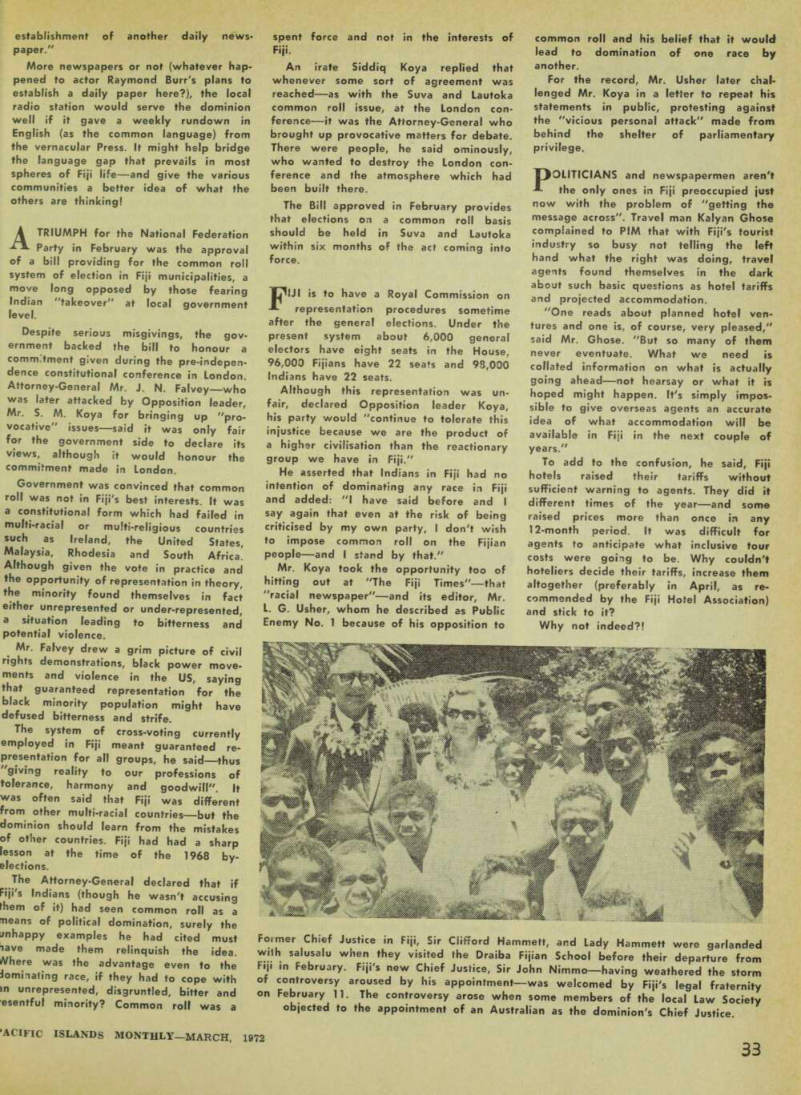
Former Chief Justice in Fiji, Sir Clifford Hammett, and Lady Hammett were garlanded with salusalu when they visited the Draiba Fijian School before their departure from Fiji in February. Fiji's new Chief Justice, Sir John Nimmo—having weathered the storm of controversy aroused by his appointment—was welcomed by Fiji's legal fraternity on February 11. The controversy arose when some members of the local Law Society objected to the appointment of an Australian as the dominion's Chief Justice.