Will It Be This Time
pp. 33-118 · Read in the full issue
For The Banabans?
Having tried innumerable other avenues in their pursuit of increased returns from the phosphates being excavated from their ancestral lands, the Banabans have decided to place their claims before the High Court in England. The court has been asked: 1. To find that all phosphate royalties received by the Crown since 1912 are held for the Bana ban community and should be paid to the Rabi Island Fund. 2. To find that the Crown should pay $156,128 to the Banaban Council of Leaders from the GEIC’s Revenue Equalisation Fund in respect of royalties for the period 1946-50. 3. To determine the sum total of royalties received by the Crown but not paid to the Rabi Island Fund or used for the benefit of the Banabans (i.e,, paid to the GEIC). 4. That all funds received by the Crown as trustee of the Rabi Island Fund or for the Banabans should be accounted for and placed at the disposal of the Banabans.
In short, the Banabans are seeking the full financial benefit of the phos phate industry over the past 60 years.
Further, they are asking that, in ac cordance with an agreement signed in 1913, the British Phosphate Com missioners be compelled to replant worked out lands on Ocean Island.
The latter claim is of particular in terest because it is based on an agree ment which pre-dates the formation of the BPC. This agreement recog nised Banaban ownership of the phos phates on Ocean Island—a position since denied by the UK Government -—in addition to the surface land rights which have never been in dispute.
From 1909 to 1912, when the Pacific Phosphate Company was try ing to acquire new mining areas, its efforts were consistently thwarted by John Quayle Dickson, the Resident Commissioner, who argued that the price offered—£2o per acre—was too low and that the Banabans should receive at least £lOO. Even this figure was ludicrously low when the company was extracting more than 12,000 tons of phosphate per acre and selling it at a net profit of 22/- per ton or over £13,000 per acre. The stalemate lasted until 1913 when E.
C. Eliot, the new Resident Commis sioner, succeeded in negotiating an agreement between the company and the Banabans.
Under the principal clauses of the agreement the purchase price was fixed in the £4O-£6O range depending on location and quality; an upper limit of 145 acres was to be trans ferred; and the company was to pay the Banabans a royalty of 6d per ton on phosphate exported (thus recog nising Banaban ownership of the phosphates). In addition it was agreed “That they [the company] shall return all worked out lands to the original owners, and that they shall replant such lands—whenever possible—with coconuts and other food bearing trees, both in the lands already worked out and in those to be worked out”.
Certainly while mining operations concentrated in the 145 acres acquired under the agreement, no serious attempt was made to fulfil
the replanting clause. Obviously, with only barren coral pinnacles remaining after mining was completed, replant ing would involve the costs of ship ping topsoil to the island—costs which would have trimmed the hand some dividends being paid by the company.
The BPC came into being in 1920 when the Governments of the United Kingdom, Australia and New Zealand combined to buy out the assets of the Pacific Phosphate Company for £3,500,000. The investment has paid for itself many times over and, for 50 years, has resulted in cheap and plentiful phosphates for Australasian farmers. The purchase agreement explicitly stated that the BPC was to receive “The full benefit of all leases tenancies and other rights to or over lands in the said islands (Ocean Island and Nauru) under land deeds made between the native landowners of the said islands and the company . . . subject to the payments and royalties thereby received and the cove nants and conditions therein contained” (italics added). It is presumably on this section that the Banabans are basing their claim against the BPC.
The replanting issue was not prominent in the 1920’5, but towards
• Continued on p, 108.
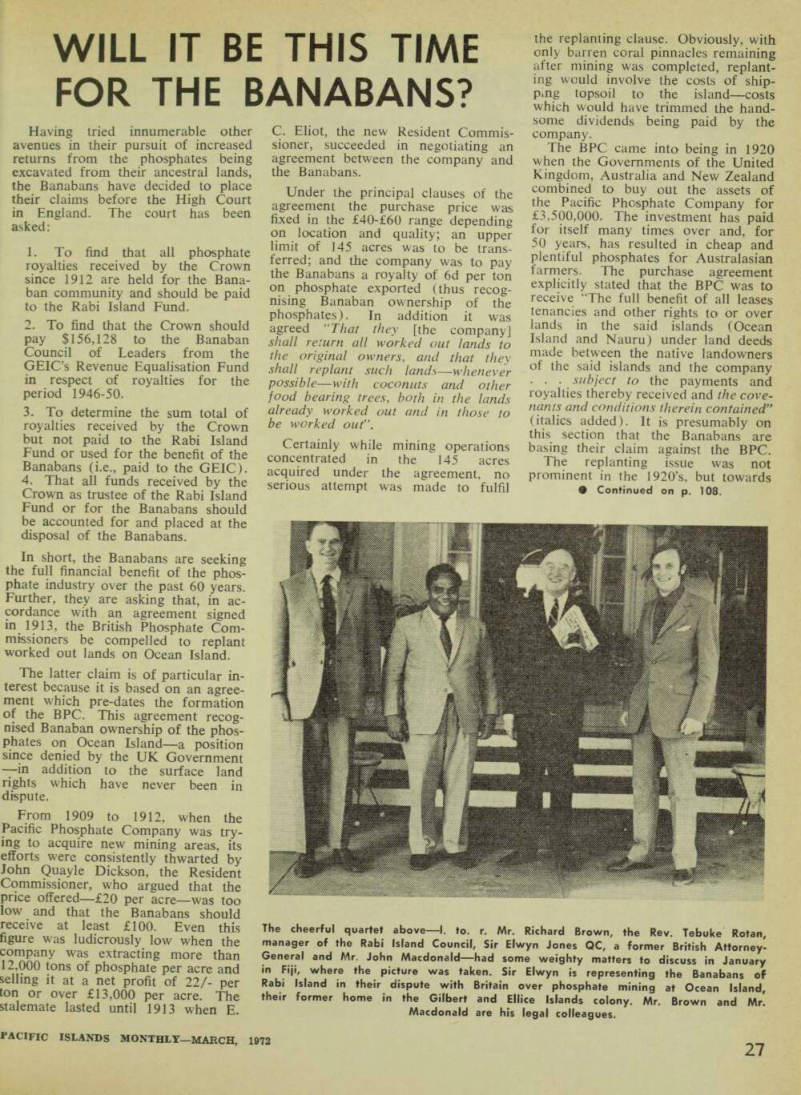
The cheerful quartet above—l. to. r. Mr. Richard Brown, the Rev. Tebuke Rotan, manager of the Rabi Island Council, Sir Elwyn Jones QC, a former British Attorney- General and Mr. John Macdonald—had some weighty matters to discuss in January in Fiji, where the picture was taken. Sir Elwyn is representing the Banabans of Rabi Island in their dispute with Britain over phosphate mining at Ocean Island, their former home in the Gilbert and Ellice Islands colony. Mr, Brown and Mr.
Macdonald are his legal colleagues.
the end of the decade Arthur Grimble as Resident Commissioner tried to negotiate an agreement for the trans fer of further land with one of the conditions being that worked out lands would not be replanted. Negoti ations broke down. Pressure was brought to bear and the Mining Ordinance of 1928 was the outcome.
Under the Ordinance land rights were declared to be surface rights only, and all phosphate rights were said to rest with the Crown (a condition which was applied only to certain precious metals in most other countries).
The Crown could, in the ‘public interest’, purchase such lands and place them at the disposal of a licensee for exploitation. Compensation for sur face rights was to be determined by the Government and any additional payments, whether royalties or not, were to be paid by grace and not by right- . . , , It is hardly surprising that the Banabans feel cheated. In effect, they have spent the past 40 years playing a team that not only made the rules but also acted as referee.
Over the past decade or so the Banabans, looking to the example of the Nauruans, have stepped up their campaign in the Press and by ap proaching the United Nations. They have received minor additional bene fits but even now the financial surplus on the Ocean Island operation is divided between the GEIC and the Banabans in an approxi mate ratio of 85 : 15. To this point the arguments have focussed on need —the need of the GEIC with its marginal economy compared with the relative wealth of the Banabans who live on the fertile Fijian island of Rabi. , Now the Banabans are asking that the matter be decided on the basis of right. By implication they are suggesting that the United Kingdom, and not phosphates, should foot the bill for the GEIC.