politics in
pp. 30-118 · Read in the full issue
All the fun of party politics in the Cooks
The Cook Islands political pot, which has been simmering for several months, has begun to boil as the election campaigners turn on the heat in a struggle for power which will be resolved with the general elections on April 11.
Challenging the ruling Cook Islands Party led by Premier Albert Henry is the newly-formed Democratic Party which, almost at birth late last year, posed a threat to the CIP when its ranks were strengthened by the United Cook Islanders Party which en masse enrolled under the Demo crats banner.
The name, the Democratic Party, was given to it by its founder. Dr.
Tom R. H. Davis, a Rarotonga-born physician with a brilliant record, especially in the United States where he lived for 19 years, holding down top medical research jobs, one in the sphere of space projects. He was medical monitor for the Mercury space project.
He left his job as research physician with Arthur D. Little Inc., of Massa chusetts to return home late last year with his goal Premier Henry’s job.
Known in the Cooks as Tom Taote, Dr. Davis is described, even by some of his opponents, as a modest, kindly and patient man. Premier Henry, out side politics, regards him as a friend and, when Dr. Davis first declared his intention of opposing the Premier, offered him a government depart mental job, but there was a sarcastic tinge to the offer.
Away from home for 19 years, Dr.
Davis, who is fluent in English, Tahitian, French and Spanish, was a little rusty with his Maori, so he polished it up, and at his meetings shines with his political speeches couched in the local dialect.
With the political thermometer rising, tempers are rising with it. An under-the-belt blow for the Demo crats came from the islanders of
Mauke where the CIP enjoys con siderable support. There they en dorsed the candidature of Mr. T. A.
Henry, the Premier’s son, a govern ment minister. But, they did more than that. They passed a resolution to close the meeting hall to any group other than the CIP wanting to use it for political meetings.
Another meeting on the same island ended with a decision that the islanders would support only the CIP, but there were accusations later that the members of the island’s council were attempting to dictate to the people how they should vote.
A dramatic accusation came from Premier Henry on February 15 at a CIP meeting in the Arorangi packing shed.
“Today,” he declared, “I received a tragic cable from Rakahanga which stated that Opposition members were stoning the houses of CIP supporters and had broken windows.”
This statement, the Cook Islands News reported, brought “gasps from the crowd”.
Dr. Davis has set himself a for midable—some say, an impossible task—in challenging the Premier and he is starting with a heavy handicap.
The CIP holds 16 of the 22 seats in the Legislative Assembly. At the general elections in 1965 the CIP won 14 seats. In 1968, it swept into leadership by winning all nine seats in Rarotonga, three in Aitutaki, and a total of 16 of the 22 available. This left the Opposition United Cook Islanders Party only six seats, all in the outer islands.
As the government, the CIP strengthened its position by setting up and assisting numerous village com mittees in Rarotonga and the outer islands and by sponsoring women’s and youth organisations. It gained the support of the elderly, infirm and destitute by introducing pensions for them, and it extended the existing
housing scheme to give a very large number of Cook Islanders modern, durable, hygienic houses at low cost.
It has introduced a measure of land reform to help small planters and has made laws to ensure that landowners get a fair deal from people who wish to lease land for the building of hotels and motels.
ClP’s opponents concede some of its claims but say that in the doing of these things CIP put the country in hock to the tune of little short of $1 million. The government was chal lenged by the UCI in the Legislative Assembly earlier in the year over its spending spree and Premier Henry couldn’t deny that there were financial difficulties. His defence was that they put the country into the red in 12 months instead of in 14 months and that the money was spent in a good cause.
Premier Henry blamed the Public Service for obstructionism which caused his government difficulty in carrying out its policies. In 1969, a constitutional change provided for political appointments to top govern ment posts, including those of resi dent agents and clerks-in-charge in the outer islands. Such men are named by the Public Service Com mission but these nominations have to have the Cabinet’s OK.
This year public servants elected to the assembly will have to resign from their posts. Previously they were allowed to keep their jobs.
The campaign proper is due to start in mid-March, but February saw numerous committee meetings of both parties in Rarotonga and some in the outer islands. Most of the meetings were well attended, with between 200 and 300 people present at some of the Rarotonga meetings.
Both parties were electing their various campaign committees.
In early February Dr. Davis said
Continued on p. 108
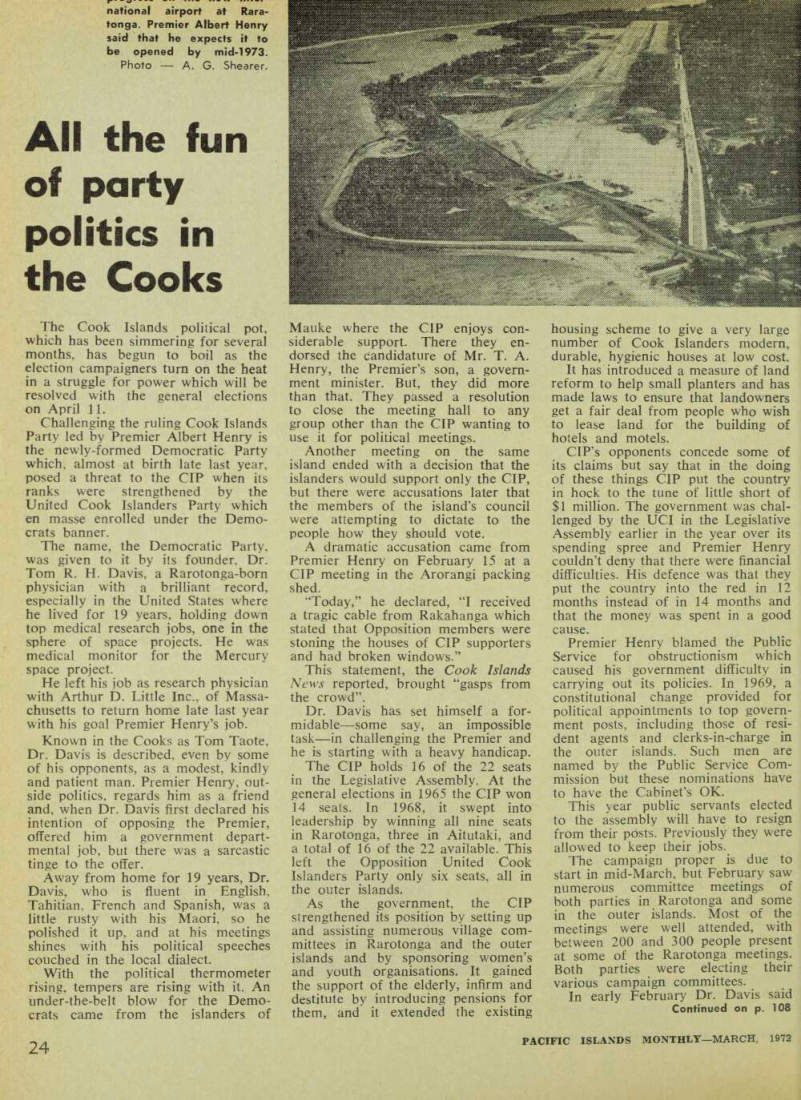
national airport at Rara tonga. Premier Albert Henry said that he expects it to be opened by mid-1973.
Photo-A. G. Shearer.
he was confident that his party would gain the majority of seats. He based his forecast on “the very apparent swing of voters away from the Cook Islands Party as demonstrated by the significantly larger crowds attending the Democratic Party rallies, and the outright support of the Ariki (chiefs) and other influential mem bers of the community.
Premier Albert Henry seemed un concerned. He said he expected mem bership of the CIP to increase and that the ClP’s campaign was pro ceeding as planned in a peaceful and orderly manner, and that it was “not yet in top gear”.
CIP supporters in the Arorangi district of Rarotonga have nominated their two candidates for the general elections. They are Messrs. Taru Moana and Tamataia Pera, both previous CIP members of the Legis lative Assembly. At a meeting con vened by the Ariki and Island Coun cil of Mitiaro it was unanimously decided that Mr. Raui Pokoati would again be the island’s CIP candidate and the CIP supporters on Mauke Island had made it clear that their candidate will be the present Minister of Internal Affairs, Mr. T. A. Henry, who won the Mauke seat, unopposed, in the May, 1968 elections. Reports say that 98 per cent, of Mauke’s population will vote CIP and that the remaining two per cent, are ‘non political’
On February 14, the Premier addressed the largest political gather
ing seen * n Cooks in recent years.
The Victory cinema, in Avarua, was packed with people and others stood outside near the loudspeaker, When asked if it was true that the Government owed $1 million and was “°ut of money’, the Premier B ave an indirect reply that implied that a government never went broke and could always raise more finance by borrowing. He said the Cook Islands people owed the government $1,700,000 in housing and economic development loans, electric power accounts, and so on. He denied allegations that he and his ministers h a d interfered with the Cooks judiciary—that they had tried to m fluence the court s judges, It s believed that the Democrats will accuse the government of ex ploiting the people because local salaries have fallen behind the m creasing cost of living. Public Ser vants had been promised salary increases of 15 per cent. Last Novem ber they received a 10 per cent, m crease and were told the remaining five per cent, would be paid when funds were available, The government had got itself into series financial difficulty by using up all its cash reserves and by accumu lating liabilities in excess of its immediate cash resources, According to the interim report by the Audit Office of New Zealand “this unsatisfactory liquidity position arose despite borrowings over the period (December 31, 1969 to Octo ber, 1971) of approximately $1,000,000 from the Post Office Savings Bank and by bank overdraft, The Democratic Party is expected
to advocate land law reforms, the liberation of the Public Service from political interference, private owner ship of Press and radio services, and other undertakings.
It is too early yet to predict what the outcome of the elections will be, but it is certain that Premier of the Cook Islands and leader of the CIP, Mr. Albert Henry, faces the greatest challenge to his and his party’s political dominance.