AH in amity on Australian immigration
pp. 29-139 · Read in the full issue
He told the Press of his bitter ex perience in 1961 of having an Aus tralian Customs officer turn the contents of his suitcase on to the floor at Sydney airport while he was a transit passenger from Fiji to India.
Ratu Mara told the news conference that he has since avoided transiting Australia wherever possible. “I am not bitter. I have learned to forget such experiences,” he said.
But he added that he wanted to force the issue with Australia on four points: (1) The question of perma nent migration to Australia from the Islands; (2) the admission of Islanders for on-the-job and institu tional training to equip them with the skills needed in the Islands— engineering and refrigeration were two he mentioned; (3) the admission of labourers to Australia for fixed periods; (4) abolition of visa require ments for non-white visitors from the Islands.
Fiji’s Prime Minister got a lot of publicity on his views.
Later, when the forum did reach the subject, Australia got Immigra tion Minister Dr. Forbes to explain Australia’s position on all four points, but the man who cooled the air was Australian Prime Minister McMahon.
Ratu Mara had also taken ad vantage of a courtesy call to Mr.
McMahon to put his position face-to face. McMahon explained Australia’s attitude and Ratu Mara afterwards told the Press that he was satisfied with the explanation, and “appreci ated” Australia’s position and diffi culties.
On the question of permanent migration he said, “I am now satis fied because I now understand the background of Australia’s policy. It is very difficult to get into my country as a permanent resident as well. We also are particular who we have in”.
On the employment of labour from the Islands he said he recognised the difficulties which would be caused through trade union protests in Aus tralia. The Fiji Prime Minister also made it clear that he had a different understanding now on the use of visas, in that Australia was using the system to combat illegal immigration.
But Ratu Mara won his point on the training of Islanders. Prime Minister McMahon promised that Australia would do something about it. Probably about 100 Islanders a year will be allowed into Australia for on-the-job training.
Ratu Mara summed up his feelings of his interview with McMahon this way: “I have no doubts now since
this meeting of minds, and I am able to explain to my people that 1 was impressed by the sympathy and will ingness of Australia to co-operate”.
What was Australia’s explanation on immigration? Dr. Forbes told it this way at the forum: Australia’s policy was to maintain a flow of settlers who would be inte grated rather than form minority groups, and since 1966 that policy has provided for the entry of some non-Europeans. Between 9,000 and 10,000 now settled in Australia were mainly relatives of people already living in Australia, or were people who had special skills or qualifica tions. More than 54,000 permanent residents were of non-European origin and there were over 10,000 trainees as well as several thousand on temporary permits.
It was not a policy of exclusion but one to create an essentially cohesive society. But it could be stressed that Australian policy was not likely to be radically changed to allow unqualified non-European migrants into the country. This policy was not a racist exclusive policy and the government was ready to co-operate for the train ing requirements of Pacific Islanders with specific needs.
Premier Albert Henry told the Press later, “We all accepted this in formation from Dr. Forbes”.
He said he had never got hot under the collar over the migration issue.
For one thing he was in a sort of a glasshouse himself and stone throwing wasn’t advisable. As he ex-
plained, Cook Islanders could enter New Zealand whenever they liked and live there permanently, but New Zealanders had to have a permit to live in the Cooks. And, he pointed out, that wasn’t a racist move. “If we allowed into our country all the New Zealanders who want to come in, there wouldn’t be room for us,” he said.
And what did happen about migra tion in the forum itself? Nothing.
Knowing it was an emotional subject, Ratu Mara took it rationally at the conference table and there were no sparks and little discussion.
Some people later asked themselves what kind of extra information Ratu Mara could have been given to make him come out like a lamb after going in like a lion? As an intelligent man he must have known beforehand the reasons for Australia’s policies, and he could have learned nothing new.
Had he been bought off in the sense that he had obtained some important, unrevealed concessions?
No, the truth is that Ratu Mara was taking advantage of Australia’s vulnerability on immigration to do some politicking. Immigration is a hot subject in the Islands, and Islanders (particularly Ratu Mara) are very conscious of the racist element in Australia’s policy which makes it mandatory for a Fijian or Indian citizen of Fiji to get a visa to enter Australia, while a European with British background from Fiji may come in without one.
Ratu Mara believes that this Aus tralian attitude on visas upsets racial harmony in Fiji, which thus makes Australian policies a live Fiji domestic issue. He deliberately set out to get as much mileage as possible out of his attack without having any inten tion of going so far as to cause a diplomatic breach. In other words, he set out to make his point. It has probably won him some Indian votes at home.
One “government” which would not appreciate one topic in the forum was the newly-formed Government of Minerva. When considering the Law of the Sea, the forum heard an appeal for assistance from Tonga perturbed at the moves by an American-based syndicate to take over Minerva Reef (see p. 93).
The forum pledged its support of Tonga in any attempt to repel boarders and promised to examine the legal aspects of ownership of reefs outside territorial waters. It will raise this question along with others in the forthcoming Law of the Sea Conference in Geneva. Forum members were naturally sympathetic to Tonga’s concern over the sudden
Continued on p. 129
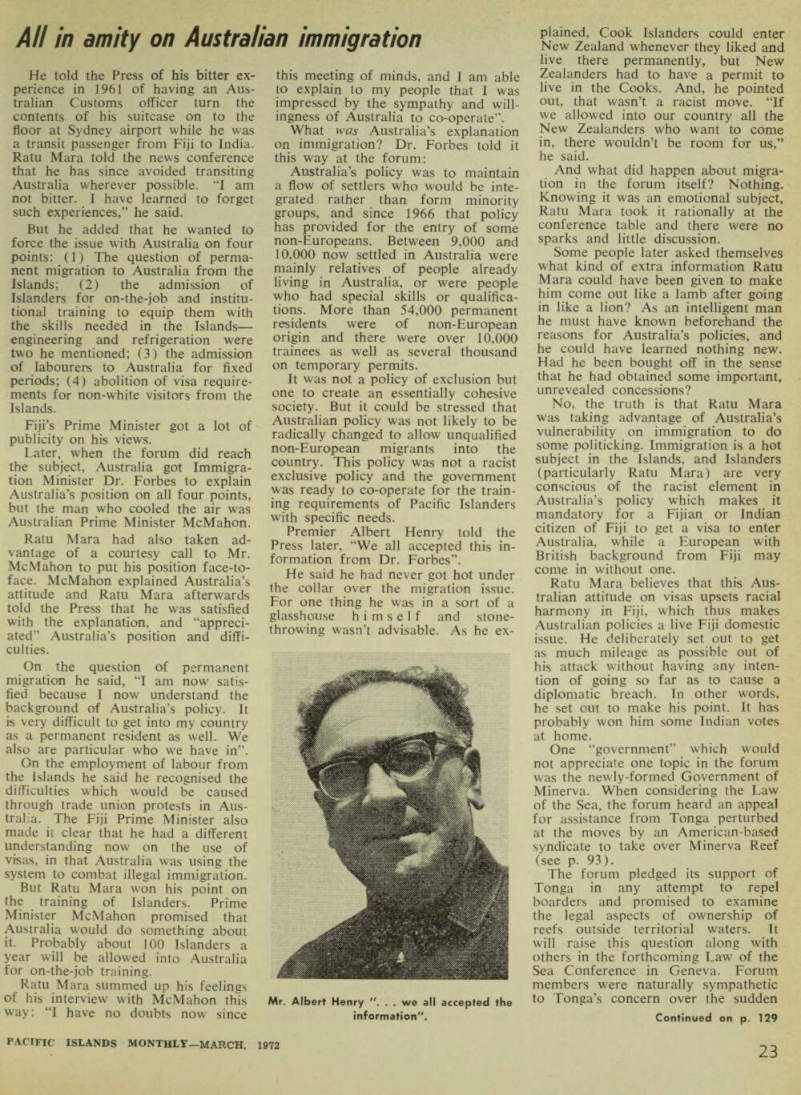
Mr. Albert Henry ". . . we all accepted the information".
emergence of another “republic” right on its doorstep; they have their own reefs to safeguard!
The Geneva conference will also be asked to discuss problems arising out of the defining of territorial waters in archipelagoes. The question is, should expanses of sea between islands in a group be international or territorial waters?
Although the forum leaders spent comparatively little time on civil aviation matters, that subject loomed large in their minds and those of the Australians. The Prime Minister of Western Samoa brought his Minister for Civil Aviation, Tupuola Efi, and also the civil aviation administrator, and Senator Cotton, Australia’s Minister for Civil Aviation, was also there.
It was one topic which did en gender a little heat, certainly from the President of Nauru who gave what one delegate described later as being the most forceful expression of a point of view he has been heard to make”. President Deßoburt both attacked and defended.
A few days earlier he had with drawn Naum from the board of Air Pacific, the consortium of airlines and nations which embraces all the forum countries, and which regards itself as being heir, with Polynesian Air Lines, to the growing regional air traffic in the Pacific. The forum was :onscious of Naum’s withdrawal. It expressed “fear of intmsion from Dutside”—that is, from other inter lational airlines and some national >nes too—and argued that the region ;hould continue to stick together on iviation.
Air Pacific (formerly Fiji Airways) md PAL started their services for the )enefit of their own people when ! very one else had no interest in the slands. Now the Islanders are afraid hat as tourism is growing, others mi try to take what is theirs. Pan Vmencan and Continental Airlines, fi, ha u- e recentl y been given ights by Washington (although bv obody else) to take a more active ole in South Pacific aviation.
Australia’s internal Ansett Airways » also taking a close interest and is ivmg a helping hand to Air Nauru i establishing its new routes from lelbourne to Naum. Ansett’s lotives are suspect and there is a :rong rumour that Ansett has a nan cial interest in Naum’s expensive ew F2B jet.
Ansett has no international rights self, but is hoping to get them,
possibly through New Guinea. The forum was not happy that Nauru was attempting to go it alone, but Presi dent Deßoburt argued forcibly that he was entitled to run his airline his own way.
There was a singular absence of any reference to a matter which, some weeks before, had raised the ire of Fiji’s Prime Minister—the $7OO air fare concession between Australia and London. This concession, it transpired, was confined to nationals of ANZ, and citizens, say, of Fiji, were barred. Ratu Mara’s reaction to this was violent. He threatened to refuse Fiji landing rights to the air lines.
He would, it was anticipated, raise the matter in the forum but he didn’t and there was no reference to it in the communique. If a compromise had been reached, the forum wasn’t told about it.
So far as shipping was concerned, the forum seems to have lost some of its earlier interest in the subject.
Tonga has rationalised its shipping, melding the vessels into one com mercial set-up (see PlM’s shipping section) and Nauru is going it alone, but the forum is interested, at least in the threat to services to the Islands posed by trade unions. The bureau —the only logical body—will prob ably have to tackle the problem likely to arise of Island shipping, operating to Australia and New Zealand, being faced with demands from the unions for employment of New Zealand or Australian nationals instead of Islanders who are on lower wage scales.
The forum couldn’t make a final decision on shipping because it is still awaiting the results of a UNDP survey. In any case, Fiji and Western Samoa are not so sure now that a regional shipping line is a good thing since it has become obvious that ship ping is an expensive operation. They are not anxious therefore to push any body’s barrow on the subject.
They are probably hoping that the matter of establishing a regional shipping line will die a natural death, so they won’t have to declare their attitude to it.
Education was another subject which appeared on the agenda but which engaged the attention of the Island leaders for only a few minutes —long enough, however, for a com plaint to be registered over the failure of the University of the South Pacific to take advantage of schemes offered by other countries to subsidise
salaries of university staff with the object of attracting the best.
Three hurricanes have caused havoc among some of the Islands this season so it was natural that the forum would be asked to give a thought to the question of help for hurricane victims.
The forum responded with alacrity.
It decided to create a disaster fund of $500,000 to be raised over the next 12 years. Forum members will contribute in equal shares and the question of its administration will be decided by the Island leaders in May.
Why May? All five leaders are ex pected to meet informally in May in Suva while the Arts Festival is on.
Nauru had another bad day during the discussion on tele-communications.
At the first forum in Wellington President Deßoburt had pointed out that although Australia, NZ and Fiji had good communications because they were on the main cables, places like Nauru, the Gilbert and Ellice, Tonga, the Samoas and the Cooks were out on a limb with poor radio telephone services restricted in times.
He proposed that the undersea cable from Guam be extended to Nauru, Tarawa and then on to the eastern Polynesian islands. In Wellington the member nations were doubtful about the high cost of this, but decided to have it investigated anyway. In Canberra it was reported that the cost was prohibitive and the forum turned thumbs down. But it agreed to look at alternative methods of communications for these off-the beaten-track islands.
There were other matters decided —oceanic resources, regional co operation—but the drama had gone with the closing of the chapter on immigration and by noon on the third day there was little to talk about other than agreement on a com munique on what they had talked about. It was issued in the afternoon, with suitable comments from Premier Henry but it’s dry bones (published for the record on p. 131).
Surely, the people of the Islands deserve something more than a bald communique? After all, it’s their future, their prosperity, their lives which are in the balance. Should they have to rely for details, who said what and to whom, on the lobbying of journalists not allowed into the meeting, nor for the most part invited to the forum’s social functions?
Now that the forum has taken on substance, should it not be opened, as the South Pacific Conference is opened, to the Press?
• Turn to p. 131 for full text of the official communique.