Japan takes a forward policy in the South Seas
pp. 27-28 · Read in the full issue
“We are interested in the Islands because we are a nation of the Pacific and that is the main reason.”
So ran a message from the Japanese Embassy in Canberra in reply to a Press request for comment on a very significant invitation which Japanese Ambassador Shizuo Saito extended to the members of the South Pacific Forum. The invitation was to dinner at the Embassy and all the Island leaders accepted.
There were rumours that the dinner was to be the vehicle for conveying to the Island leaders Japanese offers of help for their countries. But no offers were made at the dinner. Island leaders said later that speeches and conversation round the table were confined to a courteous exchange of pleasantries.
An embassy official confirmed this but also explained: “We are very much concerned with the South Pacific, particularly with Fiji, and we are taking a forward policy. In the circumstances we don’t have any concrete plan on how to carry out a programme of co operation. It is still in the embryo state.
We have to study what you need. We would have to study social situations in the various islands, what kind of products you can produce and the criterion of industry, and also the transport system. There are so many things to study. We are contemplating sending experts to the Islands to obtain this information and this may be the first task for Japan to do.”
them and gradually, together, arriving at common ground.
Certainly there were overtones of national rivalries involved. Was Fiji wanting to be the “political hub” of the Pacific? The Samoans supported Mr. Henry over the Auckland site; President Deßoburt was all for the Suva site, with Tonga on the fence.
But Tamasese, Western Samoa’s Prime Minister, was quite prepared to give way if others persisted in championing Suva.
And that was what happened.
Suddenly, out of it all, came complete agreement, and the bureau will be in Suva. It will cost $90,000 in its first year of existence; Australia and New Zealand will pay two-thirds and the remaining $30,000 will come from the Islands. To muffle the rivalries, the headship of the bureau will go round with Fiji’s turn coming way down the line.
The agreement on establishing a bureau brought up the question of the future of PIPA (the Pacific Islands Producers’ Association).
After the November trade meeting in Wellington, Fiji was worried over it because PIPA was its brainchild.
The committee had suggested that the functions of PIPA could be taken over by the bureau, or PIPA could become a sub-section. In fact, it spelled it out in terms of “assuming responsibility for PIPA”.
What worried the Fijians was the fact that in PIPA were some of the dependent territories such as GEIC and Niue, and what was to happen to their interests? Bully for Fiji for its concern over the little man!
That query has still to be answered because it looks as if PIPA will be asked to commit suicide, probably in June, at the next PIPA meeting.
It will be decided then whether PIPA is to be merged into the bureau or be allowed to live a little longer.
But it seems certain that, in the long run, PIPA must go.
The most important aspect of the bureau discussions was the desire by the forum members to create a Free Trade area in the South Pacific.
Big Brothers Australia and New Zealand had already warned them of the pitfalls that exist in lowering tariff barriers. The forum heeded the warning and when the bureau gets going, the establishment of a Free Trade agreement will be discussed.
A continuing examination will be made in the meantime of ways of lowering tariff barriers. Free trade will also be an important question at the third meeting of the forum in Suva this September.
ANZ have promised “sympathetic consideration” for any scheme that will allow Islanders easier access to Australia and New Zealand markets.
Bv winning this promise from ANZ,
the Islanders achieved a major victory, but Australia might as well recognise from the start that the Islanders are after something more than the chicken-feed they got when Australia lowered the barrier for Island artefacts and curios.
Territories outside the forum are not being ignored but it was stressed that, initially, any Free Trade area created will be confined to the five Island member countries, From trade to the next most im portant question, immigration.
If anybody following what went on at the Canberra forum attempted to use newspaper reports as a guide to what happened when immigration matters were discussed, they would have got a wrong impression, There were big headlines which looked dramatic but a lot of the stuff underneath was fairy floss. It was an emotional subject because the Islanders are conscious of racial dis crimination, of a White Australia policy and of second class citizenship.
But in the end the issue wasnt such a hot one. ... , .
There was a deal of grandstanding and politicking in the question.
Carrier of the biggest banner was Ratu Sir Kamisese Mara, who wasted no time, before the forum members even reached the subject, in l his views to Australia at a news con ference.
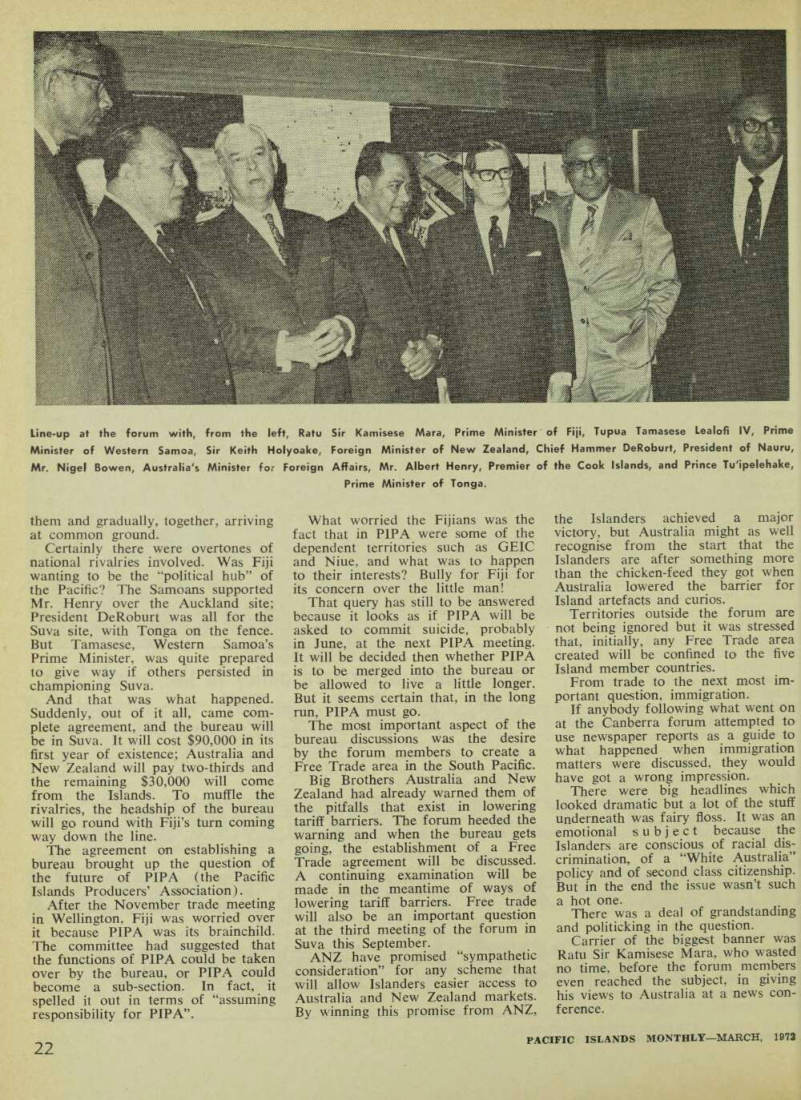
Line-up at the forum with, from the left, Ratu Sir Kamisese Mara, Prime Minister of Fiji, Tupua Tamasese Lealofi IV, Prime Minister of Western Samoa, Sir Keith Holyoake, Foreign Minister of New Zealand, Chief Hammer DeRoburt, President of Nauru, Mr. Nigel Bowen, Australia's Minister for Foreign Affairs, Mr. Albert Henry, Premier of the Cook Islands, and Prince Tu'ipelehake, Prime Minister of Tonga.