Rabaul watches
pp. 31-32 · Read in the full issue
the action and waits for results
By Judy Tudor
Rabaul and the rest of East New Britain District of Papua New Guinea hasn’t had much going for it in the last 12 months: Riots, Mataungan recalcitrance; the murder of its popu lar District Commissioner; force eight earthquakes; a tidal wave; and the exodus of a lot of people who felt that they couldn’t stick the place any longer.
Worse than any of these factors in the present depressed state of Rabaul affairs are the low prices for copra and cocoa. Recovery of these would probably go further than anything else towards raising morale in the district.
Local commercial interests and the hotels talk of a 25 per cent, fall off in business, although others, includ ing Burns Philp and Plantation Hold ings Ltd., say that their figures are better than in the previous year.
The construction phase at the copper project at Panguna, Bougain ville, rubbed off to some extent on Rabaul suppliers but this too has finished, and there has been little or no investment except from such in curable local diehards as Messrs. Jack Thurston, John Chipper, Harry Dowling and Alec Hopper, who seem to go on, perhaps from habit, perhaps because they are stuck with it.
Generally, Rabaul and the Gazelle Peninsula were on tip-toe in February awaiting the outcome of two events ~—the trial of the 13 Tolais allegedly implicated in the murder of District Commissioner Jack Emanuel; and the elections, which began on February 19 but whose results will not be known until about March 11.
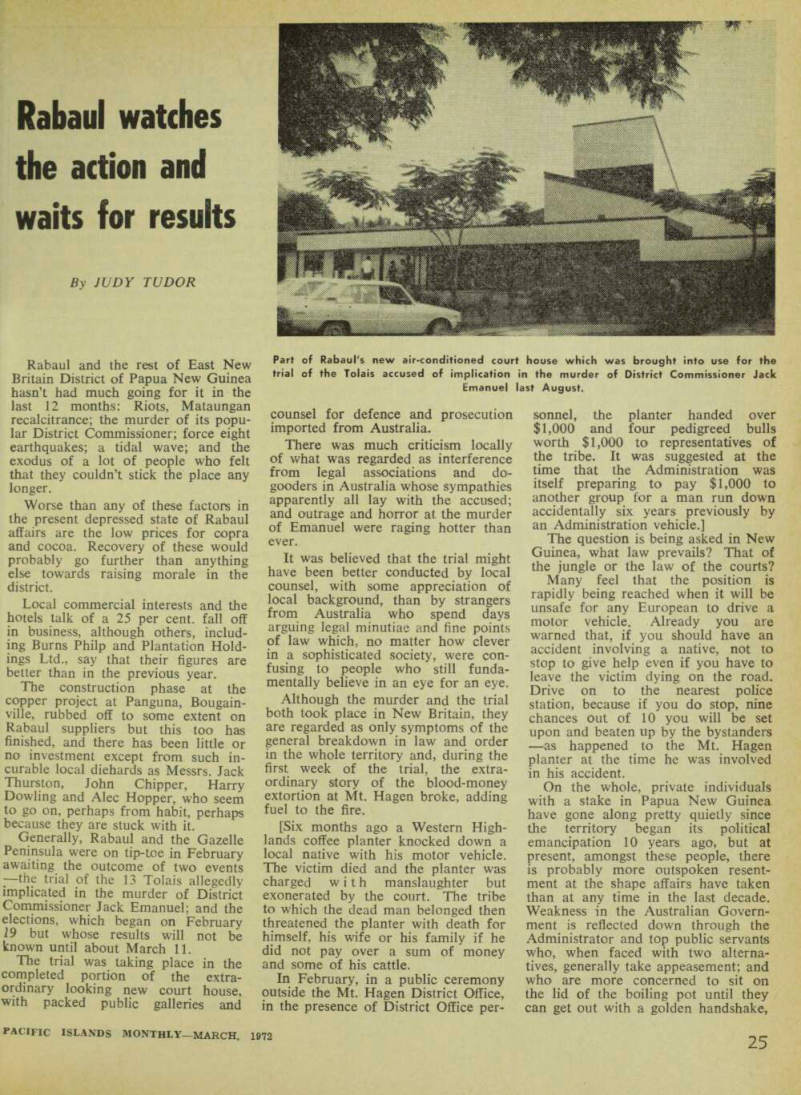
The trial was taking place in the completed portion of the extra ordinary looking new court house, with packed public galleries and
counsel for defence and prosecution imported from Australia.
There was much criticism locally of what was regarded as interference from legal associations and do gooders in Australia whose sympathies apparently all lay with the accused; and outrage and horror at the murder of Emanuel were raging hotter than ever.
It was believed that the trial might have been better conducted by local counsel, with some appreciation of local background, than by strangers from Australia who spend days arguing legal minutiae and fine points of law which, no matter how clever in a sophisticated society, were con fusing to people who still funda mentally believe in an eye for an eye.
Although the murder and the trial both took place in New Britain, they are regarded as only symptoms of the general breakdown in law and order in the whole territory and, during the first week of the trial, the extra ordinary story of the blood-money extortion at Mt. Hagen broke, adding fuel to the fire. [Six months ago a Western High lands coffee planter knocked down a local native with his motor vehicle.
The victim died and the planter was charged with manslaughter but exonerated by the court. The tribe to which the dead man belonged then threatened the planter with death for himself, his wife or his family if he did not pay over a sum of money and some of his cattle.
In February, in a public ceremony outside the Mt. Hagen District (Mice, in the presence of District Office per
sonnel, the planter handed over $l,OOO and four pedigreed bulls worth $l,OOO to representatives of the tribe. It was suggested at the time that the Administration was itself preparing to pay $l,OOO to another group for a man run down accidentally six years previously by an Administration vehicle.] The question is being asked in New Guinea, what law prevails? That of the jungle or the law of the courts?
Many feel that the position is rapidly being reached when it will be unsafe for any European to drive a motor vehicle. Already you are warned that, if you should have an accident involving a native, not to stop to give help even if you have to leave the victim dying on the road.
Drive on to the nearest police station, because if you do stop, nine chances out of 10 you will be set upon and beaten up by the bystanders —as happened to the Mt. Hagen planter at the time he was involved in his accident.
On the whole, private individuals with a stake in Papua New Guinea have gone along pretty quietly since the territory began its political emancipation 10 years ago, but at present, amongst these people, there is probably more outspoken resent ment at the shape affairs have taken than at any time in the last decade.
Weakness in the Australian Govern ment is reflected down through the Administrator and top public servants who, when faced with two alterna tives, generally take appeasement; and who are more concerned to sit on the lid of the boiling pot until they can get out with a golden handshake,
Part of Rabaul's new air-conditioned court house which was brought into use for the trial of the Tolais accused of implication in the murder of District Commissioner Jack Emanuel last August.
than they are with making firm and difficult decisions or providing leader ship.
Few top, policy-making public ser vants have any personal mana or following; there is no national leader in sight. Konedobu with its public servants and policy makers, has just become a great, disembodied “They” in which there is little faith and less hope.
No one knows how self-government —or independence if the Labour Party wins the next Australian elections—is going to work although most are convinced that it won’t, at least not as a unified force pulling the dozens of dissident factions into an instant nation.
To this extent Rabaul has more hanging on the current elections than most. The disruptive, radical Mataungan Association has been claiming for a long time that it has the hearts and minds of the majority of the Tolai people but they have never, until now, stood up to be counted. But four Mataungans are standing in four local electorates and if these win in a landslide, as many people fear that they might, it is accepted that New Britain and New Guinea will be in for a bad time.
If they should be cut down to size or receive no more than 25 per cent, of the votes, there is hope that the Gazelle Peninsula will have a little more peace than it has had in the last 12 months.
The trial of the 13 Tolais charged with the murder of District Commis sioner Jack Emanuel last August was still continuing at the end of February. The trial had begun in Rabaul on February 2. The 13 have pleaded not guilty.
The hearing has been marked by lengthy legal argument, on the pro priety of admitting various state ments as evidence and in one case on the propriety of a statement made by the Chief Justice of PNG, Mr. Justice Minogue, who is hearing the evidence.
Two Australian QC's, Mr. E. A.
Lusher and Mr. F. Galbally, are rep resenting the defendants, and another Australian QC, Mr. F. Brennan, is counsel for the crown, assisted by the Deputy Crown Solicitor in Rabaul, Mr. N. H, Pratt.
Among those who have given evi dence for the defence is John Kapu tin, a prominent member of the Mataungan Association, who said that he was told by a Rabaul police offi cer that it was up to the defendants to get legal aid. He had then sent a telegram to Australia asking about legal assistance.