Yesterday
p. 85 · Read in the full issue
With the Pacific slowly recovering from the devastation of World War 11, 1951 closed on a peaceful note after a fairly steady sort of a year with no major upheavals and only the faintest of stirrings of political consciousness among the Island peoples. The winds of change blowing from elsewhere had hardly shaken a leaf but another sort of wind brought tragedy.
If PIM had come out 20 years ago this month with black bordered pages everyone would have understood, especially after turning to page 19.
There were sad headlines on that page — Hurricane in N. Hebrides kills over 100.
It struck, of all times, on Christmas Day. Six small vessels were sunk, three more were believed lost and devastation was complete over the whole area of Ambrym and Epi, already almost overwhelmed by a volcanic eruption, and the south-eastern part of Malekula. At Epi 49 natives died in a landslide.
Just over a month later, on January 28, it was Fiji's turn. The worst-ever hurricane with winds of more than 150 miles an hour—it's still the record blow for Fiji—cut a swathe 35 miles wide across Viti Levu, killed more than 20 people and did damage estimated at £1 million. But that story had to wait until the February PIM came out.
A few days earlier the Solomons suffered, but their hurricane, said PIM, was only a "young" one. Young it might have been, but it was lusty enough to sweep away wharfs, sink ships and blast villages.
It wasn't the only bad news either.
Three people were killed when a Qantas Dragon plane crashed on the Menyamba River, 20 miles northwest of Mt. Hagen in PNG. They were pilot S. Peebles, of Madang; K. Kear, civil aviation airport inspector, and Robert Kennedy Earle, the Wabag A.D.O.
The Cook Islands people had some bad news also, although it wasn't as tragic as a hurricane or a plane crash.
They lost a whole cargo of kumeras (sweet potatoes) valued at £lO,OOO.
The cargo, 200 tons of it, arrived at Auckland in the "Waitemata". There it was discovered to be infested with "white-fringed weevil". As New Zealand hadn't the weevil, which is sudden death to kumera crops, and attempts to destroy the weevil in the cargo by fumigation failed, the whole cargo
was destroyed. The NZ Minister of Agriculture at that time had a name which is now very familiar—Holyoake.
Still in sombre vein, PIM recorded the deaths of several prominent Island people, chief among whom was Adi Litia Cakobau, grand-daughter of King Cakobau and mother of Ratu Edward Cakobau, who is now Ratu Sir Edward Cakobau, Fiji's Minister for Labour. Adi Litia, who died at Bau island, was the daughter of Cakobau's second son. Her mother was Tupoutoa of the Royal House of Tonga.
Other deaths were those of Major F. G. L. Holland, former Director of Education in the GEIC, Mr. Francis Seymour Whitcombe, retired mariner and writer of short stories, who lived in Fiji for many years, Mr. Charles B. Hill, old Suva worthy, Mr. William Young, Papua resident for over 40 years.
Miss Mamie Nora Christian, of the Pitcairn Christians, and Mr. W. H. (Bill) Carpenter, a director of W. R. Carpenter and Co., who died suddenly on January 16.
There were also many tears shed on Suva wharf on January 8 but Fijians can usually find a rainbow in the tears and there were cheers and laughter when thousands packed the decorated streets and waved farewell to the soldiers who were off to fight the communist terrorists in the Malayan jungle. They sailed in the migrant liner "Asturias" and, as the crowds cheered, an RNZAF Catalina flew low over the ship.
Although there had been no official comment, the Methodist Church, to which 90 per cent, of the Fijians belonged, was very unhappy about the whole thing. PIM said the Methodist Church had pointed out the "serious effect on the Fijians of the withdrawal of many hundreds of their most promising young men at a critical time in their economic, political and
social history."
Well, two decades later, somebody should be able to put the thing in its proper perspective.
On the same page PIM also reported that 30 Italian men were on their way to the New Hebrides to work for Mr.
Charles Graziani of Santo, and that their wives and families would follow when the men had settled down. There was, apparently, a shortage of labour in the condominium. Things have changed. There are now more than 1,000 New Hebrideans working in New Caledonia!
Talking about New Caledonia, PIM reported the creation in Paris of a Committee "for the Defence of the Pacific Franc." Prominent in its creation was Mr. Lenormand, the newly-elected Deputy for New Caledonia. The idea was to counter any move by the "Metros" to lower the exchange rate.
PIM said, "The Pacific franc is the most valuable of the francs used in the French Union." It listed exchange rates as: £1 sterling, 187.37 Pacific francs; £1 Aust., 141.75; SUSI, 64.0.
Today, the hotels in Noumea will give you 98 CFP for your Australian dollar and the Bank of Indo China 112 CFP, which gives the hotel people a nice profit.
PIM has always liked a bit of fun.
It loves to retail the chit-chat, the local gossip and scandal and the over-the-fence confidences. It retailed a story 20 years ago about the official salute accorded the Governor of Papua.
When Sir George LeHunte was Governor, PIM recalled, he was always greeted with a salute when he returned to Port Moresby. How was it worked because there were no guns at Port Moresby?
PIM told how the Head Gaoler, John Macdonald, put plugs of dynamite in open kerosene tins with detonator and fuse attached and placed them at calculated distances apart in the grass on top of Paga Hill. When the "Merrie England" with the Governor aboard appeared around the Point, John would run from one tin to the other, lighting the fuses at the correct intervals. The combination of tin cans and dynamite gave his Excellency the required number of big bangs.
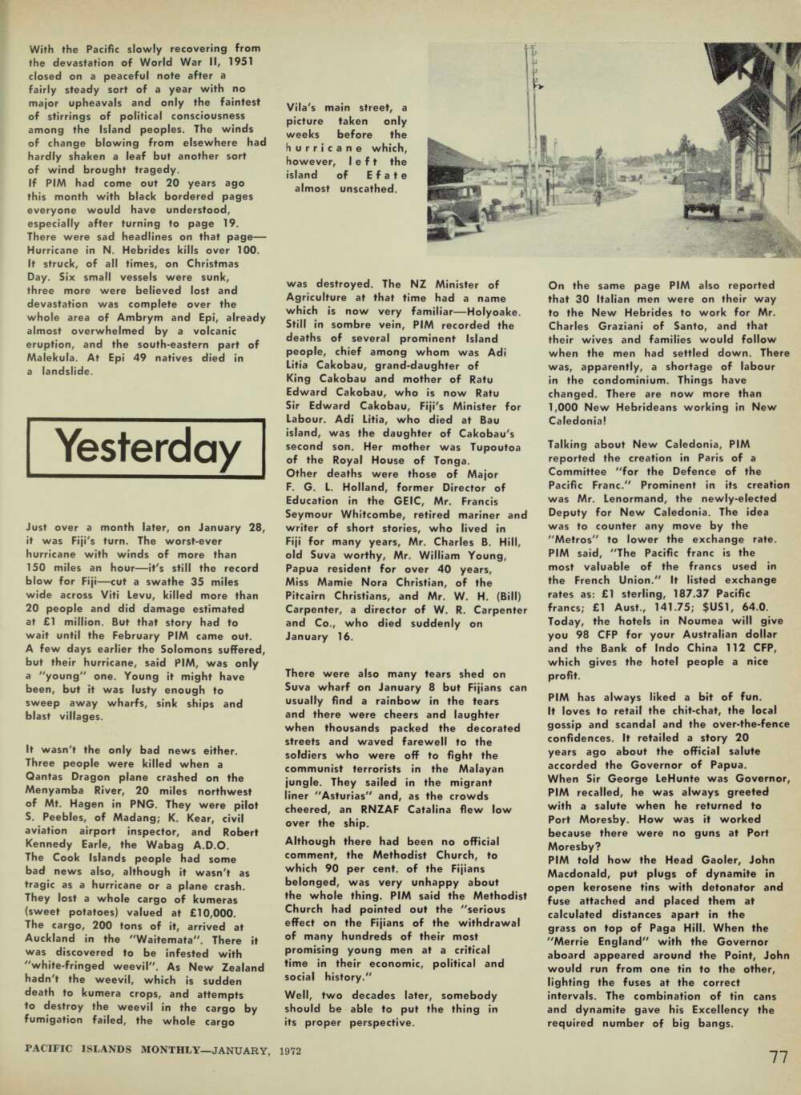
Vila's main street, a picture taken only weeks before the hurricane which, however, left the island of Efate almost unscathed.