Book Reviews
pp. 87-89 · Read in the full issue
The battle for Australia's Great Barrier Reef Province
It’s known as Australia’s Great Barrier Reef, but that’s not a correct description of the tremendously com plex maze of reefs, atolls and islands extending for more than 1,200 miles up the east coast of Queensland, en compassing an area of 100,000 square miles.
It’s not a reef but a complex, and the width of the complex varies from 10 to 15 miles at its narrowest point near Cape Melville in the north, to nearly 200 miles in the south, near Mackay. Parts of the reef are lofty islands, others are solid coral plat forms sometimes extending hundreds of feet below the sea floor.
In total they comprise the most extensive series of coral reefs that has ever existed and almost certainly the largest structure on earth today that has been created by living organisms; and far superior in strength than anything man has been able to devise.
There is a steamer track through this complex—one of the ocean high ways of the world, able to take the largest ships. This track has been closely surveyed and is studded with almost 100 lighthouses and beacons, and the pilots of the Queensland Coast and Torres Strait Pilot Service make it a safe highway as they pilot millions of tons of shipping every year through the longest single stretch of pilotage in the world.
It wasn’t always so. Last century the region was one of the most dangerous waterways of the southern hemisphere, and had claimed hundreds of ships (including, for a time, Captain Cook’s Endeavour) , and a long list of famous mariners from Cook on has paved the way for these shipping lanes. Many of today’s charts still bear the original survey marks.
One of these mariners, explorer Captain Matthew Flinders, on his voyages around the Australian con tinent in the early 1800 s, was the man who first described the reef as
the Great Barrier Reef, and the name appears on all today’s maps.
But this great complex is only a barrier in small sections. As it is not a single reef or even a series of reefs, there is today a move among geolo gists to change the name of the area to that of the Great Barrier Reef Province. With the advance of science they hope that the increased knowledge of the reefs will enable them to be grouped according to their affinities with one another.
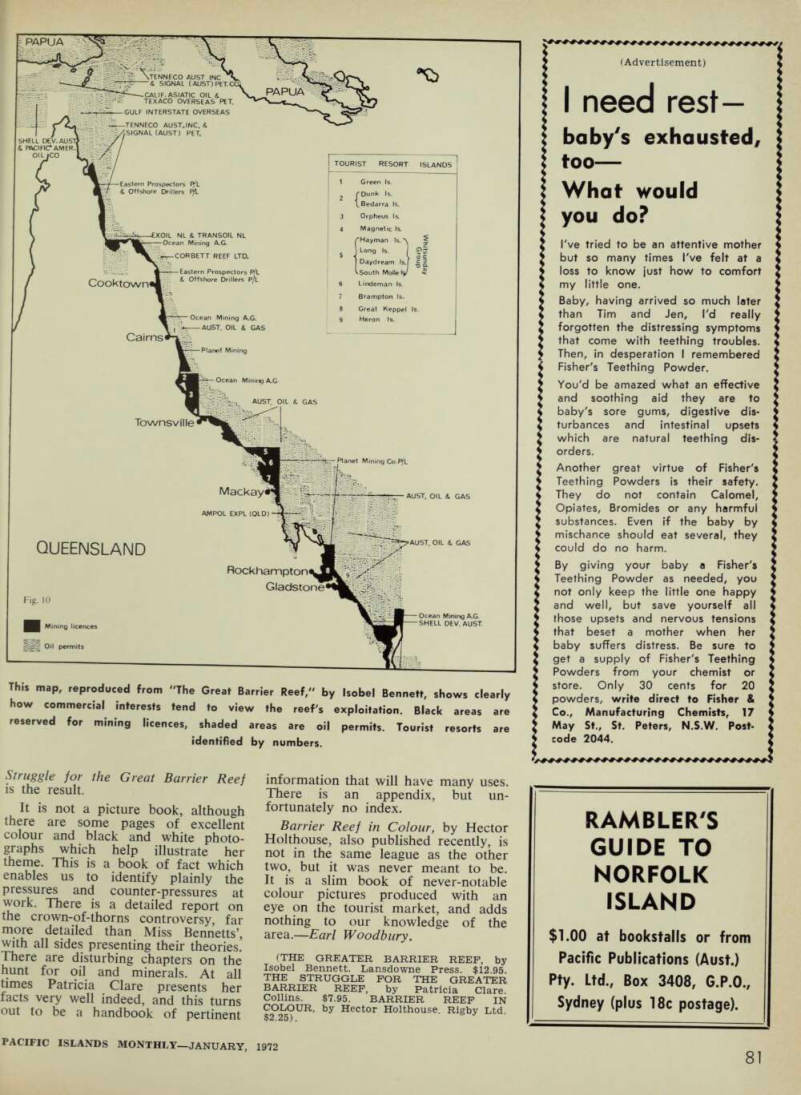
Attitudes to the reef are changing in other, more vital, ways. The eleva tion of the word “ecology” to popular usage has helped load up the band wagon with those who insist that the reef must be preserved as a unique national heritage, its resources pro tected. But there are those who want it developed as a great tourist centre, with a proper selection of hotel sites to enable the reef to be seen at its best. And there are still those who see it as an economic asset of even wider scope—an area to be exploited for its minerals and possibly for oil, a place where new harbours may be built and reef passages widened to give easier access to exploitation of the minerals of the inland and the seashore. Mineral and oil explora tion permits today cover almost the entire area of the reef province.
Quite obviously all these people cannot have their way, and already there has started the battle for the Great Barrier Reef.
What is happening on the reef now, what has happened, and what should happen? The facts are available in two recent books—lsobel Bennett’s The Great Barrier Reef, and Patricia Clare’s The Struggle for the Great Barrier Reef.
Marine biologist Isobel Bennett is well-known in the South Pacific. She has five other books to her credit, two of them in conjunction with the late Professor W, I. Dakin, of Sydney University, for whom she worked as secretary when she first joined the university staff in 1933. She retired
from the university only two months ago.
The Great Barrier Reef is the most splendid production of any of Miss Bennett’s works. In large format, with 139 colour photographs and 300 black and white illustrations, this handsome volume is as attractive as it is informative, and as valuable to the scientist as to the layman. It is thus popular science—imaginative, readable, authoritative—the Compleat reef book.
As well as a history, and predic tions for the future, there are fully illustrated sections on corals, shells, reef animals and reef life, including fish (some superb colour photography here). Maps, an extensive biblio graphy and both general and scientific indices, add to the value.
Isobel Bennett of course discusses the threat of the crown-of-thorns starfish, which has been destroying coral reefs throughout the Pacific. She puts the picture in perspective this way: “All the theories put forward, all the opinions expressed, are mere speculation, both as to cause and effect. Quite simply, no one knows.
Whether the infestation of the star fish over the past 10 years is cyclic or not, a natural phenomenon oc curring maybe once every 100 or 200 years, one very certain fact remains.
With vastly expanding human activities, the environmental con ditions of the waters of the Reef Province will never again return to the undisturbed and unspoiled state of bygone days—conditions which, a century ago, would have permitted rapid and extensive regrowth of devastated corals.”
Patricia Clare is not a marine biologist. She is a long-time Sydney journalist with an observant eye and a graceful writing style who became interested a few years ago in the conflict of interests that she saw was beginning to develop. So she went looking for the facts, and The
Struggle for the Great Barrier Reef is the result.
It is not a picture book, although there are some pages of excellent colour and black and white photo graphs which help illustrate her theme. This is a book of fact which enables us to identify plainly the pressures and counter-pressures at work. There is a detailed report on the crown-of-thorns controversy, far more detailed than Miss Bennetts’, with all sides presenting their theories!
There are disturbing chapters on the hunt for oil and minerals. At all times Patricia Clare presents her facts very well indeed, and this turns out to be a handbook of pertinent
information that will have many uses, There is an appendix, but un fortunately no index, Barrier Reef in Colour, by Hector Holthouse, also published recently, is not in the same league as the other two, but it was never meant to be It is a slim book of never-notable colour pictures produced with an eye on the tourist market, and adds nothing to our knowledge of the area .—Earl Woodbury (THE greater barrier reef, by * s T ° bel Bennett. Lansdowne Press. $12.95.
The Struggle Pgr The Greater
barrier reef, by Patricia Clare Collins - $7-95. barrier reef in s£2s)™’ by Hector Holthouse - Ltd.
This map, reproduced from “The Great Barrier Reef," by Isobel Bennett, shows clearly how commercial interests tend to view the reef's exploitation. Black areas are reserved for mining licences, shaded areas are oil permits. Tourist resorts are identified by numbers.