History seekers opened
pp. 81-83 · Read in the full issue

Pandora s Box of Samoan ghosts, gods and ghouls
From a Pago correspondent
When the American Samoa His torical Society was appointed by Governor John M. Haydon to con duct an extensive study of possible historical sites in this South Pacific territory, no one realised just how extensive the study would be.
Chairman Tuiteleleapaga Napoleone II and his commission found not only sites worthy of national re cognition, but they opened a Pandora’s Box of ghosts, gods, warriors and legends.
During visits to nearly every vil lage on the territory’s five major islands, members of the commission were welcomed at traditional ava ceremonies. Then they listened as talking chiefs narrated stories of great deeds and mysterious happenings.
Although most Samoans have a cautious respect for ghosts, or aitus, the ones of legend are good-hearted apparitions for the most part. The villagers of Alofau, for example, owe a lot to their aitus.
The combined ghosts of Samoa once travelled throughout the islands in long boats, calling at each village to claim the most handsome men, the most beautiful women and the best orators.
The Alofau aitus, who loved their village and did not want to see it looted of its finest people, told the others the villagers were suffering from a terrible disease which caused sores, or po’u. Alofau was by-passed, but to this day the villagers are known as po’ua people.
Some of the efforts of the Alofau aitus proved a bit frustrating to them.
As a gesture of goodwill, they once placed a huge stone on a mountain so the people could easily determine the boundary between their south shore village and Masefau, on the north shore. However, the people of both villages would sneak up the mountain at night and push the stone back and forth, in an effort to claim more territory. Finally, the ghosts ended the nocturnal cheating by depositing the stone in the bay at Alofau, where it rests today.
Samoa has a multitude of ancient
gods, but perhaps the most fascinating —and certainly the most envied—were the goddesses Samui’iafe and Letelesa.
Although they possessed great beauty, they were capable of making them selves more beautiful if they wanted a man. But they could change into handsome men if a lovely woman caught their eye.
Another personality with an ability to deceive was the famed warrior Nafanua, who fought bravely and was never known to retreat. Once, while Nafanua pursued the enemy across a battlefield in Western Samoa, a strong wind blew the flower cover ing from the upper part of the warrior’s body. The wind revealed to all that the feared Nafanua was, indeed, a woman.
The introduction of Christianity to American Samoa in the mid-1800s is evident in many of the legends of the territory.
A huge flat stone in the village of Faga’alu is said to cover the house and remains of a man named Sioleli, one of a few villagers who remained home to rest while the others at tended church. Witnesses said the stone flew down from a nearby mountain and crushed Sioleli’s house, and the chiefs accepted the incident as a manifestation of God’s power and wrath.
The beautiful coastal village of Vaitogi, according to the chiefs there, was once as bad and sinful as Sodom and Gomorrah. The people would not work and supplied their needs by rape, theft and plunder.
In the autumn of 1886, a man in a nearby village started a fire to clear a taro patch. The flames raced toward the wicked Vaitogi and eventually consumed it, despite every effort to control the blaze. Finally, the minister of Vaitogi called on all other ministers in the area to join him in prayers for Divine help in stopping the fire.
Two days later, a huge storm cloud formed over the area, and the flames were extinguished by a torrential downpour.
The people of Vaitogi still devote
The 'cannibal' story
the two days of September 14 and 15 to prayers of thanksgiving, and no one is allowed to enter or leave the village until the morning of the third day.
Vaitogi also claims perhaps the best known of all Samoan legends, that of the turtle and the shark.
According to the story, a blind woman and her daughter fled from Western Samoa because of daily human sacrifices there and settled in a village near Vaitogi. The sacrifices were eventually stopped, so the old woman felt she should do something to show her gratitude.
“My child and I will jump off the rocks at Vaitogi. I will turn into a turtle and my daughter will turn into a shark,” said the old woman, who also taught the villagers a song.
“Every time you want me to serve you, you will sing the song,” she said. “My daughter and I will emerge and frolic for you, and the people of all countries will come to see us.”
Today, visitors from all parts of the world visit Vaitogi to hear the people of the village sing the old woman’s song on the cliff overlooking the pounding surf.
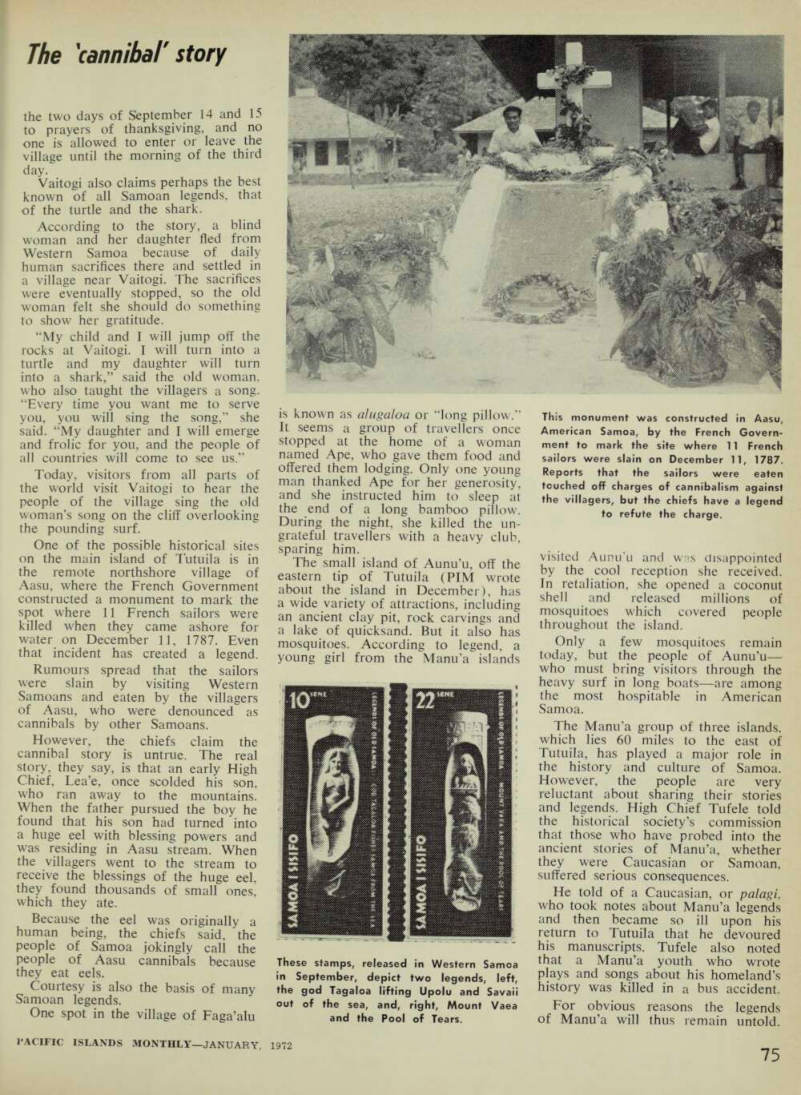
One of the possible historical sites on the main island of Tutuila is in the remote northshore village of Aasu, where the French Government constructed a monument to mark the spot where 11 French sailors were killed when they came ashore for water on December 11, 1787. Even that incident has created a legend.
Rumours spread that the sailors were slain by visiting Western Samoans and eaten by the villagers of Aasu, who were denounced as cannibals by other Samoans.
However, the chiefs claim the cannibal story is untrue. The real story, they say, is that an early High Chief, Lea’e, once scolded his son, who ran away to the mountains.
When the father pursued the boy he found that his son had turned into a huge eel with blessing powers and was residing in Aasu stream. When the villagers went to the stream to receive the blessings of the huge eel, they found thousands of small ones, which they ate.
Because the eel was originally a human being, the chiefs said, the people of Samoa jokingly call the people of Aasu cannibals because they eat eels.
Courtesy is also the basis of many Samoan legends.
One spot in the village of Faga’alu
is known as alugaloa or “long pillow.”
It seems a group of travellers once stopped at the home of a woman named Ape, who gave them food and offered them lodging. Only one young man thanked Ape for her generosity, and she instructed him to sleep at the end of a long bamboo pillow.
During the night, she killed the un grateful travellers with a heavy club, sparing him.
The small island of Aunu’u, off the eastern tip of Tutuila (PIM wrote about the island in December), has a wide variety of attractions, including an ancient clay pit, rock carvings and a lake of quicksand. But it also has mosquitoes. According to legend, a young girl from the Manu’a islands
visited Aunu’u and was disappointed by the cool reception she received.
In retaliation, she opened a coconut shell and released millions of mosquitoes which covered people throughout the island.
Only a few mosquitoes remain today, but the people of Aunu’u— who must bring visitors through the heavy surf in long boats—are among the most hospitable in American Samoa.
The Manu’a group of three islands, which lies 60 miles to the east of Tutuila, has played a major role in the history and culture of Samoa.
However, the people are very reluctant about sharing their stories and legends. High Chief Tufele told the historical society’s commission that those who have probed into the ancient stories of Manu’a, whether they were Caucasian or Samoan, suffered serious consequences.
He told of a Caucasian, or palagi, who took notes about Manu’a legends and then became so ill upon his return to Tutuila that he devoured his manuscripts. Tufele also noted that a Manu’a youth who wrote plays and songs about his homeland’s history was killed in a bus accident.
For obvious reasons the legends of Manu’a will thus remain untold.
These stamps, released in Western Samoa in September, depict two legends, left, the god Tagaloa lifting Upolu and Savaii out of the sea, and, right, Mount Vaea and the Pool of Tears.
This monument was constructed in Aasu, American Samoa, by the French Govern ment to mark the site where 11 French sailors were slain on December 11, 1787.
Reports that the sailors were eaten touched off charges of cannibalism against the villagers, but the chiefs have a legend to refute the charge.