Magazine Section
pp. 79-80 · Read in the full issue
The Duke And The Servant Girl
And Their South Seas Family
In an article I wrote in PIM in February, 1969, I reported that Richard H. R. Parkinson, one of New Guinea’s most distinguished pioneers, could have been an un acknowledged member of the Danish royal family. This naturally was of interest to many scores of people in the South Seas who are descended from the large family established in New Guinea last century by Parkin son and his equally-prominent wife.
But in 1969 I could provide no evidence of the royal connection.
Now, an article in a recent issue of a Danish magazine, Senderjysk Manedsskrift, No. 4 of 1971, gives the result of research done by Dr.
Arthur Vaag, a Danish writer. This article indicates that through a Danish royal duke’s romantic and carefully-hidden affair with a humble servant girl the Danish royal family was connected with a semi-royal family in Samoa in the latter half of last century, and with the pioneer enterprises of the Coe family in New Britain between 1880 and 1910.
The story starts with Richard Robert Parkinson, who was born in Newmarket, England on May 16, 1817. As a young man, he entered the service of the Duke of Augustenberg, in Saxe-Coburg-Gotha, or Schleswig, then part of Denmark. Christian August was the Duke of Augusten berg—a man of some distinction, ap parently a .nephew of the King of Denmark, and married to a member of a noble family.
Louise Sophie Caroline Pruning was born in Augustenberg on March 20, 1824, daughter of a master shoemaker. She died in 1915, aged 91. Those who knew her in later years said that in her youth she must have been very attractive. She entered the service of the Duke of Augustenberg in her late ’teens.
In 1844, Louise became pregnant.
The duke and his people showed deep
By R. W. Robson
concern. Soon afterwards, it was an nounced that Louise would marry Richard Robert Parkinson, now 27, a small man who was formerly a jockey and now was in charge of the duke’s stables.
The marriage took place on October 10, 1844. The baby was bom exactly five weeks later; and on December 12, 1844 it was christened Richard Heinrich Robert Parkinson.
This was the child destined to be come a pioneer planter in far-off New Guinea.
The putative father, R. R. Parkin son, disappeared immediately after the marriage. It was stated in 1860 that his whereabouts were unknown.
Louise lived on quietly in her father’s house. Apparently the family had ample means. Young Richard was well educated, and he spent eight years as a teacher in Heligoland, which at that time belonged to
England. He was a good-looking man, and notable as a writer, musician, actor and scientist.
When he was 31 years old, Parkin son joined the famous German South Seas corporation of Godeffroy, and was sent by them as a surveyor to Western Samoa. There he met the Coe family, and in 1879 he married Phoebe Coe, then only 17.
In 1879 Phoebe’s sister Emma Coe, had left her English husband, James Forsayth, and had gone to primitive New Guinea with Captain Thomas Farrell. They were never married but. as Mr. and Mrs, Farrell, they established the planting and trading empire over which Emma later presided as “Queen Emma”.
The Parkinsons joined Emma there in 1882 (two years before Germany annexed) and it was Parkinson who laid out and planted New Guinea’s first planned coconut plantations, on a magnificent area behind Rahim and Kokopo, on the Gazelle Peninsula.
Parkinson’s achievements have been described many times. His book, Thirty Years in the South Seas, is probably the most valuable work of reference on early New Britain. He died in 1909.
Phoebe lived a somewhat tragic life after that, suffering much in two wars. She died in a native village in New Ireland in 1944, during the Japanese occupation. They had 12 children and their descendants are widely known in the Islands and in Australia.
The Augustenberg family was directly related to Alexandra, who married King Edward VII of England, and to that princess who married Wilhelm 11, Emperor of Germany.
Dr. Haag’s researches show that the people of Augustenberg believed that the duke and not the man from the stables was the father of Louise’s child.
They were almost certainly right.
The duke’s eldest son, Frederick
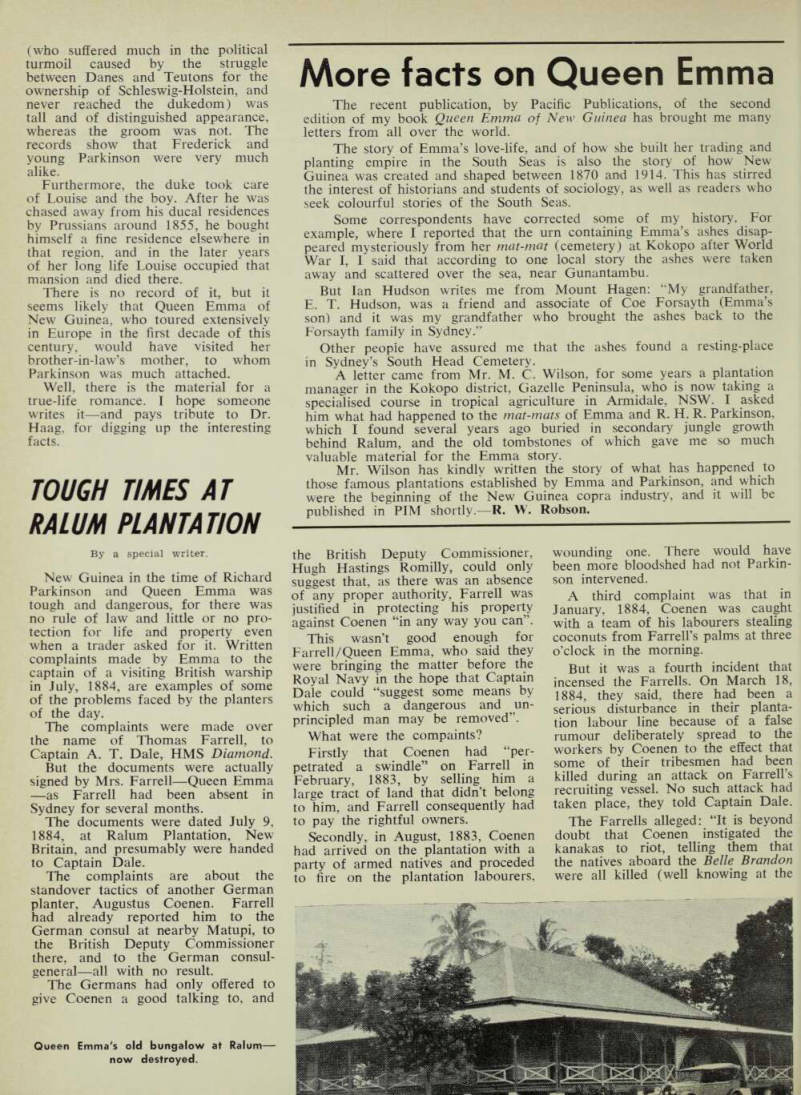
R. H. R. Parkinson.
(who suffered much in the political turmoil caused by the struggle between Danes and Teutons for the ownership of Schleswig-Holstein, and never reached the dukedom) was tall and of distinguished appearance, whereas the groom was not. The records show that Frederick and young Parkinson were very much alike.
Furthermore, the duke took care of Louise and the boy. After he was chased away from his ducal residences by Prussians around 1855, he bought himself a fine residence elsewhere in that region, and in the later years of her long life Louise occupied that mansion and died there.
There is no record of it, but it seems likely that Queen Emma of New Guinea, who toured extensively in Europe in the first decade of this century, would have visited her brother-in-law’s mother, to whom Parkinson was much attached.
Well, there is the material for a true-life romance. I hope someone writes it—and pays tribute to Dr.
Haag, for digging up the interesting facts.