The Sullivan Story-50 Years Of
pp. 57-70 · Read in the full issue
Trading Around The Islands
By John Carter
How do you make four shillings grow into a multi-million dollar trading company? For one formula, because there must be as many as there are millionaires, search the records of the C. Sullivan Group of Companies, of Margaret Street, Sydney. Better still, ask the man who did it—Charles Sullivan.
If the average tycoon, the self made man and founder of a big business out of almost nothing is a little under average height, square shouldered and compact, eyes set well apart, firm chinned, a ready talker and a natty dresser, then Charles Sullivan is an average tycoon. But he wouldn’t like the word.
He doesn’t see himself as the iron man, certainly not now, at the age of 81, retired and chafing under the penalties imposed by a recent stroke.
Not that it’s got him down. He still looks 20 years younger than he is, dresses as if he’s got a board meeting every day, enjoys talking about the old days when he became one of that select bunch, the Island Agents. Hard work, the ability to get on with people, salesmanship— of goods and self—and luck is the recipe for making a company like Sullivans.
This year, the firm he founded celebrates its first half century.
World War I was four years away in the future when Charles Sullivan, nearly 20 years old, decided to get out of his English birthplace, Liver pool, which wasn’t exactly a haven of peace and prosperity for a work ing-class Merseyside Irishman. He worked his passage to New Zealand as a steward in the steamer Cornwall and arrived with four shillings and no firm idea of what he wanted to be.
He stayed three weeks in New Zealand, then gave it away and sailed to Sydney in the Ulimaroa. Tram conducting was his first job but it didn’t last long and he turned to trade unionism, which satisfied, for a time, his aspirations to be a fighter for socialism and working class up lift.
As organiser for a clerks’ union, he’s recalled many times since, he was thrown out of all the best retail shops
in Sydney. Salesmanship was some thing he was good at and he became a representative for produce merchant T. McHugh, who had his offices in Sussex Street. But, he was still casting around for his niche in life and swapped his job for that of a self employed NSW country hotel keeper.
He had married in Sydney Susan Menzies, daughter of the printer at the Melanesian Mission headquarters on Norfolk Island. Several children later, the Sullivan family moved to Norfolk Island and Charles built a store at Middlegate where son Denis, now chairman of Sullivans, was born.
They were on the island during World War I, at the end of which he brought his family back to Sydney and returned to McHughs.
His big chance came early in 1922 when he talked himself into an agency for Paterson, Laing and Bruce Ltd. which took in New Caledonia and the New Hebrides. He’d found his vocation at last and he worked hard at it. He learned French—he had to —and worked hard at that too, be coming fluent in the language.
It was hard going in the Islands
50 years ago but Charles Sullivan had guts, drive and imagination as well as a wife, five children and £4O capital when he founded his company.
He opened an office in Sydney’s George Street North in a building crowded with Bohemian types, and he staffed it with one girl. They were hand-to-mouth days. To save travel ling expenses he sometimes worked his passage to the two territories as an assistant purser.
His reputation grew with his sales and it wasn’t long before other com panies were attracted to Sullivans.
In the face of tough opposition from other Island agents, in the field long before him, Charles got two im portant agencies, Gillespie Brothers and Nestles, for New Caledonia.
He’d turned the corner and by the mid-1920s he reached the first mile stone—a month’s turnover of £l,OOO.
Other companies tried to take his agencies. He had to fight even ship owners to get his Gillespie flour into New Caledonia but he captured a large slice of that market. Today, with restrictions removed from the importation of flour into New Cale donia, Sullivans are again selling large
quantities of Gillespie flour in the island.
He earned the reputation of being a hard fighter but a fair one and years later one of his doughtiest op ponents, Bruntons of Sydney, com plimented him on the good job he had done. What’s more, Bruntons made Sullivans its agents in Tahiti and Fiji.
With a firm footing in the two French-held territories, Charles Sul livan set his sights on New Guinea, but the going there was harder still in the late 19205. As all purchasing was controlled by the Administration he made little headway but he was fortunate in another way. He met V. G. Smith, one of the best-known agents in the territory and represen tative there for Dewars, Nestles and Paterson, Laing and Bruce.
Smith took him under his wing, showed him a few wrinkles like sample packing and introduced him to those who mattered, but he made little headway and had to withdraw.
But not for good, as it turned out.
But there were also successes. He spread his net to Fiji, Tonga and the Samoas and by the early 1930 s was well established with new offices in Kent Street and a staff comprising his brother John (who died in the 19505), a girl, and a boy, Sydney sider Albert Landon, Albert was engaged on a temporary basis because, as Charles Sullivan told him, the times were uncertain—Australia was in the throes of the Great Depression.
Forty years on, Albert is still there as company secretary, and still on
a temporary basis because his ap pointment was never confirmed!
Fresh from school in 1934 came son Denis as an office junior, and another, but later acquisition was a partner, George Step, well known in shipping circles as freight manager for Messageries Maritime. The firm went into the import business and, with French colonial stomachs in mind ’ im P orted olive oil, Vichy water and man y continental food lines, World War II killed that trade and George Step had to retire in 1941 through ill-health, dying a few years
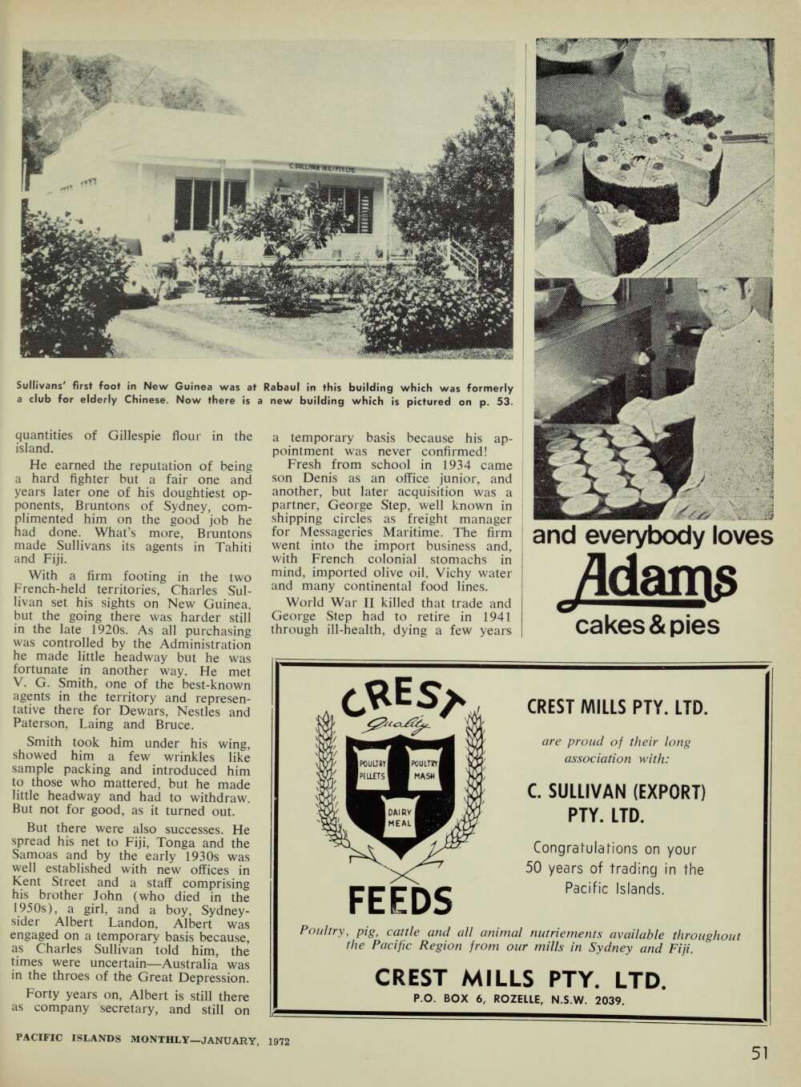
Sullivans' first foot in New Guinea was at Rabaul in this building which was formerly a club for elderly Chinese. Now there is a new building which is pictured on p. 53.
later. Earlier, in 1939, Ron Knight joined the staff from Exporters Pty.
Ltd. as shipping clerk. Ron is now director of C. Sullivan (Export) Pty. Ltd., chairman of directors of C. Sullivan (NG) Pty. Ltd., and chairman of directors of E. V. Law son Pty. Ltd.
In 1941 V. G. Smith, the friend of the tough New Guinea days, came back into the picture. He became Charles’ partner—here’s another facet of Charles Sullivan’s character; never forget a friend—but the renewed association was shortlived. Smith was dead of a stroke a few years later.
The war years were also tough.
The only links between Sydney and the Islands were those the war lords considered were essential to strengthen the sinews of war. But Sullivan survived, and with the war over, entered a new phase.
The Japanese were cleared out of New Guinea. Denis Sullivan, who had been with the AIF in Syria, came back home. The Nestle agency was extended to include Tahiti.
Fiji, so far as Sullivans was concerned, was consolidated, Dur ing the war years, Claude Israel, a Morris Hedstrom’s director, managed MH’s Sydney office and he and Charles Sullivan became close friends. When Claude was com pulsorily retired from MHs in 1949 at the age of 60—and he was far from being finished—it was decided that he would open an office in Suva for Sullivans. A new subsidiary, C.
Sullivan (Pacific Islands) Ltd. was formed with the shares held 50-50 by Charles Sullivan and Claude Israel.
The original idea was that Claude and his wife Doris would work for the company in the mornings and play golf in the afternoons, but it didn’t work out that way. The new company burgeoned so quickly that they had to work in the afternoons as well. In the 19505, Claude’s son Mark resigned as branch manager of Morris Hedstroms and joined Sullivans.
Today, the Suva-based company has a staff of 20 at Suva and three Lsutoka nn H thprp ic onnfKor partner, Australian company Kiwi “ts-there's a sentimental link
The new warehouse and offices at Rabaul.
The Sullivan story
with New Zealand—which, in con junction with United Empire Box Company, Auckland, established Kiwi United (South Pacific) Co. in Suva, which manufactures cardboard cartons, paper and plastic bags. The Kiwi-Sullivan team has now branched out in the field of development of local industries with the support of the Fiji Government.
Charles Sullivan had always coveted the New Guinea field and in 1952 he took a sea trip around the big territory, re-establishing con tact with importers. The following year Ron Knight began a round of regular visits and this time Sullivans made it stick. A new subsidiary C Sullivan (NG) Pty. Ltd. was formed.’
It struggled in the doldrums for several years, and then, about 1960, Tom Runciman, an Edinburgh-born Scot, ex-GEIC Wholesale Society, answered an advertisement in Bris bane for a manager for Sullivans.
He was engaged and sent to Rabaul and shortly after the company secured the distribution franchise for WD and HO Wills for cigarettes, cigars
and tobacco produced at their Madang factory.
Years of experience round the traps in New Guinea was brought to Sullivans in 1958 by Jack Connor who was appointed as Ron Knight’s assistant. Jack, who had many years in New Guinea as manager for Colyer Watson and worked at Kavieng, Lae, Madang and Rabaul, is now handling the firm’s activities in Tahiti, plus areas outside the traditional Pacific trade.
The fortunes of C. Sullivan (NG) Pty. Ltd. spiralled with the tobacco smoke and in next to no time a branch was opened in Lae under the manage ment of John Emery, a well known Lae citizen, who had been in New Guinea most of the time since 1936 and is one of those who can talk first hand about the nightmare walk overland from Lae to Port Moresby a few miles ahead of the Japanese Army.
At one time Lae’s main thorough-
Lazy days at sea . . . Charlie Sullivan with Le Capitaine on board the Messa geries Maritimes steamer "Pacifique" somewhere between Sydney and Santo in the leisured days when travel was by ship and there was no commuting by relaxation-robbing planes.
Copper into gold
fare was called Emery’s Road until John’s brother had a fight with the district commissioner who got his revenge by changing the name to Huon Road.
New blood was infused into the company when, in 1969, Bob Bolling, a Sydney accountant, became sec retary of the New Guinea subsidiary and later group general manager.
Wholesale warehouses were plan ned throughout PNG. One went up in Port Moresby in October, 1968 with Bob Hayes, formerly with Gillespies at Madang, as manager.
It now ranks second in size and importance to the Rabaul branch Copper was found in Bougainville in the late 1960 s and it looks as if the copper mines will be a gold mine for Sullivans. As Kieta developed, Sullivans sent out representatives from Rabaul and in November, 1969, it was decided to open a branch m Kieta. Chris Donald, son of wartime coast watcher Toby Donald, opened the branch under Francis Seeto s house. The only accommodation Chris was able to find for himself was in the construction workers’ mess. His wife, who is a nursing
Mult!-Million Dollar Baby
sister, had to bed down where she worked, at the Kieta Hospital 10 miles away.
As Kieta and nearby Arawa have grown, so have Sullivans and a ware house was opened there in June, 1971 with Hank Bodewes as manager.
Chris Donald is now 2IC in Rabaul being groomed for a senior manage ment job.
Mount Hagen was the next card in the PNG Sullivan pack. As the Wills franchise involved attention to the Highlands, a small branch was opened in September, 1970, at Mount Hagen under Tony Robertson who joined the group in 1967 as a trainee executive.
It is probably the hardest nut that Sullivans have ever had to crack.
Stock has to be brought from Lae by road which is cut now and again by landslides and floods but the branch is forging ahead.
C. Sullivan (NG) Pty. Ltd. has become a multi-million dollar baby employing about 100 people, most of them “locals”, with a go-ahead, localisation policy and European style accommodation for its indigen ous employees who are working as sales reps, and clerical staff. One local recently had a trip to Sydney for training.
The Mount Hagen branch has established close contact with the tribesmen, the out-of-town stores being serviced by indigenous sub-con tractors, and the firm has just adver tised for a PNG University under graduate for executive training.
An associate company in Rabaul has a board comprised entirely of New Guineans, including a Sullivan nominee.
It’s but a short leap from Bougain ville to the Solomons. Sullivans went into the protectorate on July 1, 1971 when it acquired all the shares in E. V. Lawson Pty. Ltd. of Honiara, an old-established concern dealing as a general agency and in insurance.
Rapid expansion is planned on New Guinea lines and at present a new warehouse is being built com plete with bond store, freezer and offices. Latest move has been to team up with Mariano Kelesi, the Govern ing Council chairman of the Health and Internal Affairs Committee.
Sullivans will establish a warehouse on a co-operative basis on Malaita to supply itinerant hawkers who deal direct with the villagers.
From Charles Sullivan and his one girl staff of 1922, Sullivans now employs more than 200. Exporting offices have been opened in Brisbane,
established in 1949 with Frank Dunn in charge; in London 1954, with Alec Witham; in Auckland 1954, Alan Kerr; and in Melbourne 1969, John
Mehegan.
There are representatives’ offices at Noumea and Vila, and resident representatives Ken Hutton, in Santo, and Henri Lent at Papeete.
With a portfolio of six subsidiary companies, it was decided to form a holding company in 1969 so that heading the list as the company
embarks on its second 50 years is C. Sullivan Holdings Ltd.
Charles Sullivan, at 81, is now retired and living at Neutral Bay and son Denis is chairman of directors, heading a “young” management team.
Five are in their 50s and three of these have more than 30 years’ ex perience with the company. Five are in their 40s, four with not less than seven years with the company, and four are in their 20s and early 30s.
A training scheme is in full opera tion with five or six youngsters being groomed for the job of guiding Sul livans further along the success road towards the firm’s 100th birthday.
• Charlie Sullivan remembers—see p. 60.
Early days remembered
Charles Sullivan was bound to get ahead. He had the drive and the initiative and he had the imagination.
He was also an “angry young man” in his young days in Sydney and wanted to put the world right.
When he soon found that he couldn’t, he piped into his Island operations the steam which he would have generated in political campaigns.
There was plenty of competition but he beat it.
“We beat competition because we were probably giving better service than some of the old ones,” he told PIM. “They were getting lazy, and you can’t afford to do that in this business.”
He also got involved in local activities, all part of an Island Agent’s job. Once in Noumea he found himself playing manager, trainer and second to an English boxer who was fighting a Frenchman.
The Frenchman was good and things didn’t look too rosy for the English man until Charles Sullivan got to work on him.
He did all that a second should.
He swabbed him down between
rounds, flapped the towel and laid down strategy. Best of all he was a strategist, and the fight a tough one.
The Englishman won, narrowly.
“Here was I,” said Charlie, “trying to make sales to New Caledonians and advising a boxer on how to beat a Frenchman! I got a lot of dirty looks for a while.”
To the New Hebrideans on Male kula Charlie was something of a magician. He was in the middle of a crowd of them one day when he decided to show off his ability as a juggler, on which he prided himself.
He had three oranges passing from one hand to the other and then up in the air when he had an idea. He took out his false teeth—“ Witc hcraft” cried the eyeball-popping natives —and added them to the circle. Later, holding them in his hand, he advanced on the natives, who fled. There is no record as to whether his sales improved in that area.
As a personality, he obviously ap pealed to French writer Pierre Benoit, who was once a fellow-passenger on one sea trip around the New Hebrides.
Benoit wrote a book, Arromango, in the 1950 s and included Charlie as a ready-made character.
With his memories of the Islands
(Continued on p. 62)
Always the natty dresser! Charles Sullivan, the debonair, young man about Sydney, at the start of his career.
Rum for executioner
of 50 years ago, Charlie has enough material for several books. They’ll never be written but, if they were, they would be coloured and violently.
He tells of being upset in the early days with the treatment of natives and of the handicaps ticket-of-leave men carried in New Caledonia. There was one sickening sight there that he never forgets. A crowd of Tonkinese plantation labourers had been sent to the guillotine for the murder of a plantation owner.
As each head fell into the basket, the executioner fortified himself with rum but in the end his resistance to the alcohol ran out before the supply of victims, and he became too drunk to carry on with the grisly job and collapsed.
Here’s another angle to the man.
He once received a letter from Spain —in Spanish. He couldn’t read it.
That irked him because he believed that a businessman should be equal to almost anything. So he learned Spanish and now speaks it fluently.
He’d have done the same if the letter had come from an Eskimo.
Being England-born, Charlie never kissed the Blarney Stone but he’s always had the Irishman’s charm to help him on his way. During World War 11, when travel between the Islands was difficult, he talked himself into a free flight from Noumea to Sydney in a United States bomber. He got on well with Admiral Halsey, the US naval com mander, and once had a fistful of the admiral’s long cigars to prove it.
Everything was grist to Charlie’s mill. “I’d sell any thing I could get my hands on,” he said. “There were plenty of customers among the planters in the New Hebrides. No other agents were seeing them at all.”
He once did very well in New Guinea after he discovered that big stocks of imported German pianolas, or player pianos, were held in bond in Sydney. This was not long after World War I, and the pianolas had not been sold because of the war, and could be bought cheaply. Charlie bought them for as little as £5 each and sent them to New Guinea for £4O, where the European population was delighted to buy them.
“There was hardly a plantation who didn’t have one of my German pianolas in the end,” recalls Charlie Sullivan from his big stock of Islands memories.