Fiji-Indians
pp. 50-51 · Read in the full issue
are more Fijian than they think
From SUE WENDT, in Suva
Anyone with temerity enough to describe Fiji as “little India in the Pacific” is very much persona non grata these days. Obvious links with India, however, are as much part of the Fiji scene as coconuts and Fiji beer.
Business is better than ever for importers of Hindi-language movies.
Indian pop songs and classical music can now be heard over the English language radio station (as well as the Hindi station) and a goodly propor tion of newspaper space is devoted to news from India.
Mosques and temples can be found even in the backblocks; handcraft and souvenirs imported from India sell alongside Fijian baskets and Japanese radios. Curry and roti is almost a national dish—a shortage of sharps constitutes a major crisis!
Despite a growing preference for trendy Western-style clothing among the more citified young, the graceful sari is here to stay.
Despite this emphasis on “things Indian” in Fiji however, it’s somehow surprising to find a growing awareness about the Pacific Islands within India itself. During a recent visit as guest of its efficient tourist organisation and of Air-India, I found myself following in the footsteps of King Taufa’ahau Tupou of Tonga and his retinue. The visitors had made quite some impact and the stature and bearing of Islanders prompted fre quent comment.
Quite ordinary people tourist guides, shop assistants, customs clerks—remembered an earlier visit by Fiji’s Prime Minister Ratu Sir Kamisese Mara. They spoke parti cularly of independence and the fact that Indians outnumber Fijians—and speculated that Fiji’s Indians must be much better off than they would be in India.
They pointed out that the cheap ness and availability of university education had created an enormous over-supply of graduates in India. If they could get jobs at all, engineers worked in petrol stations, scientists as clerks, other graduates as bus conductors. The many Fiji students at Indian universities were lucky, they felt, because there were jobs for them at home.
One effect of this job-shortage for graduates is the high standard of India’s government tourist guides.
Low paid even by Fiji standards, many are professional people glad of the job because it pays better than most other positions available to them.
Of the five guides who conducted me throughout various parts of India, two were graduates and another was studying for her Master of Arts degree, majoring in English litera ture. All were interesting and know ledgeable. One was studying German and another planned to attend Japan ese language classes, facilities for
which are provided by the govern ment tourist office.
My guide in Bombay had met many Fiji Indians, there on business trips or because of sentimental or family ties. She recalled that while they’d found India fascinating, almost all had said they wouldn’t want to live there. The differences were too great and for them, there were far more opportunities in the Islands.
While Fiji Indians may find the land of their forefathers unexpectedly alien in some respects, according to New Delhi journalist Samuel Rajappa an Indian visiting Fiji for the first time comes in for some surprises too.
Having married a Fiji girl in India two years ago, Mr. Rajappa spent six weeks in Fiji in November- December, meeting his wife’s family.
As chief sub-editor for India’s longest
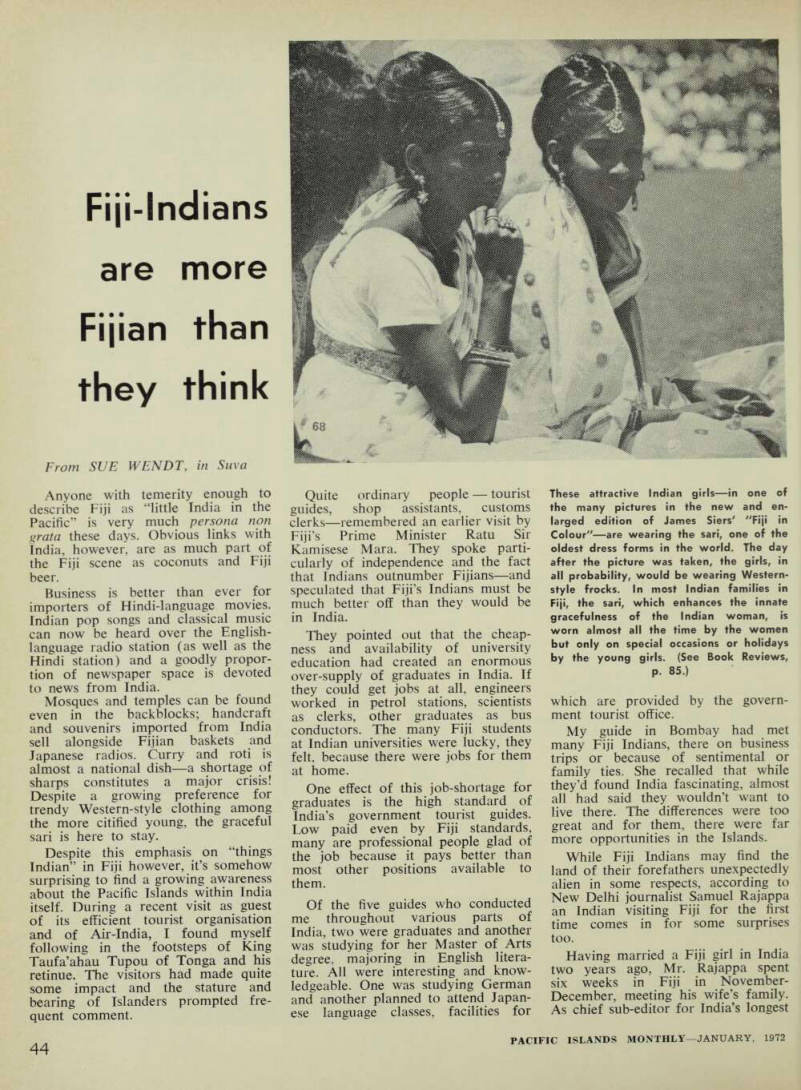
These attractive Indian girls—in one of the many pictures in the new and en larged edition of James Siers' "Fiji in Colour"—are wearing the sari, one of the oldest dress forms in the world. The day after the picture was taken, the girls, in all probability, would be wearing Western style frocks. In most Indian families in Fiji, the sari, which enhances the innate gracefulness of the Indian woman, is worn almost all the time by the women but only on special occasions or holidays by the young girls. (See Book Reviews, p. 85.)
'A new patriotism abroad'
established English-language daily, The Statesman, he was also gathering material for special articles about Indians in Fiji.
“Although it might not seem obvious to non-Indian people, Fiji born Indians are definitely orientated to their Islands environment,” he remarked to PIM. “Their whole way of life is different, even the language, which is a mixture of many dialects.
Indians here are more Westernised than they realise.
“I was most surprised however, by the importance attached to old traditions, particularly within the Hindu community.
“Although almost a century has passed since the first immigrants arrived here, the thinking of many Fiji Hindus seems to date back two or three hundred years!
“Some religious traditions are bound by factors which are no longer practised in India.
“The Indian fire-walking ritual, held annually in Fiji, does not take place anywhere in India.
“It never was a regular religious practice, yet people here feel it is a necessity for spiritual religious purification.
“An uprooted community always wants to cling to something that gives it a sense of identity. But the fire-walking ritual is completely re moved from reality.”
Mr. Rajappa described Gumming Street, Suva’s duty-free shopping centre, as “an eyesore to a non-Fiji Indian and also to Fijians.”
“Not because of its appearance but because of what it represents,” he said. “It is controlled by one sector of the Indian community, who came here as traders and have little in common with descendants of the original immigrants. There is no excuse for its existence.
“Many of these traders could benefit Fiji by re-investing their profits in new and larger premises, thereby creating employment potential. Instead—and they told me this themselves—they hoard their profits in banks outside Fiji.
“This has happened because Fiji lacks a central banking authority to control the outflow of funds.”
Mr. Rajappa said he’d been sur prised to find a tendency for some young Fiji Indians to identify them selves with caste, despite a remark able breakdown of the caste system among the older generation, “This applies mainly to descendants of the original immigrants. They seem to be searching for some identity,” he commented.
“It is rather amusing to see the way the son of a person of low caste will take the name of a higher caste. This just does not happen in India.
“But there seems no difficulty in Fiji about taking a different name.
People here arbitrarily decide which caste they belong to.
“Other Indians who came to Fiji— to trade or to practise professions— don’t do this because they already have a sense of identity. I found three clearly-defined groups—those who came to trade and who have put down no roots, those who came for professional reasons and who have identified with Fiji, and the descen dants of the original immigrants, who chose to come as indentured labour ers.”
Determination to retain “identity” has so far kept the three main races of Fiji from adopting a common ethos: the Indians because they are unsure of their future here and reluctant to relinquish home ties in case of crisis; the Fijians because change threatened to swamp their own Island traditions—and Euro peans because the majority never have seen Fiji as home. But things are changing.
Fourteen months after indepen dence, partly because many “out siders” have been forced to make a decision about taking Fiji citizenship and have decided to do so, there’s a new patriotism abroad.
Summarising his government’s achievements during the first year of independence, the Prime Minister said he couldn’t recall any stage in his lifetime when the people of Fiji were more united than they were now.
Peace was very much in the interests of the Indian community, he said. Up to independence their political history was the exploitation of fear in their minds that they might be evicted from Fiji.
“There should not be any such fear now,” he added.
“The constitution regards anyone as citizens of Fiji—those who were born here and those who have ap plied to become citizens . . . peace and not fear should be uppermost in the minds of the Indians.
“They should look for leaders who will promote peace and work with other races for the further develop ment of Fiji.”
For Indians, real proof of their permanent place in Fiji would be for Fijian-owned land to be made avail able to them, on long leases. Land is still their greatest hunger. Without land, they say, how can there be roots?
Ownership of the land is safe guarded for Fijians in the constitution.
If Fiji’s hard-working Indians could at least share in utilising it over worthwhile periods of time, they might benefit not only the subsistence level landlords, but boost Fiji’s agri cultural output.
Fiji is not little India in the Pacific any more. It’s an Island nation.
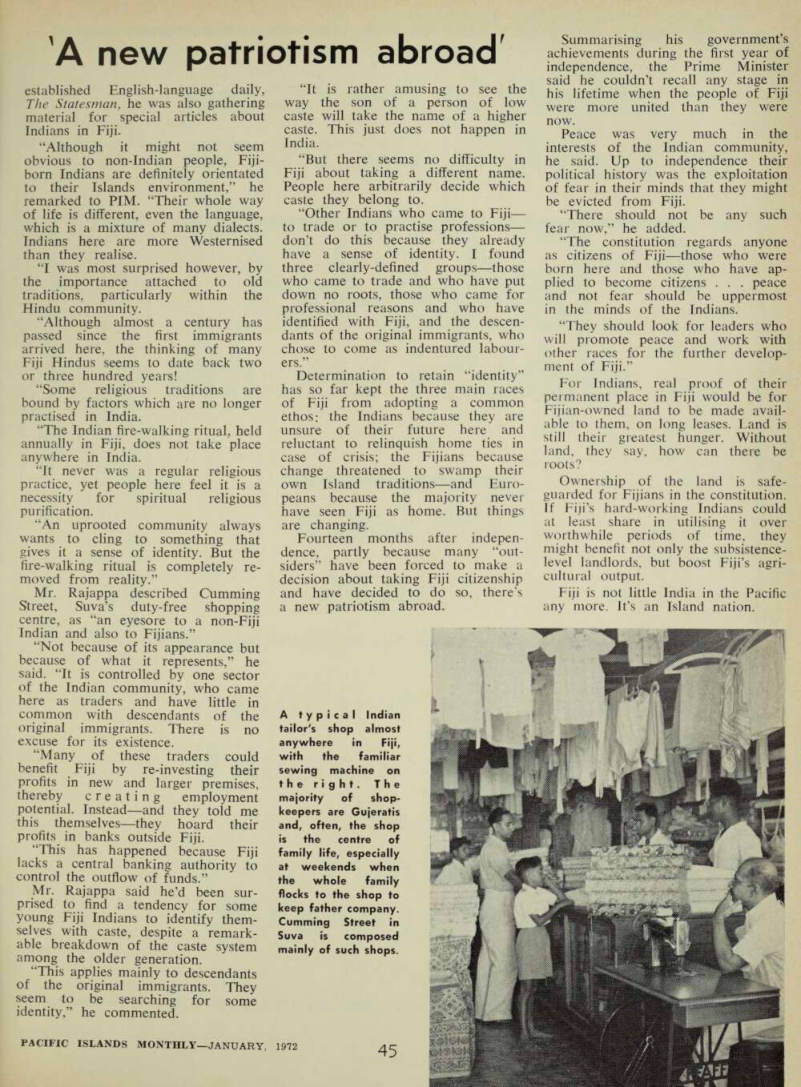
A typical Indian tailor's shop almost anywhere in Fiji, with the familiar sewing machine on the right. The majority of shop keepers are Gujeratis and, often, the shop is the centre of family life, especially at weekends when the whole family flocks to the shop to keep father company.
Gumming Street in Suva is composed mainly of such shops.