Tough Times At
pp. 80-81 · Read in the full issue
Ralum Plantation
By a special writer.
New Guinea in the time of Richard Parkinson and Queen Emma was tough and dangerous, for there was no rule of law and little or no pro tection for life and property even when a trader asked for it. Written complaints made by Emma to the captain of a visiting British warship in July, 1884, are examples of some of the problems faced by the planters of the day.
The complaints were made over the name of Thomas Farrell, to Captain A. T. Dale, HMS Diamond.
But the documents were actually signed by Mrs. Farrell—Queen Emma —as Farrell had been absent in Sydney for several months.
The documents were dated July 9, 1884, at Ralum Plantation, New Britain, and presumably were handed to Captain Dale.
The complaints are about the standover tactics of another German planter, Augustus Coenen. Farrell had already reported him to the German consul at nearby Matupi, to the British Deputy Commissioner there, and to the German consul general—all with no result.
The Germans had only offered to give Coenen a good talking to, and
the British Deputy Commissioner, Hugh Hastings Romilly, could only suggest that, as there was an absence of any proper authority, Farrell was justified in protecting his property against Coenen “in any way you can”.
This wasn’t good enough for Farrell/Queen Emma, who said they were bringing the matter before the Royal Navy in the hope that Captain Dale could “suggest some means by which such a dangerous and principled man may be removed”.
What were the compaints?
Firstly that Coenen had “per petrated a swindle” on Farrell in February, 1883, by selling him a large tract of land that didn’t belong to him, and Farrell consequently had to pay the rightful owners.
Secondly, in August, 1883, Coenen had arrived on the plantation with a party of armed natives and preceded to fire on the plantation labourers,
wounding one. There would have been more bloodshed had not Parkin son intervened. a third complaint was that in January, 1884, Coenen was caught withi a team of his labourers stealing coconuts from Farrell’s palms at three o’clock in the morning, g ut it was a f our th incident that i ncensec i the Farrells. On March 18, 1884? they sa j d there had been a ser j o us disturbance in their planta tjon i a hour line because of a false rumour deliberately spread to the workers by Coenen to the effect that some of their tribesmen had been killed during an attack on Farrells recruiting vessel. No such attack had taken place, they told Captain Dale, The Farrells alleged: “It is beyond doubt that Coenen instigated the kanakas to riot, telling them that the natives aboard the Belle Brandon were all killed (well knowing at the
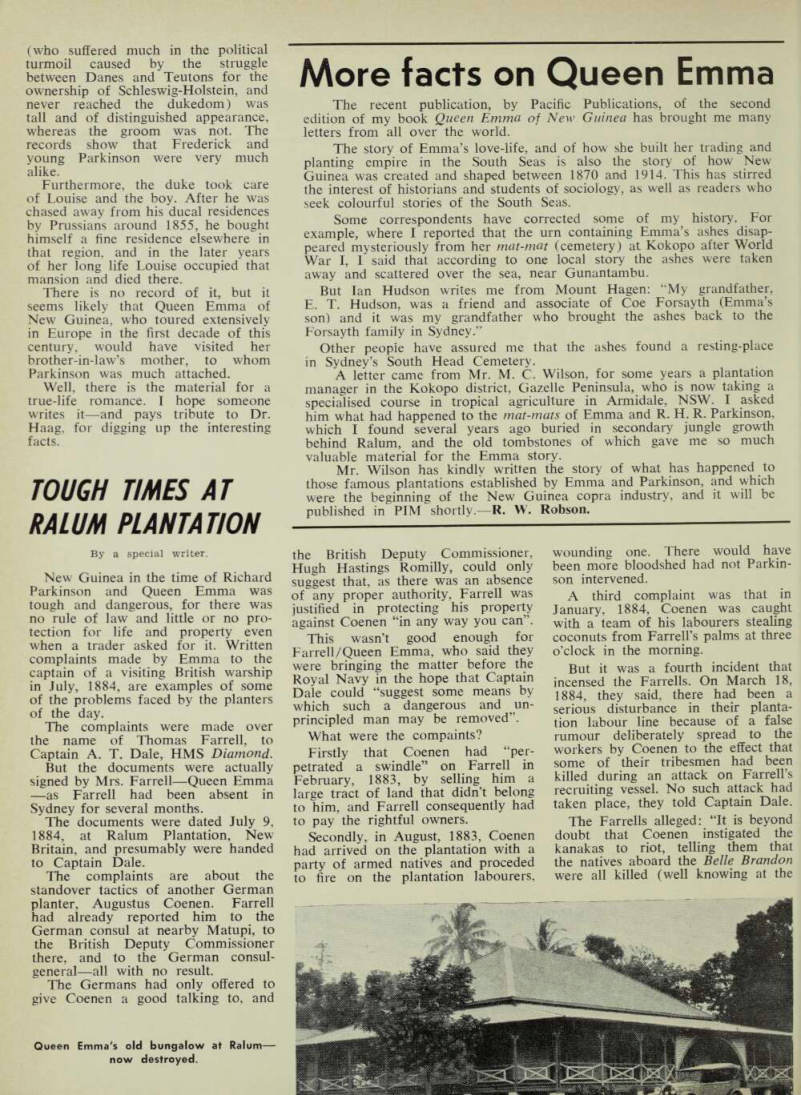
Queen Emma's old bungalow at Ralum— now destroyed.
same time that it was untrue) and urged them to demand payment from Mrs. Farrell for their lives; also telling them, finding that Mr. Parkin son was absent, to kill the Buka boys [on Farrell’s plantation] and then make fast Mrs. Farrell, Mrs. Parkin son and the other women; also sup plying them with arms to carry out these diabolical outrages. The natives made the attempt, as suggested by Coenen, but were happily frustrated by the Buka boys and white people in the neighbourhood.”
Queen Emma got her reply from Captain Dale on July 20. It was brief and to the point: “I have to inform you that I have received a letter from the Assistant High Commisisoner for the Western Pacific, stating that he has issued a notice to the effect that ‘Her Majesty’s Government will in no way recognise or assume responsibility in connec tion with the purchase by British sub jects of land in the Pacific Ocean not being British territory.’
“No complaint can therefore be entertained with regard to cases of trespass on land the ownership of which is not recognised: and you can have no authority to prohibit persons landing on the open beach, or to hinder them making use of ground which by native custom has been used for meetings for the sale of merchandise.
“It is my duty also to warn you that a stop must be put to the dangerous habit of making use of firearms to drive away trespassers from property over which, as already pointed out, no claim is recognised.
(Captain) A. T. Dale.”
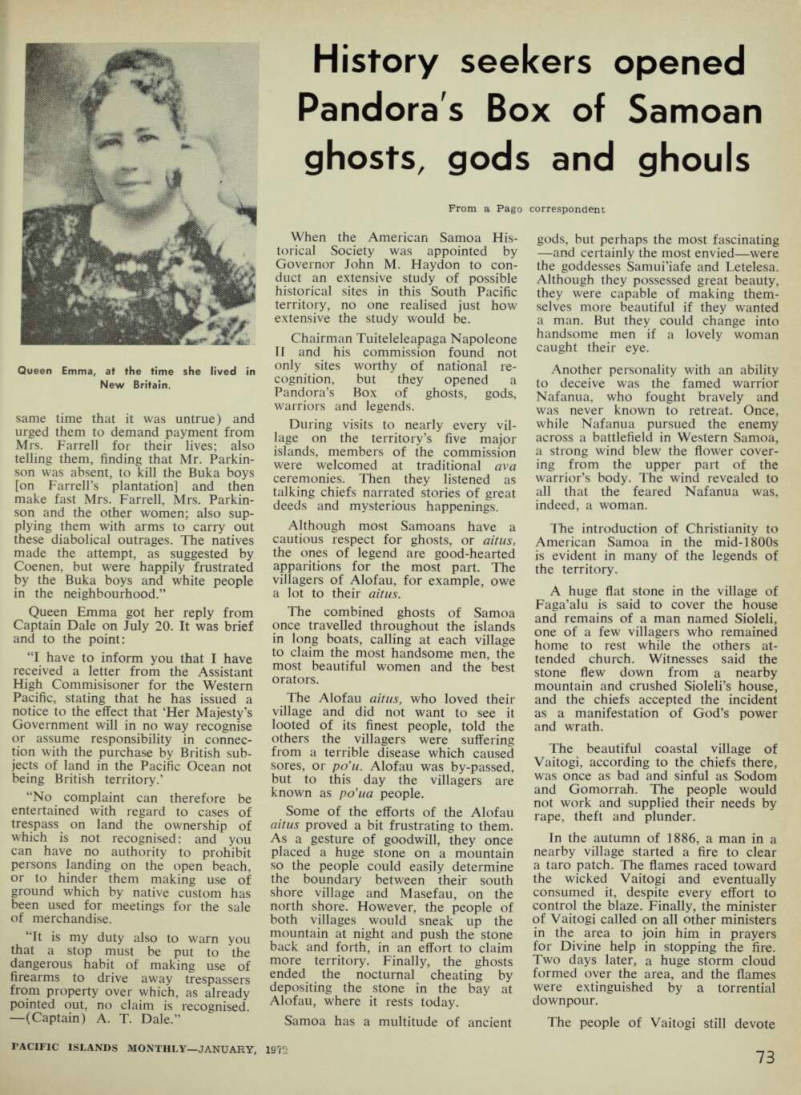
Queen Emma, at the time she lived in New Britain.