There will be no
pp. 59-61 · Read in the full issue

Waikiki on Aunuu
From a Pago correspondent
like our guide, young Peter Buaoka, an airline booking clerk, one of the new generation, educated and a trained mechanic. On the other, the primitives like his father, Timei, a pagan priest, said to be 102 years old. Rheumy-eyed Timei once worked on a Queensland sugar plantation, a victim of the blackbirding days.
He nods wisely but understands little as Peter shows us the pagan temples and explains the rituals.
He shows us the open, blackened rock oven where once a month pigs are killed, roasted and offered as a sacrifice to the sharks which, bid den by the priest in an ages-old ritual, swim into the lagoon through a gap in the reef. The eerie thing is that no sharks are seen in the lagoon between sacrifices and no villagers have ever been taken by sharks.
There are three temples in the village, each with its rows of skulls keeping silent watch, and a shell money “factory” where the Laulasi people make the most of the two worlds, the primitive and the modem.
There, the women, using the factory production line principle, chip, grind and drill the shells, some to be used in bride price arrangements and for circulation throughout the Protectorate; the rest for the tourist.
The men add the finishing touches to the strings of shells and also take charge of the sales division of the operation.
This is one concession Laulasi has ma.de to the world outside.
There will be others as the old people pass on and the young ones, educated and sophisticated, take over. Then modern ideas will build a bridge and Laulasi will no longer be an island.
ANYONE who thinks it’s impos sible, without travelling for hundreds of miles, to get away from traffic and telephones, has never heard of Aunuu in American Samoa, which doesn’t have any of either.
Aunuu is a small island which lies about a mile off the south-eastern tip of Tutuila, American Samoa’s main island, and its 500 residents are be ginning to cash in on their isle as a miniature tourist mecca.
Prime mover behind the project is High Chief Lutali Lolo Lauvao, a prominent Samoan business leader and political figure. Although many Aunuu residents travel by long boat to Tutuila to work, Lutali feels that tourism can do a lot for the little
island’s depressed economy and, since facilities are limited, there is little danger of it becoming another Wai kiki.
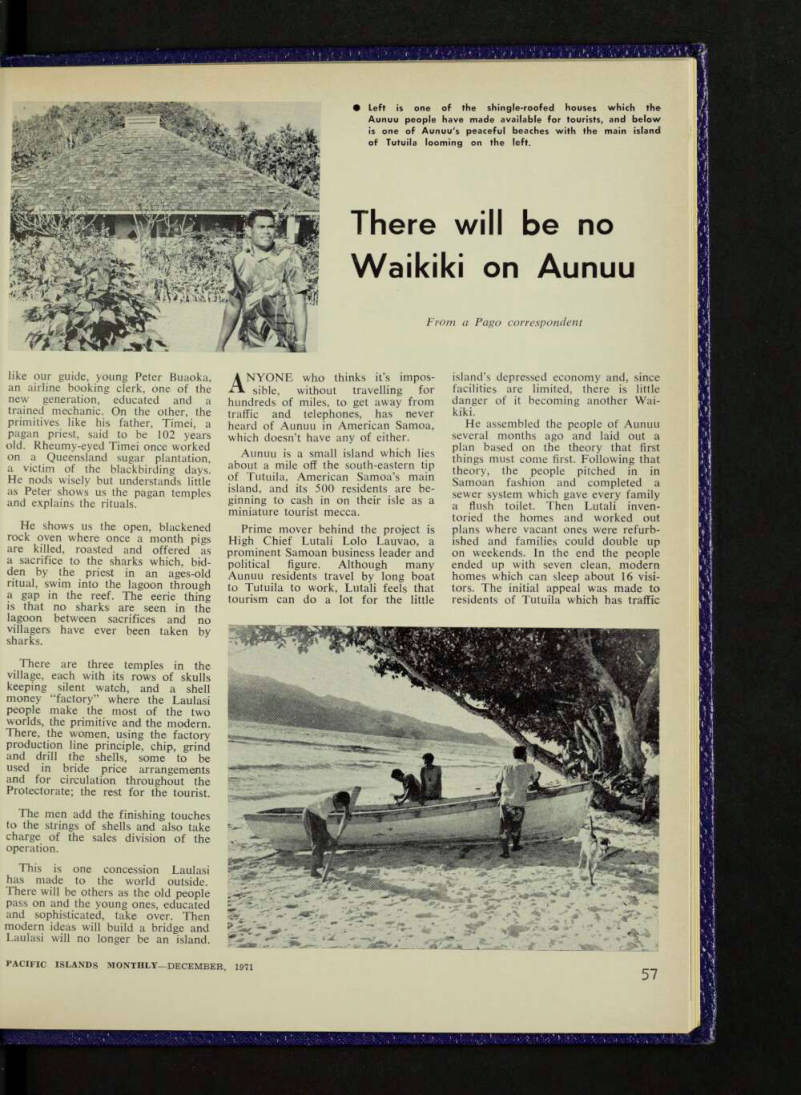
He assembled the people of Aunuu several months ago and laid out a plan based on the theory that first things must come first. Following that theory, the people pitched in in Samoan fashion and completed a sewer system which gave every family a flush toilet. Then Lutali inven toried the homes and worked out plans where vacant ones were refurb ished and families could double up on weekends. In the end the people ended up with seven clean, modern homes which can sleep about 16 visi tors. The initial appeal was made to residents of Tutuila which has traffic
Left is one of the shingle-roofed houses which the Aunuu people have made available for tourists, and below is one of Aunuu's peaceful beaches with the main island of Tutuila looming on the left.
and telephones and suffers from urbanism pangs.
Many visitors who come to Aunuu on weekends are contract employees of the American Samoa Government.
In good weather they can make the trip between the two islands by long boat, but most of them try to ride the government’s cruiser to Aunuu and go over the reef to the sandy beach by small boat.
When they reach Aunuu the visi tors all become “chiefs for a day” and the island’s people join together in showing them what real Samoan life is like. There’s Samoan food and entertainment. Aunuu actually offers a great deal, not the least of which is peace and quiet. There are long sweeps of sloping, sandy beaches that are safe for swimming. And some of the visitors take a try at reef fishing.
The southern side of the island is made up of two heavily wooded hills which offer interesting hiking to a marshy, quicksand area lying between the two hills.
The island abounds with Samoan myths and legends and the local people are happy to share them.
So far, the tourists have come only from Tutuila. Ninety-two visited the island during the Labour Day week end. Local tour companies have ap
preached Lutali about bringing pack ages of outside tourists, but he is delaying on going that far. Last year the power cable between the two islands broke and Aunuu’s electricity is being provided by a single genera tor while a new cable is fabricated in Germany. As a result, the island’s water pumps are idle at times.
When this problem is corrected,
Lutali said, Aunuu will be ready for more tourists and for those who come from outside Samoa.
At the moment, the programme is working with an experimental rate structure running from S 8 to $l2 per day and Lutali is seeking expert ad vice on what a fare rate should be.
He emphasised that he has taken pains to involve all of the Aunuu people in the programme and all will benefit from the profits of tourism.
“I don’t want just a few to corner the trade”, he said.