Will Laulasi
p. 57 · Read in the full issue
lose its remoteness?
Daru is an island outpost, lying just below the mouth of
Papua’s great Fly River delta,
where muddy waters from the interior of Papua New Guinea empty into the Gulf of Papua.
The Torres Strait islanders re gard Daru as the “stepping stone to New Guinea”, but the New Guineans regard the island as “the end of the road”.
Papua New Guinea mainland people appear to go to Daru only to work—to teach school or to work with the PNG Administration in other tasks—but Daru these days also gets a ration of tourists from Australia, who make the 120-mile flight from Thursday Island in a chartered six seater for a day on Daru. The visitors get an unforgettable view of Torres Strait on the way, with its myriad of islands and reefs dotted over a blue sea, which turns to browny grey as Daru approaches.
Daru, six square miles, is flat, with interior grasslands, and mangroves surrounding it. In the wet season the grass grows so high that the Austra lian eucalyptus trees appear to be lost in it. There are no sandy beaches on Daru—only stones and mud—and the outrigger canoes are left stranded when the tide is out. But the Daru children have a lot of fun even though they are poorer, like their parents, than the people of Queens land’s Thursday Island.
Trade is brisk enough in Dam’s waterfront stores, where tins of Sun shine Milk are likely to be lined up alongside Bacardi mm and packets of Aspros. The climate is steamy, and down at the Cerbems Arms—Dam’s sole pub. built opposite the modern Catholic Church the lunchtime crowds are downing pies and sausages with the help of “stubbies” of cold beer. There are no women among them, and the drinkers look tough, with sunburnt faces, but they’re friendly to strangers.
Dam is the last resting place of Papua’s most famous missionary, lames Chalmers, who was killed and a portion of him eaten in the nearby Gulf district in 1901, and whose grave in the town is well looked after by village people to whom the famed “Tamate” is only a legend.
The village people live in shanties of galvanised iron and timber built on stilts—not things of beauty. Daru is not beautiful, whether you consider it the stepping stone to New Guinea or the end of the road.
By John Hay
Laulasi village on Malaita in the Solomons is a rare discovery for the tourist. In a shrinking world, with most people busily exchanging their heritage for the plastic age and the dollar, the 300 villagers of Laulasi have discovered the nov elty of cashing in on a primitive culture.
And yet, there is nothing of the slick throughput of many South Sea Island tourist traps, but a genuine attempt to entertain tourists and dem onstrate their age-old arts the making of shell money, dances seen
nowhere else and a unique pagan ritual of shark worship.
The village, one of the largest in Langa Langa lagoon, is 90 minutes run by launch from the small, steamy administrative centre of Auki. The villages are built on man-made coral islands about the size of a suburban block, and are self-contained fort resses. Originally, they were built for defence against the warlike people from the Malaita hills, who feared the water.
Laulasi village was established about 300 years ago and is typically Melanesian with its steamy smells, its pigs roaming the people-wide lanes between the houses and its atmos phere of a brooding heat explosion.
There is a generation gap at Laulasi. On one side there are those
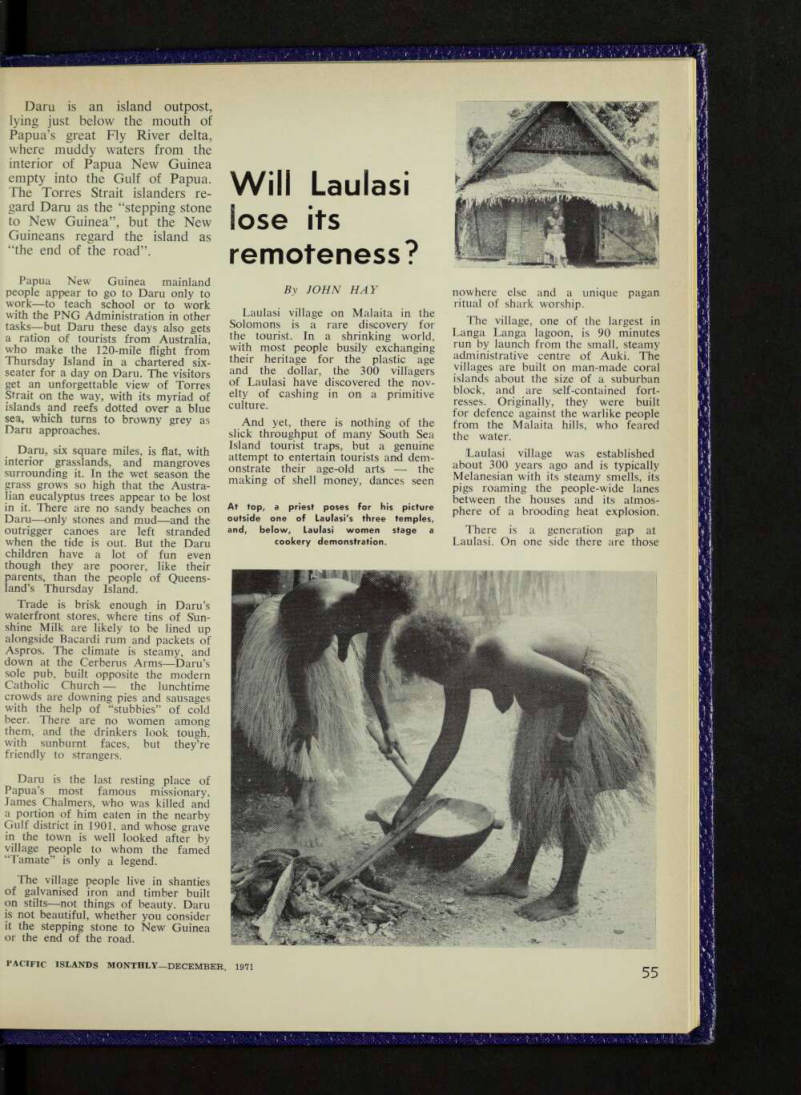
At top, a priest poses for his picture outside one of Laulasi's three temples, and, below, Laulasi women stage a cookery demonstration.