Footnotes
pp. 52-53 · Read in the full issue
Stable Politics
Yes, But Not
At Any Price
WHAT is the use of being rich? When a man gets rich, he often wants more and more and is"never satisfied with what he has. There fore being rich isn’t a good thing.”
These words are from a letter written by a New Guinean high school student and published in the Papua New Guinea Post-Courier. The writer is probably unaware that the Greek philosopher Epicurus, and not long afterwards the anonymous Jewish author of the book of Ecclesiastes, were saying exactly the same thing over 2,000 years ago.
The theme of this young man’s letter was the burning question of land tenure —communal or individual —and he has some very decided views on it. “Individual land ownership is not good,” he writes. “It will destroy the traditions of our country.”
On the same day on which this letter was published, an older and more sophisticated com
patriot of its writer an in digenous bank officer added his bit of heresy in the course of a paper read at a seminar on “Localisation” held in Port Moresby.
Referring to the frequently-aired suggestion that localisation of the economy will lead to a falling-off in efficiency and production, he said, “I do not think we Papuans and New Guineans see a fall-off in the rate of growth of the economy as necessarily a disaster
in itself. Economic development in Papua New Guinea ought to aim to produce a better life for Papuans and New Guineans.”
It was “by no means clear”, he added, that the quality of life was directly correlated with the pace of economic growth.
A few days after this I received a letter from a young Paguinean whom I do not think I have met, but who has apparently heard of me. He writes, “I think you can understand how I feel every time I hear all these non-Melanesians pon tificating from on high about what should be done with our country. They see everything from the point of view of their technological culture to which it seems they are even prepared to
sacrifice the very continuation of the human species for the sake of a brief span of further technological development. What do they know about the outlook of a native New Guinean? Is it such a crime to want to sit under a palm tree and do nothing for a while except simply take time to enjoy life? Is economic strength and ex pansion really so much more important than domestic contentment and tranquility?
“My feelings about these matters are so in tense that I must tell someone, so that at least
the protest will have been voiced.”
My correspondent was writing from Bougainville, and has probably heard about the river in which the fish are going to be poisoned by the effluent from the copper mine.
A few months ago on this page I suggested that it was time that
Paguineans started questioning the
“western” concept of the good life, and asking themselves, “What is progress, for us?”
It looks as if a few, at any rate,
are beginning to do so. More power to their pens.
During the last few months, we have heard repeated calls from investors and would-be investors for “political stability” in Papua New Guinea.
Well, I want political stability in Papua New Guinea too. After all, I live here and want to go on living here. But not political stability at any
price.
During the last 25 years, we have witnessed some pretty horrible examples of support being given by the “free” world to regimes which were plainly corrupt, cruel and tyrannous, for no better reason than that they were “anti-communist”. I suspect that some of the business tycoons who
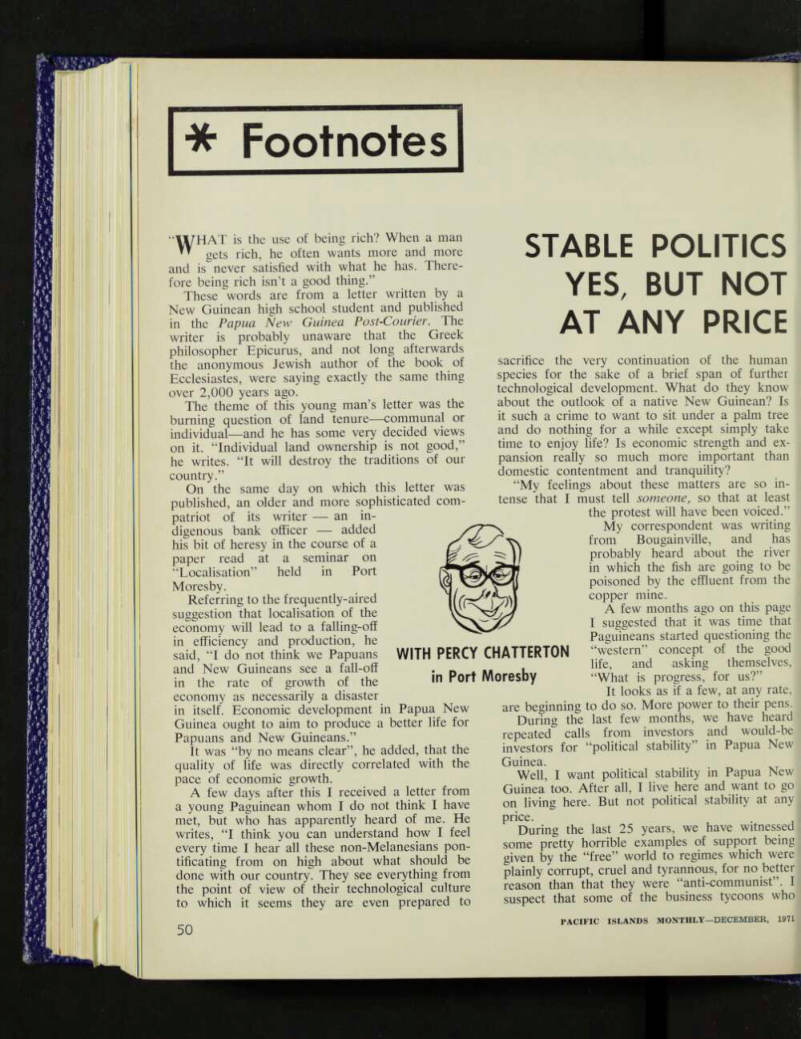
With Percy Chatterton
in Port Moresby
have been calling for political stability in Papua New Guinea wouldn’t really care how undemo cratic and oppressive that stability was so long as their investments were safeguarded.
A New South Wales-based civil engineer now visiting Papua New Guinea has warned his fellow engineers that they may be in danger of bringing science without wisdom to communities which have wisdom without science, and of imposing unsuitable projects on village communities. This gentleman endeared himself to me by having a kind word to say for the Rigo Road.
The Rigo Road runs eastward from Port Moresby parallel with the coast for about 70 miles to Rigo and on for another 20 miles or so to the Kemp Welch River. From time to time New Guineans, brown and white, have had hard things to say about it. “What is the use of it?” they have cried. “It doesn’t go anywhere.” “A sheer waste of money.”
However, the author of the bon mot quoted above points out that a study of this road has shown that in the first three years after it was built the value of garden produce sold in Port Moresby from the Rigo area was greater than the cost of building the road.
This is not only a vindication of the soundness of the exercise, but also an argument for extend ing the road further eastward to the fertile Cape Rodney area, an extension for which Scotty Uroe, MHA for Rigo-Abau, has been clamouring for years.
Among the small crumbs of comfort which the Papuan ministerial delegation brought back from its recent meeting with the Minister for
External Territories in Canberra was the in formation that the exploitation of the hydro electric potential of the Purari River, which flows into the Gulf of Papua, is again a live issue.
For me, this news touched off memories. Fif teen years or so ago, when my wife and I lived at Helena, on the Papuan mainland just opposite Yule Island, an organisation calling itself New Guinea Resources set up its headquarters on the island and began an extensive survey of the hydro-electric potential of all the major rivers flowing into the Gulf of Papua, from Yule Island westward, including the Purari. It was generally understood that their quest was being financed jointly by the Australian Government and bauxite
mining interests.
I saw a good deal of the NGR personnel in those days and found them very pleasant neigh bours, if “neighbours” is the right word to use for people from whom one is separated by two miles of often rough sea. (In Papua it often is.) Then one day they came across the Sound to say good-bye. Quite suddenly they had been ordered to pack up and return to base. And that was the last we heard of it all. The mass of painstakingly accumulated data which they had assembled was presumably tucked away in a filing cabinet some where, and has been gathering dust since.
Papuans cannot but wonder whether it would have stayed there undisturbed for 15 years, dur ing which World Bank Reports, UN Visiting Mission Reports and Five-Year Plans have piled up on our desks, if the Purari River flowed from its source on the PNG border northward through New Guinea instead of south through Papua.
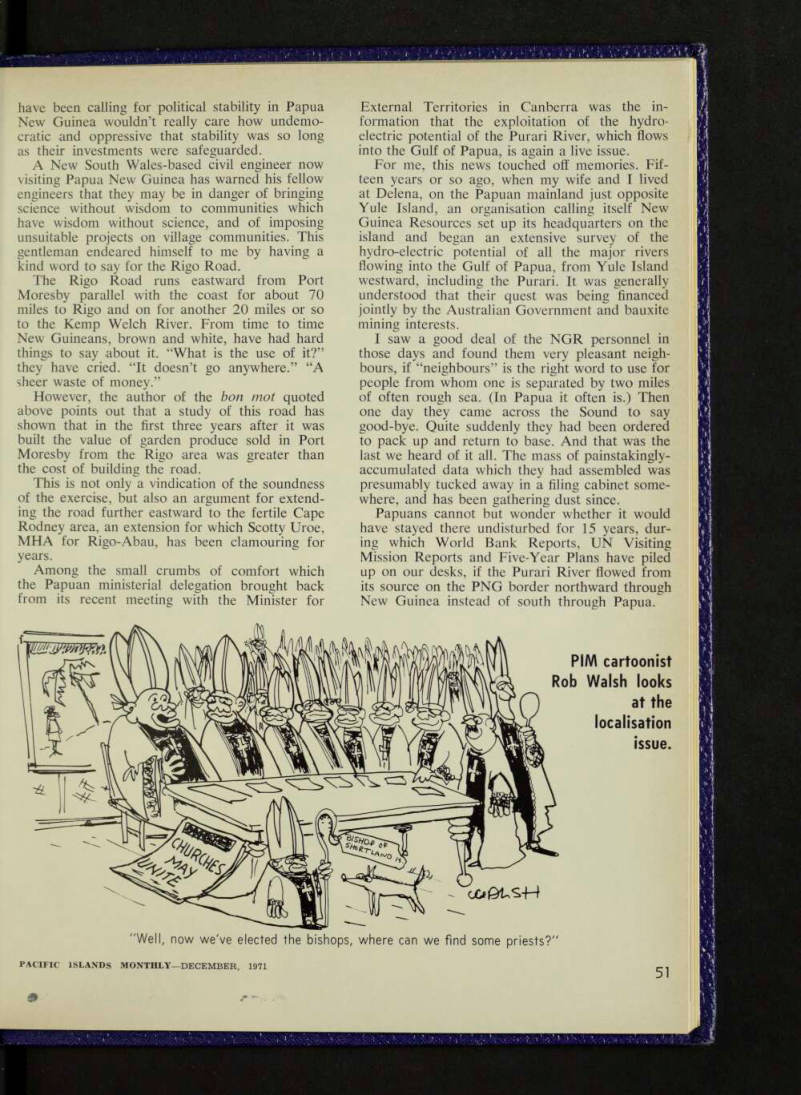
"Well, now we've elected the bishops, where can we find some priests?"