The Banner Of Nationalism
pp. 51-113 · Read in the full issue
New Guinea's New Writers Wave
By Don Woolford
Papuans and New Guineans are beginning to write creatively. Since 1968 there has been a steadily in creasing stream of works, particularly plays, poems and short stories.
Much of it is derivative; the quality is uneven and most of what so far has been written is probably more important historically and politically than artistically. But it is almost certainly the genesis of a distinctive body of literature, owing something to the West, something to Africa and the American Negroes and something to the territory’s own traditions. And its main message to date is clear: the writers are emerging as leaders of the territory’s still embryonic nationalist movement.
Rejection of imposed Western values and demands for rapid political advancement are among their main themes. For as long as the white man has the power, most of them agree, New Guineans will be unable to rebuild their shattered self-respect and manhood.
The movement probably began with the publication in 1968 of Albert Maori Kiki’s autobiography Kiki: Ten thousand years in a lifetime.
Kiki is a remarkable man. In 30 years he has moved from Neolithic life on the Purari River to the world of administration, politics and trade unions and today is one of the terri tory’s best known radical leaders.
His book is the story of his extra ordinary transition, told with a mix ture of bitterness and humour. The Australian is often condemned. Some administration officers “took local girls to their compound, stripped them naked, hosed them for 20 minutes then slept with them and ricked them out immediately after wards’.
Enter, when he fully entered the white man’s world, his life was full >f “slow, nagging, continuous protests igainst discrimination”.
Kiki, although he has moved into i new life with assurance, remembers he old with affection and still draws •trength from it.
Christianity, despite years at a mssion school, has left little mark.
To this day, talking to a tree or a iver is more important to me than itting down and listening to some- Kxiy else talking about God.”
Kiki largely set the pattern for vhat followed. From the university,
teachers’ colleges and senior high schools a steadily growing trickle of writing emerged. So far one novel, more than a dozen one-act plays and a large body of poetry and short stories have emerged. The novel, which Jacaranda published last year, is The Crocodile, by Vincent Eri.
Like Kiki, Eri is a Gulf District man who has succeeded in the white man’s world. One of the first gradu ates of the university, he is now acting Director of Education.
The Crocodile is largely concerned with the impact of Western culture and law on a Papuan village. The villagers’ reaction is an ambivalent mixture of bewilderment, resentment and attraction. The kiaps, the main visible agents of change, symbolise arrogant and unfeeling superiority.
One patrol officer, reclining on a canoe as press-ganged villagers paddle him up a river, swats at flies and complains: “The blasted flies—why won’t they leave me alone; why don’t you buzz around the smelly Kana kas?”
Later when Hoiri, the central character, returns from involuntary war service, he has the money he made carving artifacts for American soldiers confiscated by an ANGAU
officer and is paid off—with five sticks of tobacco.
Finally, as Hoiri is led handcuffed to court, he hopes his son will go to school and “grow up to under stand the things that baffle me”.
Eri’s bitterness is understated com pared with some of the young play wrights and poets, most of them university students, who have been published in the last two years.
Kumalau Tawali is perhaps the most lyrical, least explicitly political, of the university poets. From Manus Island, the home of the territory’s most famed mariners, most of his imagery is connected with the sea.
His best known poem of protest, Niu —a contraction of Niugini—is a gently sardonic allusion to the con servative Highlands view of Australia as a parent: You are the baby that crawls too long; All the others are walking— What has your mother been doing with you?
In The Bush Kanaka Speaks he examines race relations: The kiap shouts you are ignorant.
But can he shape a canoe, Tie a mast, fix an outrigger?
Can he steer a canoe through the night Without losing his way?
Does he know when a turtle comes ashore to lay its eggs?
Tawalis is more obviously bitter in his play Manki Masta.
The hero, Poro, is a simple villager who is forced to become a houseboy so that he can pay his tax. His em ployer, Mrs. Jones, has lines like, “I know too much of their ignorance . . . sometimes I wonder if they have any brains at all”. The white man is also scarified in John Waiko’s The Unexpected Hawk and Leo Hannett’s The Ungrateful Daughter. Waiko’s play concerns the removal of a village, enforced against the wishes of the people for the convenience of the local administration officers.
It contains pieces of Australian en lightenment like—District Commis sioner: I prefer them to remain Bush Kanakas. Some of these coastal people are getting too damned big headed for their own bloody good, Kiap: Yes, they go to school for a few years and they think they’ve become Europeans.
Continued on p. 11l
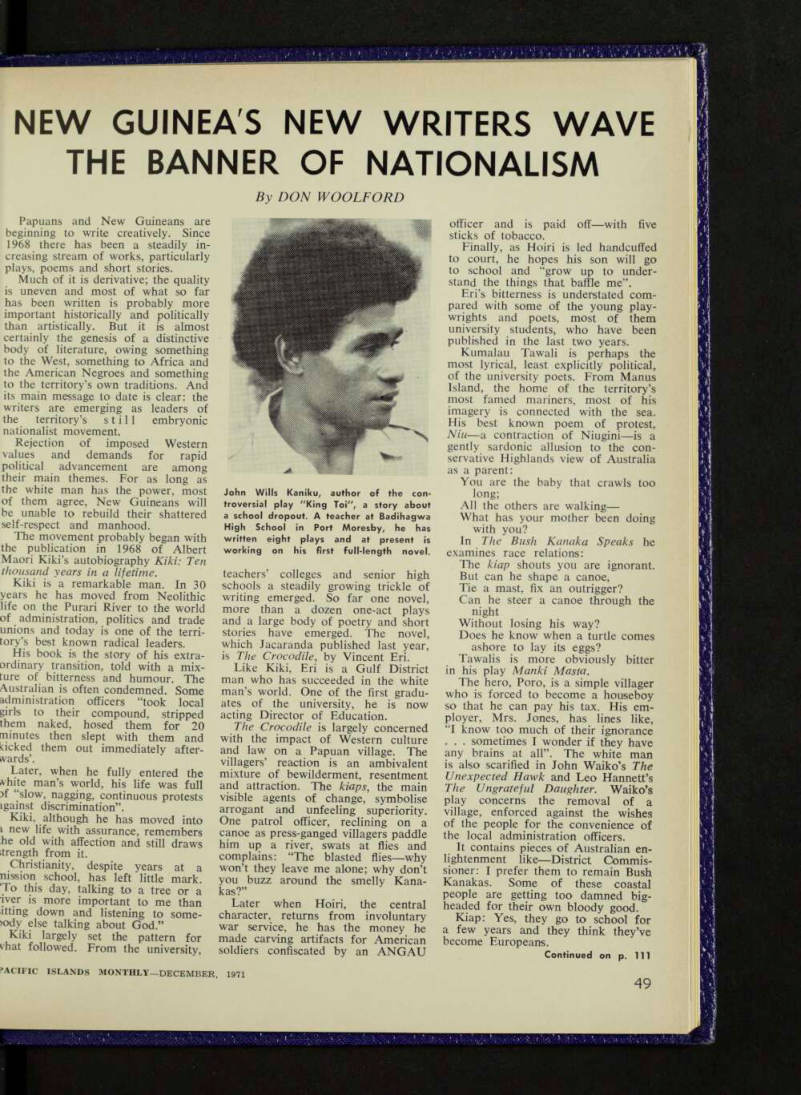
John Wills Kaniku, author of the con troversial play "King Toi", a story about a school dropout. A teacher at Badihagwa High School in Port Moresby, he has written eight plays and at present is working on his first full-length novel.
The question of wanting to be come Europeans is taken up in The Ungrateful Daughter, probably the best piece of theatre written here, with the exception of an uproarious Pidgin farce.
Hannett’s answer is an emphatic rejection of the white man’s world.
The play deals with a white couple
who adopt a native girl, Ebonita, and try to turn her into a black Australian.
The foster mother’s cry from the heart is: “We love you Ebonita, we love you. We want you to be different from them, to be like us.”
Another time she rebukes her with, “You should know better than those native girls”. Ebonita’s flat reply is “I am a native girl”.
Hannett also introduces explicit hatred. Totalabita, a conspiratorial native figure, tells Ebonita; “I too went to school. That was where I learnt to hate. That’s where I learnt about equality. When you are ready to cross the threshold they slam the door in your face.”
The writer to go furthest is John Kasaipwalova, the leader of the university’s Black Power group and the only person in PNG to publicly approve the murder of the East New Britain District Commissioner, Mr.
Jack Emanuel.
Kasaipwalova’s long poem Reluctant Flame —recently won the territory’s top poetry award. A few years ago it may have earned him a charge of sedition.
It owes much to men like Baldwin and Fanon, it is studded with trendy Black Panther obscenities, yet it has passages of remarkable power.
It is a plea for the flame of blackness to escape the smothering effect of white culture. The danger is “black stooges yessarring whitishly to make paper our destiny”. “White bastardly,” he writes later, “. . . your weighty importance has its needle into me.” In violence there is release
—“firm, beautiful black hands stoning police thugs.”
There are two important elements in the writing to date. Firstly, it represents a clearer expression of nationalism than has come from the territory’s professional politicians.
It is a sort of cultural politics, akin to negritude, which is developing as fast as, if not faster than, orthodox demands for political advance. If African experience is any guide, the writers will contribute significantly to the nationalist ideology that must emerge if any true unity is to be established.
Secondly, despite obvious short comings—particularly the almost uni versal failure to portray Australians as anything but flat caricatures—it is a lusty artistic beginning, New Guineans are writing, imagj natively and in their own distinctive idiom, of what most concerns them.
As one Papuan poet, Jack Lahui, told a seminar at Sydney’s Macquarie University recently; Australians would do well to listen.—AAP • The International Coffee Organisation has reduced by 13 per cent, the amount of coffee Papua New Guinea may export to countries other than Australia from the period October 1 to March 31. This is the equivalent of about 980 tons, but the PNG Administrator, Mr. L. W.
Johnson, said in November he ex pected there would be no difficulty in handling the whole of the crop, as Australian exports were not affected.