Institution That Hasn't Changed
pp. 46-49 · Read in the full issue
MR. FIXIT, THE ISLAND AGENT - AN
By John Carter
In the rapidly-changing Pacific Islands’ scene one institution has changed not at all—the Island Agent, who is all things to all his clients, even Father Christmas to their children. But his role in the Islands’ development, his importance as a link between the Islands and the outside world has never been recognised.
He’s been around now for 80 years, as Mr. Fixit in the lives of storekeepers and families in almost every Pacific island from New Guinea to the tiny atolls of Micronesia. As agent, he arranges for supplies of almost everything and anything wanted in the Islands—the balls of twine, the pencils, the toy, the all purpose knife, the chewing gum, the vase of artificial flowers, the dozens of different things jostling each other in a store window at the side of the dirt road miles away from the tourists’ playgrounds.
The storekeeper has just received a letter from his son in a school in Australia picked for him by the agent. Another storekeeper is purring over the dividend cheque from an Australian company, fruits of a wise investment arranged by the agent.
A woman is on her way by plane to a Sydney hospital. She’s never been away from her island home before. She’s worried and apprehen sive, but her storekeeper husband
isn’t at all concerned. It’s a minor operation, and his agent is handling everything. He’ll meet the plane, take her to hospital, visit her on visiting days and take her back to her plane when she’s ready.
The list is endless and on it are almost all the good turns and services one human can do for another. It’s service with a smile and no bill at the end of it.
Who are these agents? There are dozens of them, not hundreds, many with names well known in the Islands, but it’s their names and not their activities which are known to most people. Though they deal in com merce and charge a commission, they’re mainly a family affair.
Sydney has more than its share of the best-known ones who, over the years, have become an essential part of the Island scene.
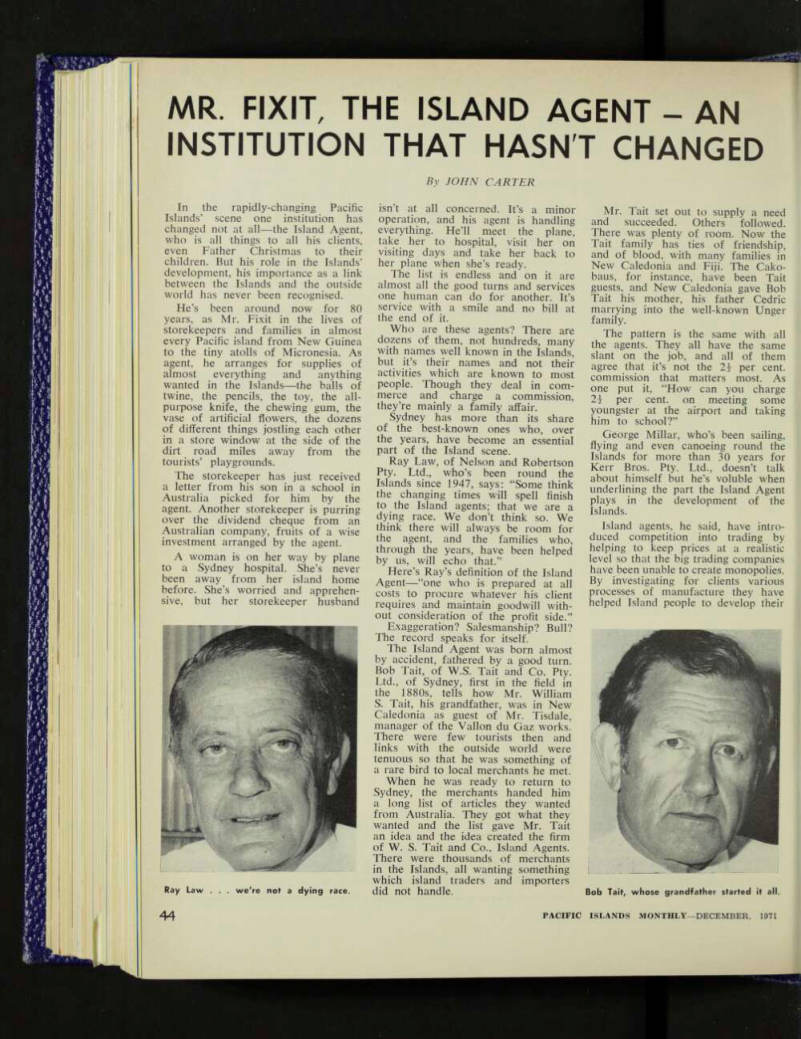
Ray Law, of Nelson and Robertson Pty. Ltd., who’s been round the Islands since 1947, says: “Some think the changing times will spell finish to the Island agents; that we are a dying race. We don’t think so. We think there will always be room for the agent, and the families who, through the years, have been helped by us, will echo that.”
Here’s Ray’s definition of the Island Agent—“one who is prepared at all costs to procure whatever his client requires and maintain goodwill with out consideration of the profit side.”
Exaggeration? Salesmanship? Bull?
The record speaks for itself.
The Island Agent was born almost by accident, fathered by a good turn.
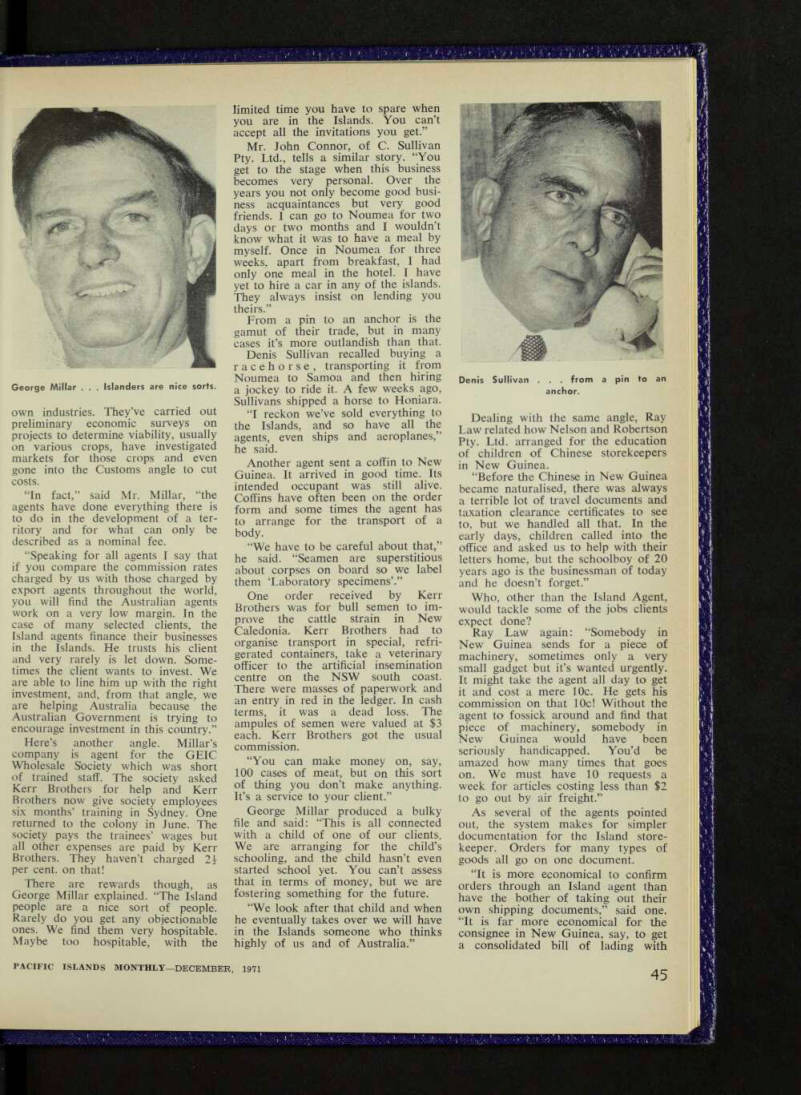
Bob Tait, of W.S. Tait and Co. Pty.
Ltd., of Sydney, first in the field in the 1880 s, tells how Mr. William S. Tait, his grandfather, was in New Caledonia as guest of Mr. Tisdale, manager of the Vallon du Gaz works.
There were few tourists then and links with the outside world were tenuous so that he was something of a rare bird to local merchants he met.
When he was ready to return to Sydney, the merchants handed him a long list of articles they wanted from Australia. They got what they wanted and the list gave Mr. Tait an idea and the idea created the firm of W. S. Tait and Co., Island Agents.
There were thousands of merchants in the Islands, all wanting something which island traders and importers did not handle.
Mr. Tait set out to supply a need and succeeded. Others followed.
There was plenty of room. Now the Tait family has ties of friendship, and of blood, with many families in New Caledonia and Fiji. The Cako baus, for instance, have been Tait guests, and New Caledonia gave Bob Tait his mother, his father Cedric marrying into the well-known Unger family.
The pattern is the same with all the agents. They all have the same slant on the job, and all of them agree that it’s not the 2i per cent, commission that matters most. As one put it, “How can you charge 2i per cent, on meeting some youngster at the airport and taking him to school?”
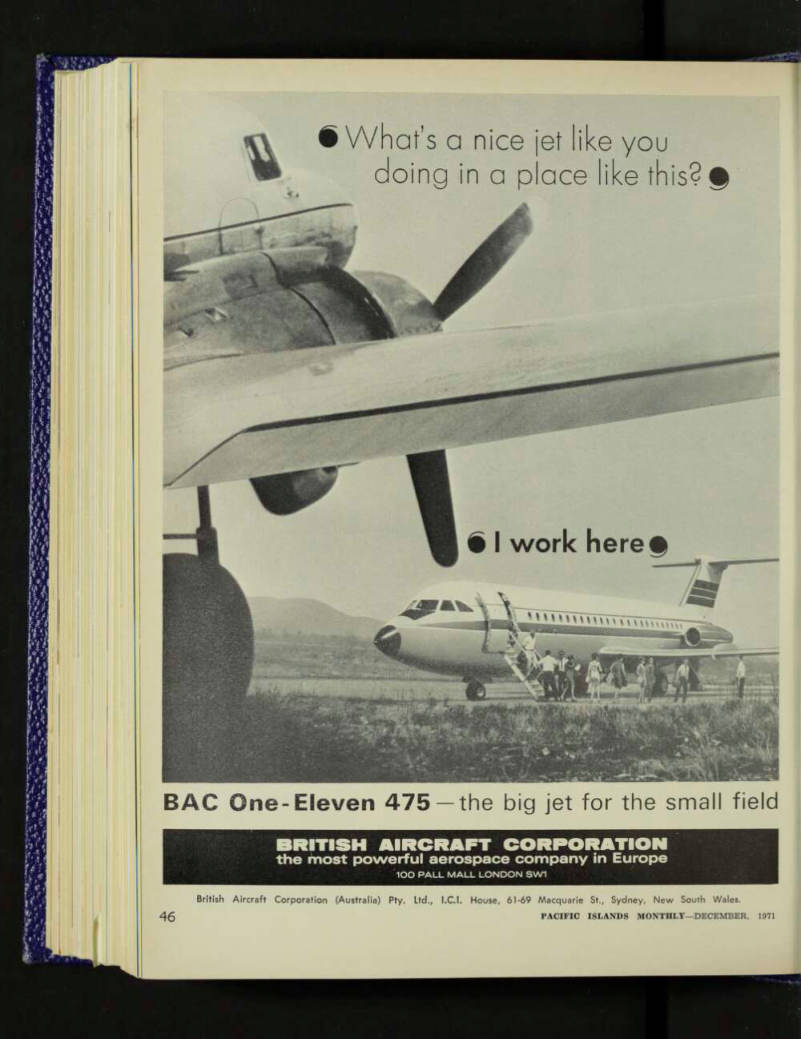
George Millar, who’s been sailing, flying and even canoeing round the Islands for more than 30 years for Kerr Bros. Pty. Ltd., doesn’t talk about himself but he’s voluble when underlining the part the Island Agent plays in the development of the Islands.
Island agents, he said, have intro duced competition into trading by helping to keep prices at a realistic level so that the big trading companies have been unable to create monopolies.
By investigating for clients various processes of manufacture they have helped Island people to develop their
Ray Law ... we're not a dying race.
Bob Tait, whose grandfather started it all.
own industries. They’ve carried out preliminary economic surveys on projects to determine viability, usually on various crops, have investigated markets for those crops and even gone into the Customs angle to cut costs.
“In fact,” said Mr. Millar, “the agents have done everything there is to do in the development of a ter ritory and for what can only be described as a nominal fee.
“Speaking for all agents I say that if you compare the commission rates charged by us with those charged by export agents throughout the world, you will find the Australian agents work on a very low margin. In the case of many selected clients, the Island agents finance their businesses in the Islands. He trusts his client and very rarely is let down. Some times the client wants to invest. We are able to line him up with the right investment, and, from that angle, we are helping Australia because the Australian Government is trying to encourage investment in this country.”
Here’s another angle. Millar’s company is agent for the GEIC Wholesale Society which was short of trained staff. The society asked Kerr Brothers for help and Kerr Brothers now give society employees six months’ training in Sydney. One returned to the colony in June. The society pays the trainees’ wages but all other expenses are paid by Kerr Brothers. They haven’t charged per cent, on that!
There are rewards though, as George Millar explained. “The Island people are a nice sort of people.
Rarely do you get any objectionable ones. We find them very hospitable.
Maybe too hospitable, with the
limited time you have to spare when you are in the Islands. You can’t accept all the invitations you get.”
Mr. John Connor, of C. Sullivan Pty. Ltd., tells a similar story. “You get to the stage when this business becomes very personal. Over the years you not only become good busi ness acquaintances but very good friends. I can go to Noumea for two days or two months and I wouldn’t know what it was to have a meal by myself. Once in Noumea for three weeks, apart from breakfast, I had only one meal in the hotel. I have yet to hire a car in any of the islands.
They always insist on lending you theirs.”
From a pin to an anchor is the gamut of their trade, but in many cases it’s more outlandish than that.
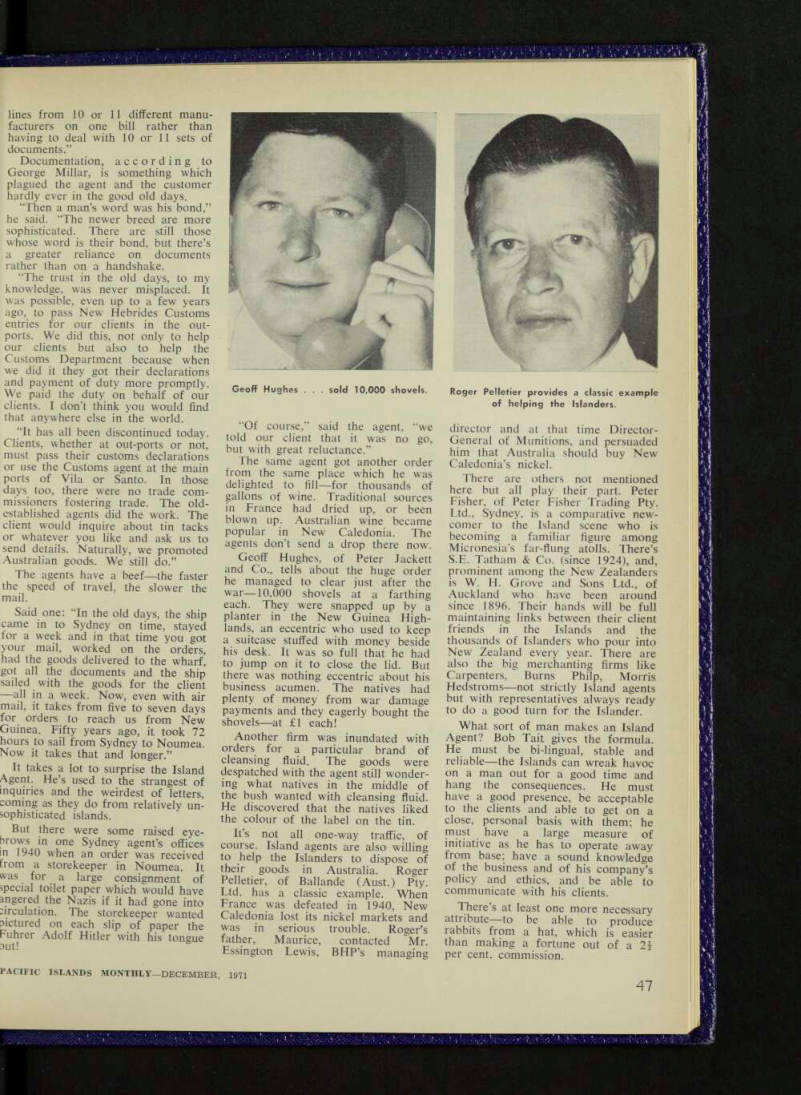
Denis Sullivan recalled buying a racehorse, transporting it from Noumea to Samoa and then hiring a jockey to ride it. A few weeks ago, Sullivans shipped a horse to Honiara.
“I reckon we’ve sold everything to the Islands, and so have all the agents, even ships and aeroplanes,” he said.
Another agent sent a coffin to New Guinea. It arrived in good time. Its intended occupant was still alive.
Coffins have often been on the order form and some times the agent has to arrange for the transport of a body.
“We have to be careful about that,” he said. “Seamen are superstitious about corpses on board so we label them ‘Laboratory specimens’.”
One order received by Kerr Brothers was for bull semen to im prove the cattle strain in New Caledonia. Kerr Brothers had to organise transport in special, refri gerated containers, take a veterinary officer to the artificial insemination centre on the NSW south coast.
There were masses of paperwork and an entry in red in the ledger. In cash terms, it was a dead loss. The ampules of semen were valued at $3 each. Kerr Brothers got the usual commission.
“You can make money on, say, 100 cases of meat, but on this sort of thing you don’t make anything.
It’s a service to your client.”
George Millar produced a bulky file and said: “This is all connected with a child of one of our clients.
We are arranging for the child’s schooling, and the child hasn’t even started school yet. You can’t assess that in terms of money, but we are fostering something for the future.
“We look after that child and when he eventually takes over we will have in the Islands someone who thinks highly of us and of Australia.”
Dealing with the same angle, Ray Law related how Nelson and Robertson Pty. Ltd. arranged for the education of children of Chinese storekeepers in New Guinea.
“Before the Chinese in New Guinea became naturalised, there was always a terrible lot of travel documents and taxation clearance certificates to see to, but we handled all that. In the early days, children called into the office and asked us to help with their letters home, but the schoolboy of 20 years ago is the businessman of today and he doesn’t forget.”
Who, other than the Island Agent, would tackle some of the jobs clients expect done?
Ray Law again: “Somebody in New Guinea sends for a piece of machinery, sometimes only a very small gadget but it’s wanted urgently.
It might take the agent all day to get it and cost a mere 10c. He gets his commission on that 10c! Without the agent to fossick around and find that piece of machinery, somebody in New Guinea would have been seriously handicapped. You’d be amazed how many times that goes on. We must have 10 requests a week for articles costing less than $2 to go out by air freight.”
As several of the agents pointed out, the system makes for simpler documentation for the Island store keeper. Orders for many types of goods all go on one document.
“It is more economical to confirm orders through an Island agent than have the bother of taking out their own shipping documents,” said one.
“It is far more economical for the consignee in New Guinea, say, to get a consolidated bill of lading with
George Millar ... Islanders are nice sorts.
Denis Sullivan ... from a pin to an anchor.
lines from 10 or 11 different manu facturers on one bill rather than having to deal with 10 or 11 sets of documents.”
Documentation, according to George Millar, is something which plagued the agent and the customer hardly ever in the good old days.
“Then a man’s word was his bond,” he said. “The newer breed are more sophisticated. There are still those whose word is their bond, but there’s a greater reliance on documents rather than on a handshake.
“The trust in the old days, to my knowledge, was never misplaced. It was possible, even up to a few years ago, to pass New Hebrides Customs entries for our clients in the out ports. We did this, not only to help our clients but also to help the Customs Department because when we did it they got their declarations and payment of duty more promptly.
We paid the duty on behalf of our clients. I don't think you would find that anywhere else in the world.
“It has all been discontinued today.
Clients, whether at out-ports or not, must pass their customs declarations or use the Customs agent at the main ports of Vila or Santo. In those days too, there were no trade com missioners fostering trade. The old established agents did the work. The client would inquire about tin tacks or whatever you like and ask us to send details. Naturally, we promoted Australian goods. We still do.”
The agents have a beef—the faster the speed of travel, the slower the mail.
Said one: “In the old days, the ship came in to Sydney on time, stayed for a week and in that time you got your mail, worked on the orders, had the goods delivered to the wharf, got all the documents and the ship sailed with the goods for the client — all in a week. Now, even with air mail, it takes from five to seven days for orders to reach us from New Guinea. Fifty years ago, it took 72 hours to sail from Sydney to Noumea.
Now it takes that and longer.”
It takes a lot to surprise the Island Agent. He’s used to the strangest of inquiries and the weirdest of letters, coming as they do from relatively un sophisticated islands.
But there were some raised eye brows in one Sydney agent’s offices in 1940 when an order was received From a storekeeper in Noumea. It was for a large consignment of special toilet paper which would have angered the Nazis if it had gone into circulation. The storekeeper wanted sictured on each slip of paper the Fuhrer Adolf Hitler with his tongue aut!
“Of course,” said the agent, “we told our client that it was no go, but with great reluctance.”
The same agent got another order from the same place which he was delighted to fill—for thousands of gallons of wine. Traditional sources in France had dried up, or been blown up. Australian wine became popular in New Caledonia. The agents don’t send a drop there now.
Geoff Hughes, of Peter Jackett and Co., tells about the huge order he managed to clear just after the war—lo,ooo shovels at a farthing each. They were snapped up by a planter in the New Guinea High lands, an eccentric who used to keep a suitcase stuffed with money beside his desk. It was so full that he had to jump on it to close the lid. But there was nothing eccentric about his business acumen. The natives had plenty of money from war damage payments and they eagerly bought the shovels—at £1 each!
Another firm was inundated with orders for a particular brand of cleansing fluid. The goods were despatched with the agent still wonder ing what natives in the middle of the bush wanted with cleansing fluid.
He discovered that the natives liked the colour of the label on the tin.
It’s not all one-way traffic, of course. Island agents are also willing to help the Islanders to dispose of their goods in Australia. Roger Pelletier, of Ballande (Aust.) Pty.
Ltd. has a classic example. When France was defeated in 1940, New Caledonia lost its nickel markets and was in serious trouble. Roger’s father, Maurice, contacted Mr.
Essington Lewis, BHP’s managing
director and at that time Director- General of Munitions, and persuaded him that Australia should buy New Caledonia’s nickel.
There are others not mentioned here but all play their part. Peter Fisher, of Peter Fisher Trading Pty.
Ltd., Sydney, is a comparative new comer to the Island scene who is becoming a familiar figure among Micronesia’s far-flung atolls. There’s S.E. Tatham & Co. (since 1924), and, prominent among the New Zealanders is W. H. Grove and Sons Ltd., of Auckland who have been around since 1896. Their hands will be full maintaining links between their client friends in the Islands and the thousands of Islanders who pour into New Zealand every year. There are also the big merchanting firms like Carpenters, Burns Philp, Morris Hedstroms—not strictly Island agents but with representatives always ready to do a good turn for the Islander.
What sort of man makes an Island Agent? Bob Tait gives the formula.
He must be bi-lingual, stable and reliable—the Islands can wreak havoc on a man out for a good time and hang the consequences. He must have a good presence, be acceptable to the clients and able to get on a close, personal basis with them; he fnjjst have a large measure of initiative as he has to operate away from base; have a sound knowledge of the business and of his company’s policy and ethics, and be able to communicate with his clients.
There’s at least one more necessary attribute—to be able to produce rabbits from a hat, which is easier than making a fortune out of a 2i per cent, commission.
Geoff Hughes ... sold 10,000 shovels.
Roger Pelletier provides a classic example of helping the Islanders.